
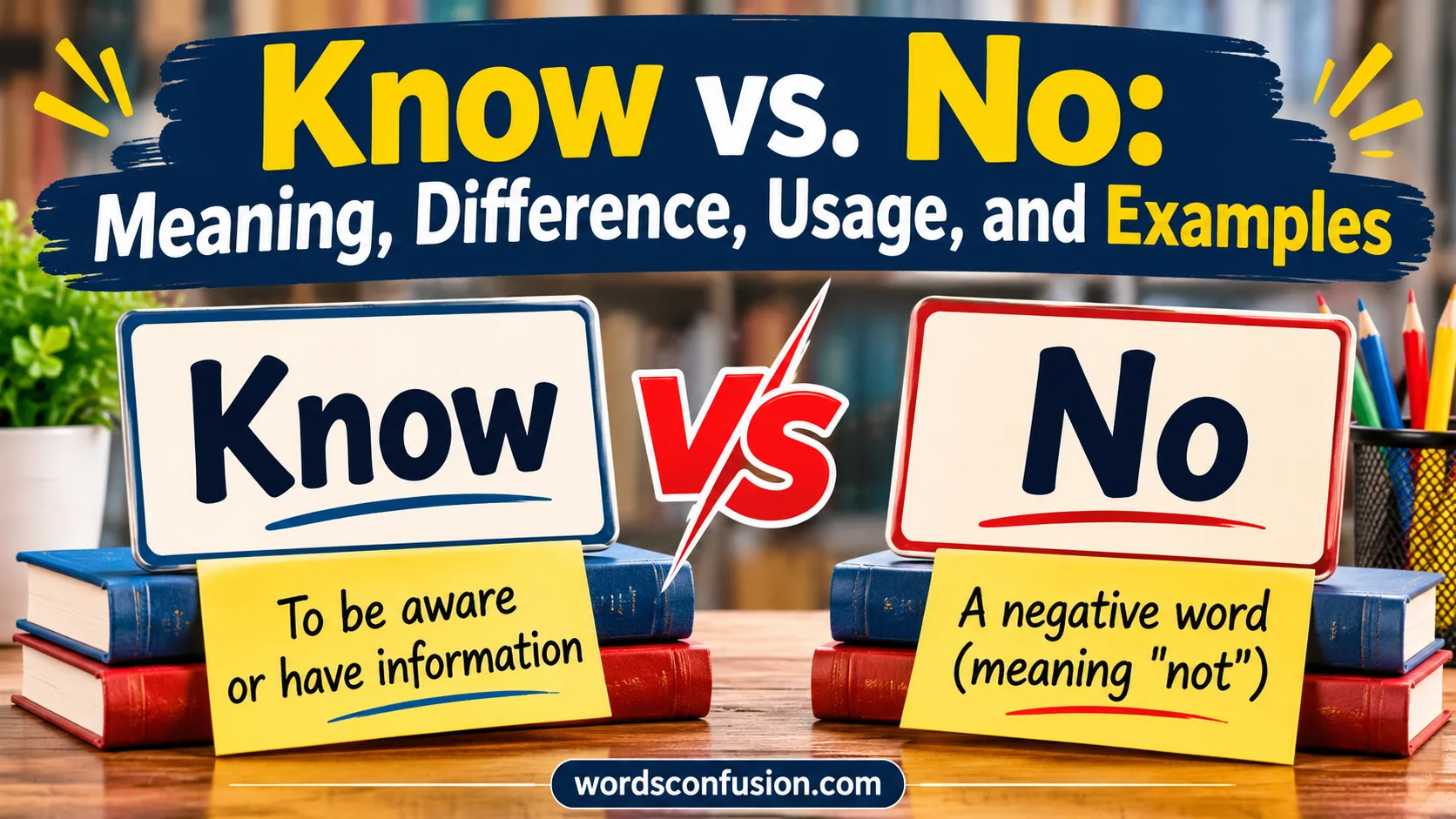
Have you ever wondered whether to write know or no in a sentence? These two words sound exactly alike, yet their meanings and grammatical functions are completely different. Because they share the same pronunciation, even fluent English speakers sometimes confuse them when writing quickly.
The difference becomes easy once you understand what each word communicates. Know relates to information, awareness, and understanding. No, on the other hand, expresses refusal, disagreement, denial, or the absence of something.
For example, consider these two sentences:
- I know the answer to your question.
- No, I don’t have the answer to your question.
Both words sound identical when spoken aloud. However, replacing one with the other changes the sentence’s meaning entirely.
Whether you’re writing an email, completing a school assignment, chatting with friends, or improving your English vocabulary, understanding know vs. no will help you avoid common spelling mistakes. Let’s explore their meanings, grammatical roles, differences, and everyday uses with clear explanations and practical examples.
Quick Answer
Know and no are homophones. They have the same pronunciation but different spellings and meanings.
- Know: A verb that means to understand, recognize, or have information about something or someone.
- No: A word that expresses refusal, disagreement, denial, or the absence of something. It can function as a determiner, adverb, or noun.
Examples:
- I know how to solve this problem.
- No, I don’t want to solve it right now.
- She knows the truth.
- There is no reason to worry.
Easy trick to remember:
- Know = Knowledge. Both relate to information and understanding.
- No = Negative. Use it when expressing refusal or the absence of something.
Comparison Overview
Although know and no sound alike, their grammatical functions and meanings distinguish them. The following table highlights their main differences.
| Feature | Know | No |
| Meaning | To understand or have information | Expresses refusal, denial, or absence |
| Part of speech | Verb | Determiner, adverb, noun |
| Pronunciation | /noʊ/ | /noʊ/ |
| Spelling | Contains a silent K | Begins with N |
| Main purpose | Express knowledge or awareness | Express a negative response or quantity |
| Present tense | Know, knows | No change |
| Past tense | Knew | No change |
| Past participle | Known | No change |
| -ing form | Knowing | No change |
| Example | I know your name. | No, I don’t know him. |
The biggest distinction is straightforward: know describes having knowledge while no communicates a negative meaning.
Remember that pronunciation alone cannot help you choose the correct spelling. You must consider what your sentence means.
Main Differences Between Know and No
Understanding the individual meanings of these words makes their differences much easier to recognize. Let’s examine how each word works in everyday English.
Meaning of Know
Know is a verb that describes having information, understanding, awareness, or familiarity with something. When you know something, you possess information about it or understand it in some way.
People use this word in conversations, academic writing, professional communication, and everyday situations.
For example, you might know someone’s name, understand a mathematical formula, recognize a familiar face, or remember an important event.
Consider these examples:
- I know the answer to the question.
- She knows how to play the guitar.
- Do you know where the nearest hospital is?
- We know each other from college.
- He knew about the meeting yesterday.
In each sentence, know communicates some form of information, awareness, or familiarity.
Common situations where you use know:
- Knowledge of facts: I know the capital of France.
- Understanding: She knows how this machine works.
- Familiarity with people: I know your brother.
- Awareness: They know about the changes.
- Recognition: I know that voice.
Another important point is that know has several grammatical forms. Depending on the subject and tense, you may need to use knows, knew, known, or knowing.
For example, you say “I know” but “She knows.” Similarly, “I knew” describes knowledge in the past.
Meaning of No
No is a word that expresses a negative response, refusal, disagreement, or the absence of something.
Unlike know, which functions as a verb, no can perform several grammatical roles. It commonly appears in conversations and written English when someone wants to reject an offer, answer a question negatively, or indicate that something does not exist.
For example:
- No, I don’t need any help.
- There is no water in the bottle.
- She gave me a clear no.
- No students attended the meeting.
- He has no experience in this field.
The word doesn’t always communicate a direct refusal. Its meaning depends on the sentence.
Consider these common uses:
- Refusal: No, I don’t want to go.
- Disagreement: No, that’s not correct.
- Absence: There is no sugar left.
- Prohibition: No smoking is allowed here.
- Negative quantity: I have no questions.
Notice how no changes its role depending on the context. It can stand alone as an answer or appear before a noun to indicate that something is absent.
Know vs. No: Parts of Speech
One of the most important differences between these words involves their grammatical functions.
Know is a verb, whereas no can function as a determiner, adverb, or noun.
Understanding these roles helps you select the correct word when constructing sentences.
Know as a Verb
A verb describes an action, condition, or state. Know is a stative verb because it generally describes a state of understanding or awareness rather than a physical action.
Examples:
- I know the truth.
- She knows my address.
- They knew about the problem.
- We have known each other for years.
The verb can also appear with different sentence structures.
| Sentence Pattern | Example |
| Know + noun | I know the answer. |
| Know + person | She knows John. |
| Know + how to | He knows how to cook. |
| Know + that-clause | I know that you’re busy. |
| Know + question word | Do you know where she lives? |
| Know + about | They know about the situation. |
These patterns show how know connects a person with information, skills, people, or situations.
No as a Determiner
A determiner appears before a noun and provides information about it. No works as a determiner when it communicates the absence of something.
Examples:
- There are no tickets available.
- She has no brothers.
- We have no time to waste.
- There is no milk in the refrigerator.
In these sentences, no appears before a noun and indicates zero quantity or complete absence.
No as an Adverb
An adverb can modify an adjective, another adverb, or an expression. No can function as an adverb to strengthen a negative statement or response.
Examples:
- The answer is no better than before.
- She is no longer interested.
- He is no more qualified than his colleague.
It also appears independently as a negative response:
- No, I can’t attend the meeting.
- No, that’s not what I meant.
No as a Noun
The word no can also function as a noun when it refers to a negative answer or refusal.
Examples:
- His answer was a firm no.
- I expected a yes but received a no.
- She accepted his no without arguing.
In these examples, no represents the actual negative response rather than introducing one.
Read More: Flys vs. Flies: Meaning, Spelling, Differences, and Examples
Know vs. No: Pronunciation
Here is something interesting: know and no are pronounced exactly the same in standard American English.
Both have the IPA pronunciation /noʊ/.
The word know contains a silent K. You pronounce the N sound directly without saying the first letter.
The word no begins with the same N sound and ends with the same long O vowel sound.
| Word | Pronunciation | Silent Letter |
| Know | /noʊ/ | K |
| No | /noʊ/ | None |
Because their pronunciation is identical, these words belong to a group called homophones.
Homophones are words that share the same pronunciation but have different meanings. Their spellings may also differ.
Other common examples include:
- Write and right: To write something versus a correct direction or answer.
- Sea and see: A large body of salt water versus the act of looking.
- Flour and flower: An ingredient used in baking versus a plant’s bloom.
- Pair and pear: Two matching things versus a type of fruit.
- Hear and here: The ability to listen versus a location.
The same principle applies to know and no. Their sounds match, but their meanings depend on the spelling and context.
When to Use Know
Use know whenever you want to express knowledge, understanding, awareness, or familiarity.
It usually appears as a verb and connects the subject with information or something familiar.
Here are the most common situations.
When You Have Information About Something
Use know when you possess information about a fact, event, situation, or subject.
Examples:
- I know the correct spelling.
- She knows the company’s history.
- They know the rules of the game.
- Do you know his phone number?
When You Understand Something
You can use know when describing your understanding of a process, skill, or subject.
Examples:
- He knows how to repair computers.
- I know how difficult this situation is.
- She knows what she needs to do.
- We know how the system works.
When You Are Familiar With Someone
Use know to describe familiarity with a person.
Examples:
- I know your teacher.
- Do you know my cousin?
- She has known him since childhood.
- They know each other very well.
When You Recognize Something
Know can also describe recognizing a person, sound, place, or familiar object.
Examples:
- I know that voice.
- She knew him immediately.
- Do you know this place?
- I know that song from somewhere.
When to Use No
Use no when you want to communicate refusal, disagreement, denial, or the absence of something.
Its position in a sentence depends on the meaning you want to express.
When Answering a Question Negatively
Use no when someone asks a question and your answer is negative.
Examples:
- Are you hungry? No, I’m not.
- Did you finish your homework? No, I didn’t.
- Can you help me? No, I’m busy right now.
- Is this your book? No, it’s my brother’s.
When Refusing an Offer or Request
Use no when declining an invitation, rejecting an offer, or refusing to do something.
Examples:
- No, thank you. I already ate.
- She said no to the invitation.
- He politely said no to the offer.
- I told them no because I was busy.
A simple no can communicate a complete answer. You don’t always need to provide a lengthy explanation.
When Expressing the Absence of Something
Use no before a noun to indicate that something doesn’t exist or isn’t available.
Examples:
- There is no food in the kitchen.
- We have no money left.
- There are no seats available.
- He has no experience with this software.
When Expressing Prohibition
You can use no in signs, instructions, and warnings to communicate that something isn’t permitted.
Examples:
- No parking.
- No smoking.
- No entry.
- No pets allowed.
These expressions are especially common on public signs and in workplace rules.
Frequently Asked Questions
What Is the Main Difference Between Know and No?
The main difference is their meaning and grammatical function. Know is a verb that describes understanding, information, or familiarity. No expresses refusal, disagreement, denial, or the absence of something.
For example, “I know the answer” expresses knowledge while “No, I don’t have the answer” provides a negative response.
Are Know and No Pronounced the Same?
Yes. Both words have the same pronunciation in standard American English: /noʊ/.
The K in know is silent. Therefore, both words sound identical when spoken.
Are Know and No Homophones?
Yes. Know and no are homophones because they share the same pronunciation but have different spellings and meanings.
Other examples include write and right, sea and see, and flour and flower.
Is Know a Verb or a Noun?
Know is primarily a verb. It describes possessing information, understanding something, or being familiar with someone.
Examples:
- I know the answer.
- She knows my brother.
- They knew about the changes.
Can No Be Used as a Noun?
Yes. No can function as a noun when it represents a negative answer or refusal.
Examples:
- His answer was a firm no.
- I received a no from the manager.
- She accepted his no.
Conclusion:
Understanding know vs. no is simple once you recognize their different meanings and grammatical functions. Although both words sound exactly alike, they aren’t interchangeable. Know is a verb that describes information, understanding, awareness, or familiarity. No expresses refusal, disagreement, denial, or the absence of something.
Remember the easiest trick: know connects with knowledge while no connects with negativity. Whenever you’re unsure, consider what your sentence communicates rather than relying on pronunciation. With a little practice, you’ll confidently choose the correct word in conversations, emails, school assignments, and everyday writing.

Andrew Wilson is an experienced language researcher and content writer specializing in WordsConfusion topics. He helps readers understand commonly confused English words, spelling differences, grammar rules, word meanings, and proper usage through clear explanations, practical examples, and easy-to-follow language guides. His goal is to make English learning simple, accurate, and accessible for students, writers, professionals, and everyday learners.