Have you ever wondered whether to write peace or piece? You’re not alone. These two words confuse many English learners and even native speakers because they sound exactly alike. However, their meanings, spellings, and uses are entirely different.
The confusion usually appears when you’re writing quickly. For example, you might want to describe a calm environment but accidentally write piece instead of peace. Similarly, when asking for a portion of cake, writing peace of cake would be incorrect.
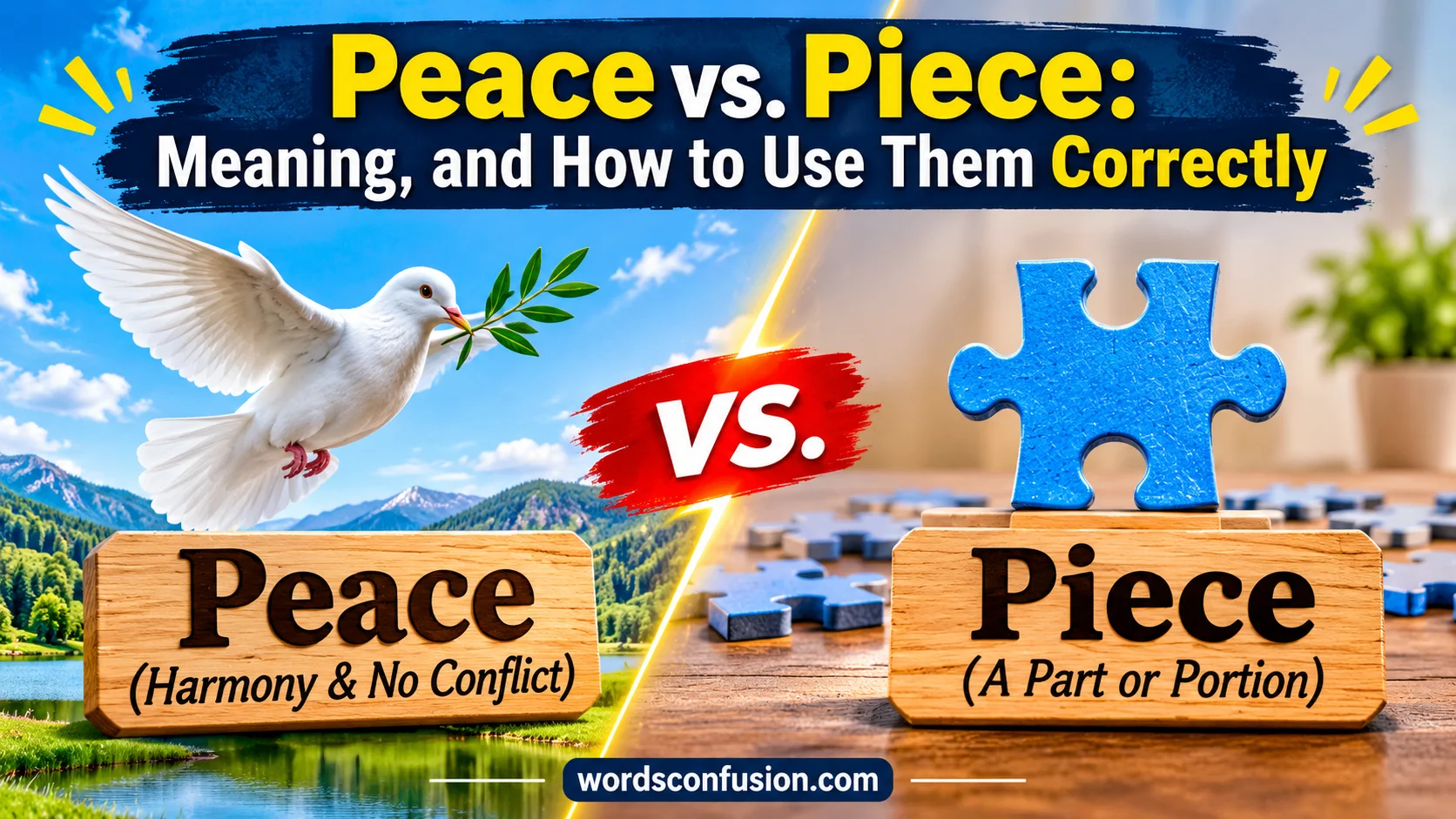
Although both words share the same pronunciation, they serve different purposes in everyday communication. Peace describes calmness, harmony, and freedom from conflict. Piece refers to a part, portion, or individual item belonging to something larger.
Understanding the difference doesn’t require complicated grammar rules. You simply need to recognize what each word describes and how people use it in sentences.
In this guide, you’ll learn the meanings of peace and piece, their grammatical uses, common expressions, practical examples, and easy tricks to remember the correct spelling.
Quick Answer
Peace means a state of calmness, harmony, or freedom from war, violence, and disagreement. It describes a situation where people feel safe, relaxed, or free from conflict.
Piece means a part, portion, or individual item of something. You can use it when discussing food, objects, artwork, documents, or different components of a larger whole.
Here are the essential differences:
- Peace: Calmness, harmony, and freedom from conflict.
- Piece: A part, section, portion, or individual item.
- Pronunciation: Both words sound identical: /piːs/.
- Part of speech: Both primarily function as nouns.
- Plural form: Peace generally has no ordinary plural form, while piece becomes pieces.
- Example of peace: Everyone deserves to live in peace.
- Example of piece: Would you like another piece of pizza?
Easy trick: Remember that peace is about feeling calm, while a piece is a part of something.
Comparison Overview
Although peace and piece have identical pronunciations, their meanings and grammatical uses differ considerably. The following table provides a quick comparison.
| Feature | Peace | Piece |
| Meaning | Calmness, harmony, or absence of conflict | A part, portion, or individual item |
| Pronunciation | /piːs/ | /piːs/ |
| Part of Speech | Primarily a noun | Primarily a noun |
| Plural Form | Usually uncountable | Pieces |
| Main Idea | Tranquility and agreement | A portion or component |
| Common Usage | World peace, inner peace, peace treaty | Piece of cake, piece of paper, puzzle piece |
| Related Words | Peaceful, peacefully, peacemaker | Pieces, piecemeal, piecework |
| Example | She finally found peace. | I need a piece of paper. |
The simplest way to distinguish these words is to consider the meaning of your sentence.
If you’re describing a calm environment, a friendly relationship, or the absence of fighting, choose peace. If you’re referring to something you can divide, hold, count, or identify as an individual item, choose piece.
For example:
- The neighbors want peace after their disagreement.
- The neighbors shared a piece of homemade cake.
Both sentences sound similar when spoken. However, their meanings are completely different.
What Does Peace Mean?
Peace refers to a state of calmness, harmony, or freedom from conflict. It can describe relationships between individuals, conditions within a country, or someone’s personal emotional state.
People commonly use this word when discussing safety, cooperation, understanding, and the absence of violence. However, peace doesn’t always mean that everything is perfect. Sometimes it simply means people can resolve their differences without fighting.
For example, two friends might disagree about something but still maintain peace by respecting each other’s opinions.
Peace can also describe an individual’s emotional condition. Someone who feels comfortable, relaxed, and free from constant worry might say they’ve found inner peace.
Different Meanings and Uses of Peace
The word peace appears in several situations. Understanding these meanings will help you use it naturally.
Peace as freedom from war or violence
This meaning usually describes relationships between countries, communities, or opposing groups.
For example, when two countries stop fighting and agree to resolve their differences through discussion, they may establish a peaceful relationship.
Examples:
- The two countries signed an agreement to maintain peace.
- Citizens hoped the conflict would finally end.
- The international community called for peace.
- The leaders discussed ways to prevent another war.
Peace as harmony between people
Peace can also describe friendly relationships between individuals or groups. It suggests mutual respect, understanding, and cooperation.
Examples:
- The family tries to maintain peace at home.
- Their disagreement ended when they finally apologized.
- Good communication helps maintain peace between coworkers.
- The neighbors agreed to live together peacefully.
Peace as inner calmness
Sometimes peace has nothing to do with arguments or wars. Instead, it describes how someone feels inside.
A person experiencing inner peace might feel comfortable with their decisions and less affected by everyday stress.
Examples:
- Meditation helps her find inner peace.
- Spending time with nature gives me peace.
- He finally feels at peace with his past.
- Reading a book brings her a sense of peace.
Peace as freedom from disturbances
People also use peace when discussing quiet surroundings and uninterrupted time.
For example, someone working from home might ask family members to give them some peace and quiet.
Examples:
- I need some peace and quiet to finish this assignment.
- The countryside offers peace away from busy city life.
- She enjoys the peace of early mornings.
- Please let me study in peace.
Peace as agreement or reconciliation
Peace can describe the process of ending an argument or restoring a relationship.
Examples:
- The two friends made peace after their disagreement.
- They reached a peaceful agreement.
- Both sides agreed to work toward reconciliation.
- His apology helped restore peace within the family.
Example Sentences With Peace
Here are additional examples showing how people use peace in everyday English.
- Everyone deserves to live in peace.
- The peaceful village attracts visitors every summer.
- She wants peace instead of unnecessary arguments.
- The government introduced measures to protect peace.
- My grandparents enjoy the peace of rural life.
- He found peace after forgiving his old friend.
- The community organized a peaceful demonstration.
- Nothing matters more than peace of mind.
- The agreement brought peace to the region.
- I prefer a peaceful environment when working.
Notice how every sentence describes harmony, calmness, or freedom from conflict.
What Does Piece Mean?
Piece means a part, portion, section, or individual item of something. People use it when discussing objects, food, artwork, music, writing, and many other things.
Unlike peace, which usually describes a condition, piece identifies something that can be considered part of a larger whole or an individual item.
For example, when you cut a pizza into eight portions, each portion becomes a piece of pizza. Similarly, when a glass breaks, its individual fragments are pieces of glass.
The word can also describe something that isn’t physical. A newspaper article, musical composition, or work of literature can be called a piece.
Different Meanings and Uses of Piece
Let’s explore the most common meanings of piece with practical examples.
Piece as a part of a larger object
This is one of the most common uses of the word. It describes an individual section separated from something larger.
Examples:
- A piece of the wooden table broke.
- She found a missing piece of the puzzle.
- The mechanic replaced a damaged piece of equipment.
- He picked up a piece of broken glass.
Piece as a portion of food
People frequently use piece when discussing food, especially items divided into smaller portions.
Examples:
- Can I have another piece of chocolate?
- She ordered a piece of strawberry cheesecake.
- He gave his brother a piece of bread.
- Everyone received a piece of birthday cake.
Piece as an individual item
The word can identify one item belonging to a collection or group.
Examples:
- The museum displayed an ancient piece of pottery.
- She bought a beautiful piece of jewelry.
- Each piece in the collection has a different design.
- He owns several valuable pieces of furniture.
Piece as a work of art, music, or literature
A creative work can also be called a piece. This usage doesn’t necessarily mean that the work is physically divided into smaller parts.
Examples:
- The pianist performed a beautiful piece of music.
- She wrote an interesting piece about American history.
- The artist created an impressive piece of sculpture.
- I read a thoughtful piece of literature.
Piece as a component of something abstract
Sometimes the word refers to one part of an idea, argument, plan, or larger situation.
Examples:
- This information is an important piece of evidence.
- We still need one piece of the puzzle.
- Every employee contributed a piece of the project.
- That explanation provides another piece of information.
Piece as an article or written work
In journalism and everyday communication, piece can refer to a written article, essay, or report.
Examples:
- The newspaper published a piece about education.
- She wrote a short piece for the school magazine.
- His latest piece discusses environmental protection.
- I found an interesting piece about technology.
Example Sentences With Piece
Here are more examples to help you recognize the word in different contexts.
- Please give me a piece of paper.
- He dropped a piece of chocolate on the floor.
- The children assembled the puzzle piece by piece.
- I need a new piece of furniture.
- She performed a difficult piece of classical music.
- Can you cut this sandwich into smaller pieces?
- Every piece of equipment needs regular maintenance.
- The artist sold her latest piece.
- He shared an important piece of information.
- I found a piece of glass near the window.
In each sentence, piece identifies an individual item, portion, or component.
Read More: Mail vs. Male: Meaning, Differences, Usage, and Examples
Main Differences Between Peace and Piece
Although these words sound exactly alike, their meanings create a clear distinction. Looking at their differences in context makes choosing the correct spelling much easier.
Difference in Meaning
The biggest difference concerns what each word represents.
Peace describes a condition or state of harmony. It often relates to relationships, emotional well-being, safety, and the absence of conflict.
Piece describes a portion or individual item. It usually refers to something that belongs to a larger object, collection, or category.
Compare these sentences:
- The community wants peace after years of conflict.
- The child wants a piece of chocolate.
The first sentence describes a desired condition. The second identifies a portion of food.
Difference in Usage
Both words appear in everyday English, but they belong to different expressions and contexts.
You commonly use peace in situations involving:
- Relationships and disagreements.
- International conflicts.
- Emotional comfort.
- Quiet surroundings.
- Cooperation and reconciliation.
You commonly use piece when discussing:
- Food and portions.
- Objects and materials.
- Artwork and music.
- Written articles.
- Individual components.
For example, people say peace of mind when discussing emotional comfort. However, they say a piece of advice when referring to a helpful suggestion.
Difference in Context
Context determines which spelling belongs in a sentence.
Consider this example:
“She finally found peace after completing the project.”
Here, peace describes emotional relief.
Now consider:
“She found a piece of paper under the desk.”
In this sentence, piece refers to an individual portion of paper.
The pronunciation doesn’t help distinguish these words because they sound identical. Instead, you must understand the sentence’s meaning.
Difference in Grammar
Both words primarily function as nouns. However, they behave differently in sentences.
Peace commonly functions as an uncountable noun.
Examples:
- Peace is important for every community.
- We hope for lasting peace.
- She needs some peace and quiet.
You generally don’t say one peace when referring to calmness.
Piece usually functions as a countable noun.
Examples:
- I bought one piece of cake.
- She collected five pieces of pottery.
- We need three more pieces.
Because piece is countable, it commonly takes singular and plural forms.
| Form | Peace | Piece |
| Singular | Peace | Piece |
| Plural | Not normally used for its usual meaning | Pieces |
| Example | We want peace. | We want two pieces. |
Difference in Word Associations
Their related words also help distinguish them.
| Peace-related words | Piece-related words |
| Peaceful | Pieces |
| Peacefully | Piecemeal |
| Peacemaker | Piecework |
| Peacekeeping | Pieceworker |
| Peacefulness | Centerpiece |
For example, peaceful describes something calm or free from conflict. Meanwhile, piecemeal describes something done gradually or in separate parts.
These word families provide another useful way to recognize the correct spelling.
Peace vs. Piece: Examples in Everyday Sentences
Sometimes the easiest way to understand two confusing words is to compare them directly.
The following examples show how changing one letter changes the meaning completely.
| Peace | Piece |
| I want some peace and quiet. | I want a piece of cake. |
| The leaders worked toward peace. | She bought a piece of furniture. |
| Music gives me peace. | He played a beautiful piece of music. |
| They finally made peace. | I found a missing piece of the puzzle. |
| The family lives in peace. | Please cut me another piece of bread. |
| Peace helps communities grow. | Each piece has a different shape. |
| She values her inner peace. | He broke a piece of glass. |
| The agreement brought peace. | I need a piece of information. |
Using Peace and Piece in the Same Sentence
You can also use both words together when their meanings fit naturally.
Examples:
- After eating a piece of cake, she enjoyed some peace and quiet.
- The children shared a piece of chocolate while their parents discussed peace.
- He found peace in his garden while repairing a broken piece of furniture.
- The artist created a beautiful piece of artwork about world peace.
These examples demonstrate why understanding context matters more than pronunciation.
Frequently Asked Questions
What Is the Main Difference Between Peace and Piece?
The main difference is their meaning. Peace describes calmness, harmony, and freedom from conflict. Piece refers to a portion, section, or individual item of something.
For example, people want peace in their communities, but they might share a piece of cake with their friends.
Are Peace and Piece Pronounced the Same?
Yes. Both words are pronounced /piːs/. They are homophones, meaning they have identical pronunciations but different spellings and meanings.
Because their sounds are identical, you must use context to determine which spelling belongs in a sentence.
Is It Peace of Mind or Piece of Mind?
Peace of mind is the correct expression when referring to emotional comfort, security, or freedom from worry.
For example: “Having a stable job gives me peace of mind.”
However, a piece of your mind appears in the expression “give someone a piece of your mind.” It means speaking frankly or angrily to someone.
Can Piece Mean a Part of Something?
Yes. Piece commonly describes one part or portion of something larger.
For example, a slice of bread, a section of glass, or one component of a puzzle can be called a piece.
The word can also describe an individual work of art, music, or literature.
What Are Some Examples of Peace and Piece in Sentences?
Here are four simple examples:
- We all want peace in the world.
- She ate a piece of chocolate.
- He needs peace and quiet.
- I found a piece of paper.
The first and third sentences use peace to describe calmness. The other two use piece to identify individual portions or items.
Conclusion:
Understanding the difference between peace vs. piece is simple once you recognize what each word means. Although they sound identical, they serve completely different purposes in English. Peace describes calmness, harmony, emotional comfort, and freedom from conflict. Piece refers to a portion, section, or individual item belonging to something larger.
Remember the simple connection: peace means calm, while piece means part. For example, you can enjoy a piece of cake while sitting peacefully in your garden. Pay attention to context rather than pronunciation, and you’ll find it much easier to choose the correct spelling in everyday writing.
