Have you ever typed “keeped” in an email, school assignment, or social media post only to wonder if it was correct? You’re not alone. Many English learners and even native speakers occasionally pause when writing the past tense of keep. Since most English verbs simply add -ed to form the past tense, it’s easy to assume that keeped follows the same rule.
However, English doesn’t always play by predictable rules. Some of its most commonly used verbs are irregular, which means they change their forms in unique ways. The verb keep is one of them. Instead of becoming keeped, it changes to kept.
Understanding the difference between Keeped vs Kept isn’t just about memorizing a spelling. It also helps you communicate more clearly, write with confidence, and avoid one of the most common grammar mistakes in English.
In this guide, you’ll learn:
- Why kept is the correct form.
- Why keeped is incorrect.
- How irregular verbs work.
- Dozens of real-world examples.
- Common expressions that use kept.
- Helpful memory tricks that make the correct form easy to remember.
- A practice quiz to test your understanding.
By the end of this article, you’ll never hesitate between keeped and kept again.
Quick Answer: Keeped vs Kept
The answer is simple:
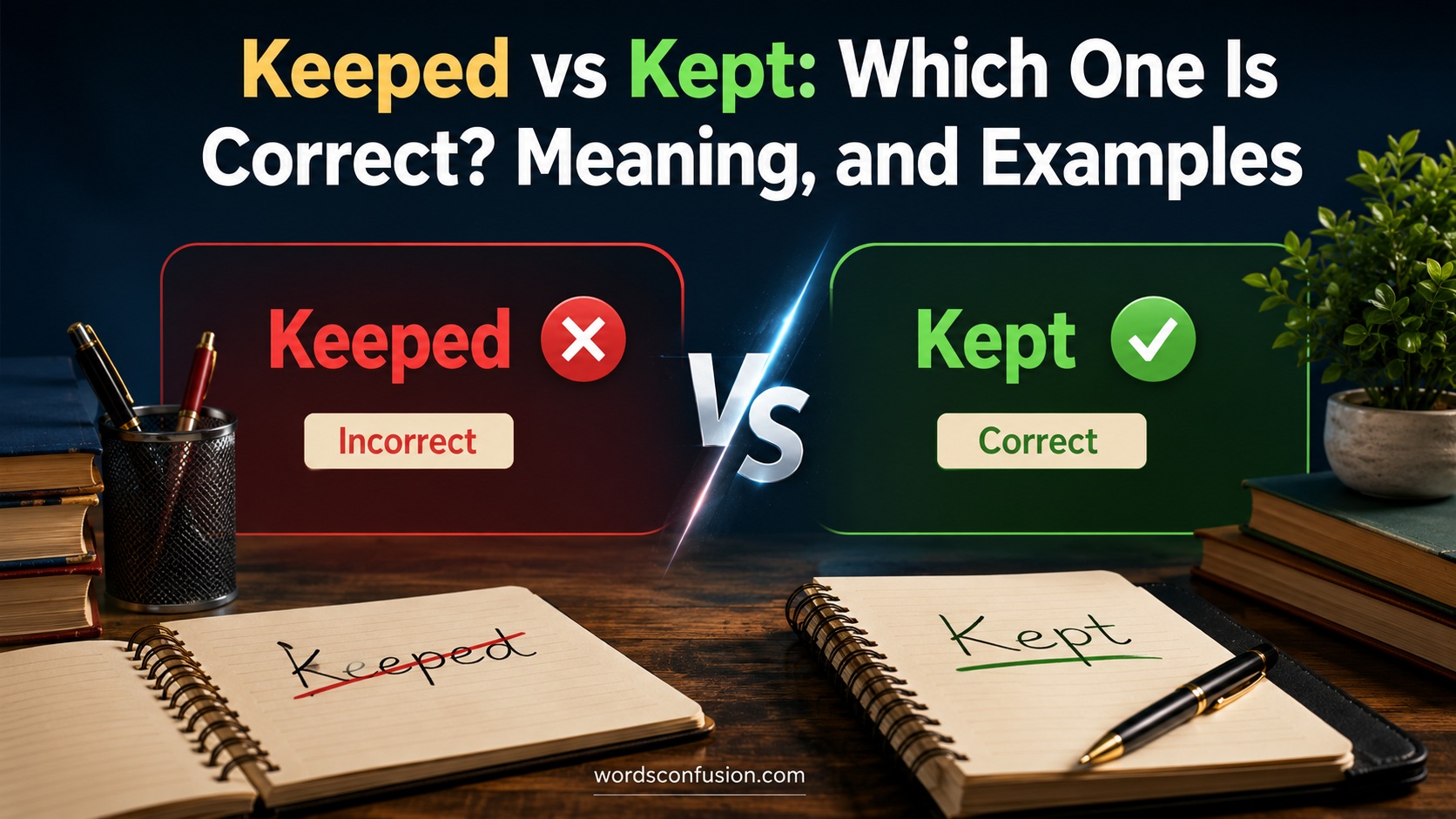
Kept is the only correct past tense and past participle of the verb keep.
Keeped is not a recognized English word and should never be used in standard American or British English.
| Word | Correct? | Meaning |
| Keeped | No | Not a valid English word |
| Kept | Yes | Past tense and past participle of keep |
Examples
Correct
- I kept your notebook safe.
- She kept her promise.
- They have kept all the receipts.
- We kept the door locked.
Incorrect
- I keeped your notebook.
- She has keeped her promise.
- They keeped the lights on.
- We had keeped everything organized.
Whenever you need the past form of keep, choose kept.
Why “Kept” Is Correct
The reason lies in the way English verbs work.
English verbs fall into two broad categories:
- Regular verbs
- Irregular verbs
Regular verbs follow a predictable pattern. You simply add -ed to the base form.
| Base Verb | Past Tense |
| Walk | Walked |
| Play | Played |
| Open | Opened |
| Watch | Watched |
The verb keep doesn’t follow this pattern. It belongs to a group of irregular verbs, which change spelling instead of adding -ed.
| Base Verb | Past Tense | Past Participle |
| Keep | Kept | Kept |
| Sleep | Slept | Slept |
| Sweep | Swept | Swept |
| Leave | Left | Left |
Instead of becoming keeped, the word changes internally to kept.
This change developed naturally over hundreds of years as English evolved from earlier Germanic languages. Many of today’s most frequently used verbs retained their historical forms instead of adopting the regular -ed ending.
That’s why English speakers say:
- I kept my keys.
- She kept her promise.
- We kept the room clean.
Not:
- I keeped my keys.
- She keeped her promise.
Why People Mistakenly Write “Keeped”
If keeped is wrong, why do so many people write it?
The answer is simple. English teaches beginners that adding -ed creates the past tense.
For many verbs, that’s exactly right.
- Jump → Jumped
- Cook → Cooked
- Paint → Painted
- Laugh → Laughed
After learning this rule, many people naturally assume that keep becomes keeped.
That’s a logical guess, but English contains hundreds of exceptions.
The regular verb habit
When you’re learning English, your brain searches for patterns. Since most verbs follow the -ed rule, it’s tempting to apply it everywhere.
For example:
- Work → Worked
- Talk → Talked
- Start → Started
So learners often think:
- Keep → Keeped
Unfortunately, that’s one of the exceptions.
Influence of pronunciation
Another reason is pronunciation.
When speaking quickly, some learners don’t clearly hear the short e sound in kept. As a result, they spell the word based on what they expect rather than what they hear.
Autocorrect isn’t perfect
Modern spell checkers catch many grammar mistakes, but they don’t always identify every error immediately.
If you’re typing quickly, keeped may slip through unnoticed, especially in informal writing or certain software.
Learning irregular verbs takes time
Irregular verbs don’t follow one universal rule.
Consider these examples:
| Base Verb | Past Tense |
| Go | Went |
| See | Saw |
| Eat | Ate |
| Keep | Kept |
| Buy | Bought |
| Think | Thought |
Each verb changes differently.
That’s why memorizing common irregular verbs is one of the most valuable skills for improving your English.
Understanding the Verb “Keep”
Before learning how kept works, it’s helpful to understand the meaning of keep itself.
The verb keep has several meanings depending on the situation. Despite these different meanings, its past tense always remains kept.
To continue having something
This is one of the most common meanings.
Examples
- I keep all my childhood photos.
- She keeps every birthday card.
- They kept the family business for decades.
To store something safely
Sometimes keep means to place something somewhere secure.
Examples
- Keep your passport in a safe place.
- He kept the documents inside a locked drawer.
- We kept extra supplies in the garage.
To maintain a condition
The verb also means maintaining something in a particular state.
Examples include:
- Keep the room clean.
- Keep the door closed.
- Keep your phone charged.
- Keep the engine running.
Past tense:
- We kept the room clean.
- They kept the gate closed.
To continue doing something
Sometimes keep means not stopping.
Examples:
- Keep smiling.
- Keep practicing.
- Keep reading.
- Keep learning.
Past tense:
- She kept practicing until midnight.
- They kept working despite the rain.
To remain
Occasionally, keep means to stay in a particular condition.
Examples:
- Please keep calm.
- Keep quiet during the meeting.
- Keep focused on your goals.
Past tense:
- Everyone kept calm.
- The audience kept quiet throughout the ceremony.
Verb Forms of Keep
Learning every form of the verb helps you avoid mistakes in speaking and writing.
| Verb Form | Word |
| Base Form | Keep |
| Third Person Singular | Keeps |
| Present Participle | Keeping |
| Past Tense | Kept |
| Past Participle | Kept |
Notice something important.
The past tense and the past participle are exactly the same.
This makes grammar much easier because you only need to remember one past form.
Examples of every verb form
| Verb Form | Example Sentence |
| Keep | I keep my desk organized. |
| Keeps | She keeps a journal every day. |
| Keeping | They are keeping everyone informed. |
| Kept | We kept every receipt. |
| Kept | I have kept my promise. |
Once you remember keep → kept, you’ll automatically know both the past tense and the past participle.
How to Use “Kept” Correctly
Using kept becomes easy once you understand when it functions as the simple past tense and when it serves as the past participle.
Although both forms are spelled the same, they appear in different grammatical structures.
Kept as the Simple Past Tense
Use kept to describe an action that happened and ended in the past.
Examples:
- I kept every letter my grandparents wrote.
- She kept the secret for years.
- We kept our vacation plans private.
- The teacher kept the classroom organized.
- They kept the windows open all afternoon.
- He kept his old bicycle even after buying a new one.
- My parents kept every school report card.
- The company kept detailed financial records.
- The dog kept barking throughout the night.
- Everyone kept smiling despite the heavy rain.
In each sentence, the action happened in the past and is complete.
Kept as the Past Participle
Use kept with helping verbs such as have, has, or had to form perfect tenses.
Examples:
- I have kept all your messages.
- She has kept every promise she made.
- They have kept the tradition alive for generations.
- We had kept our tickets before entering the stadium.
- He had kept the news private until the announcement.
- The museum has kept the original painting in excellent condition.
- Our neighbors have kept their garden beautiful for years.
- The coach had kept the team’s strategy confidential.
A simple way to remember this rule is:
If you see “have,” “has,” or “had,” the correct form is always “kept,” never “keeped.”
Using kept correctly helps your writing sound natural, polished, and grammatically accurate. It also prevents one of the most common mistakes made by English learners.
Everyday Examples of “Kept”
The best way to remember kept is to see it used in everyday situations. The more examples you read, the more natural the correct form becomes.
Personal Life
These examples show how people commonly use kept in daily conversations.
- I kept my old photos in a scrapbook.
- She kept her favorite sweater for years.
- We kept the birthday decorations as souvenirs.
- My brother kept every movie ticket from our trips.
- They kept the family recipe a secret.
- I kept the receipt in my wallet.
- He kept his room surprisingly clean.
- We kept our promises to each other.
School
Students and teachers frequently use the verb keep.
- The teacher kept the quizzes until the end of the semester.
- I kept my notes organized before the final exam.
- Sarah kept asking thoughtful questions during class.
- The principal kept parents informed about school events.
- We kept our science project in the laboratory.
- Jake kept improving his grades through hard work.
- The librarian kept rare books in a secure room.
Workplace
Professional communication often includes kept.
- The manager kept everyone updated on the project.
- Our team kept the meeting productive.
- She kept detailed records of every transaction.
- The company kept customer information confidential.
- We kept the deadline despite unexpected challenges.
- The accountant kept accurate financial reports.
- He kept his colleagues motivated throughout the project.
Relationships
Many expressions involving trust and honesty use kept.
- She kept her promise.
- He kept his word.
- They kept in touch after college.
- We kept each other’s secrets.
- My parents kept supporting me through difficult times.
- They kept their friendship alive despite living far apart.
Sports
Athletes and coaches also use the verb naturally.
- The goalkeeper kept the ball out of the net.
- Our captain kept the team focused.
- The coach kept encouraging every player.
- She kept running despite the heat.
- They kept their winning streak alive.
- The referee kept the game under control.
Business
Business writing frequently includes kept.
- The company kept its pricing competitive.
- Management kept employees informed.
- The CEO kept investors updated.
- The store kept enough inventory for the holiday season.
- We kept our customers satisfied through excellent service.
- The marketing team kept the campaign consistent.
Travel
Travel conversations provide more useful examples.
- We kept our passports in a hotel safe.
- She kept her boarding pass until landing.
- They kept extra cash for emergencies.
- I kept my camera with me throughout the trip.
- We kept our luggage locked during the journey.
- The guide kept everyone together during the tour.
These examples demonstrate one important fact: no matter the situation, the correct word is always kept, never keeped.
Read More: Spelled vs Spelt: What’s the Difference? Meaning, and Examples
Common Expressions Using “Kept”
The verb kept appears in many common English expressions. Learning these phrases will improve both your speaking and writing.
Kept Quiet
This expression means to remain silent or avoid sharing information.
Examples
- She kept quiet during the meeting.
- Everyone kept quiet while the baby slept.
Kept Calm
This phrase means to stay relaxed during a stressful situation.
Examples
- The pilot kept calm during the emergency.
- He kept calm under pressure.
Kept Going
This expression means to continue despite difficulties.
Examples
- She kept going even after everyone else gave up.
- We kept going despite the heavy rain.
Kept in Touch
This means to continue communicating with someone.
Examples
- We kept in touch after graduation.
- They have kept in touch for over twenty years.
Kept a Promise
This phrase means to do what you said you would do.
Examples
- He kept his promise to help.
- She always keeps her promises.
Kept a Secret
This means not revealing confidential information.
Examples
- My best friend kept my secret.
- They kept the surprise party hidden until her birthday.
Kept an Eye on
This expression means to watch someone or something carefully.
Examples
- Grandma kept an eye on the children.
- The security guard kept an eye on the entrance.
Kept Track of
This means to monitor or record information.
Examples
- We kept track of our expenses.
- The teacher kept track of attendance.
Kept Safe
This phrase means protected from danger or damage.
Examples
- The documents were kept safe in a vault.
- She kept the jewelry safe at home.
Kept Waiting
This expression means someone had to wait longer than expected.
Examples
- We were kept waiting for nearly an hour.
- Customers were kept waiting because of the delay.
Knowing these expressions makes your English sound much more natural because native speakers use them every day.
Keep in Different Verb Tenses
The verb keep appears in almost every English tense. Understanding these forms helps you use the verb accurately in both speech and writing.
| Tense | Example |
| Simple Present | I keep my files organized. |
| Present Continuous | I am keeping the room clean. |
| Simple Past | I kept every receipt. |
| Past Continuous | I was keeping notes during the lecture. |
| Present Perfect | I have kept my promise. |
| Past Perfect | She had kept the letter for years. |
| Future Simple | I will keep your secret. |
| Future Perfect | They will have kept the tradition alive for fifty years. |
Notice that kept only appears in the simple past, present perfect, and past perfect forms. In future and present tenses, the base form keep remains unchanged.
FAQs:
Is keeped a real English word?
No. Keeped is not a recognized English word. Standard dictionaries and grammar guides identify kept as the only correct past tense and past participle of keep. In formal writing, academic work, and everyday communication, you should always use kept.
Why is the past tense of keep “kept” instead of “keeped”?
The verb keep is an irregular verb, which means it doesn’t form its past tense by adding -ed. Instead, it changes to kept, following a historical pattern found in English. Similar irregular verbs include sleep → slept and sweep → swept.
Is kept both the past tense and the past participle?
Yes. Kept serves as both the simple past tense and the past participle of keep.
Examples:
- Simple Past: We kept the meeting short.
- Present Perfect: We have kept every promise.
- Past Perfect: They had kept the documents secure.
Do native English speakers ever say keeped?
Native English speakers generally use kept. While you may occasionally hear keeped from young children or English learners who are still learning grammar rules, it is considered a grammatical mistake and isn’t acceptable in standard English.
How can I remember the difference between keeped and kept?
A simple memory trick is to pair keep with other similar irregular verbs.
| Base Verb | Correct Past Tense |
| Keep | Kept |
| Sleep | Slept |
| Sweep | Swept |
Remember this pattern:
Keep → Kept, never Keeped.
The more you read and use kept in sentences, the more natural it will become.
Conclusion:
The debate over Keeped vs Kept has a straightforward answer: kept is the only correct past tense and past participle of keep. Although adding -ed works for many regular verbs, keep is an irregular verb that follows its own pattern. As a result, keeped isn’t a valid English word and should never appear in formal or informal writing.
Whenever you’re talking about something you held onto, maintained, protected, or continued in the past, use kept with confidence. Whether you’re writing an essay, sending a business email, or having a casual conversation, choosing the correct verb form makes your English clearer and more professional.

Andrew Wilson is an experienced language researcher and content writer specializing in WordsConfusion topics. He helps readers understand commonly confused English words, spelling differences, grammar rules, word meanings, and proper usage through clear explanations, practical examples, and easy-to-follow language guides. His goal is to make English learning simple, accurate, and accessible for students, writers, professionals, and everyday learners.