Have you ever paused while writing and wondered whether “separate” or “seperate” is the correct spelling? You’re not alone. Thousands of people search for Separate vs Seperate every month because it’s one of the most commonly misspelled words in English.
The confusion usually comes from pronunciation. Many people pronounce the word in a way that makes it sound like it contains an “e” after the “p”, which leads to the incorrect spelling “seperate.” However, English spelling doesn’t always match pronunciation. In this case, only one spelling is accepted in dictionaries, schools, professional writing, and everyday communication.
Understanding the difference isn’t just about passing a spelling test. Correct spelling improves your credibility in emails, academic papers, resumes, business documents, and social media posts. Even a small spelling mistake can leave a poor impression, especially in professional settings.
In this guide, you’ll learn which spelling is correct, why people confuse the two words, how to remember the right spelling forever, and how to use “separate” correctly with plenty of real-life examples.
Quick Answer
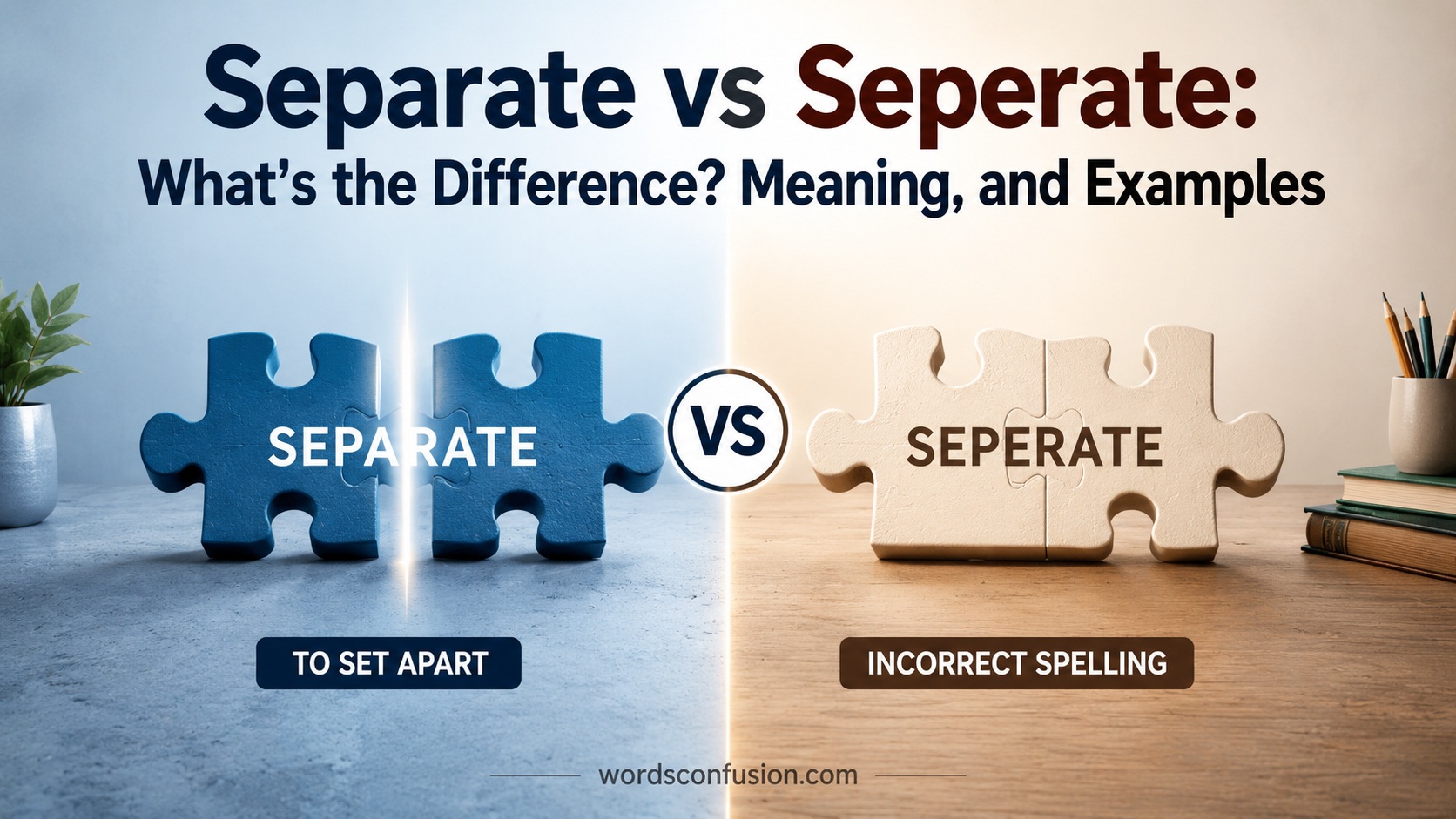
Separate is the only correct spelling in American and British English.
Seperate is simply a misspelling. It isn’t recognized as a standard English word and shouldn’t appear in formal or informal writing.
Here’s the difference at a glance:
| Word | Correct? | Meaning |
| Separate | Yes | To divide, keep apart, or existing independently |
| Seperate | No | Incorrect spelling of “separate” |
If you’re ever unsure, remember this simple trick:
There is an “A” after the “P” in sepARate.
That one small reminder can help you avoid one of English’s most common spelling mistakes.
Is It “Separate” or “Seperate”?
If you’re deciding between separate and seperate, the answer is simple: separate is always correct.
Although many people accidentally type seperate, no major English dictionary recognizes it as a proper word. Whether you’re writing an email, a school assignment, a blog post, or a business report, you should always use separate.
Here’s a quick comparison.
| Feature | Separate | Seperate |
| Correct English spelling | Yes | No |
| Found in dictionaries | Yes | No |
| Accepted in academic writing | Yes | No |
| Used in professional documents | Yes | No |
| Grammatically correct | Yes | No |
The mistake is so common that spell-checkers often catch it immediately. However, relying solely on spell check isn’t a good habit. Knowing the correct spelling helps you write with more confidence and accuracy.
Is “Seperate” Ever Correct?
No.
Seperate has never been the standard spelling in modern English. It isn’t an alternative spelling, a regional variation, or an older form of the word. It is simply a spelling error.
Unlike words such as color and colour, where American and British English use different spellings, separate has the same spelling worldwide.
Whether you’re writing in:
- American English
- British English
- Canadian English
- Australian English
- New Zealand English
…the correct spelling remains separate.
Here’s what different dictionaries agree on:
| Dictionary | Correct Spelling |
| Merriam-Webster | Separate |
| Oxford English Dictionary | Separate |
| Cambridge Dictionary | Separate |
| Collins Dictionary | Separate |
| Dictionary.com | Separate |
Since every major dictionary uses the same spelling, there’s no situation where seperate is considered acceptable.
What Does “Separate” Mean?
The word separate has several meanings depending on how you use it in a sentence. It can function as a verb, an adjective, and, less commonly, a noun.
Despite these different grammatical roles, the central idea remains the same: to keep things apart or existing independently.
Separate as a Verb
As a verb, separate means to divide, split, disconnect, or move apart.
It often describes taking one thing away from another.
Examples:
- Please separate the white clothes from the colored ones.
- The teacher asked students to separate into small groups.
- Oil and water naturally separate after a few minutes.
- We need to separate recyclable waste from regular trash.
You can also use separate when discussing emotions, relationships, or organizations.
For example:
- The company decided to separate its marketing department from sales.
- The couple agreed to separate before filing for divorce.
Separate as an Adjective
As an adjective, separate describes things that are distinct, individual, or not connected.
Examples:
- They booked separate hotel rooms.
- Each applicant received a separate interview.
- The twins attend separate universities.
- Keep the documents in separate folders.
Using separate as an adjective emphasizes that people or objects remain independent from one another.
Separate as a Noun
Although less common, separate can also be a noun.
In fashion, separates are individual clothing pieces that can be mixed and matched.
Examples:
- The boutique sells stylish separates for work.
- Her wardrobe includes several designer separates.
In legal and historical contexts, separate may also appear in specialized phrases, though this usage is relatively rare in everyday English.
Why Do People Misspell “Separate” as “Seperate”?
The misspelling seperate isn’t random. Several factors make this word surprisingly difficult to spell.
Pronunciation Can Be Misleading
Many English speakers pronounce the second syllable so quickly that it sounds like “sep-er-ate.”
Because people often spell words the way they hear them, they naturally replace the “a” with an “e.”
English contains many words where pronunciation doesn’t perfectly match spelling, and separate is one of them.
English Has Inconsistent Spelling Rules
English borrows words from Latin, French, Greek, German, and many other languages.
As a result, spelling patterns aren’t always predictable.
Compare these words:
| Word | Middle Vowel |
| Separate | A |
| Desperate | E |
| Operate | E |
| Moderate | E |
| Celebrate | E |
Because so many familiar words use “e”, writers often assume separate follows the same pattern.
Fast Typing Leads to Errors
Typing quickly increases the chance of reversing or replacing letters.
Many people know the correct spelling but accidentally write:
- seperate
- seperated
- seperation
- seperately
These errors are common in emails, text messages, and social media posts.
Memory Plays Tricks
Your brain often remembers the overall shape of a word instead of every individual letter.
Since seperate looks similar to separate, your brain may not immediately notice the mistake during proofreading.
That’s why reading your writing slowly is often more effective than skimming it.
Influence of Regional Accents
Different accents can also affect spelling.
Some speakers pronounce the middle syllable more clearly than others, making the incorrect spelling seem logical.
However, regardless of pronunciation, the written form never changes.
How to Remember the Correct Spelling
Spelling separate correctly doesn’t have to feel like memorizing random letters. A few simple memory tricks can help you remember it every time.
Remember “SepARate”
The easiest trick is to focus on the letters AR.
Think of it like this:
sepARate = There’s an “A” right after the “P.”
Many students remember this because the letters AR stand out in the middle of the word.
Read More: Keeped vs Kept: Which One Is Correct? Meaning, and Examples
Think About the Meaning
The word separate means to divide or keep things apart.
Imagine the letter A standing between two groups. That A helps “separate” the letters around it.
This visual association makes the spelling easier to recall.
Break the Word into Syllables
Instead of trying to memorize the whole word, divide it into smaller parts.
Sep + ar + ate
Breaking longer words into syllables makes them much easier to spell correctly.
Write It Several Times
One of the oldest learning techniques still works.
Write the word several times.
- Separate
- Separate
- Separate
- Separate
- Separate
Your brain gradually builds muscle memory through repetition.
Compare the Correct and Incorrect Spellings
Looking at both versions side by side helps reinforce the correct one.
| Correct | Incorrect |
| Separate | Seperate |
| Separately | Seperately |
| Separation | Seperation |
| Separated | Seperated |
Notice that every correct form keeps the letter A after the P.
Separate Pronunciation
Although pronunciation contributes to the spelling confusion, the pronunciation itself is straightforward once you know it.
American English Pronunciation
/ˈsep.ə.reɪt/
British English Pronunciation
/ˈsep.ər.eɪt/
The word contains three syllables.
SEP • uh • rate
The first syllable receives the primary stress.
Even though the middle vowel often sounds like a soft “uh”, the correct spelling still uses the letter A, not E.
When to Use “Separate”
You can use separate in many different situations. The meaning stays consistent, but the context changes.
In Everyday Conversation
People frequently use separate while talking about daily activities.
Examples include:
- Please keep the receipts in separate envelopes.
- Let’s travel in separate cars.
- The children sleep in separate bedrooms.
- Separate the clean dishes from the dirty ones.
These examples show how naturally the word fits into everyday speech.
In Academic Writing
Schools, colleges, and universities regularly use separate in assignments and research papers.
Examples:
- Write your answers on a separate sheet of paper.
- The experiment contains three separate stages.
- Researchers analyzed the results in separate categories.
- Each chapter examines a separate topic.
Using the correct spelling is especially important in academic work because spelling mistakes can reduce credibility.
In Business Communication
Professional writing often requires the word separate.
Examples:
- Please send each invoice as a separate attachment.
- The finance and HR departments operate as separate teams.
- We created separate budgets for each project.
- Store confidential documents in separate folders.
Correct spelling reflects attention to detail, which matters in the workplace.
In Legal and Technical Writing
Legal contracts and technical documents rely on precise language.
Examples include:
- The agreement treats both companies as separate legal entities.
- Keep electrical wires separate from water pipes.
- The engineer designed separate safety systems.
- Patient records remain in separate files for privacy reasons.
Precision is critical in these fields, making accurate spelling essential.
Common Examples of “Separate” in Sentences
Seeing words in context makes them much easier to understand.
Everyday Examples
- We decided to sit at separate tables.
- Please separate the recycling before taking out the trash.
- The twins have separate bedrooms now.
- She packed her shoes in a separate bag.
- Keep raw meat separate from vegetables.
School Examples
- Write your essay on a separate page.
- The teacher asked us to separate into discussion groups.
- Each subject has a separate notebook.
- Students completed separate science projects.
Workplace Examples
- We maintain separate databases for each client.
- The company created separate departments for customer support and sales.
- Please send every contract as a separate PDF.
- Keep personal expenses separate from business expenses.
Relationships
- After months of discussion, the couple decided to separate.
- Although they live separate lives, they remain close friends.
- The mediator recommended keeping financial matters separate.
Travel
- We booked separate hotel rooms.
- The airline placed our luggage in separate compartments.
- Each traveler received a separate boarding pass.
Technology
- Save each project in a separate folder.
- Store backup files on a separate drive.
- The software installs in a separate directory.
- Keep your work account separate from your personal account.
Common Mistakes to Avoid
Many spelling mistakes come from habit rather than a lack of knowledge. Recognizing these errors can help you avoid them.
| Incorrect | Correct | Why It Is Wrong |
| Seperate | Separate | Incorrect spelling |
| Seperated | Separated | The base word is spelled incorrectly. |
| Seperately | Separately | Derived words keep the original spelling. |
| Seperation | Separation | The noun also uses A, not E. |
| Please seperate these files. | Please separate these files. | Incorrect verb spelling. |
| Two seperate offices | Two separate offices | Incorrect adjective spelling. |
Another common mistake involves pronunciation. Some people assume that because the word sounds like it contains an “e,” they should spell it that way. English doesn’t always follow pronunciation, so relying only on sound can lead to errors.
A good habit is to proofread slowly. Instead of reading sentence by sentence, look specifically at words you often misspell. This small step catches mistakes that your brain might otherwise overlook.
FAQs:
Is “seperate” ever the correct spelling?
No. Separate is the only correct spelling in American and British English. Seperate is a common misspelling and should never be used in academic, professional, or everyday writing.
Why do so many people spell “separate” as “seperate”?
Most people make this mistake because of the way the word is pronounced. The middle syllable often sounds like it contains an “e,” even though the correct spelling uses an “a.” Fast typing and unfamiliarity with the word also contribute to the error.
Is “separate” a verb or an adjective?
It can be both. As a verb, it means to divide or keep apart. As an adjective, it describes things that are distinct or not connected. In some specialized contexts, it can also function as a noun.
How can I remember the correct spelling of “separate”?
A simple memory trick is to remember sepARate. Focus on the letters AR after the P. Repeating the word, using it in sentences, and comparing it with the incorrect spelling seperate can also help reinforce the correct form.
Do “separate” and “separately” follow the same spelling rule?
Yes. Every word derived from separate keeps the same “a” after the p. This includes:
- Separate
- Separated
- Separating
- Separately
- Separation
If you remember the spelling of the base word, you’ll find it much easier to spell its related forms correctly.
Conclusion:
The debate between Separate vs Seperate has a clear answer. Separate is the only correct spelling, while seperate is simply a misspelling that should be avoided in every type of writing.
Whether you’re writing an email, preparing a school assignment, creating business documents, or publishing online content, using the correct spelling demonstrates attention to detail and strengthens your credibility. Although the pronunciation can make the word seem confusing, remembering the simple “sepARate” trick makes it much easier to spell correctly.

Andrew Wilson is an experienced language researcher and content writer specializing in WordsConfusion topics. He helps readers understand commonly confused English words, spelling differences, grammar rules, word meanings, and proper usage through clear explanations, practical examples, and easy-to-follow language guides. His goal is to make English learning simple, accurate, and accessible for students, writers, professionals, and everyday learners.