If you’ve ever paused while typing receive and wondered whether it should be spelled receive or recieve, you’re not alone. This is one of the most common spelling mistakes in English. Even fluent speakers occasionally reverse the letters “e” and “i” because the pronunciation doesn’t make the correct spelling obvious.
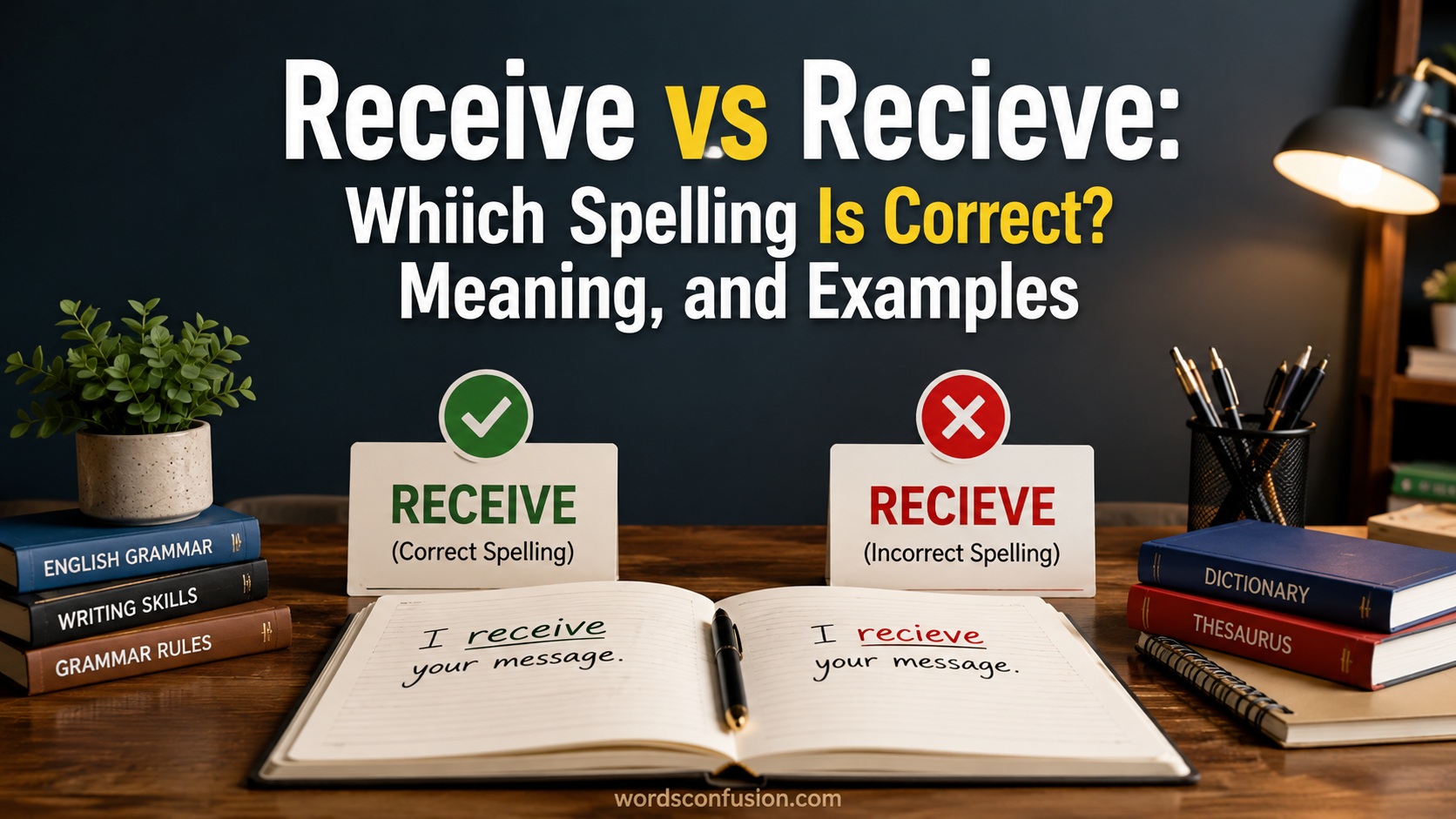
The good news is that the answer is simple. Receive is the only correct spelling. Recieve is always a misspelling.
In this guide, you’ll learn the difference between receive vs recieve, why people confuse the two, how to remember the correct spelling, and how to use receive confidently in everyday writing. You’ll also find grammar tips, pronunciation guidance, comparison tables, practical examples, and common mistakes to avoid.
Quick Answer
Receive is the correct spelling.
Recieve is incorrect and should never be used in formal or informal writing.
| Word | Correct? | Meaning |
| Receive | Yes | To get, accept, or be given something. |
| Recieve | No | A misspelling of receive. |
Example:
- Correct: I received your email this morning.
- Incorrect: I recieved your email this morning.
Whenever you’re unsure, remember this simple rule:
After the letter “C,” use “EI.”
That small reminder can save you from making one of the most frequent spelling errors in English.
Receive vs Recieve at a Glance
Before diving deeper, here’s a quick comparison between the two spellings.
| Feature | Receive | Recieve |
| Correct English spelling | Yes | No |
| Found in dictionaries | Yes | No |
| Accepted in academic writing | Yes | No |
| Accepted in business writing | Yes | No |
| Common typing mistake | No | Yes |
| Recommended by grammar checkers | Yes | No |
The table makes the answer clear. Receive is the only spelling recognized by English dictionaries and style guides. If you write recieve, grammar-checking tools such as Microsoft Word, Google Docs, or Grammarly will usually flag it as an error.
Which Is Correct: Receive or Recieve?
The correct spelling is receive.
Although both words may sound identical when spoken, only receive follows standard English spelling rules. The spelling recieve results from accidentally switching the positions of “e” and “i.”
This mistake happens because English pronunciation doesn’t always match spelling. Since both versions sound nearly the same, many writers type the letters in the wrong order without realizing it.
Receive Is the Correct Spelling
The verb receive means to get, accept, take, or be given something.
You can receive many different things, including:
- Emails
- Packages
- Gifts
- Payments
- Awards
- Advice
- Information
- Support
- Medical treatment
- Invitations
Here are a few examples:
- I received a confirmation email after placing my order.
- She received an award for outstanding leadership.
- We received excellent customer service.
- Did you receive my message yesterday?
Each sentence uses the correct spelling.
Why “Recieve” Is Wrong
The word recieve does not exist in standard English.
It’s simply a spelling error caused by reversing two vowels.
Common reasons include:
- Typing too quickly.
- Forgetting the spelling rule.
- Writing from memory instead of checking.
- Assuming pronunciation determines spelling.
Fortunately, this mistake is easy to avoid once you understand why receive follows a specific spelling pattern.
What Does “Receive” Mean?
The verb receive means to get something that is given, sent, offered, or delivered to you.
Depending on the situation, its meaning changes slightly while keeping the same core idea.
Here are the most common meanings.
To Get Something
This is the most common use.
Examples:
- I received your package today.
- They received several job applications.
- She received a birthday card from her grandmother.
To Accept Something
Sometimes receive means willingly accepting something offered.
Examples:
- He received the award with gratitude.
- The organization received generous donations.
- Our team received valuable feedback.
To Experience Something
You can also receive treatment, attention, praise, or criticism.
Examples:
- She received excellent medical care.
- The movie received positive reviews.
- The proposal received widespread support.
To Be Given Information
Another common meaning involves communication.
Examples:
- Have you received the latest report?
- We received your complaint yesterday.
- Customers receive notifications automatically.
Although these meanings differ slightly, they all revolve around the same central idea: something comes to you.
How to Pronounce “Receive”
Many spelling mistakes happen because pronunciation can be misleading.
Receive is pronounced:
ri-SEEV
IPA Pronunciation:
/rɪˈsiːv/
Break it into two parts:
Re + ceive
The stress falls on the second syllable.
Examples:
- receive
- received
- receiving
- receiver
Reading the word aloud several times can help reinforce both its pronunciation and spelling.
Why People Spell Receive as Recieve
If receive is so common, why do millions of people spell it incorrectly?
The answer lies in how the human brain processes language.
The “I Before E” Rule Causes Confusion
Many people remember learning this saying:
“I before E except after C.”
Unfortunately, they often remember only the first half.
They think “I always comes before E,” which leads them to write recieve instead of receive.
In reality, receive actually follows the complete rule because the letters come after C.
Fast Typing
Typing quickly increases the chances of reversing nearby letters.
This happens frequently with words such as:
- receive
- believe
- friend
- piece
Even experienced writers make this mistake when they don’t proofread.
Muscle Memory
Sometimes your fingers remember the wrong spelling because you’ve typed it incorrectly many times before.
Once incorrect spelling becomes a habit, it keeps appearing until you consciously practice the correct version.
Pronunciation Doesn’t Help
Unlike phonetic languages, English often separates pronunciation from spelling.
Whether you write receive or recieve, both appear to sound the same.
That makes visual memory more important than pronunciation.
Learning English as a Second Language
English learners often struggle because many spelling rules contain exceptions.
Without regular reading, it’s easy to swap the vowels accidentally.
The more you encounter receive in books, articles, and emails, the more natural the correct spelling becomes.
The “I Before E Except After C” Rule
One of the best-known English spelling rules says:
“I before E except after C.”
Although the rule has several exceptions, receive follows it perfectly.
Let’s break it down.
Words That Follow the Rule After C
| Word | Correct Spelling |
| Receive | EI |
| Conceive | EI |
| Perceive | EI |
| Deceive | EI |
| Ceiling | EI |
Notice that each word places E before I because the letters come after C.
Common Exceptions
English wouldn’t be English without exceptions.
Some words don’t follow this rule, including:
- weird
- science
- efficient
- sufficient
- foreign
- leisure
These words developed from different historical language influences, which explains why they break the familiar pattern.
Rather than relying on the rule alone, it’s helpful to read widely and become familiar with common spellings through regular exposure.
A Simple Memory Trick
If you often forget whether it’s receive or recieve, use this quick reminder:
The letter C likes EI.
Or remember this sentence:
“After C comes EI in receive.”
It takes only a few seconds to recall, yet it can prevent a spelling mistake every time you write the word.
Another helpful strategy is to group receive with similar words:
- deceive
- perceive
- conceive
- ceiling
Because these words all share the same “cei” pattern, recognizing one makes it easier to remember the others.
By practicing this pattern instead of memorizing individual words, you’ll build stronger spelling habits that last.
Examples of “Receive” in Sentences
The best way to remember the correct spelling is to see receive used in real-life situations. Reading and writing natural sentences helps reinforce the correct spelling until it becomes second nature.
Everyday Examples
- I received your text while I was driving.
- Did you receive the invitation for the wedding?
- We received several compliments on our new home.
- She received flowers on her birthday.
- You’ll receive a confirmation email shortly.
School Examples
- Every student received a certificate after completing the course.
- I received full marks on my science project.
- The teacher received positive feedback from parents.
- Students receive their report cards at the end of each semester.
- Our class received new textbooks this week.
Workplace Examples
- Employees receive their salaries on the last Friday of every month.
- I received approval for my vacation request.
- Our department received additional funding this year.
- The company received hundreds of applications for the position.
- She received a promotion after years of hard work.
Business Examples
- Customers receive free shipping on orders over $50.
- The business received excellent online reviews.
- We received payment within two business days.
- The supplier received the purchase order yesterday.
- Investors received detailed financial reports.
Technology Examples
- I received a software update this morning.
- Users receive notifications whenever someone replies.
- Have you received the verification code?
- The server received thousands of requests every minute.
- Your device will receive security updates automatically.
Healthcare Examples
- The patient received immediate medical attention.
- She received treatment at a specialized clinic.
- Children receive vaccinations according to the recommended schedule.
- He received excellent care during his hospital stay.
- Many patients receive follow-up appointments after surgery.
These examples show that receive works naturally in both formal and informal situations.
Common Mistakes People Make
Although receive is a common word, several related spelling mistakes appear regularly in emails, school assignments, and social media posts.
Here’s how to avoid them.
| Incorrect | Correct |
| Recieve | Receive |
| Recieving | Receiving |
| Reciever | Receiver |
| Recieved | Received |
Let’s look at each mistake.
Recieve
This is the most common error.
Incorrect:
- I hope you recieve my package.
Correct:
- I hope you receive my package.
Recieving
When adding -ing, the spelling remains receiving.
Incorrect:
- She is recieving visitors today.
Correct:
- She is receiving visitors today.
Reciever
The person who receives something is called a receiver.
Incorrect:
- John is the reciever of the award.
Correct:
- John is the receiver of the award.
Recieved
The past tense is received.
Incorrect:
- We recieved your application.
Correct:
- We received your application.
Remember that every form of the word keeps the “cei” letter pattern.
Receive in Different Verb Forms
Learning every form of the verb helps you avoid mistakes in writing and speaking.
| Verb Form | Word |
| Base Form | Receive |
| Third-Person Singular | Receives |
| Present Participle | Receiving |
| Past Tense | Received |
| Past Participle | Received |
Read More: Separate vs Seperate: What’s the Difference? Meaning, and Examples
Examples of Each Form
Base Form
- I always receive helpful advice from my mentor.
Third-Person Singular
- She receives dozens of emails every day.
Present Participle
- We are receiving guests this evening.
Past Tense
- They received the shipment yesterday.
Past Participle
- The payment has been received successfully.
Notice that every form preserves the correct “ei” sequence.
Receive vs Accept
Although people often use receive and accept interchangeably, they don’t always mean the same thing.
Receiving simply means getting something.
Accepting means agreeing to take or approve something.
Here’s a comparison.
| Receive | Accept |
| Means to get something | Means to willingly agree to take something |
| Can happen automatically | Usually involves a choice |
| Focuses on obtaining | Focuses on approval or agreement |
Examples
Receive
- I received your email this morning.
The email arrived whether you wanted it or not.
Accept
- I accepted the job offer yesterday.
You made a conscious decision to agree.
Another Example
Imagine someone hands you a gift.
You receive it the moment it’s given to you.
You accept it when you decide to keep it.
That’s the key difference.
Receive vs Get
Another pair that causes confusion is receive and get.
Both describe obtaining something, yet their tone differs.
| Receive | Get |
| More formal | More casual |
| Common in business writing | Common in conversation |
| Often used in official communication | Used in everyday speech |
Examples
Formal:
- You will receive an invoice by email.
Casual:
- You’ll get an invoice by email.
Both sentences are correct.
The first sounds professional.
The second sounds conversational.
FAQs:
Is “recieve” ever the correct spelling?
No. Recieve is never correct in standard English. The only accepted spelling is receive.
Why is “receive” spelled with “EI” instead of “IE”?
The word receive follows the common spelling guideline “I before E except after C.” Because the vowels come after the letter C, they appear as EI.
What is the past tense of “receive”?
The past tense and past participle of receive are received.
Example: She received the package yesterday.
How do you remember the correct spelling of “receive”?
A simple memory trick is:
After C comes EI.
You can also group receive with similar words like deceive, perceive, and conceive, which all use the same “cei” pattern.
Is “receiving” spelled with “IE” or “EI”?
The correct spelling is receiving with EI.
Correct: We are receiving guests this evening.
Incorrect: We are recieving guests this evening.
Conclusion:
The debate over receive vs recieve has a straightforward answer. Receive is the only correct spelling, while recieve is always a misspelling. Whether you’re writing an email, completing a school assignment, preparing a business report, or posting on social media, using the correct spelling helps your writing appear more professional and credible.
One of the easiest ways to remember the spelling is the familiar rule “I before E except after C.” Since receive comes after the letter C, the correct letter order is “EI.” Although English contains many spelling exceptions, receive follows this rule perfectly.

Andrew Wilson is an experienced language researcher and content writer specializing in WordsConfusion topics. He helps readers understand commonly confused English words, spelling differences, grammar rules, word meanings, and proper usage through clear explanations, practical examples, and easy-to-follow language guides. His goal is to make English learning simple, accurate, and accessible for students, writers, professionals, and everyday learners.