Have you ever wondered whether to write plain or plane? These two words often confuse English learners and native speakers because they sound exactly alike. However, their meanings, spellings, and grammatical uses are quite different. Choosing the wrong one can change the meaning of an entire sentence.
For example, you might write, “She wore a plane white shirt” when you actually mean “She wore a plain white shirt.” Similarly, writing “The plain landed safely” instead of “The plane landed safely” creates an entirely different meaning.
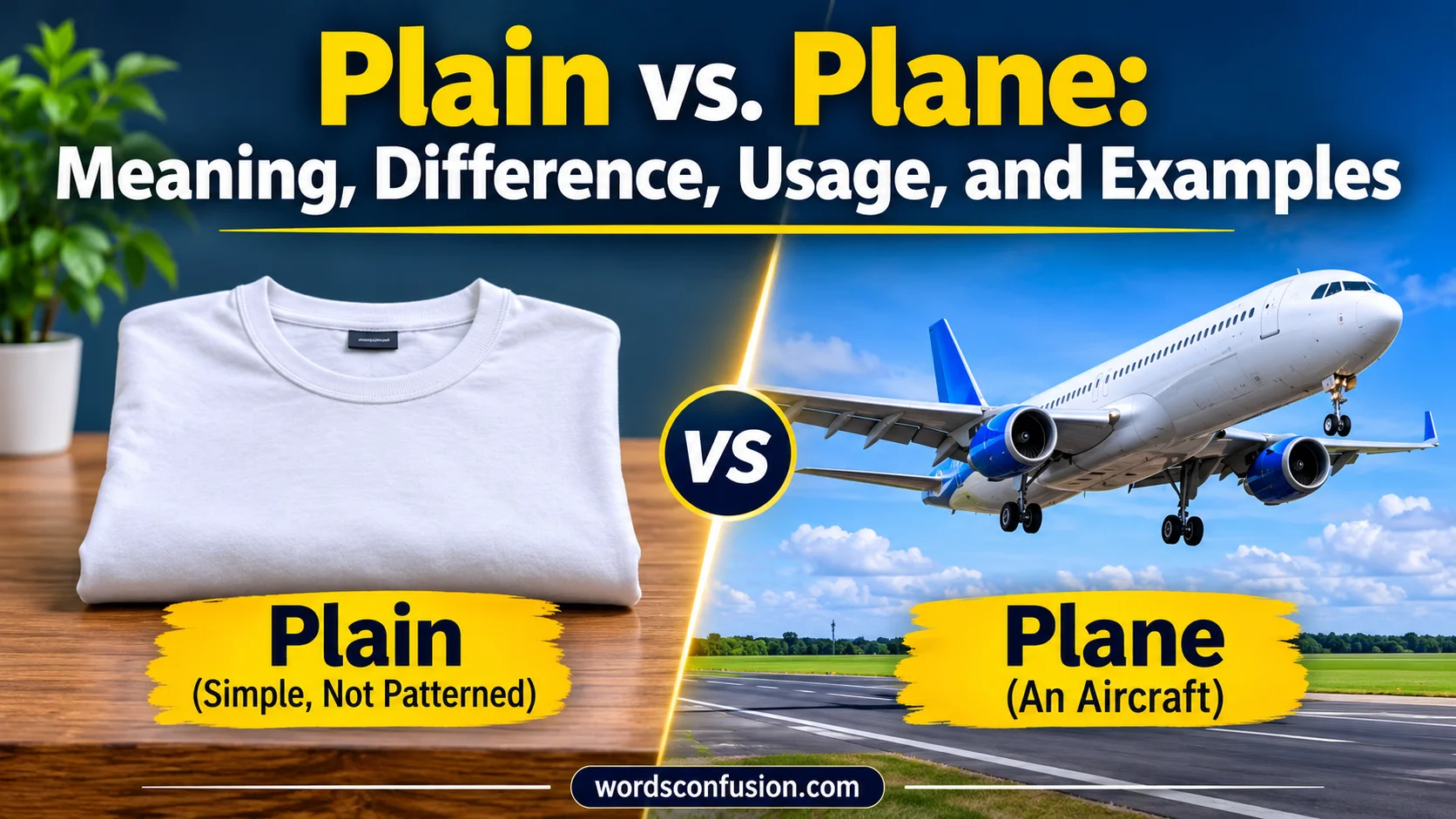
The confusion becomes easier to understand once you learn what each word represents. Plain usually describes something simple, ordinary, or clear. It can also refer to a large area of flat land. Plane, on the other hand, commonly refers to an aircraft, a flat mathematical surface, or a woodworking tool.
Quick Answer:
Plain means simple, ordinary, clear, or without decoration. It can also describe a large, relatively flat area of land.
Plane usually means an aircraft or a flat surface in geometry. It can also refer to a woodworking tool used to smooth wooden surfaces.
Here are two simple examples:
- Plain: She bought a plain white T-shirt without any designs.
- Plane: The plane arrived at the airport twenty minutes late.
Both words have the same pronunciation: /pleɪn/. However, you cannot use them interchangeably because their meanings are different.
Quick memory trick:
- Plain = Plain and simple.
- Plane = Airplane.
If you’re describing something simple or undecorated, choose plain. If you’re talking about an aircraft or a mathematical surface, choose plane.
Comparison Overview
Although plain and plane sound identical, their grammatical roles and meanings distinguish them. Understanding these differences helps you select the correct spelling without hesitation.
| Feature | Plain | Plane |
| Pronunciation | /pleɪn/ | /pleɪn/ |
| Part of speech | Adjective, noun, adverb | Noun, verb |
| Main meaning | Simple, ordinary, or clear | Aircraft or flat surface |
| Secondary meaning | Flat area of land | Woodworking tool |
| Common usage | Plain clothes, plain language | Plane ticket, geometric plane |
| Related words | Plainly, plainness | Planes, planed, planing |
| Example | She wore a plain dress. | The plane took off. |
The easiest distinction: Plain generally describes appearance, simplicity, or clarity. Plane usually identifies an object, surface, or technical concept.
For example, a plain wooden table has a simple design. A carpenter might use a plane to smooth its surface.
What Does Plain Mean?
The word plain has several meanings in English. Its most common use describes something simple, ordinary, or lacking decoration. Depending on the sentence, it can also describe clear communication, an open landscape, or something obvious.
Let’s examine its different grammatical uses.
Plain as an Adjective
An adjective describes a noun. When you use plain as an adjective, you’re usually describing something simple, uncomplicated, ordinary, or without decorative features.
For example, a plain shirt doesn’t have elaborate patterns, embroidery, or colorful designs. It has a simple appearance.
Here are the most common meanings of plain as an adjective.
Simple or Without Decoration
This is one of the most familiar uses of plain. It describes something that doesn’t have extra designs, decorations, or unnecessary details.
Examples:
- She wore a plain black dress to the meeting.
- The bedroom has plain white walls.
- He prefers plain furniture with simple designs.
- I bought a plain notebook without pictures on its cover.
Ordinary or Not Special
Plain can also describe someone or something that looks ordinary rather than striking or unusual.
Examples:
- The restaurant serves plain food at reasonable prices.
- She thought the decoration looked rather plain.
- The building has a plain exterior without elaborate architectural details.
When describing someone’s appearance, plain can sometimes suggest that a person isn’t conventionally attractive. However, this meaning can sound unkind or judgmental. Use it carefully.
Clear and Easy to Understand
Another important meaning of plain relates to communication. It describes information that people can understand without difficulty.
You’ll often encounter this meaning in expressions such as plain English and plain language.
Examples:
- The teacher explained the lesson in plain English.
- Please give me a plain explanation of the problem.
- The contract uses plain language instead of complicated legal terms.
- Her intentions were plain to everyone.
Without Additional Ingredients or Flavors
In food-related contexts, plain describes something served without added flavors, toppings, or special ingredients.
Examples:
- I ordered plain yogurt for breakfast.
- She prefers plain rice with grilled vegetables.
- He drank plain coffee without sugar or cream.
- The children ate plain pasta with butter.
Notice how the meaning changes slightly depending on the noun. However, the central idea remains the same: something is simple or unadorned.
Plain as a Noun
When plain functions as a noun, it refers to a broad area of relatively flat land. Plains generally have few major changes in elevation compared with mountainous regions.
These landscapes can support agriculture, grazing, wildlife habitats, and human settlements.
For example, the Great Plains of North America stretch across parts of the United States and Canada. This vast region includes grasslands, agricultural areas, and different types of natural habitats.
Examples:
- Farmers grow wheat across the Great Plains.
- The river flows through a wide coastal plain.
- Herds of animals once moved across the open plains.
- The settlement developed on a fertile plain.
Important geographical fact: The Great Plains cover parts of ten U.S. states, extending from Texas northward toward Montana and North Dakota. They also continue into southern Canada.
The word plain in this context has nothing to do with aircraft. It describes a geographical landscape.
Plain as an Adverb
Although less common, plain can also function as an adverb. In this role, it emphasizes that something is obvious, direct, or completely true.
Examples:
- The decision was plain wrong.
- He told me plain and simple that he couldn’t attend.
- She said plain that she didn’t agree with the proposal.
In everyday American English, people may use plainly more often in formal or carefully written sentences.
For example:
- She plainly disagreed with the decision.
- The evidence plainly shows what happened.
Both forms communicate clarity or emphasis, but their grammatical structures differ.
Common Word Forms of Plain
Understanding related forms helps you recognize plain in different sentences.
| Word | Meaning | Example |
| Plain | Simple or clear | She wore a plain shirt. |
| Plainly | Clearly or obviously | He plainly explained his concerns. |
| Plainness | The quality of being simple | The room’s plainness made it feel peaceful. |
| Plains | Large areas of flat land | The plains support extensive farming. |
These related words preserve the central meanings of simplicity, clarity, or geographical flatness.
What Does Plane Mean?
The word plane has several distinct meanings. Most people associate it with an aircraft, but the word also appears in mathematics, woodworking, and technical discussions.
Unlike plain, it doesn’t generally describe something simple or undecorated.
Let’s look at its major meanings.
Plane as a Noun: Aircraft
The most familiar meaning of plane is an aircraft. It refers to a powered flying vehicle that generally uses fixed wings to generate lift.
People commonly use plane when discussing air travel, transportation, airports, and aviation.
For example, when someone says, “My plane leaves at noon,” they’re talking about an aircraft scheduled to depart at that time.
Examples:
- Our plane landed safely after a long flight.
- She booked a plane ticket to New York.
- The plane disappeared behind the clouds.
- Several planes were waiting at the airport.
- Their plane experienced a short delay because of bad weather.
Plane vs. airplane: In American English, plane is a common shortened form of airplane. Both words refer to the same type of aircraft.
However, plane can also have other meanings depending on the context.
Plane as a Noun: A Flat Surface in Geometry
In mathematics, especially geometry, a plane is a flat, two-dimensional surface that extends infinitely in every direction.
Imagine a perfectly flat sheet of paper that continues beyond its visible edges forever. That gives you a useful starting picture of a mathematical plane.
A geometric plane has:
- Two dimensions: length and width.
- No thickness.
- No boundaries or edges in the mathematical model.
- An infinite extent in every direction.
Mathematicians use planes to study points, lines, angles, shapes, and spatial relationships.
Examples:
- A triangle can lie entirely within one plane.
- Two intersecting lines can occupy the same plane.
- The diagram represents a horizontal plane.
- Parallel lines in a plane never intersect.
Important distinction: A mathematical plane is an abstract geometric concept. A physical tabletop may look flat, but it has thickness and limited dimensions.
Read More: Peace vs. Piece: Meaning, and How to Use Them Correctly
Plane as a Noun: A Woodworking Tool
Another meaning of plane relates to carpentry and woodworking.
A hand plane is a tool that removes thin layers of wood to create a smoother, flatter, or more accurately shaped surface.
Traditional hand planes contain a sharp blade held at a controlled angle. As the carpenter pushes the tool across the wood, the blade removes a thin shaving.
Woodworkers use planes for several purposes:
- Smoothing rough wooden surfaces.
- Removing small imperfections.
- Flattening wooden boards.
- Adjusting the edges of doors.
- Creating accurate joints between wooden pieces.
Examples:
- The carpenter used a plane to smooth the wooden tabletop.
- He sharpened the blade of his hand plane.
- The workshop contains several types of woodworking planes.
A woodworking plane has no connection with an airplane. The spelling is simply the same because plane has multiple meanings.
Plane as a Verb
The word plane can also function as a verb. In woodworking, it means to smooth, flatten, or shape wood using a plane.
For example, a carpenter might plane the edge of a wooden door to make it fit properly within its frame.
Examples:
- The carpenter planed the rough wooden board.
- She is planing the cabinet door.
- He planed the surface until it became smooth.
- They planed the edges to create a better fit.
The verb has several forms:
| Form | Example |
| Base form | Plane the wooden board. |
| Third-person singular | He planes the surface. |
| Past tense | She planed the table. |
| Present participle | They are planing the wood. |
Be careful with the spelling of planing. It has one final n before the suffix -ing because the final e disappears.
Main Differences Between Plain and Plane
Now that you understand both definitions, let’s examine their differences more closely. Although pronunciation doesn’t help distinguish them, meaning and context make the correct choice clear.
Difference in Meaning
The most important difference concerns what each word describes.
Plain generally relates to simplicity, ordinary appearance, clarity, or open land.
Plane generally refers to an aircraft, a geometric surface, or a woodworking tool.
Consider these examples:
- She bought a plain notebook. (A notebook without decoration.)
- She boarded a plane. (An aircraft.)
- The Great Plains have extensive grasslands. (Geographical land.)
- The shape lies on a geometric plane. (A mathematical surface.)
Each word communicates a different idea. Replacing one with the other changes the sentence’s meaning.
Difference in Parts of Speech
Both words can function as nouns. However, their other grammatical roles differ.
| Grammatical role | Plain | Plane |
| Adjective | A plain shirt | Not commonly used this way |
| Noun | A wide plain | An airplane or geometric plane |
| Adverb | Plain wrong | Not commonly used this way |
| Verb | Not a standard verb in this sense | To plane wooden surfaces |
Understanding these grammatical differences can help you recognize the correct spelling when writing.
For example, if you need an adjective to describe a simple dress, plain is the appropriate choice.
If you’re describing an action performed by a carpenter, plane is correct.
Frequently Asked Questions
What Is the Main Difference Between Plain and Plane?
The main difference is their meaning and grammatical use. Plain describes something simple, ordinary, clear, or without decoration. It can also refer to flat land. Plane usually refers to an aircraft, a mathematical surface, or a woodworking tool.
For example, a plain shirt has no decorative design, while a plane carries passengers through the air.
Are Plain and Plane Homophones?
Yes. Plain and plane are homophones because they have identical pronunciations but different spellings and meanings.
Both are pronounced /pleɪn/ in standard American English. However, their meanings depend on the context in which you use them.
Is It Plain or Plane When Referring to an Airplane?
Plane is correct when referring to an aircraft.
For example:
- Our plane leaves at 10 a.m.
- The plane arrived ahead of schedule.
- She booked a plane ticket to Florida.
You can also use airplane, which is the full and equally correct term in American English.
Is It Plain or Plane When Describing Something Simple?
Plain is correct when describing something simple, ordinary, or without decoration.
For example:
- She bought a plain white shirt.
- I prefer plain coffee.
- The room has plain furniture.
In these sentences, plain describes the appearance or condition of something.
What Is the Difference Between a Plain and a Plane in Geography and Mathematics?
A plain is a large area of relatively flat or gently rolling land. For example, the Great Plains form an extensive geographical region in North America.
A plane is a flat, two-dimensional surface used in geometry. It extends infinitely in every direction.
Although both words can relate to flatness, they describe completely different concepts.
Can Plain and Plane Ever Be Used Interchangeably?
No. They are homophones, not synonyms. Their pronunciation is identical, but their meanings differ.
You cannot use plain when referring to an aircraft or plane when describing something simple.
For example, “a plain shirt” and “a plane ticket” are correct. Switching the words would change the intended meaning.
Is Plane a Verb?
Yes. Plane can function as a verb in woodworking. It means to smooth, flatten, or shape wood using a woodworking plane.
For example:
“The carpenter planed the wooden board before assembling the furniture.”
The past-tense form is planed, while the present participle is planing.
What Does Plain as Day Mean?
“Plain as day” is an English expression meaning extremely obvious or easy to understand.
For example:
“Her excitement was plain as day when she opened the gift.”
The expression uses plain to emphasize clarity or obviousness.
Conclusion:
Understanding plain vs. plane becomes easy when you focus on meaning rather than pronunciation. Both words sound exactly alike, but they serve different purposes in English. Use plain when describing something simple, ordinary, clear, or a large area of flat land. Choose plane when referring to an aircraft, a mathematical surface, or a woodworking tool.
Remember the simple association: plain means plain and simple, while plane means airplane or a flat mathematical surface. Once you recognize these differences and practice using both words in sentences, you’ll avoid this common spelling mistake and write with greater confidence.

Andrew Wilson is an experienced language researcher and content writer specializing in WordsConfusion topics. He helps readers understand commonly confused English words, spelling differences, grammar rules, word meanings, and proper usage through clear explanations, practical examples, and easy-to-follow language guides. His goal is to make English learning simple, accurate, and accessible for students, writers, professionals, and everyday learners.