Have you ever wondered whether to write role or roll when both words sound exactly the same? You’re not alone. These two words often confuse English learners and native speakers because they share the same pronunciation but have completely different meanings and uses.
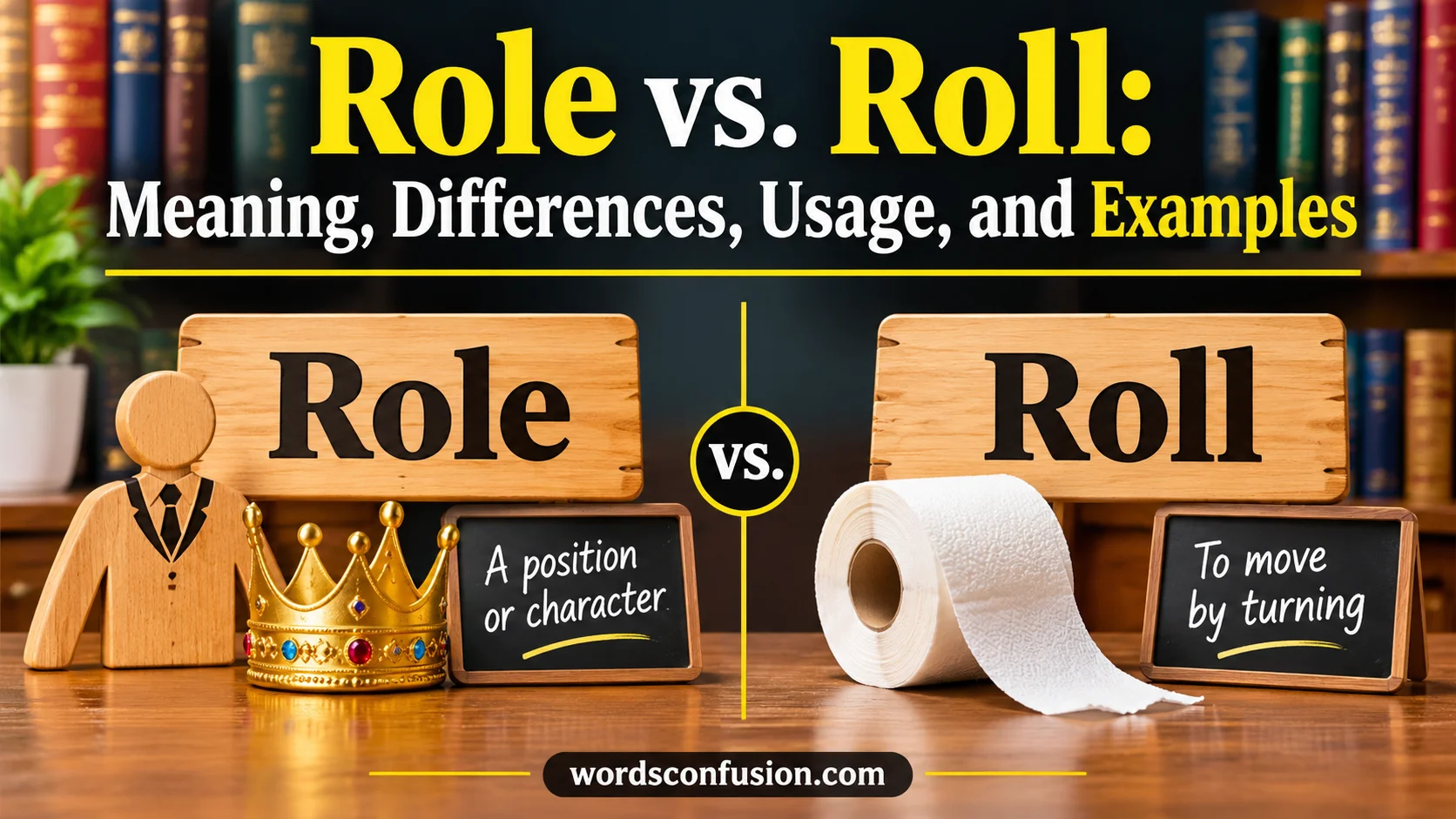
The difference becomes easier when you understand what each word represents. Role refers to a person’s position, responsibility, function, or character in a particular situation. Roll, on the other hand, can describe movement, a type of bread, a list of names, or a rounded object.
For example, you might play an important role in your company, but you can also roll a ball across the office floor. The pronunciation doesn’t change, but the meaning does.
Understanding role vs. roll helps you avoid common spelling mistakes in professional emails, school assignments, creative writing, and everyday conversations. Although context usually makes the intended meaning clear, choosing the correct spelling makes your writing more accurate and professional.
Quick Answer:
Role means a position, responsibility, function, or character that someone or something has in a particular situation. Roll refers to an action involving turning or moving, a rounded object, a type of bread, or a list of names.
Here are two simple examples:
- Role: My role in the company involves managing customer relationships.
- Roll: The children watched the ball roll down the hill.
The easiest way to remember the difference is to associate role with responsibility and roll with movement or an object.
Although both words sound alike, you cannot use them interchangeably because their meanings are different.
Comparison Overview
The words role and roll belong to a group of English words called homophones. Homophones have the same pronunciation but different meanings and spellings.
Their grammatical functions also differ. Role primarily works as a noun, while roll can function as both a noun and a verb.
| Comparison Point | Role | Roll |
| Part of speech | Primarily a noun | Noun and verb |
| Main meaning | Position, function, or responsibility | Movement, object, bread, or list |
| Pronunciation | /roʊl/ | /roʊl/ |
| Common usage | Work, acting, relationships, responsibilities | Movement, food, attendance, objects |
| Example | She plays an important role in education. | Please roll the ball toward me. |
| Common expression | Leading role | Roll call |
| Memory trick | Think of responsibility | Think of movement |
One important distinction is that role generally describes what someone or something does, while roll often describes an action or something physical.
However, roll has several meanings beyond physical movement. For example, a teacher might check the classroom roll to record attendance.
Main Differences Between Role vs. Roll
The biggest difference between these words lies in their meanings. Although they sound identical, they describe different things.
Role focuses on purpose, position, and responsibility. Roll focuses on movement, objects, food, and lists.
Understanding these differences becomes easier when you examine how each word appears in everyday situations.
Difference in Meaning
A role describes the part someone or something plays in a particular situation. It can refer to a professional position, family responsibility, fictional character, or function within a group.
For example:
- A manager has a leadership role in a business.
- A mother plays an important role in raising children.
- An actor performs the role of a detective in a movie.
- Education plays an important role in personal development.
In contrast, roll describes several different things depending on the context.
For example:
- A ball can roll across the floor.
- You can eat a bread roll with dinner.
- A teacher can check the class roll.
- You can purchase a roll of wrapping paper.
The surrounding words usually reveal which meaning the writer intends.
Difference in Grammar
Another important distinction involves grammar.
Role primarily functions as a noun. It identifies a position, function, or responsibility rather than describing an action.
Examples:
- Her role is to manage the department.
- He accepted a new role at the hospital.
- The actor received a supporting role.
Roll functions as both a noun and a verb.
As a noun:
- I bought a cinnamon roll.
- The teacher checked the attendance roll.
- He performed a forward roll.
As a verb:
- Please roll the carpet carefully.
- The ball started to roll.
- She rolled her eyes.
This grammatical difference can help you select the correct spelling when you’re unsure.
Difference in Everyday Usage
People commonly use role when discussing responsibilities, employment, entertainment, and relationships.
Meanwhile, roll appears frequently in conversations about food, movement, attendance, and physical objects.
Consider these examples:
| Context | Correct Word | Example |
| Employment | Role | She accepted a management role. |
| Acting | Role | He played the lead role. |
| Family | Role | Parents have an important role in education. |
| Food | Roll | I ordered a fresh bread roll. |
| Attendance | Roll | The teacher checked the class roll. |
| Movement | Roll | The ball began to roll. |
| Paper products | Roll | She bought a roll of paper towels. |
| Business | Roll | The company plans to roll out a new service. |
The key is to focus on the intended meaning rather than pronunciation.
What Does Role Mean?
Role is a noun that describes the position, function, responsibility, or character someone or something has in a particular situation.
It explains what a person does, how they contribute, or what purpose they serve within a group or activity.
For example, a teacher’s role involves educating students, explaining lessons, and helping them develop important skills. Similarly, a manager’s role may involve supervising employees, organizing projects, and making business decisions.
The word also appears in entertainment. An actor might play the role of a doctor, detective, or historical figure in a television show or movie.
Common Meanings of Role
The word role has several related meanings. Its interpretation depends on the situation.
A person’s position or responsibility
A role can describe someone’s duties within an organization, workplace, or group.
Examples:
- Her role involves managing the marketing team.
- My role in this project is to organize the research.
- He recently accepted a senior role at the company.
A character in entertainment
In movies, television shows, and theater, a role refers to the character an actor portrays.
Examples:
- She played the leading role in the movie.
- His role as a police officer impressed the audience.
- The director offered him a supporting role.
A person’s function in society or relationships
People also use role to describe responsibilities within families, friendships, and communities.
Examples:
- Parents play an important role in children’s lives.
- Teachers have a valuable role in society.
- Communication plays a major role in healthy relationships.
The function of something
A role doesn’t always belong to a person. Objects, systems, and ideas can also have roles.
Examples:
- Technology plays an important role in modern healthcare.
- Water has a vital role in plant growth.
- Research plays a central role in scientific development.
Read More: Plain vs. Plane: Meaning, Difference, Usage, and Examples
Role Examples in Sentences
Here are additional examples showing how to use role naturally:
- She plays an important role in the success of the business.
- His role as team captain requires strong leadership skills.
- The actor received an award for his latest role.
- Everyone should understand their role in the organization.
- Parents play a major role in shaping children’s behavior.
- Technology has changed its role in modern education.
- The company created a new role for an experienced designer.
- Her role in the investigation was particularly important.
- Exercise plays a valuable role in maintaining physical fitness.
- He struggled to balance his professional and personal roles.
Notice that every example involves a position, responsibility, character, or function.
Common Expressions With Role
Several English expressions use the word role. Learning them will help you understand everyday conversations and professional writing.
| Expression | Meaning | Example |
| Play a role | Contribute to something | Exercise plays a role in good health. |
| Leading role | Main position or character | She received the leading role. |
| Supporting role | Secondary position or character | He played a supporting role in the film. |
| Key role | Particularly important responsibility | She has a key role in the project. |
| Take on a role | Accept a responsibility | He took on a leadership role. |
| Role model | Person whose behavior others admire | My teacher is a great role model. |
| Role reversal | An exchange of positions or responsibilities | The activity involved a role reversal. |
| Job role | A person’s duties at work | Her job role includes managing accounts. |
One especially common expression is role model. It describes someone whose behavior, achievements, or qualities provide a positive example for others.
For instance, a dedicated teacher might become a role model for students because of their patience, honesty, and commitment.
What Does Roll Mean?
Roll can function as both a noun and a verb. Its meaning changes depending on how someone uses it.
As a verb, it commonly describes something turning over or moving along a surface. As a noun, it can refer to bread, a list of names, a cylindrical object, or a particular movement.
For example, when you push a ball across the ground, you make it roll. When you buy bread from a bakery, you might purchase a dinner roll.
The word also appears in expressions such as roll call, roll out, and on a roll.
Roll as a Verb
When roll functions as a verb, it usually describes movement, turning, or shaping something into a rounded form.
Here are its most common uses.
To move by turning over and over
This meaning describes an object or person moving through repeated rotations.
Examples:
- The ball rolled across the playground.
- The wheel continued to roll down the road.
- The children rolled around on the grass.
To make something move by turning
You can also use roll when someone causes an object to move.
Examples:
- Roll the suitcase toward the door.
- He rolled the cart into the storage room.
- She rolled the ball across the table.
To shape something into a rounded form
People often use roll when preparing food or working with materials.
Examples:
- Roll the dough into small balls.
- She rolled the paper into a tube.
- The baker rolled the pastry before adding the filling.
To move smoothly or begin operating
The word can also describe vehicles, activities, and processes that begin or continue.
Examples:
- The car rolled slowly into the parking lot.
- Let’s get the meeting rolling.
- The production team is ready to roll.
To turn or rotate part of the body
People commonly use roll to describe movements involving their eyes, shoulders, or other body parts.
Examples:
- She rolled her eyes at his comment.
- He rolled his shoulders before exercising.
- The athlete rolled onto his back.
Roll as a Noun
As a noun, roll refers to several objects, items, and actions.
A small piece of bread
A bread roll is a small portion of bread, usually round or slightly elongated.
Examples:
- I ate a warm dinner roll with soup.
- She bought six fresh rolls from the bakery.
- We served bread rolls with the meal.
A list of names
A roll can refer to an official or organized list of people.
Examples:
- The teacher checked the attendance roll.
- Every student must appear on the class roll.
- The secretary reviewed the membership roll.
A cylindrical object or material
A roll can also describe something wound around itself, often forming a cylinder.
Examples:
- Please bring a roll of paper towels.
- She purchased a roll of wrapping paper.
- The mechanic replaced a roll of tape.
A movement involving turning
The word can describe a physical movement in which someone or something turns over.
Examples:
- The gymnast performed a forward roll.
- The child practiced a backward roll.
- The dog made a playful roll on the grass.
A series or sequence
In certain expressions, roll describes a continuing period of success or a sequence of events.
Examples:
- The team is on a winning roll.
- The business enjoyed a successful roll of new product launches.
- The singer had a remarkable run of performances.
Common Expressions With Roll
The word roll appears in many everyday English expressions. Some have meanings that aren’t immediately obvious from their individual words.
| Expression | Meaning | Example |
| Roll call | Reading a list of names to check attendance | The teacher started roll call. |
| On a roll | Experiencing continued success | Our team is on a roll. |
| Roll out | Introduce or launch something | The company will roll out a new product. |
| Roll over | Turn onto another side | The dog rolled over. |
| Roll up | Gather or fold something into a rounded shape | Roll up the poster. |
| Rock and roll | A popular style of music | He enjoys listening to rock and roll. |
| Get the ball rolling | Start an activity or process | Let’s get the ball rolling. |
| A roll of the dice | An uncertain decision or risk | Starting the business was a roll of the dice. |
These expressions are useful in both casual and professional communication.
For example, a company might roll out a new service, while a successful sales team might say they’re on a roll.
Frequently Asked Questions
What Is the Main Difference Between Role and Roll?
The main difference involves their meanings. Role refers to a position, responsibility, function, or character. Roll can describe movement, a bread product, a list of names, or a rounded object.
For example, a teacher has a role in education, while a ball can roll across the classroom.
Are Role and Roll Pronounced the Same?
Yes. In standard American English, role and roll are homophones. Both have the same pronunciation, /roʊl/.
Their spelling and meanings differ even though their sounds match.
Is Role a Noun or a Verb?
Role is primarily a noun. It identifies a person’s position, responsibility, function, or character.
For example:
- She accepted a new role.
- His role involves managing the team.
- The actor played a leading role.
What Does Roll Mean in Roll Call?
In roll call, the word roll refers to a list of names.
A teacher, manager, or other official may read the names aloud to determine who is present.
For example: “The teacher began roll call at the start of class.”
Is It Role Model or Roll Model?
The correct expression is role model.
A role model is someone whose actions, behavior, or achievements inspire others.
For example: “My grandfather has always been a role model for me.”
Roll model is a common spelling mistake.
Conclusion:
Understanding role vs. roll becomes simple once you focus on meaning rather than pronunciation. Although both words sound identical in American English, they serve different purposes in writing and conversation. Role refers to a position, responsibility, function, or character, while roll describes movement, bread, lists, and rounded objects. Remember that you play a role in a project but can roll a ball across the floor.
