
If you’ve ever paused while writing the plural of tomato, you’re not alone. The word looks simple until you need to decide whether the correct plural is tomatoes or tomatos. That tiny extra e causes a surprising amount of confusion.
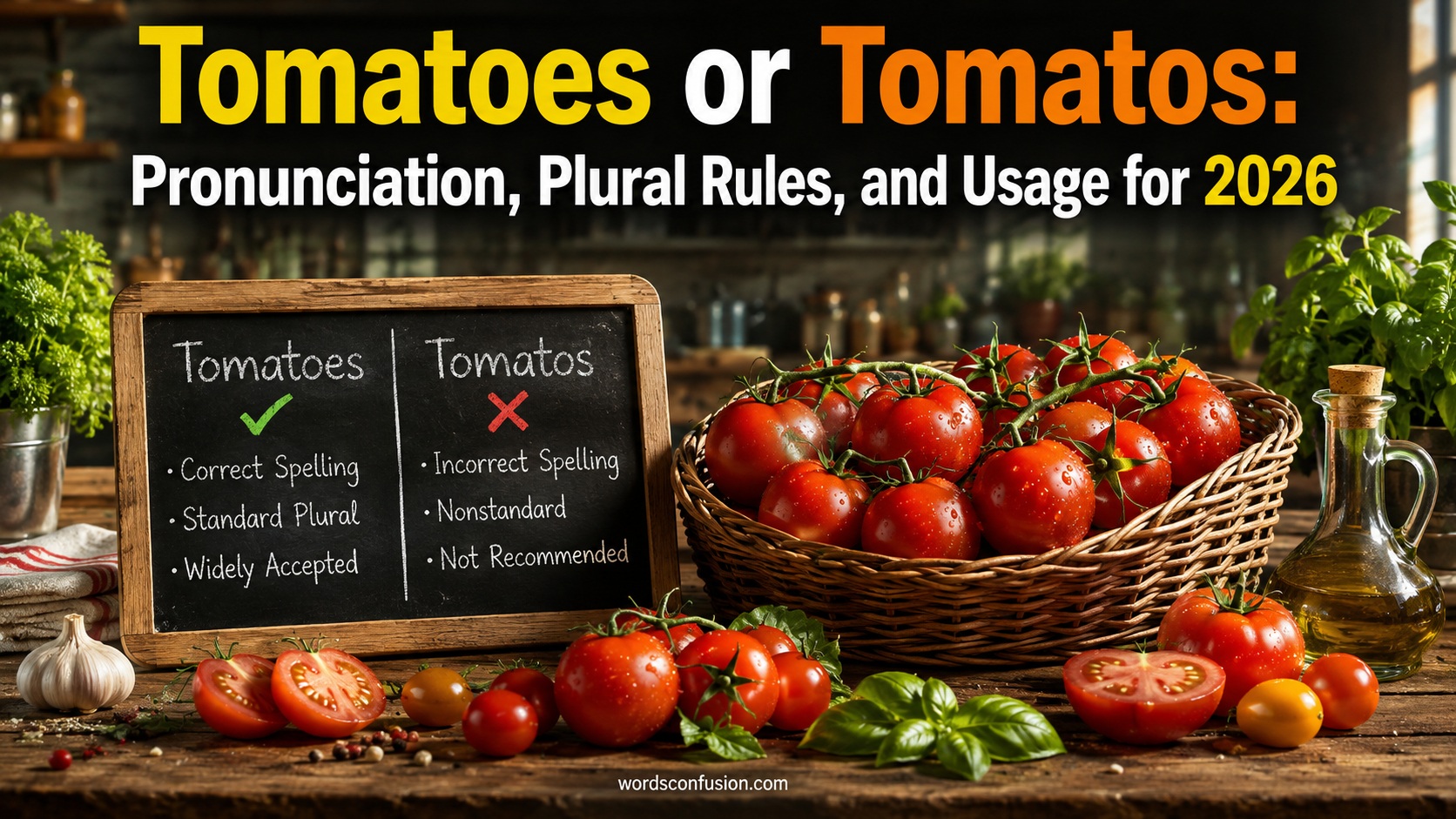
The good news is that the standard spelling is straightforward: tomatoes is correct. Tomatos is a common spelling mistake in standard English.
The confusion comes partly from the way English handles nouns ending in -o. Some words take -es in the plural. Others take only -s. For example, potato becomes potatoes while photo becomes photos. That inconsistency makes tomato easy to second-guess.
Quick Answer
Tomatoes is the correct plural of tomato. Tomatos is not the standard plural spelling.
| Form | Status | Meaning |
| tomato | Correct | One tomato |
| tomatoes | Correct | More than one tomato |
| tomatos | Incorrect | Common spelling mistake |
For example:
- Correct: I bought five tomatoes.
- Incorrect: I bought five tomatos.
- Correct: She sliced one tomato.
- Incorrect: She sliced one tomatoes.
The basic rule is easy to remember:
tomato → tomatoes
The plural adds -es rather than simply adding -s.
Comparison Overview
The biggest difference between tomatoes and tomatos is that only one follows standard English spelling.
| Feature | Tomatoes | Tomatos |
| Correct spelling | Yes | No |
| Singular form | Tomato | — |
| Plural form | Tomatoes | — |
| Standard English | Yes | No |
| Used in formal writing | Yes | No |
| Used in dictionaries as standard plural | Yes | No |
| Typical use | More than one tomato | Spelling error |
The extra e matters. Removing it changes the word into a nonstandard spelling.
If you’re writing an essay, recipe, article, email, school assignment, or professional document, always choose tomatoes.
Main Differences Between Tomatoes and Tomatos
There’s really one central distinction: tomatoes is the correct plural while tomatos is a misspelling.
However, understanding why the correct form looks the way it does can prevent future mistakes.
Tomatoes Is the Standard Plural
The singular noun is tomato.
When you talk about more than one, the standard plural is tomatoes.
Examples include:
- one tomato
- two tomatoes
- several tomatoes
- fresh tomatoes
- ripe tomatoes
- cherry tomatoes
- canned tomatoes
The spelling remains consistent regardless of whether you’re discussing food, gardening, farming, or recipes.
Tomatos Is a Spelling Error
Tomatos may look logical because many English plurals simply add -s.
For instance:
- book → books
- car → cars
- apple → apples
- photo → photos
- video → videos
That pattern can tempt writers to produce tomato → tomatos.
English doesn’t always work that neatly. Some nouns ending in -o use -es. Tomato belongs to that group.
Therefore:
tomato + es = tomatoes
Not:
tomato + s = tomatos
What Does Tomato Mean?
A tomato is the fruit of a tomato plant. People commonly eat it raw or cooked in salads, sauces, soups, sandwiches, stews, and countless other dishes.
The word can refer to the individual fruit itself or to the plant that produces it depending on context.
Consider these examples:
“I picked a tomato from the garden.”
Here, tomato means the individual fruit.
“The tomato is growing rapidly.”
Here, tomato can refer to the plant.
The noun can also appear in food-related expressions:
- tomato sauce
- tomato soup
- tomato paste
- tomato salad
- tomato juice
- tomato plant
- tomato garden
- tomato sandwich
When more than one fruit or plant is involved, tomatoes becomes appropriate.
What Is the Correct Plural of Tomato?
The correct plural is tomatoes.
This spelling follows the established plural form used in standard English.
Tomato → Tomatoes
The transformation looks like this:
Singular: tomato
Plural: tomatoes
The ending changes from -o to -oes.
Examples:
- one tomato → two tomatoes
- one potato → several potatoes
- one hero → several heroes
- one echo → several echoes
This doesn’t mean every English noun ending in -o follows the same pattern. English has several competing plural patterns.
That’s why learning the established form of individual words remains important.
Why Is “Tomatos” Incorrect?
The spelling tomatos incorrectly treats tomato as though it belonged to the group of nouns that form plurals by adding only -s.
That approach works for some words:
- photo → photos
- piano → pianos
- radio → radios
- video → videos
It doesn’t work for tomato.
The accepted spelling adds -es:
tomato → tomatoes
A useful way to think about it is that English plural spelling isn’t a single mathematical formula. Instead, different groups of nouns have developed different conventional patterns over time.
Once you learn the conventional form, the problem becomes much easier.
How to Pronounce Tomato
Pronunciation adds another layer to the tomatoes question because American and British English commonly pronounce tomato differently.
tomato (tuh-MAY-toh)
American English Pronunciation
In American English, tomato is commonly pronounced approximately:
tuh-MAY-toh
The stressed syllable sounds like MAY.
You might hear:
- “tuh-MAY-toh”
The plural tomatoes is commonly pronounced approximately:
tuh-MAY-tohz
The ending has a z sound.
British English Pronunciation
In British English, tomato is commonly pronounced approximately:
tuh-MAH-toh
The stressed vowel differs from the common American pronunciation.
The plural is approximately:
tuh-MAH-tohz
The spelling doesn’t change. Only the pronunciation differs.
How to Pronounce Tomatoes
tomatoes (tuh-MAY-tohz)
The plural tomatoes generally ends with a z sound.
A simple comparison looks like this:
| Word | Common US pronunciation | Common UK pronunciation |
| Tomato | tuh-MAY-toh | tuh-MAH-toh |
| Tomatoes | tuh-MAY-tohz | tuh-MAH-tohz |
Accent can affect the exact sound. Regional varieties may produce slightly different pronunciations.
The important point is that tomatoes is spelled with -es even though the ending doesn’t sound like a clearly separated “ess” syllable.
Tomatoes Pronunciation vs. Tomato Pronunciation
The plural doesn’t simply add another full syllable in the way some learners might expect.
Compare:
tomato
with:
tomatoes
The plural adds the grammatical ending while maintaining the basic pronunciation pattern of the word.
In everyday speech, the ending sounds closer to -tohz.
For example:
- “I want one tomato.”
- “I want three tomatoes.”
The pronunciation changes slightly at the end because the plural ending adds a voiced z sound.
The Plural Rule for Words Ending in -O
The word tomato provides a useful lesson about English pluralization.
Many nouns form plurals by adding -s:
- cat → cats
- table → tables
- book → books
Some nouns ending in -o take -es:
- tomato → tomatoes
- potato → potatoes
- hero → heroes
- echo → echoes
Other nouns ending in -o take -s:
- photo → photos
- piano → pianos
- radio → radios
- video → videos
This means you shouldn’t rely on a rigid rule such as “every word ending in O gets ES.” That’s not accurate.
Read More: Bass or Base: Easy English Tips and Everyday Examples for 2026
Words Ending in -O That Take -ES
Here are several familiar examples:
| Singular | Plural |
| tomato | tomatoes |
| potato | potatoes |
| hero | heroes |
| echo | echoes |
Words Ending in -O That Take -S
Compare those with:
| Singular | Plural |
| photo | photos |
| piano | pianos |
| radio | radios |
| video | videos |
This contrast explains why tomatos can seem reasonable at first glance. English has enough variation to make the wrong form look plausible.
Why English Has Different -O Plural Patterns
English spelling reflects centuries of language development. Vocabulary has entered English from many different linguistic sources. As a result, plural patterns don’t always behave uniformly.
Some nouns ending in -o historically developed or retained -es plurals. Other words became established with -s.
Modern writers don’t need to reconstruct the history every time they spell tomatoes. The practical lesson is simpler:
Learn the conventional plural for each word.
Think of it like learning a road map. Once you know which route the word takes, you don’t need to redesign the roads.
Tomatoes in Singular and Plural Sentences
Understanding the difference becomes much easier when you see the words in context.
Singular Tomato Examples
Use tomato when you’re referring to one item.
- I sliced a tomato for the sandwich.
- That tomato looks perfectly ripe.
- She planted a tomato in the backyard.
- He ate one tomato with his lunch.
- The recipe calls for a large tomato.
The singular form often appears after a, one, or another singular determiner.
Plural Tomatoes Examples
Use tomatoes when you’re talking about two or more.
- I bought six tomatoes at the market.
- The farmer grows organic tomatoes.
- These tomatoes are ready to eat.
- We need three tomatoes for the recipe.
- The garden produced hundreds of tomatoes this season.
The plural form often appears with numbers and plural determiners such as many, several, these, and those.
Tomato vs. Tomatoes in Context
Compare these pairs carefully.
| Singular | Plural |
| I need one tomato. | I need four tomatoes. |
| The tomato is ripe. | The tomatoes are ripe. |
| She planted a tomato. | She planted several tomatoes. |
| He chopped the tomato. | He chopped the tomatoes. |
Notice that the verb can change as well.
The tomato is fresh.
The tomatoes are fresh.
The noun’s number affects the grammar around it.
Tomatoes in Everyday Food Expressions
You’ll encounter tomatoes in many common food-related phrases.
Cherry Tomatoes
Cherry tomatoes are small varieties of tomatoes that are commonly eaten whole or added to salads and cooked dishes.
Example:
“She added cherry tomatoes to the salad.”
Canned Tomatoes
Canned tomatoes are tomatoes preserved and packaged for later use.
Example:
“The soup requires two cans of tomatoes.”
Sun-Dried Tomatoes
Sun-dried tomatoes have been dried to remove much of their moisture.
Example:
“The pasta tastes great with sun-dried tomatoes.”
Fresh Tomatoes
Fresh tomatoes usually refers to tomatoes that haven’t been preserved or processed in the same way as canned products.
Example:
“Fresh tomatoes make the sandwich taste brighter.”
These expressions demonstrate how naturally the plural appears in everyday English.
FAQs:
Is “tomatos” a correct spelling?
No. Tomatos is a common spelling error. The standard plural spelling is tomatoes.
What is the plural of tomato?
The plural of tomato is tomatoes.
Example:
“The farmer harvested 500 tomatoes.”
Why is it tomatoes instead of tomatos?
The established plural of tomato uses -es rather than simply adding -s.
Therefore:
tomato → tomatoes
How do you pronounce tomatoes?
In common American English, tomatoes is approximately pronounced tuh-MAY-tohz. In common British English, it is approximately tuh-MAH-tohz.
Regional accents can produce additional variations.
Is tomato singular or plural?
Tomato is singular.
Tomatoes is plural.
For example:
- one tomato
- two tomatoes
Conclusion:
The tomatoes or tomatos question has a clear answer: tomatoes is the correct standard plural of tomato, while tomatos is a spelling mistake. The extra e may seem small, but it makes the difference between the accepted form and an incorrect one.
Remember the simple pattern: one tomato, two tomatoes. Although English has different plural patterns for words ending in -o, tomato follows the -es pattern, just like potato → potatoes.
Pronunciation can vary between American and British English, but the spelling stays the same. Whether you’re writing a recipe, school assignment, blog post, or everyday message, choose tomatoes whenever you mean more than one tomato.

Andrew Wilson is an experienced language researcher and content writer specializing in WordsConfusion topics. He helps readers understand commonly confused English words, spelling differences, grammar rules, word meanings, and proper usage through clear explanations, practical examples, and easy-to-follow language guides. His goal is to make English learning simple, accurate, and accessible for students, writers, professionals, and everyday learners.