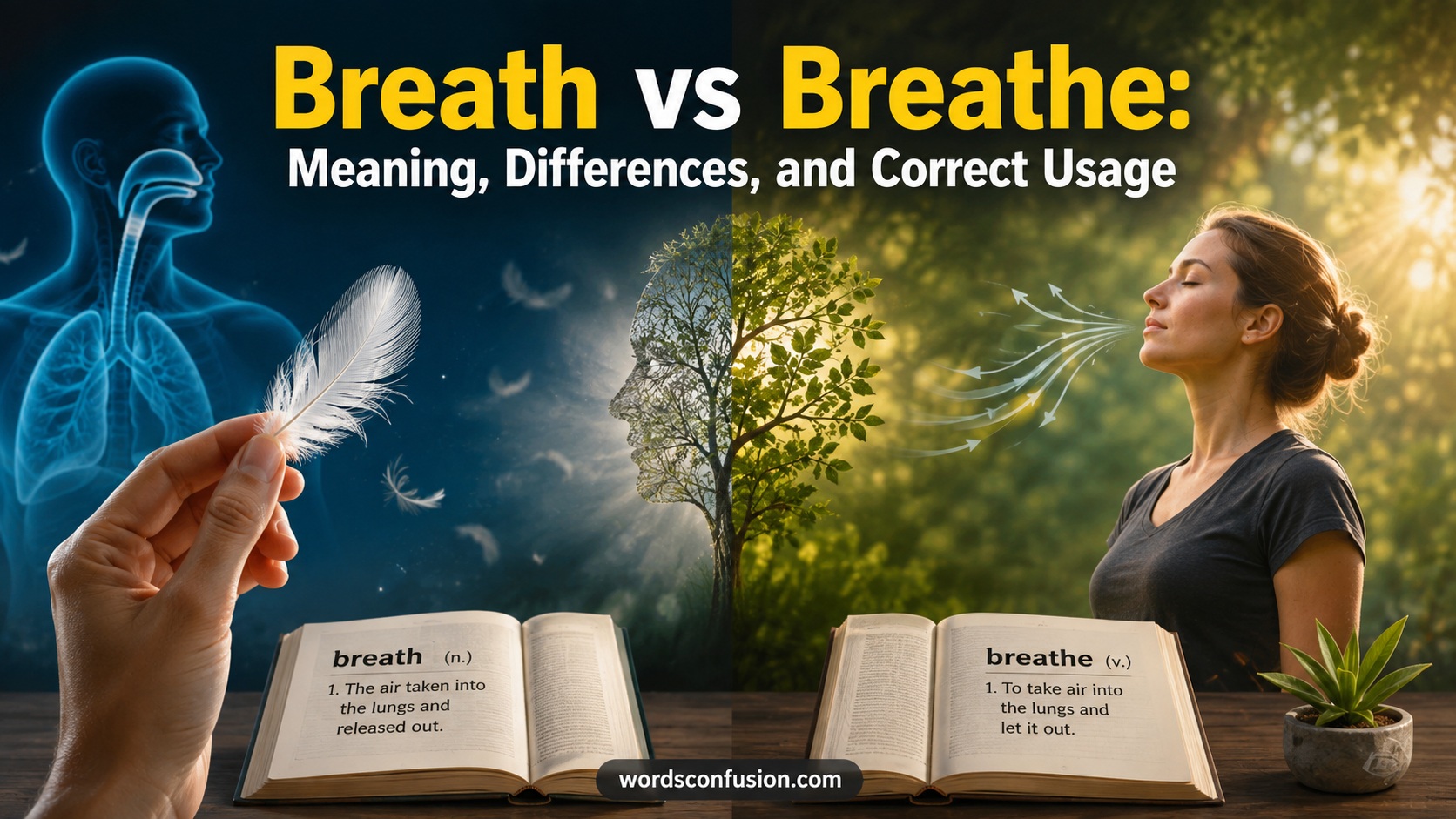
Have you ever paused while writing and wondered whether to use breath or breathe? You’re not alone. These two words look almost identical, yet they serve completely different purposes in English. One is a noun, while the other is a verb. A single silent “e” changes both the pronunciation and the meaning.
Because they sound similar, many English learners and even native speakers mix them up. You might see sentences like “Take a deep breathe” or “I can’t breath.” Although these mistakes are common, they’re easy to avoid once you understand how each word works.
In this guide, you’ll learn the difference between breath vs breathe, how to pronounce them correctly, when to use each one, and practical memory tricks that make the distinction easy to remember. You’ll also find plenty of real-world examples, grammar tips, and common expressions that will help you use both words with confidence.
Quick Answer
The difference between breath and breathe is simple:
- Breath is a noun. It refers to the air you inhale and exhale.
- Breathe is a verb. It means to inhale and exhale air.
| Word | Part of Speech | Meaning | Example |
| Breath | Noun | The air taken into or expelled from the lungs | Take a deep breath before speaking. |
| Breathe | Verb | To inhale and exhale air | Try to breathe slowly during meditation. |
A simple way to remember the difference is this:
- You take a breath.
- You breathe every day.
Comparison Overview
Before diving deeper, here’s a quick comparison of breath vs breathe.
| Feature | Breath | Breathe |
| Part of Speech | Noun | Verb |
| Meaning | Air moving into or out of the lungs | The action of taking air into and out of the lungs |
| Pronunciation | Breth (/brɛθ/) | Breedh (/briːð/) |
| Describes | A thing | An action |
| Common Usage | Take a breath | Breathe deeply |
| Example | She took a deep breath. | She couldn’t breathe. |
Although only one letter separates these words, their grammar, pronunciation, and usage are entirely different.
Main Differences Between Breath vs Breathe
Understanding the main differences helps you choose the correct word every time.
Breath Is a Noun
A breath is something you have or take. It refers to the air that enters or leaves your lungs.
Examples:
- Take a deep breath before diving.
- His breath smelled like mint.
- She held her breath during the movie.
Whenever you’re talking about the air itself or a single inhalation or exhalation, use breath.
Breathe Is a Verb
Breathe describes the action of taking air into and out of your lungs.
Examples:
- Please breathe slowly.
- It’s difficult to breathe at high altitudes.
- Remember to breathe while exercising.
If the sentence describes an action, the correct word is breathe.
The Silent “E” Changes Everything
Many English words become verbs after adding an e at the end.
Notice the pattern:
| Noun | Verb |
| Bath | Bathe |
| Breath | Breathe |
| Cloth | Clothe |
This pattern explains why breath becomes breathe.
Breath vs Breathe: What’s the Difference?
Although these words share the same root, they play different roles in English grammar.
Think about this sentence:
Take a deep breath before you breathe underwater with scuba equipment.
Both words appear together, but each has a unique job.
- Breath names something.
- Breathe describes what someone does.
Once you recognize whether your sentence needs a noun or a verb, choosing the correct word becomes much easier.
What Does Breath Mean?
Breath is a noun that refers to the air moving into or out of the lungs. It can also describe a single act of breathing or someone’s breathing itself.
Pronunciation
Breath is pronounced:
/brɛθ/
It rhymes with:
- death
- meth
- Beth
The ending sounds like “th” in think.
When to Use Breath
Use breath when talking about:
- Air from the lungs
- A single inhalation
- Breathing capacity
- Smell from someone’s mouth
- A short pause
Examples:
- I needed a moment to catch my breath.
- His breath formed tiny clouds in the cold air.
- One deep breath helped calm her nerves.
- The runner was completely out of breath.
What Does Breathe Mean?
Breathe is a verb. It means to inhale oxygen and exhale carbon dioxide.
Without breathing, the human body cannot survive.
Pronunciation
Breathe is pronounced:
/briːð/
It rhymes with:
- seethe
- teethe
- wreathe
The ending sounds like “th” in this.
When to Use Breathe
Use breathe whenever you’re describing the action.
Examples:
- Try to breathe through your nose.
- Patients should breathe slowly during the test.
- Fresh mountain air helps people breathe more comfortably.
- Stop running for a minute and breathe.
Pronunciation Difference Between Breath and Breathe
Many learners understand the grammar but still pronounce these words incorrectly.
Here’s the difference.
| Word | IPA | Ending Sound |
| Breath | /brɛθ/ | Unvoiced th as in think |
| Breathe | /briːð/ | Voiced th as in this |
A Simple Trick
Say these aloud:
- Think → Breath
- This → Breathe
Matching the ending sounds helps you pronounce both words naturally.
Grammar Rules You Should Know
Grammar provides the easiest way to tell these words apart.
Use Breath After Articles
If the word follows a, an, the, my, your, his, her, or their, it’s almost always breath because these words introduce nouns.
Examples:
- Take a breath.
- His breath was visible.
- Your breath smells fresh.
Use Breathe After Subjects
If the sentence needs an action, choose breathe.
Examples:
- I breathe through my nose.
- Birds breathe with lungs.
- Babies breathe naturally.
Use Breath After Adjectives
Examples:
- Deep breath
- Fresh breath
- Bad breath
- Slow breath
Adjectives describe nouns, so they pair with breath.
Use Breathe After Helping Verbs
Examples:
- Can breathe
- Should breathe
- Must breathe
- Will breathe
- Might breathe
Helping verbs are followed by the base form of a verb, making breathe the correct choice.
Memory Tricks That Actually Work
Instead of memorizing grammar rules, try these practical tricks.
Remember: Breath Is Something You Have
You can take, hold, lose, or catch your breath.
If you can put a, the, or my before the word, choose breath.
Examples:
- A breath
- My breath
- The breath
Remember: Breathe Is Something You Do
Actions require verbs.
You breathe while sleeping.
You breathe while running.
You breathe every second of your life.
The Silent “E” Means Action
The extra e turns the noun into a verb.
Think about these pairs:
- Bath → Bathe
- Cloth → Clothe
- Breath → Breathe
The pattern stays the same, making it easier to remember.
Examples of Breath in Sentences
Reading examples helps you recognize natural usage.
Everyday Conversation
- Take a deep breath before answering.
- I finally caught my breath after climbing the stairs.
- His breath fogged the window.
- She held her breath while waiting for the results.
Sports and Fitness
- The swimmer controlled every breath.
- Marathon runners conserve each breath.
- One deep breath can improve focus before a race.
Medical Context
- The doctor listened to her breath sounds.
- Shortness of breath may require medical attention.
- Bad breath sometimes signals an underlying dental problem.
Writing and Literature
- The room became silent except for his steady breath.
- She released a long breath of relief.
- Every breath reminded him how close he had come to danger.
Examples of Breathe in Sentences
Everyday Conversation
- Don’t forget to breathe.
- I couldn’t breathe because of the smoke.
- Please breathe slowly and stay calm.
- Open the window so we can breathe fresh air.
Examples of Breathe in Sentences
Health and Wellness
Controlled breathing plays an important role in both physical and mental health. Doctors, therapists, and fitness trainers often recommend breathing exercises because they help reduce stress and improve oxygen flow.
Examples:
- Try to breathe deeply when you feel anxious.
- Patients should breathe normally during the examination.
- Learning to breathe correctly can improve your posture.
- People with asthma may find it harder to breathe during an attack.
Exercise and Sports
Proper breathing helps your body perform better. Whether you’re lifting weights, running a marathon, or practicing yoga, your breathing technique matters.
Examples:
- Remember to breathe steadily while lifting weights.
- Cyclists must breathe rhythmically during long rides.
- Swimmers learn how to breathe without losing speed.
- Professional athletes practice how to breathe efficiently under pressure.
Meditation and Yoga
Breathing exercises form the foundation of many meditation techniques. A slow, controlled breath helps calm both the body and the mind.
Examples:
- Sit comfortably and breathe through your nose.
- Close your eyes and breathe in for four seconds.
- Yoga instructors teach students to breathe with every movement.
- Deep breathing helps you breathe more naturally under stress.
Emergency Situations
Breathing becomes especially important during emergencies.
Examples:
- The paramedic checked whether the patient could breathe.
- Remove the object that’s blocking the airway so the person can breathe.
- Firefighters wear oxygen masks so they can breathe safely.
- If someone stops breathing, seek emergency medical help immediately.
Read More: Beside vs Besides: Meaning, Differences, and Examples
Common Phrases and Idioms with Breath
English contains many everyday expressions that use breath. Understanding them makes your speaking and writing sound more natural.
Take a Deep Breath
Meaning: Calm yourself before doing something difficult.
Example:
Take a deep breath before your interview.
Catch Your Breath
Meaning: Rest after physical activity.
Example:
We stopped halfway up the hill to catch our breath.
Hold Your Breath
Meaning: Stop breathing for a short time or wait anxiously for something.
Examples:
- Hold your breath while swimming underwater.
- I held my breath until the winner was announced.
Out of Breath
Meaning: Breathing heavily after physical effort.
Example:
He was completely out of breath after running five miles.
Under Your Breath
Meaning: Speak very quietly so others cannot hear.
Example:
She apologized under her breath.
Save Your Breath
Meaning: Stop trying to persuade someone because it won’t work.
Example:
Save your breath. He’s already made his decision.
Waste Your Breath
Meaning: Spend time saying something that has no effect.
Example:
Don’t waste your breath arguing with someone who refuses to listen.
Breath of Fresh Air
Meaning: Someone or something refreshing and different.
Example:
The new manager has been a real breath of fresh air.
FAQs:
Is breath a noun or a verb?
Breath is always a noun. It refers to the air you inhale and exhale or a single act of breathing.
Example:
- Take a deep breath before diving into the pool.
Is breathe always a verb?
Yes. Breathe is always a verb. It describes the action of taking air into and out of your lungs.
Examples:
- Remember to breathe slowly during meditation.
- It’s easier to breathe after the rain.
How can I easily remember the difference between breath and breathe?
A simple memory trick is to focus on the extra “e” in breathe.
- Breath = Noun (something you have or take)
- Breathe = Verb (something you do)
Think of these examples:
- Take a breath.
- Breathe deeply.
If you’re describing an action, use breathe. If you’re naming a thing, use breath.
What is the plural of breath?
The plural form of breath is breaths.
Examples:
- The doctor counted her breaths per minute.
- After climbing the hill, he took several deep breaths.
The word breathe does not have a plural because it is a verb.
Why do people confuse breath and breathe?
People often confuse these words because they:
- Differ by only one letter.
- Have similar pronunciation.
- Share the same root word.
- Both relate to breathing.
The easiest way to avoid mistakes is to identify whether your sentence needs a noun or a verb before choosing the word.
Conclusion:
Although breath and breathe look similar, they have different meanings, pronunciations, and grammatical roles. Breath is a noun that refers to the air you inhale and exhale or a single inhalation or exhalation. Breathe is a verb that describes the action of taking air into and out of your lungs.
A quick grammar check can prevent most mistakes. If the sentence names a thing, choose breath. If it describes an action, choose breathe. You can also remember that the extra “e” in breathe signals an action, much like bath → bathe and cloth → clothe.
With the pronunciation tips, grammar rules, memory tricks, and real-world examples covered in this guide, you’ll be able to use breath and breathe confidently in everyday conversations, academic writing, and professional communication. The more you practice, the more natural the correct choice will become.

Andrew Wilson is an experienced language researcher and content writer specializing in WordsConfusion topics. He helps readers understand commonly confused English words, spelling differences, grammar rules, word meanings, and proper usage through clear explanations, practical examples, and easy-to-follow language guides. His goal is to make English learning simple, accurate, and accessible for students, writers, professionals, and everyday learners.