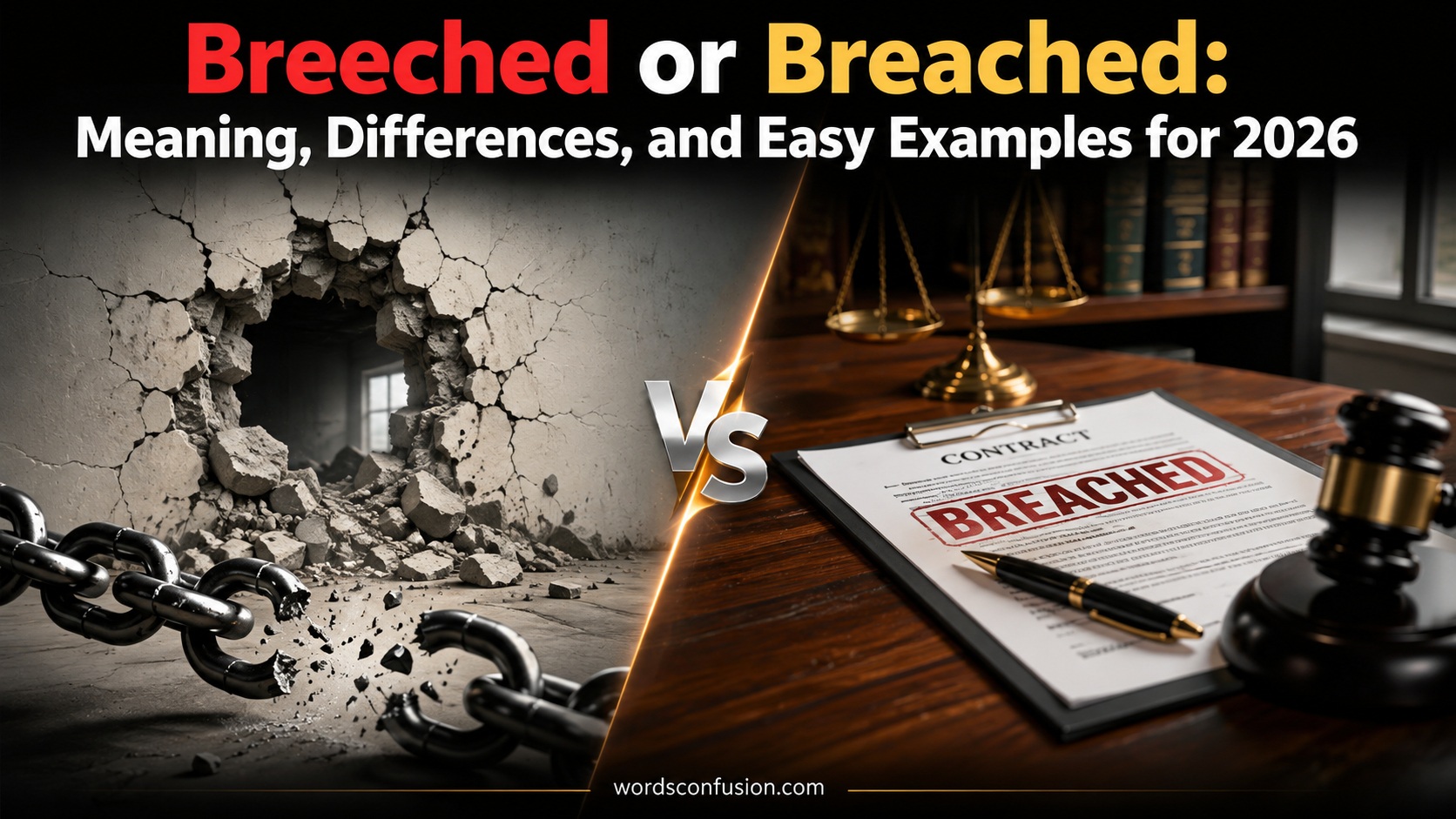
Have you ever typed “breeched” when you meant “breached”? You’re not alone. These two words sound almost identical, which makes them easy to mix up in writing. Yet their meanings are quite different.
The confusion usually appears in sentences about contracts, security, rules, privacy, walls, or agreements. In those situations, breached is almost always the word you need. Breeched is a real word too, but it comes from the different word breech and has much narrower uses.
The difference becomes simple once you connect each word with its root meaning. Breach relates to breaking, violating, or creating an opening. Breech relates to the rear part of something, clothing called breeches, and several specialized uses.
This guide explains breeched vs. breached in detail, with clear definitions, examples, common mistakes, memory tricks, and practical sentence patterns.
Quick Answer
Breached is correct when you mean violated, broke, broke through, or created an opening. For example, “The company breached the contract” means the company violated the contract.
Breeched is the past tense of breech. It has specialized meanings connected with breeches, the rear part of something, or certain firearm terminology.
The easiest way to remember the difference is:
- Breached = broke or violated something
- Breeched = related to breech, such as breeches or a specialized rear-part meaning
So, if you’re writing about a contract, agreement, law, privacy, security system, wall, barrier, or rule, use breached.
Comparison Overview
The two words differ by only one letter, but that small difference changes the meaning completely.
| Word | Base Word | Main Meaning | Commonness | Example |
| Breached | Breach | Violated, broke, or broke through | Very common | The company breached the agreement. |
| Breeched | Breech | Used in specialized meanings related to breech | Uncommon | The child was breeched in traditional clothing. |
Another useful comparison involves their nouns:
| Noun | Meaning | Example |
| Breach | A violation, break, gap, or opening | The leak resulted from a security breach. |
| Breech | Rear part, especially of a firearm; also related to breeches | The gun was loaded through the breech. |
The spelling breached contains the vowel pattern from breach, while breeched follows breech. Because both words sound alike, pronunciation won’t help you choose the spelling.
Meaning does the job.
Main Differences Between Breeched and Breached
The biggest difference comes from their base words. Breached comes from breach, while breeched comes from breech.
Breached Means Broken, Violated, or Broken Through
When something has been breached, someone or something has broken through it or violated it.
For example:
The company breached the terms of the contract.
Here, breached means violated.
The same idea works in many situations:
- breached a contract
- breached an agreement
- breached a law
- breached someone’s trust
- breached security
- breached a barrier
- breached a wall
- breached a defense
The exact meaning depends on the object following the verb.
Breeched Has a Much Narrower Meaning
Breeched comes from breech, not breach. The word appears mainly in specialized or historical contexts.
For instance, breech can relate to the rear part of a firearm. It can also refer to clothing called breeches.
That means you shouldn’t treat breeched as a fancy spelling of breached.
They aren’t interchangeable.
The Fastest Way to Choose
Ask yourself one question:
Does the sentence mean “broken,” “violated,” or “broken through”?
If yes, choose breached.
If the sentence refers to a meaning associated with breech, choose breeched.
That simple test will solve most spelling decisions immediately.
What Does “Breached” Mean?
Breached is the past tense and past participle of breach.
The verb breach has several related meanings. Although these meanings look different at first, they share the central idea of breaking through a boundary or violating something that should remain intact.
Breached as “Violated”
One of the most common meanings involves rules, agreements, duties, or promises.
The tenant breached the rental agreement.
The tenant violated a condition of the agreement.
Similarly:
He breached the terms of the contract.
The company breached its agreement with the supplier.
She breached the confidentiality clause.
In these examples, something wasn’t physically broken. Instead, a rule or obligation was violated.
Breached in Contract Law
Legal and business writing uses breached frequently.
A contract creates obligations between parties. When one party fails to meet an important contractual obligation, that party may have breached the contract.
For example:
The contractor breached the contract by failing to complete the work within the agreed period.
Notice that breeched would be incorrect here.
A useful pattern is:
breach + contract/agreement/terms/duty/obligation
Examples include:
- The seller breached the contract.
- The employee breached the agreement.
- The company breached its obligations.
- The supplier breached the terms of the deal.
Breached Someone’s Trust
Breached also works with trust.
He breached her trust by sharing private information.
The meaning here is similar to violating a promise or obligation. Trust creates an expectation of proper behavior. Breaking that expectation can constitute a breach.
Other examples include:
The disclosure breached the patient’s trust.
She felt that her friend had breached her confidence.
Breached in Security and Privacy
Modern technology has made breached especially common in cybersecurity.
When unauthorized people gain access to protected information or systems, writers often describe the system or security as breached.
Examples:
Hackers breached the company’s network.
The attackers breached the organization’s security defenses.
Investigators discovered that customer data had been exposed after the system was breached.
The related noun breach appears constantly in cybersecurity:
- data breach
- security breach
- privacy breach
- network breach
- breach of confidential information
Don’t write “data breeched.”
The correct form is:
data breached
or, more naturally in many contexts:
a data breach occurred
Breached as “Broken Through”
The word can also describe physically breaking through something.
The floodwater breached the riverbank.
Here, the water broke through the bank.
You can use the same idea with:
- walls
- barriers
- defenses
- dams
- levees
- boundaries
For example:
The soldiers breached the defensive wall.
The storm breached the coastal barrier.
Rising water breached the dam.
In each sentence, something that previously blocked movement was broken through.
Breached When Talking About Whales
There’s another legitimate use that sometimes surprises readers.
A whale can breach when it leaps out of the water.
For example:
The humpback whale breached beside the boat.
This meaning has nothing to do with contracts or cybersecurity. It describes the whale’s movement through the water.
Still, the spelling remains breached, not breeched.
What Does “Breeched” Mean?
Breeched is a real English word. The problem is that writers often use it where breached belongs.
The word comes from breech, which has several specific meanings.
Breeched as the Past Tense of “Breech”
Breeched is the past tense and past participle of the verb breech.
Unlike breach, this verb has specialized meanings.
Its usage can relate to breeches, the rear part of a firearm, or other technical meanings derived from breech.
Because these meanings don’t usually appear in everyday sentences, breeched is far less common than breached.
Breeched and Clothing
Historically, breeches referred to a type of clothing covering the body from the waist to the knees or below.
The word appears especially often in historical descriptions of clothing.
For example:
The young boy was breeched according to the customs of the period.
In this context, breeched relates to dressing someone in breeches.
This usage is uncommon in modern everyday American English. Most people today don’t regularly use breeched to describe ordinary clothing.
Breeched in Firearm Terminology
Breech also has an important technical meaning in firearms.
The breech is the rear portion of a firearm’s barrel or the part associated with the chamber and loading mechanism, depending on the firearm and context.
This gives rise to specialized terminology such as:
- breech mechanism
- breech-loading firearm
- breech block
- breech end
The related verb breech can appear in technical descriptions involving firearm construction or modification.
Because this terminology belongs to a specialized field, general readers are much more likely to encounter breached than breeched.
Breech vs. Breach: Understanding the Base Words
Learning the nouns makes the past-tense forms much easier.
What Does “Breach” Mean?
Breach can function as both a noun and a verb.
As a noun, it can mean:
- a violation of a rule or agreement
- a gap in a wall or defense
- a break in security
- an opening created in something
Examples:
The incident was a serious breach of trust.
Engineers repaired the breach in the dam.
The company reported a security breach.
As a verb, breach means to violate or break through something.
Its past tense is:
breached
What Does “Breech” Mean?
Breech also works as a noun and verb, but its meanings are different.
It can refer to:
- the rear part of a firearm
- the buttocks or rear part of the body in certain contexts
- a baby’s position when the buttocks or feet present first during birth
- clothing associated with breeches
These meanings may look unrelated, but they share the basic idea of the rear or lower part.
Its past tense is:
breeched
That gives you a clean word family:
breach → breached
breech → breeched
Read More: Spicey or Spicy: How to Spell It Right Every Time in 2026
Why Do Breeched and Breached Sound the Same?
The two words are homophones in standard English. That means they have the same pronunciation but different spellings and meanings.
English contains many homophones that cause similar problems.
For example:
- there / their / they’re
- to / too / two
- brake / break
- principal / principle
- complement / compliment
Breach and breech belong to the same general category.
When speaking, you may not notice which word someone means. In writing, however, the spelling carries the meaning.
That’s why context matters.
If someone says:
“The security was breeched.”
You may understand the intended meaning immediately. But the standard spelling is:
“The security was breached.”
Breached vs. Breeched Examples
The easiest way to master the difference is to see the words working in real sentences.
Examples of “Breached”
The company breached its contract with the supplier.
Hackers breached the organization’s network.
The soldiers breached the outer wall.
Heavy rain breached the riverbank.
She breached his confidence by revealing the secret.
The employee breached the company’s confidentiality policy.
The whale breached near the surface.
The defendant was accused of breaching the agreement.
Every example uses breached because something was violated or broken through.
Examples of “Breeched”
The child was breeched in traditional historical clothing.
The firearm was designed with a specialized breech mechanism.
The technical manual described how the breeched weapon functioned.
These uses are specialized. They don’t mean violated or broken through.
Common Mistakes With Breeched and Breached
Because the words sound alike, the mistakes usually happen when someone writes from pronunciation rather than meaning.
“Breeched a Contract” vs. “Breached a Contract”
Incorrect:
The company breeched the contract.
Correct:
The company breached the contract.
A contract can be breached because a party violates its terms.
“Breeched Security” vs. “Breached Security”
Incorrect:
Hackers breeched the company’s security.
Correct:
Hackers breached the company’s security.
Cybersecurity uses breach and breached.
“Breeched the Agreement” vs. “Breached the Agreement”
Incorrect:
She breeched the agreement.
Correct:
She breached the agreement.
An agreement creates obligations. Violating those obligations constitutes a breach.
“Breeched the Wall” vs. “Breached the Wall”
Incorrect:
The troops breeched the wall.
Correct:
The troops breached the wall.
The troops broke through the wall, so breached is the correct choice.
Common Phrases With “Breached”
Certain combinations appear so frequently that they’re worth learning as complete phrases.
| Phrase | Meaning | Example |
| Breached a contract | Violated a contract | The company breached a contract. |
| Breached an agreement | Violated an agreement | The seller breached the agreement. |
| Breached security | Defeated security protections | Attackers breached security. |
| Breached someone’s trust | Violated someone’s trust | He breached her trust. |
| Breached confidentiality | Violated confidentiality | The disclosure breached confidentiality. |
| Breached a barrier | Broke through a barrier | Floodwater breached the barrier. |
| Breached a wall | Broke through a wall | The troops breached the wall. |
| Breached the dam | Broke through the dam | The water breached the dam. |
These combinations are excellent clues. If you see words such as contract, security, agreement, trust, confidentiality, wall, barrier, or dam, breached will usually be the correct choice.
A Practical Case Study: Choosing the Right Word
Imagine you’re writing this sentence:
The hackers ___ the company’s database.
You hear the word in your head and wonder whether it should be breeched or breached.
Start with the meaning.
Did the hackers dress someone in breeches? No.
Did they work with the rear section of a firearm? No.
Did they break through a security boundary? Yes.
Therefore:
The hackers breached the company’s database.
Now consider a different sentence:
The museum displayed a historical firearm with an unusual ___ mechanism.
Here, you’re talking about the rear/loading mechanism of a firearm.
The correct word is:
The museum displayed a historical firearm with an unusual breech mechanism.
The context solves the spelling problem.
FAQs:
Is “breeched” a correct word?
Yes. Breeched is a legitimate word. It’s the past tense of breech, but its uses are much more specialized than those of breached.
Is it “breeched” or “breached” a contract?
The correct phrase is “breached a contract.”
A contract is breached when someone violates its terms or fails to fulfill a relevant contractual obligation.
Is “breeched” the past tense of “breech”?
Yes. Breeched is the past tense and past participle of breech.
Is “breached” the past tense of “breach”?
Yes. Breached is both the past tense and past participle of breach.
For example:
The company breached the agreement.
Are “breeched” and “breached” pronounced the same?
Yes. They are homophones, meaning they share the same pronunciation while having different spellings and meanings.
Conclusion:
The correct word depends entirely on what you mean. Use “breached” when something has been violated, broken, compromised, or broken through. This includes contracts, agreements, laws, trust, security systems, walls, barriers, and other boundaries. Use “breeched” only when the sentence relates to the separate word “breech,” particularly its specialized meanings involving breeches, firearms, or similar terminology.
