Have you ever typed spicey and then paused because it just looked a little strange? You’re not alone. The word spicy creates a surprisingly common spelling trap because the noun spice already ends in e. Adding -y seems like it should produce spicey. Yet standard English takes a different route.
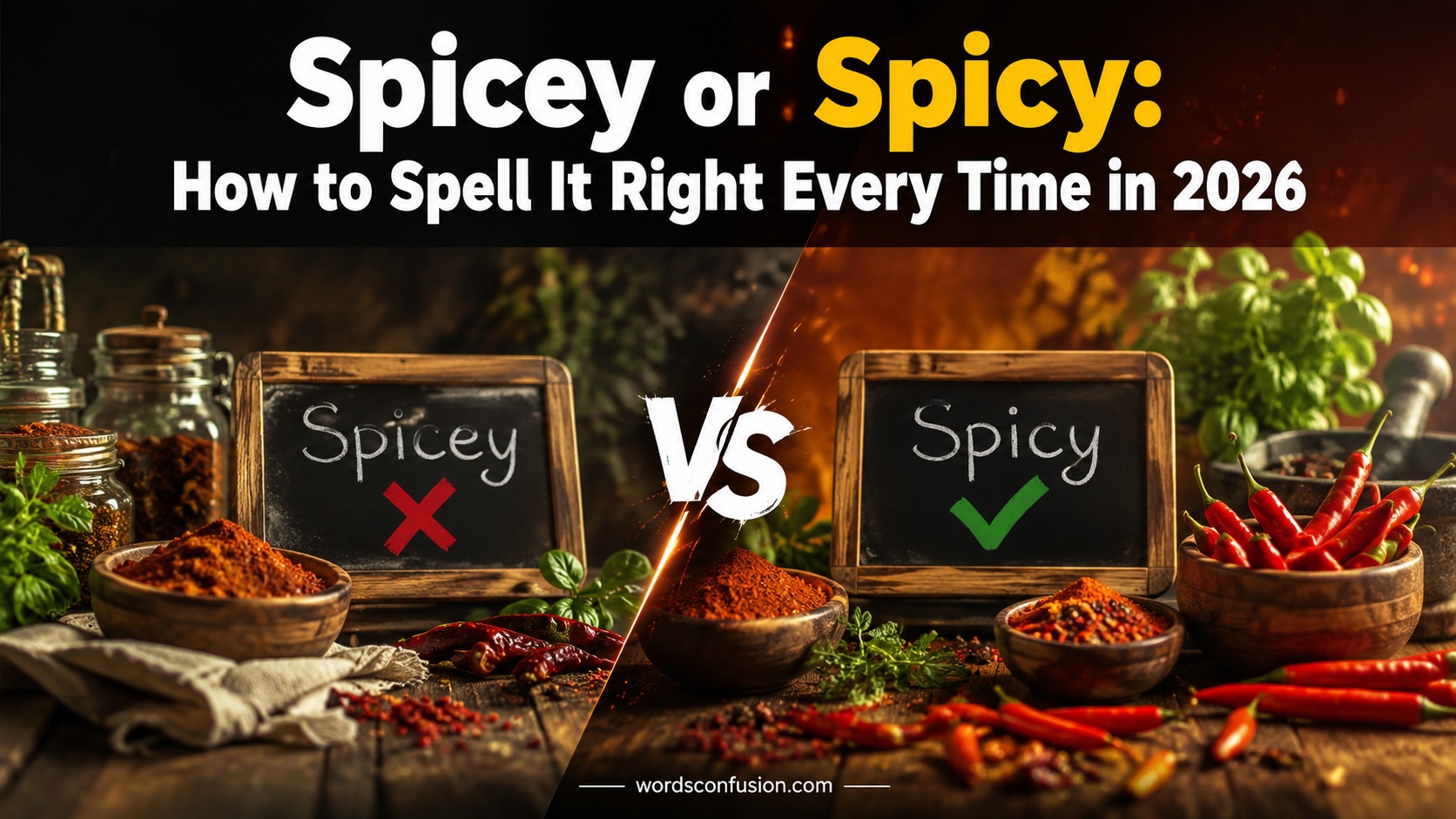
The spelling you should normally use is spicy. It means having the flavor, quality, or characteristic effect of spices, especially a strong or hot flavor in food. For example, you can say, This curry is spicy.
There is one important detail, though. Spicey isn’t simply a made-up word or a spelling that has never existed. It appears as a variant spelling in some dictionaries. That distinction matters if you’re trying to give readers an accurate answer rather than labeling every nonstandard-looking form as an outright mistake.
So, why does English drop the e? When should you use spicy? Is spicey ever acceptable? And how do forms such as spicier, spiciest, and spiciness fit into the picture?
Let’s settle the spicey or spicy question once and for all.
Quick Answer
Spicy is the standard spelling you should use in modern everyday English. Spicey is recorded as a variant spelling, but it isn’t the usual choice for standard writing.
The basic distinction is simple:
- Spicy = standard spelling
- Spicey = recognized variant spelling
- Spice = noun or verb
- Spicier = comparative form
- Spiciest = superlative form
- Spiciness = noun describing the quality of being spicy
For example:
Correct standard usage: This salsa is very spicy.
The easiest spelling rule to remember is:
SPICE → SPICY
Drop the final e before adding -y.
Comparison Overview
The quickest way to understand spicey or spicy is to compare the two forms side by side.
| Feature | Spicy | Spicey |
| Standard modern spelling | Yes | No |
| Recorded in dictionaries | Yes | Yes, as a variant |
| Common in everyday writing | Yes | Much less common |
| Appropriate for school writing | Yes | Usually avoid |
| Appropriate for professional writing | Yes | Usually avoid |
| Meaning | Having the flavor or quality of spice | Variant form of spicy |
| Comparative form | Spicier | Not normally used |
| Superlative form | Spiciest | Not normally used |
| Noun form | Spiciness | — |
| Recommended choice | Yes | Generally no |
The key point is that spicy is the form you’ll want in nearly every ordinary writing situation.
If you’re writing an essay, recipe, blog post, email, menu, product description, or social media caption, spicy is the safer and more familiar choice.
Main Differences Between Spicey or Spicy
The biggest difference isn’t meaning. Both forms point readers toward the same adjective. The real difference is standard usage and spelling preference.
Spicy Is the Standard Spelling
Spicy is the normal spelling used in contemporary English.
It works as an adjective that describes something containing spices or having a strong, pungent, or hot flavor.
Examples include:
- The chicken wings are spicy.
- She ordered a spicy curry.
- I prefer spicy salsa.
- That sauce has a spicy kick.
- This soup isn’t spicy enough for me.
When you’re unsure which spelling to choose, use spicy.
Spicey Is a Variant Spelling
Spicey has appeared as a spelling variant of spicy. That means calling it completely nonexistent would be inaccurate.
However, dictionary recognition doesn’t automatically make two spellings equally common or equally suitable for every context.
Think of it like two roads leading to the same destination. One is the established main route. The other exists, but most drivers have little reason to take it.
For standard modern writing, spicy is the established route.
The Difference Is Mainly Orthographic
The meaning doesn’t suddenly change because someone writes spicey instead of spicy. The spelling is what changes.
Compare:
- spicy food
- spicey food
Most readers will understand both. However, the first version follows the standard spelling you’ll see in contemporary dictionaries and ordinary edited writing.
That’s why spicy should be your default.
Why Is Spicy Spelled Without the E?
This is where the confusion really begins.
The noun spice ends with the letter e. If you simply attach y, you might naturally expect:
spice + y = spicey
But English doesn’t form the standard adjective that way.
Instead, the final e disappears:
spice → spic + y → spicy
That gives us the familiar spelling spicy.
The Simple Spelling Pattern
The useful pattern is:
spice + y → spicy
Not:
spice + y → spicey
The final e isn’t needed before the y in the standard spelling.
This type of spelling change can feel odd because English doesn’t always follow perfectly predictable rules. Still, once you learn the established form, the pattern becomes easy to remember.
Think of Spice and Spicy as a Word Family
The easiest way to remember the spelling is to connect related words:
- spice
- spicy
- spicier
- spiciest
- spiciness
Notice what happens after spice. The related adjective becomes spicy, not spicey.
That word family gives you a useful mental shortcut.
What Does Spicy Mean?
Spicy is an adjective with several related meanings.
Its most familiar meaning describes food with a strong taste produced by spices or ingredients that create a hot sensation.
For example:
The restaurant serves incredibly spicy noodles.
The word can also describe something with a strong, lively, provocative, or exciting quality when used figuratively.
Spicy Meaning in Food
When people talk about food, spicy can refer to strong flavors or a noticeable burning sensation.
Common examples include:
- chili peppers
- hot sauces
- spicy curries
- pepper-heavy dishes
- seasoned noodles
- spicy salsa
- chili-based soups
Consider these examples:
The curry is spicy, but the rice is mild.
Add less chili if you don’t want the soup to be too spicy.
This salsa has a surprisingly spicy finish.
The exact sensation can vary considerably. A dish may have bold spice flavors without being extremely hot.
Spicy Doesn’t Always Mean Extremely Hot
This distinction is worth remembering.
People often use spicy and hot interchangeably when discussing food. However, the two words don’t always communicate exactly the same idea.
A dish can taste strongly seasoned and spicy without producing an intense burning sensation.
For example:
The curry is flavorful and spicy, but it isn’t particularly hot.
Here, spicy describes the character of the food, while hot focuses more strongly on the heat sensation.
Spicy Can Have Figurative Meanings
Food isn’t the only thing that can be spicy.
In informal contexts, the word can describe something lively, provocative, bold, or slightly shocking.
For example:
The debate became spicy after both candidates challenged each other.
You might also see the word used for provocative entertainment, comments, stories, or discussions.
However, this figurative use depends heavily on context. It can sound playful in casual conversation while sounding inappropriate or overly informal in a serious piece of writing.
Examples of Figurative Spicy
- The interview took a spicy turn.
- The comedian made a few spicy comments.
- The discussion became surprisingly spicy.
- The magazine published a spicy story.
These uses rely on the original idea of something having a strong or stimulating quality.
When Should You Use Spicy?
In almost every normal writing situation, spicy is the form to choose.
Use it when you’re writing:
- School assignments
- College papers
- Blog articles
- Recipes
- Menus
- Product descriptions
- Emails
- Business content
- Website copy
- Social media posts
- Everyday messages
For example, if you’re describing a restaurant menu, write:
Spicy Chicken Tacos
rather than:
Spicey Chicken Tacos
The first version looks natural to modern readers and follows standard spelling conventions.
Is Spicey Ever Correct?
This question deserves a careful answer.
Spicey is a recorded spelling variant of spicy. Therefore, it isn’t accurate to say that the sequence of letters has never been used or recognized.
However, there’s an important difference between being a documented variant and being the preferred spelling for ordinary writing.
If you’re writing modern American English, spicy is the practical choice.
Read More: Shiney or Shiny: Stop Making This Spelling Mistake in 2026
Why You May See Spicey
You might encounter spicey in:
- Older texts
- Informal writing
- User-generated content
- Names or titles
- Historical material
- Sources that use variant spellings
- Typographical errors
If you’re quoting an original source, preserving its spelling may be appropriate.
Otherwise, there’s usually no advantage to choosing spicey over spicy.
A Practical Rule
Use spicy unless you’re intentionally reproducing a source that uses spicey.
That rule solves the problem for most writers.
Why Does Spicey Look So Natural?
There’s a good reason people make this mistake.
The word spice is already familiar. When you want to turn it into an adjective, your brain may simply attach -y to the complete word.
That produces:
spice + y = spicey
Visually, it seems logical.
English spelling, however, doesn’t always reward the most obvious combination of letters.
The established adjective is:
spicy
This is one of those cases where memorizing the actual word family is more useful than trying to reason from the spelling every time.
A Quick Memory Trick
Remember this sentence:
Spice makes food spicy.
The two words sit naturally together:
spice → spicy
Once you remember that relationship, spicey starts looking unusual instead of natural.
Spicy Pronunciation
Spicy is generally pronounced like:
SPY-see
Its pronunciation doesn’t require a complicated explanation. The word has two syllables:
spi-cy
The first syllable sounds like spy, while the second sounds like see.
So:
spicy = SPY-see
Importantly, the spelling difference between spicy and spicey doesn’t create a separate standard pronunciation that you need to learn.
Spicy, Spicier, and Spiciest
Once you know spicy, the other adjective forms are easy.
Spicy
Use spicy for the basic adjective.
This sauce is spicy.
Spicier
Use spicier when comparing two things.
This salsa is spicier than the one we tried yesterday.
The final y changes to i before -er:
spicy → spicier
Spiciest
Use spiciest when something has the highest degree within a comparison.
That was the spiciest curry on the menu.
Again, the y changes to i:
spicy → spiciest
Word-Form Table
| Word | Function | Example |
| Spice | Noun/verb | Add some spice to the dish. |
| Spicy | Adjective | The sauce is spicy. |
| Spicier | Comparative adjective | This sauce is spicier. |
| Spiciest | Superlative adjective | This is the spiciest dish. |
| Spiciness | Noun | I like the spiciness of the curry. |
This word family also explains why learning spicy correctly helps you avoid several related spelling mistakes.
Spicy vs. Spiced: What’s the Difference?
Another common source of confusion is spicy versus spiced.
They aren’t interchangeable.
Spicy describes a quality or characteristic of something, especially a strong or hot flavor.
Spiced generally means that someone has added spices to something.
Compare these sentences:
The curry is spicy.
The rice was spiced with cinnamon.
The first sentence describes the flavor or character of the curry. The second tells you that spices were added to the rice.
Spicy vs. Spiced Comparison
| Word | Main idea | Example |
| Spicy | Strong, pungent, or hot flavor | The curry is spicy. |
| Spiced | Made or flavored with spices | The rice was spiced with cinnamon. |
A dish can be spiced without being particularly spicy.
For instance, cinnamon-spiced bread can have a warm, sweet flavor rather than a hot chili-like taste.
Spicy vs. Hot: Are They the Same?
Not always.
Hot can describe temperature, but when talking about food, it can also describe a strong burning sensation caused by ingredients such as chili peppers.
Spicy has a broader relationship with spices, seasoning, and strong flavor.
Consider:
The soup is spicy, but it’s not very hot.
This sentence makes sense because the soup can contain bold spices without producing a powerful burning sensation.
A Useful Comparison
| Term | Typical focus | Example |
| Spicy | Strong spice flavor or characteristic | This curry is spicy. |
| Hot | Burning heat or temperature | These peppers are extremely hot. |
| Mild | Low level of spice or heat | I prefer mild salsa. |
Context determines which word works best.
Common Mistakes With Spicey or Spicy
Even simple spelling questions can create recurring errors. Here are the most useful ones to avoid.
Mistake: Writing Spicey in Standard Writing
Incorrect for standard usage:
This chicken is spicey.
Standard choice:
This chicken is spicy.
Mistake: Adding Y Without Removing E
The temptation comes from treating the word as a simple combination:
spice + y = spicey
Instead, remember the established spelling:
spice → spicy
Mistake: Confusing Spicy With Spiciness
These words have different grammatical roles.
Spicy is an adjective.
The sauce is spicy.
Spiciness is a noun.
The spiciness of the sauce surprised me.
You wouldn’t normally write:
The sauce is spiciness.
Likewise, you wouldn’t use spicy when the sentence requires a noun.
Mistake: Using Spicy and Spiced as Synonyms
As explained earlier, spicy describes a quality, while spiced focuses on preparation or seasoning.
The chicken is spicy.
The chicken was spiced with paprika.
Both sentences can be correct, but they communicate different information.
FAQs:
Is spicy or spicey correct?
Spicy is the standard spelling for modern everyday English. Spicey is a documented variant spelling, but it isn’t the usual choice for standard writing.
Is spicey a real word?
Spicey is a recorded variant spelling of spicy. Therefore, it’s more accurate to call it a variant than to claim that it has never existed. For normal modern writing, however, spicy is the preferred form.
Why is spicy spelled without an e?
The standard adjective is formed as spice → spicy, with the final e removed before y is added. That’s why spicy is standard rather than spicey.
How do you spell spicy in American English?
The standard American English spelling is spicy.
The sauce is spicy.
What is the plural of spicy?
Spicy is an adjective, so it doesn’t have a plural form. The noun it modifies can be plural:
spicy peppers
spicy dishes
Conclusion:
When choosing between spicey or spicy, spicy is the standard spelling you should use in modern American English. Although spicey appears as a recognized variant spelling, it isn’t the usual choice for everyday, academic, professional, or online writing.
The spelling becomes easier once you remember the word family: spice → spicy → spicier → spiciest → spiciness. The simple trick is to drop the final “e” from spice before adding “y.”
