
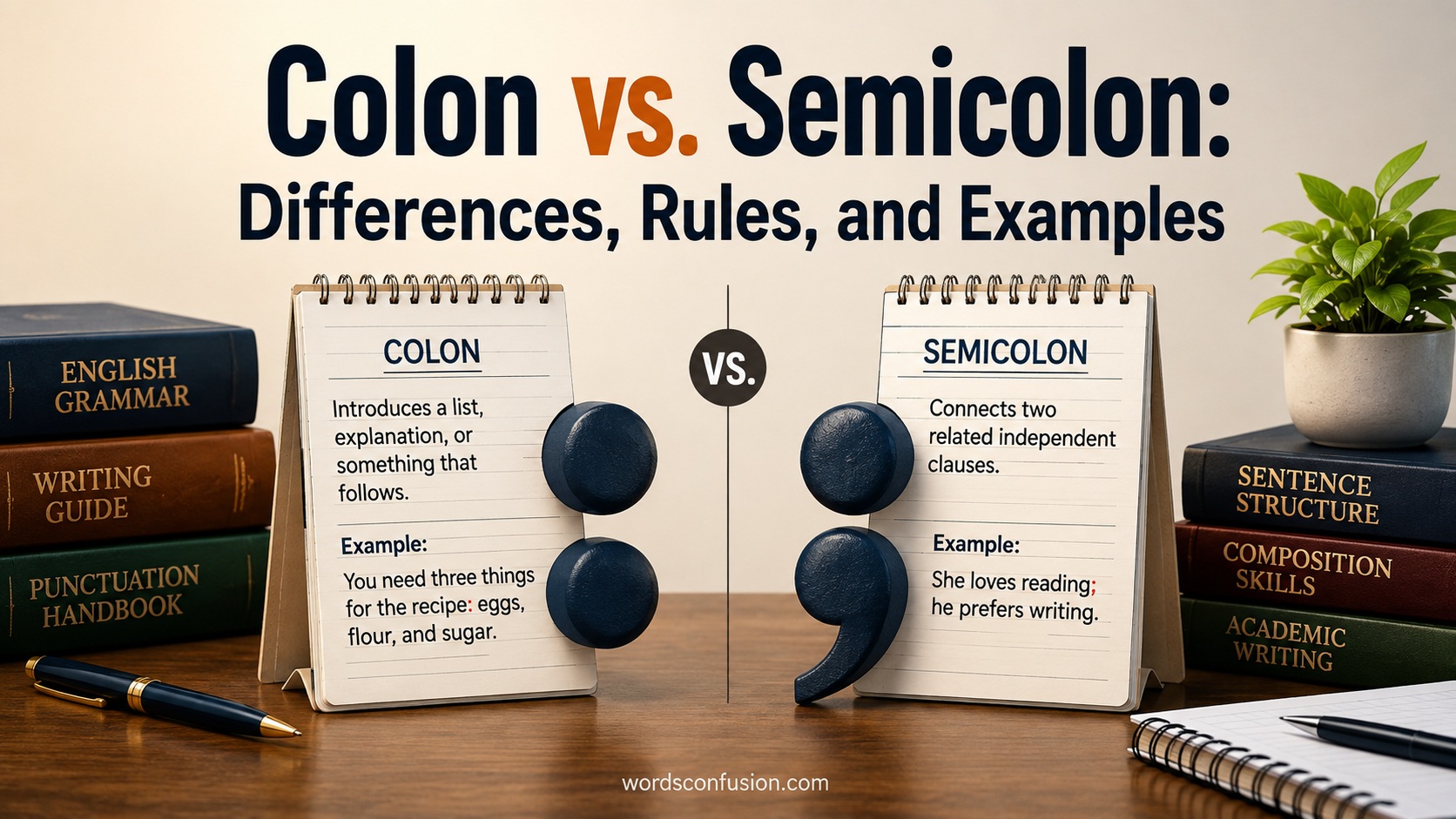
A colon and a semicolon are easy to confuse. They even look like close relatives: one has a dot above a line while the other has a comma-shaped mark below a dot. Yet they perform very different jobs in English writing. The key to mastering colon vs. semicolon is understanding the relationship between the ideas around the punctuation mark.
A colon usually tells the reader that something important is coming next. It can introduce a list, explanation, example, definition, or elaboration. A semicolon, on the other hand, connects closely related independent clauses or separates complicated items in a list.
Consider these two sentences:
- She brought three things: a notebook, a pen, and a laptop.
- She brought her laptop; she needed it for the presentation.
The colon introduces information. The semicolon connects two complete thoughts.
That small difference solves most colon vs. semicolon questions. Once you understand what each punctuation mark is trying to accomplish, choosing between them becomes much easier.
Quick Answer
The simplest way to remember colon vs. semicolon is this: a colon introduces or explains something, while a semicolon connects closely related ideas.
| Punctuation | Main purpose | Example |
| Colon : | Introduces a list, explanation, example, or elaboration | She needed three things: food, water, and shelter. |
| Semicolon ; | Connects closely related independent clauses | She was tired; she continued working. |
| Semicolon ; | Separates complex list items | We visited Austin, Texas; Denver, Colorado; and Miami, Florida. |
Think of a colon as pointing forward.
Colon: “Here comes the explanation.”
Think of a semicolon as keeping two ideas together.
Semicolon: “These two complete thoughts are closely connected.”
If you’re unsure, check the grammar on both sides. A semicolon normally joins two independent clauses. A colon usually introduces what follows by creating an explanatory, illustrative, or introductory relationship.
Comparison Overview
The difference between a colon and semicolon becomes much clearer when you compare their functions directly.
| Feature | Colon | Semicolon |
| Symbol | : | ; |
| Main job | Introduces or expands information | Connects or separates related information |
| Introduces a list | Yes | No |
| Separates complex list items | No | Yes |
| Joins closely related independent clauses | Sometimes, when the second part explains the first | Yes |
| Introduces an explanation | Yes | No |
| Introduces an example | Yes | No |
| Used before however between independent clauses | No | Yes |
| Used for time | Yes | No |
| Used for ratios | Yes | No |
| Can appear in titles and subtitles | Yes | Rarely |
| Can replace a period between related clauses | No | Often |
The most important distinction is grammatical rather than visual.
A colon creates an introductory relationship. The material after it usually gives the reader more information about what came before.
A semicolon creates a connection between ideas that have greater grammatical independence. The clauses on each side can generally stand as complete sentences.
Main Differences Between Colon vs. Semicolon
The biggest difference between colon vs. semicolon comes down to what happens after the punctuation.
A colon often says, “Here is what I mean.”
A semicolon often says, “These two thoughts belong together.”
A Colon Introduces Information
A colon commonly introduces information that explains, identifies, illustrates, or expands on the preceding statement.
For example:
She had one goal: winning the championship.
The phrase after the colon tells you what the goal was.
Another example:
The recipe requires four ingredients: flour, eggs, milk, and butter.
The colon introduces the list.
A Semicolon Connects Complete Thoughts
A semicolon can join two independent clauses that are closely related.
The rain finally stopped; the players returned to the field.
Both parts could stand alone:
- The rain finally stopped.
- The players returned to the field.
The semicolon keeps them together because their meanings are strongly connected.
A Colon Points Forward
The colon creates a sense of expectation.
He had one thing on his mind: the upcoming interview.
The reader naturally expects the words after the colon to identify or explain the “one thing.”
A Semicolon Holds Ideas Together
A semicolon doesn’t normally introduce an explanation or list. Instead, it creates a bridge between two related thoughts.
The interview was tomorrow; he spent the evening preparing.
The two ideas have a direct connection, but neither clause introduces the other as a list or explanation.
What Is a Colon?
A colon (:) is a punctuation mark used to introduce or emphasize information that follows.
You can think of it as a signpost. The writer makes a statement and then uses the colon to tell the reader that the next material will develop that statement.
Use a Colon to Introduce a List
One of the most common uses of a colon is introducing a list.
You need three things for the hike: water, food, and a map.
The part before the colon establishes the category. The material afterward identifies the individual items.
Another example:
The company offers three main services: consulting, training, and technical support.
The colon works because the words after it expand on the information before it.
However, don’t automatically put a colon before every list.
Incorrect:
My favorite fruits are: apples, oranges, and bananas.
Better:
My favorite fruits are apples, oranges, and bananas.
The phrase “My favorite fruits are” already leads directly into the list. The colon isn’t necessary.
Use a Colon to Introduce an Explanation
A colon can introduce an explanation that clarifies the preceding statement.
There was only one problem: nobody had the key.
The second part explains the problem.
Another example:
She couldn’t attend the meeting: her flight had been delayed.
The second clause explains why she couldn’t attend.
Use a Colon to Introduce an Example
A colon can introduce an example when the preceding statement prepares the reader for it.
Some animals are surprisingly fast: the cheetah can reach remarkable speeds.
The second part illustrates the broader point.
A colon can also introduce a specific example after a general statement:
He had developed one bad habit: checking his phone during meetings.
Use a Colon to Introduce an Elaboration
Sometimes the material after the colon doesn’t simply list items. Instead, it develops or amplifies the preceding thought.
The decision was obvious: waiting any longer would only make things worse.
The second part expands on why the decision was obvious.
This use is especially common in persuasive and explanatory writing because the colon creates emphasis without requiring a new sentence.
Use a Colon Before Certain Quotations
A colon can introduce a quotation when the preceding wording forms a suitable introduction.
For example:
The coach offered one simple message: “Stay focused.”
The colon signals that the quotation supplies the message.
The important point is that a colon isn’t required merely because quotation marks follow. The grammatical relationship between the introduction and quotation matters.
Use a Colon in Titles and Subtitles
Colons frequently separate a main title from a descriptive subtitle.
For example:
Grammar Essentials: A Practical Guide to Better Writing
The first part gives the broad subject. The second part explains what the work covers.
This pattern appears frequently in books, articles, reports, presentations, and academic papers.
Other Common Uses of Colons
Colons also appear outside ordinary sentence structures.
Time:
The meeting begins at 9:30.
Ratios:
The mixture uses a 2:1 ratio of water to concentrate.
References and formal formatting:
Colons appear in several specialized systems for citations, addresses, labels, and other structured information.
These uses don’t compete with the semicolon. They’re separate conventions that are easy to recognize once you’ve seen them.
What Is a Semicolon?
A semicolon (;) is a punctuation mark that sits between a comma and a period in strength.
Its most important grammatical function is joining closely related independent clauses without using a coordinating conjunction.
For example:
The store was closing; we needed to hurry.
Both sides are complete thoughts. The semicolon tells the reader that the ideas are connected.
Read More: Drier or Dryer: Meaning, UK vs US Usage, and Examples for 2026
Use a Semicolon Between Related Independent Clauses
An independent clause can stand alone as a complete sentence.
Consider:
The weather improved; the hikers continued their journey.
The first clause is complete:
The weather improved.
The second clause is also complete:
The hikers continued their journey.
Because the ideas are closely related, the writer can join them with a semicolon.
You could also use a period:
The weather improved. The hikers continued their journey.
The meaning remains similar, but the period creates a stronger break.
Use a Semicolon Before “However”
One common semicolon construction involves conjunctive adverbs such as however, therefore, nevertheless, moreover, consequently, and instead.
For example:
The plan looked promising; however, the cost was too high.
The semicolon separates the two independent clauses. The comma after however belongs to the conjunctive adverb construction.
Another example:
The evidence seemed convincing; nevertheless, the jury remained uncertain.
This structure is common in formal and academic writing.
Use Semicolons in Complex Lists
Semicolons can separate list items when those items already contain commas.
Compare a simple list:
We visited Boston, Denver, Miami, and Seattle.
Ordinary commas work perfectly.
Now consider a list containing cities and states:
We visited Boston, Massachusetts; Denver, Colorado; Miami, Florida; and Seattle, Washington.
The internal commas identify the city and state. The semicolons separate the larger items.
Without semicolons, the sentence becomes harder to scan.
Semicolons Don’t Simply Mean “Stronger Comma”
This is a common misconception.
A semicolon has a specific grammatical role. You can’t insert one wherever a sentence feels like it needs a stronger pause.
Incorrect:
Because the weather changed; we canceled the trip.
The first part isn’t an independent clause.
Better:
Because the weather changed, we canceled the trip.
Or:
The weather changed; we canceled the trip.
The difference comes from sentence structure, not from how long you want the pause to feel.
Colon vs. Semicolon Examples
Examples make the distinction much easier to remember.
Example: Introducing a List
Correct:
She packed three essentials: water, food, and a flashlight.
The colon introduces the list.
Incorrect:
She packed three essentials; water, food, and a flashlight.
The semicolon doesn’t perform the introductory job required here.
Example: Connecting Two Complete Thoughts
Correct:
The deadline was approaching; everyone worked late.
Both clauses are independent and closely related.
Example: Explaining a Previous Statement
Correct:
Everyone worked late for one reason: the deadline was approaching.
The second part explains the first.
This is a good illustration of why punctuation can change the relationship between ideas.
Compare:
The deadline was approaching; everyone worked late.
with:
Everyone worked late for one reason: the deadline was approaching.
The semicolon connects two related events. The colon introduces an explanation.
Example: Complex List
The project involved teams from Dallas, Texas; Chicago, Illinois; and Phoenix, Arizona.
Each city-state combination contains a comma. Semicolons keep the larger items separate.
Example: “However”
The product received strong reviews; however, sales remained low.
The semicolon separates the two independent clauses.
Colon vs. Semicolon in Lists
Lists create some of the most common punctuation mistakes.
The key is to distinguish between introducing the list and separating the items inside the list.
Use a Colon to Introduce the List
Bring these items: your passport, wallet, phone, and charger.
The colon tells the reader that the promised items are coming.
Use Semicolons to Separate Complex Items
The winners came from Austin, Texas; Portland, Oregon; and Tampa, Florida.
Here, semicolons divide the list items because each item contains its own comma.
You Can Use Both in One Sentence
A sentence can legitimately contain both punctuation marks when each one has a different job.
The trip required three things: careful planning, enough money, and flexible dates; without them, the schedule would become difficult to manage.
The colon introduces the three things. The semicolon connects the completed thought about the trip with the closely related independent clause afterward.
However, this structure can become heavy. If the sentence feels crowded, separate it into two sentences.
Colon vs. Semicolon Between Two Independent Clauses
This is where the distinction becomes more subtle.
A semicolon can connect two independent clauses when the ideas have a close relationship.
The restaurant was full; we decided to leave.
A colon can connect complete clauses when the second clause explains, illustrates, or elaborates on the first.
We decided to leave: the restaurant was completely full.
Notice the difference.
In the first sentence, the two events sit beside each other.
In the second sentence, the second clause explains the decision.
When a Semicolon Is Better
Use a semicolon when you want to emphasize the relationship between two complete thoughts without presenting one as an explanation of the other.
The sun was setting; the temperature began to drop.
The two events are closely connected.
When a Colon Is Better
Use a colon when the second part answers, explains, identifies, or expands on something in the first part.
There was one reason we left early: the temperature had dropped sharply.
The second part provides the reason.
Why Meaning Matters
Punctuation isn’t merely a collection of grammatical speed bumps. It helps readers understand how ideas fit together.
A semicolon says:
“Keep these related thoughts together.”
A colon says:
“Pay attention to what comes next because it develops the previous thought.”
That distinction makes your writing clearer and more deliberate.
FAQs:
Is a colon stronger than a semicolon?
Not exactly. They serve different grammatical purposes.
A colon generally introduces or develops information. A semicolon connects closely related independent clauses or separates complex list items.
Can a colon connect two complete sentences?
Yes, in certain constructions. The second clause should normally explain, clarify, identify, or expand on the first.
For example:
She knew what she had to do: she needed to apologize.
The second clause explains what she had to do.
Can a semicolon introduce a list?
Generally, no.
Use a colon to introduce an ordinary list:
Bring three things: water, food, and sunscreen.
Semicolons can separate the items within a complex list, especially when those items contain internal commas.
Should I use a colon before “however”?
Not when however is connecting two independent clauses.
Use:
The plan was expensive; however, we approved it.
You can also write:
The plan was expensive. However, we approved it.
Conclusion:
Understanding colon vs. semicolon becomes much easier when you focus on the relationship between the ideas in a sentence. A colon (:) usually introduces a list, explanation, example, or elaboration. A semicolon (;) connects closely related independent clauses or separates complex items in a list.
When you’re unsure, remember the simple rule: a colon introduces, while a semicolon connects. Use the colon when the words that follow explain or expand on what came before. Choose the semicolon when two complete thoughts are closely connected.
