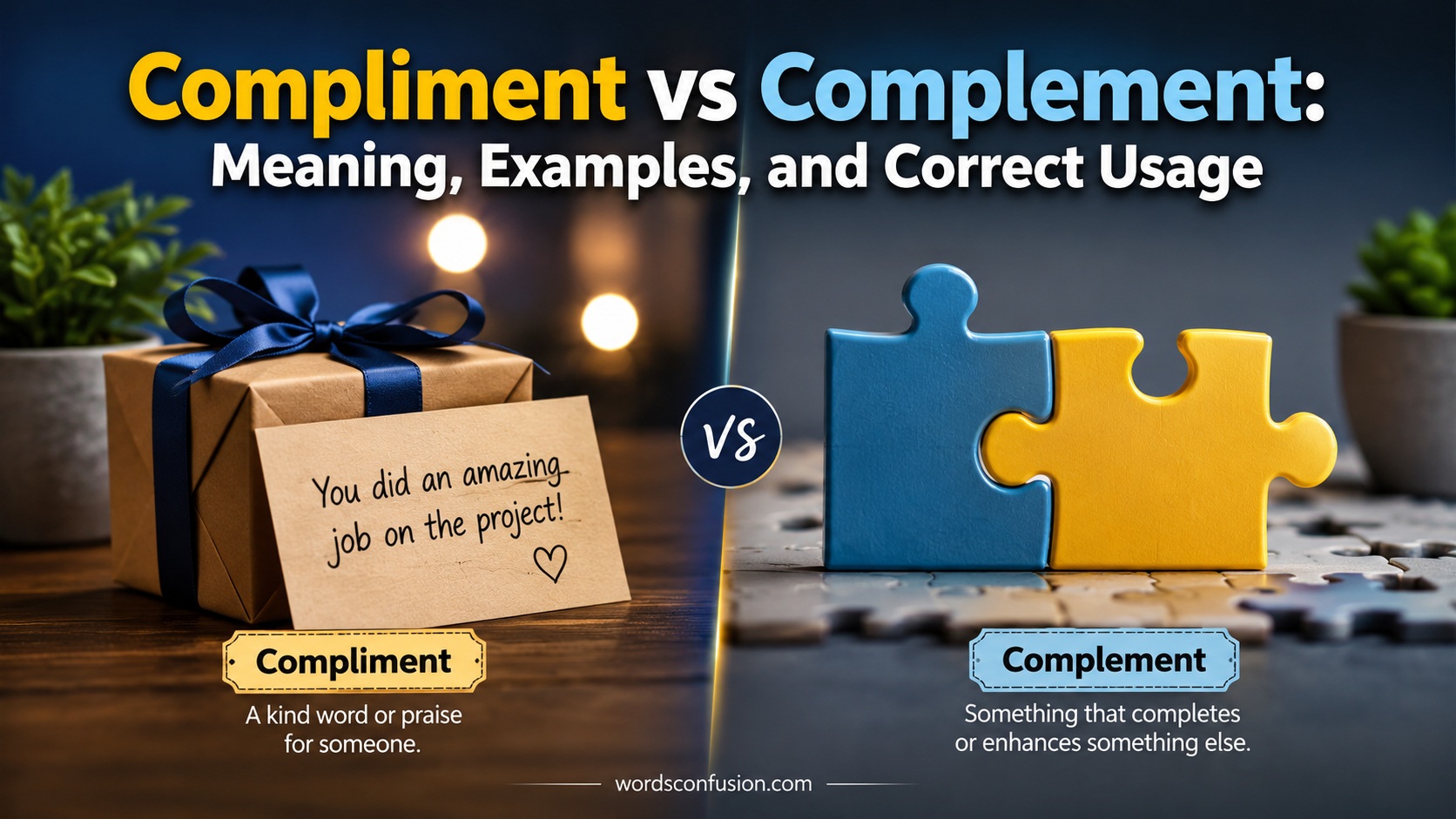
Many English words sound alike but carry completely different meanings. Compliment and complement are a perfect example. Since both words share the same pronunciation, people often mix them up in emails, academic writing, business communication, and everyday conversations. A single misplaced letter can completely change what you want to say.
Imagine telling someone that their new jacket compliments their shoes. If you mean the jacket looks great with the shoes, you’ve actually used the wrong word. The correct sentence is “The jacket complements the shoes.” However, if you tell your friend, “I compliment your fashion sense,” you’re expressing praise. Although the words sound identical, they serve very different purposes.
Understanding the distinction helps you communicate with confidence. Whether you’re writing professionally, preparing for an English exam, or simply trying to improve your grammar, knowing when to use each word will make your writing clearer and more accurate.
This guide explains the meanings of compliment vs complement, highlights their differences, provides memorable tricks to avoid confusion, and includes plenty of real-world examples you can use immediately.
Quick Answer
The difference is simple:
- Compliment means to praise, admire, or express approval of someone or something.
- Complement means to complete, improve, enhance, or go well with something else.
Quick Comparison
| Word | Meaning | Easy Memory Trick | Example |
| Compliment | Praise or admiration | I = I admire someone | She gave me a wonderful compliment. |
| Complement | Completes or improves something | E = Complete | The sauce complements the pasta perfectly. |
Remember this simple rule:
- If you’re talking about kind words, use compliment.
- If you’re talking about a perfect match or something that completes another thing, use complement.
Comparison Overview
Although compliment and complement sound exactly alike, they belong to different contexts and express different ideas. One relates to people and praise, while the other relates to things working well together.
| Feature | Compliment | Complement |
| Primary Meaning | Praise or admiration | Something that completes or enhances another thing |
| Pronunciation | /ˈkɒm.plɪ.mənt/ | /ˈkɒm.plə.mənt/ |
| Part of Speech | Noun and Verb | Noun and Verb |
| Used for People? | Frequently | Sometimes |
| Used for Objects? | Occasionally | Very Frequently |
| Emotional Meaning | Yes | Usually No |
| Common Contexts | Conversations, speeches, emails, reviews | Fashion, food, design, business, education, science |
| Example | He paid her a compliment. | The furniture complements the room. |
Even native English speakers occasionally confuse these words because spell-check software cannot always identify the mistake. The sentence may be grammatically correct even though the wrong word changes the meaning.
Main Differences Between Compliment vs Complement
The easiest way to understand compliment vs complement is to focus on what each word is trying to communicate.
Compliment Means Praise
Use compliment whenever you express admiration, appreciation, or respect.
For example:
- You compliment a coworker on an excellent presentation.
- A customer compliments a restaurant for outstanding service.
- A teacher compliments a student for hard work.
- Friends compliment each other on new hairstyles or achievements.
In every case, the word relates to positive words or expressions of admiration.
Complement Means Complete or Enhance
Use complement when one thing makes another thing better, stronger, or more complete.
Examples include:
- Fresh basil complements tomato soup.
- Her leadership skills complement his technical expertise.
- The blue curtains complement the white walls.
- Exercise complements a healthy diet.
Here, nothing is being praised. Instead, one thing naturally improves or completes another.
The Core Difference
The distinction becomes much easier when you think about the purpose of the sentence.
| If You Mean… | Correct Word |
| Praise someone | Compliment |
| Admire someone’s work | Compliment |
| Say something nice | Compliment |
| Match perfectly | Complement |
| Improve another thing | Complement |
| Complete something | Complement |
A Simple Memory Trick
A quick spelling trick can save you from making mistakes.
- Compliment contains the letter “I.” Think of “I admire you.”
- Complement contains the letter “E.” Think of “complete.”
This small association helps many English learners choose the correct spelling without hesitation.
Side-by-Side Examples
Reading both words together makes the difference much clearer.
| Compliment | Complement |
| She complimented my presentation. | Her presentation complemented the conference theme. |
| He received several compliments after the speech. | His experience complements the team’s strengths. |
| I compliment your honesty. | Your honesty complements your leadership skills. |
| They complimented the chef on the delicious meal. | The wine complements the steak beautifully. |
| She complimented his creativity. | The colorful artwork complements the modern office. |
Notice how compliment always involves people expressing admiration, while complement focuses on relationships between people, objects, skills, colors, or ideas.
Why People Confuse These Words
There are several reasons why these words cause confusion.
- They are homophones, meaning they sound exactly the same.
- Both can function as nouns and verbs.
- They differ by only one letter.
- Auto-correct tools often fail to catch the mistake because both spellings are valid English words.
- Many people learn them through conversation before seeing them in writing.
Because of these similarities, writers often rely on context rather than pronunciation to choose the correct word.
Real-Life Example
Consider these two sentences:
- Your speech deserves a compliment.
- Your confidence complements your communication skills.
The first sentence expresses praise.
The second explains that confidence makes communication skills even stronger.
Although the words sound identical, their meanings couldn’t be more different.
Why Learning the Difference Matters
Using the correct word improves both your writing and your credibility. In professional emails, academic papers, business reports, and social media posts, choosing the right spelling shows attention to detail.
For example:
- A hiring manager may compliment your resume.
- Your experience may complement your education.
- A client may compliment your customer service.
- Excellent customer service may complement a high-quality product.
These small distinctions make your writing precise and polished while helping readers understand exactly what you mean.
What Does Compliment Mean?
A compliment is an expression of praise, admiration, respect, or approval. You use it when you want to say something kind about a person’s appearance, skills, behavior, or achievements.
The word can act as both a noun and a verb.
- As a noun, it refers to the praise itself.
- As a verb, it means to express that praise.
Compliment as a Noun
When used as a noun, compliment refers to a positive remark.
Examples:
- She gave me a thoughtful compliment.
- His manager offered a sincere compliment after the presentation.
- Receiving a genuine compliment boosted her confidence.
Compliment as a Verb
As a verb, compliment means to praise someone directly.
Examples:
- The teacher complimented the students on their hard work.
- Everyone complimented him on his new suit.
- Customers frequently compliment the hotel’s excellent service.
Common Situations Where You Use “Compliment”
People give compliments every day in different settings.
- At work
- In school
- During interviews
- At weddings
- On social media
- In customer reviews
- Among family and friends
For example:
- “Your presentation was clear and engaging.”
- “You’ve done an amazing job.”
- “I love your writing style.”
- “Your garden looks beautiful.”
Each sentence expresses admiration, making compliment the correct choice.
Common Expressions with “Compliment”
English includes several popular phrases that use compliment.
| Expression | Meaning | Example |
| Pay someone a compliment | Say something nice | I paid her a compliment about her artwork. |
| Take it as a compliment | Accept praise positively | He laughed and took it as a compliment. |
| Return the compliment | Praise someone back | She returned the compliment with a smile. |
| Fishing for compliments | Trying to receive praise | Stop fishing for compliments. |
| With my compliments | Given as a gift | Please accept this dessert with my compliments. |
| Compliments of the chef | A free dish from the chef | We received an appetizer compliments of the chef. |
Synonyms for Compliment
Depending on the sentence, you can replace compliment with similar words.
- Praise
- Admiration
- Appreciation
- Approval
- Tribute
- Acclaim
- Commendation
Each synonym carries a slightly different tone, but they all relate to expressing something positive.
What Does Complement Mean?
A complement is something that completes, improves, strengthens, or matches another thing.
Unlike compliment, this word usually doesn’t involve emotions or praise. Instead, it describes how two or more things work well together.
Like compliment, it also functions as both a noun and a verb.
Complement as a Noun
As a noun, complement refers to something that completes or enhances something else.
Examples:
- Fresh herbs are the perfect complement to grilled chicken.
- His experience is an excellent complement to the team’s creativity.
- Good lighting is an important complement to modern interior design.
Complement as a Verb
As a verb, complement means to improve, complete, or enhance another person or thing.
Examples:
- The curtains complement the furniture beautifully.
- Her communication skills complement her technical knowledge.
- These colors complement each other perfectly.
Everyday Examples of “Complement”
You probably hear or read this word more often than you realize.
Food
- Lemon complements grilled fish.
- Garlic complements roasted vegetables.
- Coffee complements chocolate desserts.
Fashion
- A silver necklace complements a black dress.
- Brown shoes complement a navy suit.
Interior Design
- Wooden furniture complements white walls.
- Natural light complements minimalist spaces.
Business
- Marketing complements sales efforts.
- Customer support complements product quality.
Technology
- Artificial intelligence complements human decision-making.
- Cloud storage complements local backups.
Common Expressions with “Complement”
| Expression | Meaning |
| Complement each other | Work well together |
| Perfect complement | Ideal match |
| Complementary skills | Skills that strengthen one another |
| Complementary colors | Colors opposite each other on the color wheel |
| Complementary products | Products designed to be used together |
| Complement system | A group of proteins that support the immune system |
Notice that many industries use complement because they focus on things working together rather than praising each other.
Compliment vs Complement in Grammar
One reason these words confuse people is that they share the same grammatical roles.
Both function as nouns and verbs, but their meanings remain completely different.
| Grammar Role | Compliment | Complement |
| Noun | Praise | Something that completes |
| Verb | To praise | To complete or enhance |
Compliment as a Noun
Examples:
- Thank you for the compliment.
- She appreciated every compliment she received.
Compliment as a Verb
Examples:
- They complimented the chef.
- I complimented my coworker on her creativity.
Complement as a Noun
Examples:
- His patience is the perfect complement to her enthusiasm.
- Fresh bread is a great complement to soup.
Complement as a Verb
Examples:
- The artwork complements the room.
- These features complement one another perfectly.
Read More: Capital vs Capitol: Meaning, Differences, and Correct Usage
Real-Life Examples of Compliment vs Complement
Looking at realistic situations makes the difference much easier to remember.
In Everyday Conversation
Compliment
- Your haircut looks fantastic.
- Thank you for the compliment.
- Everyone complimented her cooking.
Complement
- Your glasses complement your face shape.
- That sauce complements the pasta.
- Soft music complements the relaxing atmosphere.
In the Workplace
Compliment
- The manager complimented the team after completing the project.
- Clients complimented the company’s customer service.
Complement
- Strong leadership complements technical expertise.
- Good communication complements project management skills.
In Education
Compliment
- The professor complimented the student’s research.
Complement
- Practical experience complements classroom learning.
In Marketing
Businesses often pair products together because they complement each other.
Examples include:
- Phones and wireless earbuds
- Cameras and tripods
- Laptops and external monitors
- Coffee and flavored syrups
Meanwhile, satisfied customers often compliment businesses for excellent products and service.
Sentence Pairs That Show the Difference
Reading similar sentences side by side helps you understand how each word changes the meaning.
| Compliment | Complement |
| She complimented my writing. | Her editing skills complement my writing. |
| He received several compliments. | His experience complements the team. |
| I compliment your honesty. | Honesty complements strong leadership. |
| They complimented the restaurant staff. | The dessert complements the main course. |
| My boss complimented my report. | The charts complement the report. |
| We complimented the speaker. | The visuals complement the presentation. |
| Friends complimented her outfit. | The handbag complements the outfit. |
| The audience complimented the singer. | The piano complements the singer’s voice. |
FAQs:
What is the main difference between compliment and complement?
The main difference is their meaning. A compliment is a statement of praise or admiration, while a complement is something that completes, enhances, or works well with another person or thing.
How can I remember the difference between compliment and complement?
Use this simple memory trick:
- Compliment contains “I”, which can remind you of “I admire you.”
- Complement contains “E”, which can remind you of “complete.”
This trick makes it easier to choose the correct spelling.
Is it “compliment your outfit” or “complement your outfit”?
It depends on what you mean.
- If you’re praising someone’s outfit, say “I compliment your outfit.”
- If you’re saying one item matches another, say “Those shoes complement your outfit.”
What is the difference between complementary and complimentary?
These adjectives have different meanings.
- Complementary means matching, completing, or enhancing.
- The curtains are complementary to the furniture.
- Complimentary means expressing praise or provided free of charge.
- She was complimentary about the new design.
- Guests received complimentary breakfast.
Why are compliment and complement so often confused?
People confuse these words because they are homophones, meaning they have the same pronunciation but different spellings and meanings. They also function as both nouns and verbs, which makes context the key to choosing the correct word.
Conclusion:
Although compliment and complement sound exactly the same, they have completely different meanings. A compliment is an expression of praise or admiration, while a complement is something that completes, enhances, or pairs well with something else. Understanding this simple distinction will help you avoid one of the most common spelling mistakes in English.
A quick way to remember the difference is to focus on the purpose of your sentence. If you’re giving someone kind words or recognizing their achievements, use compliment. If you’re describing how two things improve or complete each other, use complement.

Andrew Wilson is an experienced language researcher and content writer specializing in WordsConfusion topics. He helps readers understand commonly confused English words, spelling differences, grammar rules, word meanings, and proper usage through clear explanations, practical examples, and easy-to-follow language guides. His goal is to make English learning simple, accurate, and accessible for students, writers, professionals, and everyday learners.