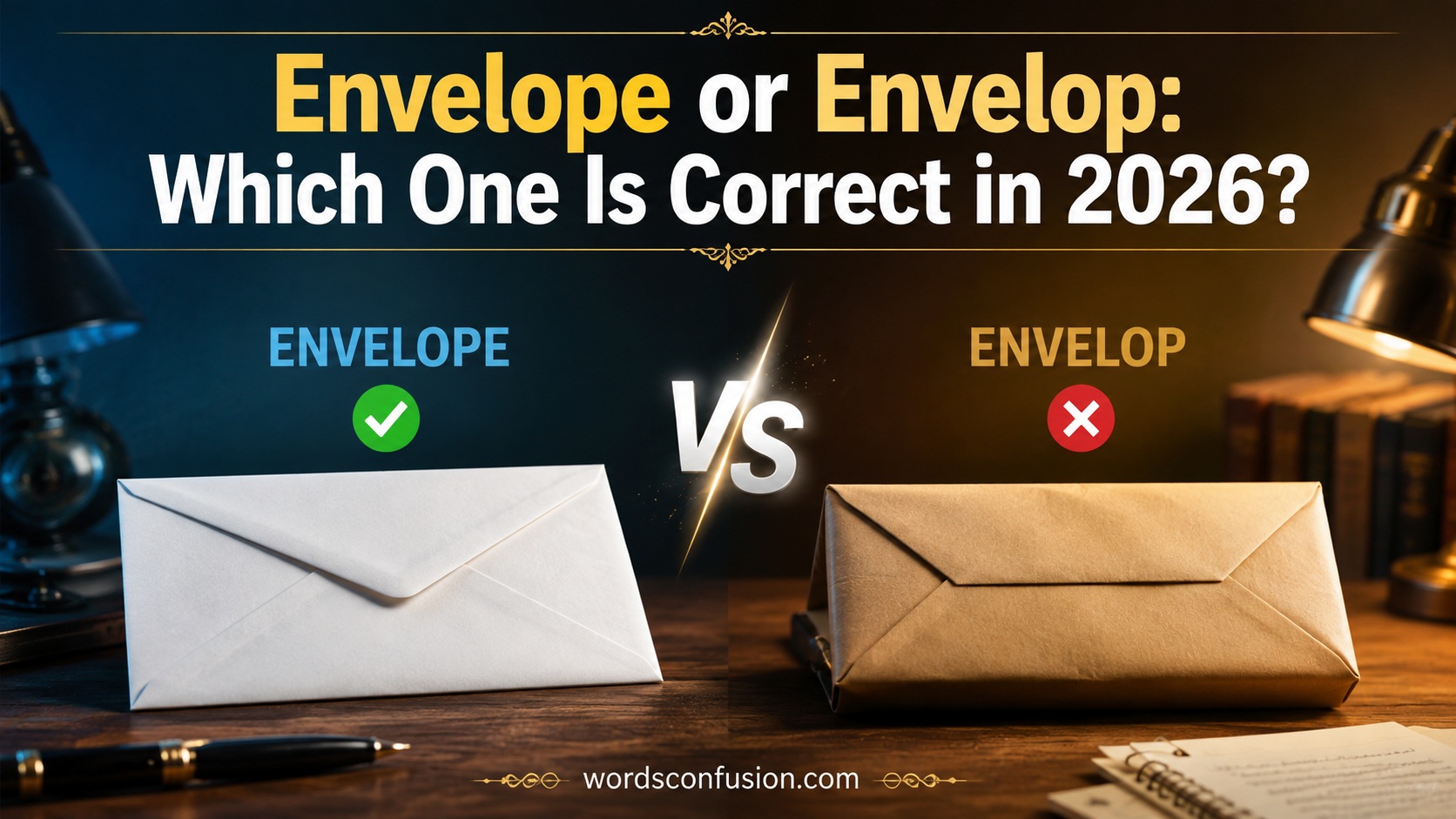
Envelope or envelop is one of those English word pairs that can make you stop mid-sentence. The two words look almost identical, share related meanings, and differ by only one letter. That tiny e at the end, however, changes the word’s role and meaning.
If you’re talking about the paper container that holds a letter, envelope is correct. If you’re describing something that surrounds, covers, or encloses another thing, envelop is the right word.
The confusion becomes even easier to understand when you see both words in real sentences. You might put a check inside an envelope, while fog envelops a mountain. One word names a thing. The other describes an action.
Although envelop looks like a shortened or misspelled version of envelope, it isn’t a mistake. Both are established English words. The important part is knowing when each one belongs in your sentence.
Quick Answer
Envelope and envelop are both correct words, but they aren’t interchangeable.
- Envelope is mainly a noun. It refers to a paper container for letters, documents, and cards. It can also mean an outer covering, surrounding layer, or defined limit.
- Envelop is a verb. It means to surround, cover, or enclose something completely.
Quick examples
She placed the invitation inside an envelope.
Thick fog began to envelop the highway.
Here’s the easiest rule to remember:
Envelope = a thing.
Envelop = an action.
The extra e matters. If you’re naming the container that holds a letter, choose envelope. If you’re describing something surrounding another object, person, or place, choose envelop.
Comparison Overview
| Feature | Envelope | Envelop |
| Part of speech | Noun | Verb |
| Main meaning | A container, covering, or boundary | To surround, cover, or enclose |
| Common use | Letters, cards, documents | Fog, smoke, darkness, emotions |
| Pronunciation | Usually EN-vuh-lope | Usually en-VEL-up |
| Example | Put the letter in an envelope. | Fog began to envelop the town. |
| Past tense | Not applicable as a noun | Enveloped |
| Present tense | Not applicable as a noun | Envelops |
| Present participle | Not applicable | Enveloping |
The biggest difference is grammatical. Envelope names something, while envelop describes something happening.
That distinction solves most cases immediately.
Main Differences Between Envelope or Envelop
The difference between envelope or envelop becomes much clearer when you examine their parts of speech, meanings, pronunciation, and sentence patterns.
Envelope Is Primarily a Noun
Envelope functions primarily as a noun. In everyday American English, the most familiar meaning is a flat paper container used for mailing or presenting letters and documents.
For example:
The invitation arrived in a beautifully decorated envelope.
Here, envelope names the physical object.
The word can also describe something that surrounds another object. In technical fields, its meaning can extend to a defined range, outer layer, or boundary.
For instance:
The aircraft remained within its operating envelope.
The word still functions as a noun in that sentence. It doesn’t describe an action.
Envelop Is a Verb
Envelop works as a verb. It describes the act of surrounding, covering, or enclosing something.
Consider this sentence:
Dark clouds enveloped the mountain.
The word enveloped tells you what the clouds did. They surrounded or covered the mountain.
You can use envelop with physical things:
Smoke enveloped the building.
You can also use it figuratively:
A strange silence enveloped the room.
In the second example, silence doesn’t physically wrap around the room like paper. Instead, the sentence creates an image of silence completely filling or surrounding the space.
Their Meanings Are Related
The similarity between these words isn’t random. Both words connect with the idea of covering or surrounding.
An envelope can be a covering or container. To envelop something means to cover or surround it.
That shared idea explains why people often confuse them.
Think of the relationship this way:
Envelope → the covering or container
Envelop → the act of covering or surrounding
Once you understand that connection, the spelling becomes much easier to remember.
What Does Envelope Mean?
Envelope has several meanings, although the paper container remains the most common everyday sense.
A traditional envelope consists of folded paper or another material that creates a pocket. People use it to hold letters, cards, checks, invitations, and other relatively flat items.
Envelope as a Paper Container
This is the meaning you’ll encounter most often.
Examples include:
- a business envelope
- a wedding invitation envelope
- a mailing envelope
- a return envelope
- a security envelope
- a greeting card envelope
Consider these examples:
Please write the recipient’s address on the envelope.
He opened the envelope and found a handwritten letter.
The company sent the documents in a large envelope.
In each case, envelope identifies a physical object.
Envelope as an Outer Covering
The noun can also describe an outer layer that surrounds something.
For example:
The virus has a lipid envelope.
Here, envelope doesn’t mean a paper container. It refers to an outer structure surrounding the virus.
This broader meaning appears frequently in scientific and technical writing.
Envelope as a Limit or Range
In specialized contexts, envelope can describe a range or boundary within which something operates.
For example:
The aircraft exceeded its safe operating envelope.
In this context, the word refers to a defined set of operating conditions.
The same idea appears in phrases such as performance envelope and operating envelope.
The Expression “Push the Envelope”
One of the most recognizable expressions containing envelope is push the envelope.
It means to test or extend the accepted limits of something.
For example:
The new design pushes the envelope of what the technology can achieve.
Here, nobody is physically pushing a paper envelope. The phrase uses envelope figuratively to represent a boundary or limit.
What Does Envelop Mean?
Envelop is a verb meaning to surround, cover, or completely enclose something.
It often creates a strong visual image. Imagine fog spreading across a road until you can barely see the pavement. The fog envelops the road.
Envelop Something Physically
The verb commonly describes physical surroundings.
Thick smoke enveloped the apartment building.
Snow enveloped the mountain peak.
Mist enveloped the valley before sunrise.
In each sentence, one thing spreads around another.
Envelop Something Figuratively
The word also works with abstract ideas, feelings, and situations.
Fear enveloped the crowd.
A feeling of calm enveloped her.
Silence enveloped the theater after the performance.
This figurative use gives envelop a more expressive quality than a simple verb such as surround.
Envelop Does Not Mean “Put Something in an Envelope”
This point causes another common misunderstanding.
The verb envelop does not normally mean putting an item inside a mailing envelope.
You wouldn’t write:
Please envelop the letter.
Instead, you’d normally say:
Please put the letter in an envelope.
Envelop means surrounding or covering something. It doesn’t describe the ordinary act of placing a letter into a paper envelope.
Envelope vs. Envelop Pronunciation
Spelling isn’t the only difference. Envelope and envelop also have different common pronunciations.
How to Pronounce Envelope
In American English, envelope is commonly pronounced approximately:
EN-vuh-lope
The final syllable sounds like lope.
For example:
Please seal the EN-vuh-lope.
How to Pronounce Envelop
Envelop is commonly pronounced approximately:
en-VEL-up
The stress falls on the second syllable.
For example:
Clouds en-VEL-up the mountain.
The pronunciation difference can help you recognize the words when you’re listening rather than reading.
Why Pronunciation Matters
Suppose someone says:
“The fog enveloped the village.”
If you hear the verb pronounced correctly, it becomes easier to distinguish it from envelope.
That’s useful for English learners because the spelling difference can seem deceptively small.
Envelope and Envelop in Real Sentences
The best way to understand this pair is to see the words working naturally in different situations.
Everyday Examples
She slipped the birthday card into an envelope.
The morning fog began to envelop the neighborhood.
The check came in a plain white envelope.
Darkness enveloped the streets after sunset.
Professional Examples
Please place the signed contract in the envelope.
Uncertainty enveloped the organization after the announcement.
The documents arrived in a sealed envelope.
Smoke quickly enveloped the warehouse.
Literary and Descriptive Examples
Envelop often appears in descriptive writing because it suggests complete surrounding.
Warm sunlight enveloped the garden.
A thick mist enveloped the forest.
The quiet atmosphere enveloped the old library.
Meanwhile, envelope remains useful when the writer wants to identify an object or boundary.
The letter rested inside a cream-colored envelope.
The aircraft stayed within its performance envelope.
Common Mistakes With Envelope and Envelop
These words create several predictable errors. Fortunately, most disappear once you identify the intended grammatical function.
Mistake: Writing “Envelop” for the Paper Container
Incorrect:
I mailed the letter in an envelop.
Correct:
I mailed the letter in an envelope.
The paper container requires the final e.
Read More: Sightseeing or Siteseeing: Which Spelling Is Correct?
Mistake: Thinking “Envelop” Is a Misspelling
Incorrect assumption:
Envelop is just a misspelled version of envelope.
That’s false.
Envelop is a real English verb. It means to surround, cover, or enclose completely.
Correct:
Clouds enveloped the mountain.
Mistake: Using “Envelope” as a Verb
Incorrect:
Thick fog envelope the town.
Correct:
Thick fog enveloped the town.
The noun envelope can’t simply replace the verb envelop.
Mistake: Confusing “Envelop” With “Enclose”
The two verbs overlap, but they aren’t always identical.
Enclose often focuses on putting something inside boundaries.
The fence enclosed the garden.
Envelop emphasizes surrounding or covering something.
Fog enveloped the garden.
The distinction can be subtle, but the imagery differs. Enclose often suggests boundaries. Envelop often suggests something spreading around or over another thing.
Envelop Verb Forms
Because envelop is a verb, it changes according to tense and grammatical structure.
| Verb form | Example |
| Envelop | Clouds envelop the peaks. |
| Envelops | Fog envelops the valley. |
| Enveloped | Darkness enveloped the town. |
| Enveloping | An enveloping mist covered the road. |
The past tense and past participle both use enveloped.
Envelop in the Present Tense
Heavy clouds envelop the mountain every winter.
When the subject is singular, use envelops:
Fog envelops the road before sunrise.
Envelop in the Past Tense
Thick smoke enveloped the building.
This is one of the most common forms you’ll see in descriptive writing.
Envelop in the Present Participle
The enveloping darkness made the hikers nervous.
The -ing form can work as part of a verb phrase or as a descriptive modifier.
How to Know Whether to Use Envelope or Envelop
When you’re unsure, don’t stare at the spelling. Look at the sentence’s meaning.
Use Envelope When You Mean a Thing
Ask yourself:
Am I naming a container, covering, outer layer, or boundary?
If yes, choose envelope.
Examples:
- an addressed envelope
- a sealed envelope
- a paper envelope
- a viral envelope
- a performance envelope
Use Envelop When You Mean an Action
Ask:
Is something surrounding, covering, or enclosing something else?
If yes, choose envelop.
Examples:
- Fog envelops the city.
- Smoke enveloped the building.
- Darkness enveloped the valley.
- Silence enveloped the room.
This simple test works surprisingly well.
A Simple Memory Trick for Envelope or Envelop
Here’s an easy way to lock the distinction into memory:
An envelope is a thing. To envelop is to surround.
You can make the rule even shorter:
Thing → envelope
Action → envelop
Imagine a letter sitting inside a paper envelope.
Now imagine fog spreading around a mountain. The fog envelops the mountain.
That mental contrast gives you two separate pictures instead of two confusing spellings.
Case Study: Choosing the Correct Word in Context
Consider this short scenario.
A company sends a customer a printed refund notice. The notice goes inside a white paper container.
The correct sentence is:
The company mailed the refund notice in an envelope.
Now imagine a different situation. Thick smoke spreads across the company’s building.
The correct sentence becomes:
Thick smoke enveloped the building.
The subject changes from an object to an action. Consequently, the correct word changes too.
Why This Example Matters
Many spelling questions become easier when you stop comparing words in isolation.
Instead, identify what the sentence needs.
If the blank needs a noun, envelope may fit.
If it needs a verb, envelop may fit.
Grammar often gives you the answer before spelling does.
FAQs:
Is “envelop” a correct English word?
Yes. Envelop is a standard English verb. It means to surround, cover, or completely enclose something.
For example:
Fog enveloped the valley.
It isn’t a misspelling of envelope.
Is “envelope” a noun or a verb?
Envelope is primarily a noun. Its most familiar meaning is a paper container used for letters and documents.
It can also refer to an outer covering or a defined boundary or range.
What is the difference between envelope and envelop?
Envelope is primarily a noun meaning a container, covering, or boundary. Envelop is a verb meaning to surround, cover, or enclose.
For example:
Put the letter in an envelope.
Fog began to envelop the city.
Is envelop the same as enclose?
Not always.
Enclose generally means to put something within boundaries or surround it. Envelop emphasizes surrounding or covering something, often completely.
For example:
A fence encloses the yard.
Fog envelops the yard.
The words overlap, but they create slightly different images.
How do you pronounce envelop?
In common American English pronunciation, envelop is pronounced approximately en-VEL-up, with the stress on the second syllable.
Conclusion:
The confusion between envelope or envelop comes from their nearly identical spelling, but the difference is simple once you understand their roles. Envelope is primarily a noun for a paper container, outer covering, or defined boundary. Envelop is a verb meaning to surround, cover, or completely enclose something.
Remember this quick rule: an envelope is a thing, while to envelop is an action. You put a letter inside an envelope, but fog can envelop a road. Both words are correct in 2026; the right choice depends entirely on what you mean and how the word functions in your sentence.
