Have you ever written “unconsolable” and wondered whether it should actually be “inconsolable”? You’re not alone. These two words look almost identical, sound similar, and carry essentially the same meaning. That makes the choice surprisingly tricky, especially when you want your writing to sound natural and polished.
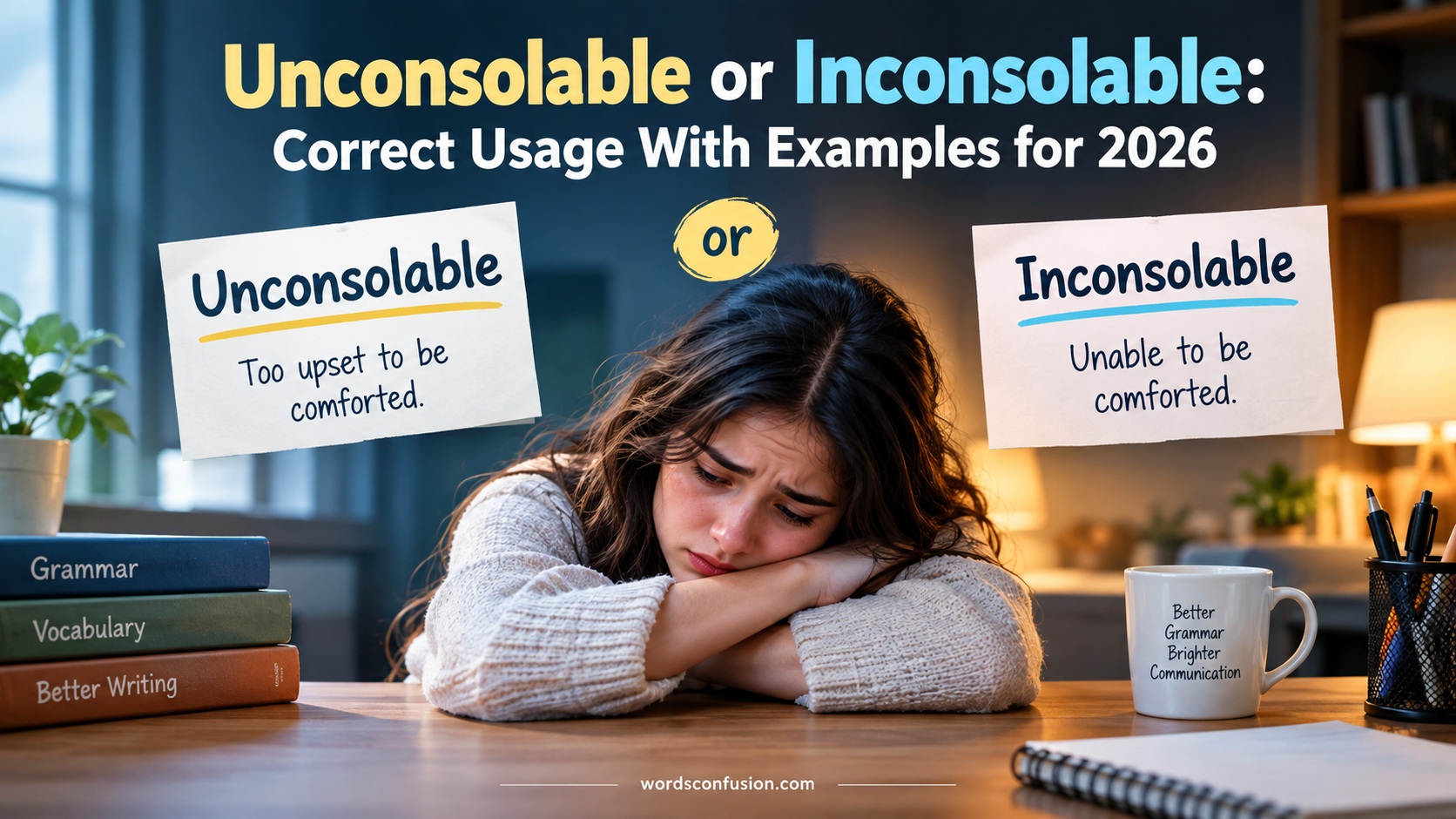
The confusion becomes even more interesting because both “inconsolable” and “unconsolable” are legitimate English words. However, they aren’t equally common. Inconsolable is the much more familiar and widely preferred form in modern English, while unconsolable appears less often.
Both adjectives describe someone who cannot be comforted or consoled. Imagine someone experiencing such intense grief that every attempt to make them feel better fails. That person may be described as inconsolable.
So, which word should you choose? If you’re writing an essay, article, email, story, or everyday sentence, inconsolable is generally the better choice. Still, understanding why unconsolable exists and when it can appear will help you avoid treating a valid word as a simple spelling mistake.
Quick Answer
Inconsolable is the preferred and more common form in modern English. Unconsolable is also a legitimate word, but it’s much less common.
Both words mean unable to be comforted, soothed, or consoled, usually because someone is experiencing intense sadness, grief, distress, or emotional pain.
| Word | Correct? | Meaning | Modern usage |
| Inconsolable | Yes | Unable to be comforted | Very common |
| Unconsolable | Yes | Unable to be comforted | Less common |
| Consolable | Yes | Able to be comforted | Less common in everyday speech |
If you’re unsure which one to use, remember this simple rule:
When in doubt, choose “inconsolable.”
For example:
- She was inconsolable after her father’s death.
- The child became inconsolable after losing her favorite toy.
- He was inconsolable when he learned that his dog had died.
You can use unconsolable in similar sentences because the word is recognized in English. However, inconsolable will usually sound more natural to modern readers.
Comparison Overview
The difference between inconsolable and unconsolable isn’t mainly about meaning. It’s about frequency, familiarity, and preferred usage.
| Feature | Inconsolable | Unconsolable |
| Part of speech | Adjective | Adjective |
| Basic meaning | Unable to be comforted | Unable to be comforted |
| Correct spelling | Yes | Yes |
| Common in modern English | Yes | No |
| Less common variant | No | Yes |
| Suitable for formal writing | Yes | Yes, but less natural |
| Suitable for creative writing | Yes | Yes |
| Refers to intense emotional distress | Yes | Yes |
| Best choice for most situations | Yes | Usually no |
The safest conclusion is straightforward: inconsolable is the standard choice for most modern writing.
That doesn’t make unconsolable wrong. Calling it incorrect would create a different problem because dictionaries recognize the word. The important distinction is between “less common” and “incorrect.”
Those aren’t the same thing.
Main Differences Between Unconsolable and Inconsolable
The main difference is usage frequency rather than definition. Both words describe someone who cannot be comforted.
Inconsolable Is More Common
If you read modern English regularly, you’ll encounter inconsolable far more often than unconsolable.
It appears naturally in news writing, literature, personal narratives, biographies, conversations, and descriptions of grief or emotional distress.
For example:
After hearing the devastating news, she was inconsolable.
The sentence sounds completely natural because inconsolable has become the established form most readers expect.
Unconsolable Is Less Frequent
Unconsolable isn’t simply a misspelling created by someone who forgot the correct prefix. It’s an established variant.
However, many readers aren’t accustomed to seeing it. As a result, it can look unusual even when the writer has used it correctly.
Consider these sentences:
- The mother was inconsolable after losing her child.
- The mother was unconsolable after losing her child.
The basic meaning remains the same. The first sentence simply sounds more familiar to most contemporary readers.
Neither Word Means the Opposite of the Other
This point causes unnecessary confusion.
You might assume that inconsolable and unconsolable have different meanings because English uses both in- and un- as prefixes.
Here, however, they don’t create a meaningful contrast.
Both forms describe someone who cannot be consoled.
The distinction is therefore not:
- inconsolable = one condition
- unconsolable = opposite condition
Instead, it’s closer to:
- inconsolable = common established form
- unconsolable = less common variant
What Does Inconsolable Mean?
Inconsolable is an adjective that describes someone who cannot be comforted or made to feel better.
The word usually carries strong emotional force. Someone who is merely disappointed probably isn’t inconsolable. The word suggests a much deeper emotional reaction.
For example:
- She was disappointed when the concert was canceled.
- She was devastated after losing her closest friend.
- She was inconsolable after hearing about the tragedy.
Notice how the emotional intensity increases.
Inconsolable often appears when ordinary attempts at comfort don’t seem to help.
A person may cry continuously, withdraw from others, express overwhelming grief, or remain deeply distressed despite receiving support.
Inconsolable Meaning in Simple English
You can think of inconsolable as:
Too upset, sad, or distressed to be comforted.
That’s the simplest practical definition.
The word doesn’t necessarily tell you why someone feels this way. Instead, it describes the person’s emotional state.
Examples of Inconsolable
- She was inconsolable after her grandmother passed away.
- The little boy became inconsolable when his mother left.
- He remained inconsolable for several hours.
- The family was inconsolable after the sudden loss.
- She was inconsolable with grief.
- The child became inconsolable after waking from the nightmare.
- He looked inconsolable after receiving the disappointing news.
Each sentence presents a situation in which normal comfort doesn’t seem sufficient.
Is Inconsolable a Correct Word?
Yes. Inconsolable is a completely correct and established English word.
It has been used in English for centuries. Major dictionaries recognize it as an adjective meaning unable to be consoled.
The word comes from the idea of consoling someone. To console someone means to comfort that person during sadness, grief, disappointment, or trouble.
Adding the negative prefix creates the sense of being unable to receive or benefit from that comfort.
So the relationship is easy to understand:
console → console someone → consolable → inconsolable
For example:
- Her friends tried to console her.
- She seemed consolable at first.
- Later, she became inconsolable.
The final word describes an emotional state that resists comfort.
Is Unconsolable a Correct Word?
Yes. Unconsolable is a real English word.
This is an important point because many people assume that anything less common than inconsolable must be an error.
That’s not the case.
Unconsolable has the same fundamental meaning as inconsolable. It describes someone who cannot be comforted.
The problem isn’t correctness. The problem is frequency.
Because inconsolable dominates contemporary usage, unconsolable can feel strange to readers who rarely encounter it.
Examples of Unconsolable
- The grieving mother appeared unconsolable.
- The child was unconsolable after losing his favorite blanket.
- He seemed unconsolable after the terrible news.
- She remained unconsolable despite everyone’s attempts to help.
- The family was unconsolable after the unexpected tragedy.
These sentences are grammatically understandable and semantically correct.
Still, if the goal is to choose the form that sounds most familiar and natural, inconsolable wins.
Why Is Inconsolable More Common Than Unconsolable?
English has several prefixes that can create negative meanings. In- and un- are two of them.
That doesn’t mean speakers can freely swap them in every word.
English developed over many centuries through a mixture of Germanic, Latin, French, and other influences. Different words settled into different forms. Some alternatives survived while others became rare.
That’s why English contains pairs and patterns that don’t always follow a neat mathematical rule.
For example:
- inaccurate, not unaccurate
- incomplete, not usually uncomplete
- invisible, not unvisible
- unhappy, not inhappy
- unable, not inable
Both in- and un- can express negation, but their use depends heavily on the history and established convention of each word.
Inconsolable became the dominant form. Unconsolable survived as a less common alternative.
That’s a useful lesson in English vocabulary: a word’s accepted form often depends on established usage rather than a simple prefix rule.
Inconsolable vs. Unconsolable Examples
Seeing the two forms side by side makes the distinction much easier.
| Inconsolable | Unconsolable |
| She was inconsolable after the loss. | She was unconsolable after the loss. |
| The child became inconsolable. | The child became unconsolable. |
| He was inconsolable with grief. | He was unconsolable with grief. |
| She remained inconsolable for hours. | She remained unconsolable for hours. |
| The family was inconsolable. | The family was unconsolable. |
| He looked inconsolable after the announcement. | He looked unconsolable after the announcement. |
| The toddler was inconsolable after waking. | The toddler was unconsolable after waking. |
| She became inconsolable after the breakup. | She became unconsolable after the breakup. |
The important point is that changing the prefix doesn’t substantially change the meaning.
However, the first column reflects the form that most readers will expect.
How to Use Inconsolable in a Sentence
Inconsolable works in several common sentence structures.
Inconsolable After “Be”
This is one of the simplest patterns.
- She was inconsolable.
- He was inconsolable after the accident.
- The child was inconsolable all evening.
- They were inconsolable after the loss.
The verb be connects the subject directly to the adjective.
Inconsolable After “Become”
You can use become when someone’s emotional state changes.
- She became inconsolable after hearing the news.
- The child became inconsolable when his father left.
- He became inconsolable after the final result.
This structure highlights the transition into an intense emotional state.
Inconsolable With “Remain”
Use remain inconsolable when the condition continues.
- She remained inconsolable throughout the night.
- He remained inconsolable despite his friends’ support.
- The family remained inconsolable for days after the tragedy.
Inconsolable With “Grief”
One of the most natural combinations is inconsolable grief.
For example:
She was overwhelmed by inconsolable grief after the loss of her brother.
Here, the adjective emphasizes the depth of the grief.
Other combinations include:
- inconsolable sorrow
- inconsolable sadness
- inconsolable despair
- inconsolable child
- inconsolable crying
- inconsolable distress
Inconsolable in Different Contexts
The word isn’t limited to one particular kind of sadness.
Inconsolable Grief
Inconsolable grief describes grief so intense that ordinary comfort doesn’t appear to ease it.
For example:
The family struggled with inconsolable grief after the sudden death.
This phrase commonly appears in serious discussions about bereavement and loss.
An Inconsolable Child
Children can become inconsolable when they’re frightened, hurt, exhausted, or separated from someone they trust.
For example:
The toddler became inconsolable after waking from a frightening dream.
Here, inconsolable means that attempts to calm the child aren’t working.
Inconsolable After a Loss
Loss is one of the most common contexts for the word.
You might write:
- She was inconsolable after losing her pet.
- He became inconsolable after the death of his friend.
- The family was inconsolable after the unexpected loss.
Inconsolable After Disappointment
The word can also describe extreme disappointment.
For example:
The young athlete was inconsolable after missing the winning shot.
This doesn’t necessarily involve death or grief. The person’s emotional response is simply so intense that comfort doesn’t seem to help.
Read More: Envelope or Envelop: Which One Is Correct in 2026?
Inconsolable vs. Unconsolable vs. Unconsoled
These three words look related, but there’s a useful distinction.
| Word | Meaning |
| Inconsolable | Unable to be comforted |
| Unconsolable | Unable to be comforted; less common variant |
| Unconsoled | Not comforted or left without consolation |
Inconsolable focuses strongly on the person’s condition.
Unconsoled can instead emphasize the fact that comfort hasn’t been provided or hasn’t been received.
For example:
She was inconsolable after the tragedy.
This tells you about her emotional state.
Compare it with:
She remained unconsoled after the tragedy.
That sentence emphasizes the lack of consolation.
The difference is subtle but useful when you want precise wording.
Inconsolable vs. Consolable
The relationship between these two words is easier to understand.
Consolable means capable of being comforted.
Inconsolable means unable to be comforted.
| Word | Meaning | Example |
| Consolable | Able to be comforted | The child was consolable after a few minutes. |
| Inconsolable | Unable to be comforted | The child was inconsolable after hearing the news. |
In everyday English, consolable isn’t nearly as common as inconsolable. Still, the contrast helps explain the structure of the word.
Think of it like this:
consolable → comfort can work
inconsolable → comfort doesn’t seem to work
Common Mistakes With Unconsolable and Inconsolable
Understanding the words is only half the battle. You also need to know what mistakes to avoid.
Mistake 1: Saying “Unconsolable” Is Always Wrong
This is the biggest misconception.
Unconsolable is recognized as a word. It’s simply less common than inconsolable.
Therefore, correcting every use of unconsolable as though it were a spelling error isn’t accurate.
A better explanation is:
“Unconsolable” is acceptable but uncommon. “Inconsolable” is the more widely used form.
Mistake 2: Using Inconsolable for Mild Sadness
Inconsolable is a strong word.
If someone feels slightly disappointed because their favorite restaurant is closed, describing them as inconsolable would sound humorous or exaggerated.
Compare:
Natural:
I was disappointed when the restaurant closed early.
Strong and serious:
She was inconsolable after losing her mother.
Potentially humorous exaggeration:
He was inconsolable when his favorite team lost.
The third example can work in casual writing because exaggeration creates a playful effect.
Mistake 3: Confusing Inconsolable With Inconsolably
These words have different grammatical jobs.
Inconsolable is an adjective.
She was inconsolable.
Inconsolably is an adverb.
She cried inconsolably.
The difference is easy to remember:
- inconsolable describes a person or state.
- inconsolably describes how an action happens.
Mistake 4: Assuming Inconsolable Means Permanently Sad
The word doesn’t necessarily mean that someone will never recover.
It describes a person’s emotional condition at a particular point.
For example:
She was inconsolable immediately after receiving the news.
That doesn’t tell us how she will feel tomorrow, next month, or next year.
It simply describes the intensity of her distress at that moment.
FAQs:
Is unconsolable a real word?
Yes. Unconsolable is a real English word meaning unable to be consoled or comforted. It’s recognized as a less common form of inconsolable.
Is inconsolable the correct spelling?
Yes. Inconsolable is the established and much more common spelling. It’s generally the best choice for modern English writing.
What is the difference between inconsolable and unconsolable?
There is little to no difference in their basic meaning. Both describe someone who cannot be comforted. The main difference is usage frequency because inconsolable is much more common.
Should I use inconsolable or unconsolable?
Use inconsolable in most situations. It’s the more familiar and natural choice for everyday, professional, academic, and formal writing.
What does inconsolable mean?
Inconsolable means extremely upset, sad, or distressed in a way that makes the person difficult or impossible to comfort.
Conclusion:
When choosing between unconsolable or inconsolable, the safest choice is inconsolable. Both words mean unable to be comforted or consoled, but inconsolable is far more common and familiar in modern English.
Unconsolable isn’t necessarily wrong. It’s a legitimate but less frequent variant that you may encounter in certain types of writing. For everyday communication, academic work, professional writing, and most online content, inconsolable is the clearer choice.

Andrew Wilson is an experienced language researcher and content writer specializing in WordsConfusion topics. He helps readers understand commonly confused English words, spelling differences, grammar rules, word meanings, and proper usage through clear explanations, practical examples, and easy-to-follow language guides. His goal is to make English learning simple, accurate, and accessible for students, writers, professionals, and everyday learners.