Have you ever paused while writing and wondered whether you should use farther or further? You’re not alone. These two words look similar, sound almost identical, and often appear in the same kinds of sentences. Because of that, many English learners and even native speakers use them interchangeably.
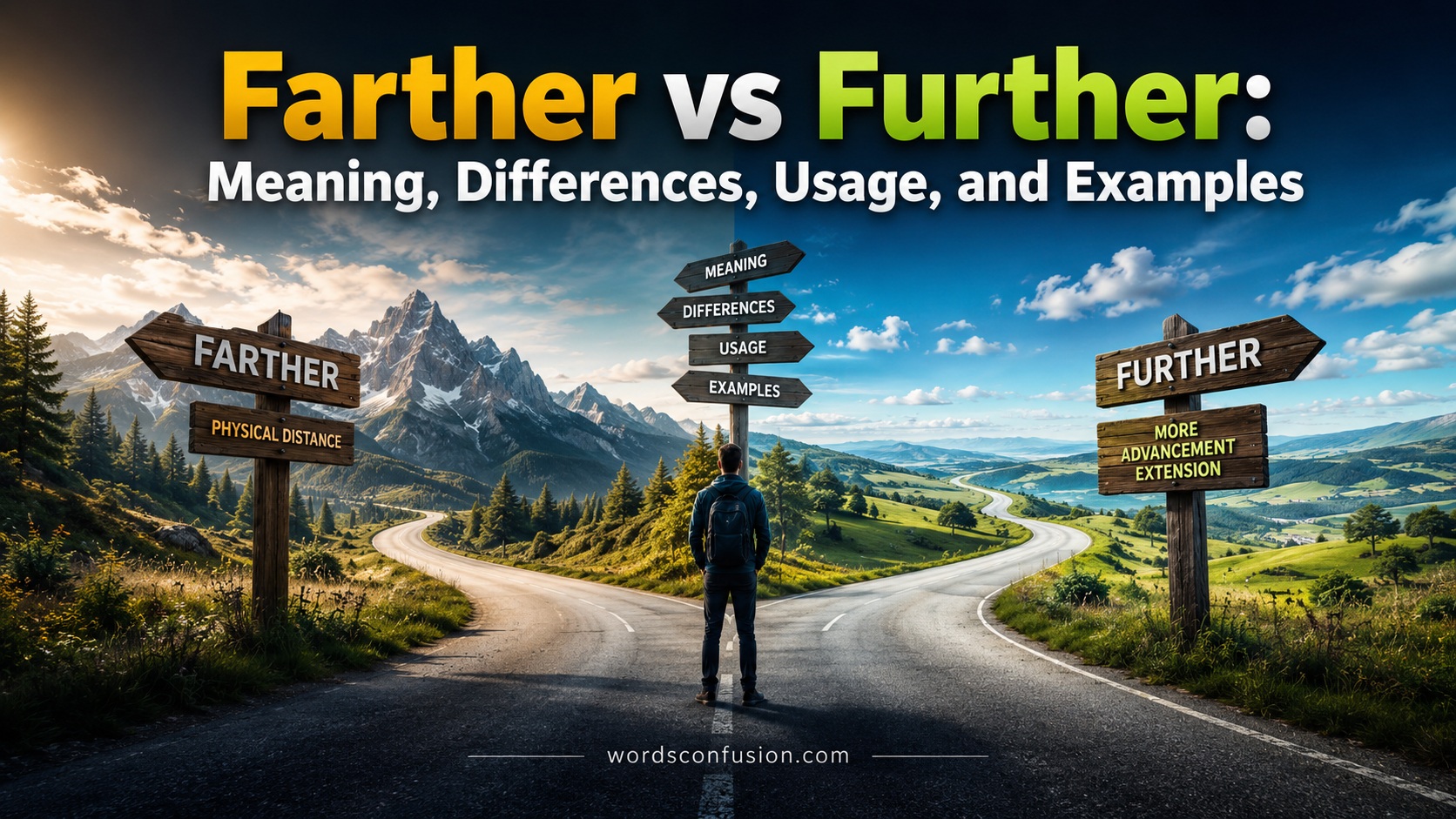
The good news is that understanding the difference isn’t as difficult as it seems. In traditional English grammar, farther refers to physical distance, while further usually describes figurative distance, additional information, or advancement. However, modern English has blurred the distinction in many situations, making further acceptable in places where farther was once the only correct choice.
Knowing when to use each word helps you write more clearly and confidently. Whether you’re preparing a school assignment, drafting a business email, writing a blog post, or simply trying to improve your English, mastering farther vs further will make your writing more precise.
In this guide, you’ll learn the meanings of both words, discover their key differences, explore grammar rules, see plenty of real-life examples, and pick up simple memory tricks that will help you choose the correct word every time.
Quick Answer
The easiest way to remember the difference between farther and further is this:
- Farther refers to physical distance.
- Further refers to figurative distance, additional information, progress, or advancement.
- In modern English, further is also widely accepted when talking about physical distance, although farther remains the more specific choice.
Examples:
- We walked farther than we planned.
- Before making a decision, I need further information.
- She continued further into the discussion.
- The hikers traveled farther up the mountain trail.
If you’re talking about measurable distance, choose farther. If you’re talking about ideas, time, progress, or “more,” choose further.
Comparison Overview
| Feature | Farther | Further |
| Primary Meaning | Greater physical distance | Greater degree, additional amount, or figurative distance |
| Physical Distance | Yes | Yes (accepted in modern English) |
| Figurative Meaning | Rarely | Yes |
| Means “Additional” | No | Yes |
| Can Be a Verb | No | Yes (“to further a goal”) |
| Formal Writing | Preferred for literal distance | Preferred for abstract ideas and additional information |
| Common Phrase | Go farther down the road | Further details, further education, until further notice |
Main Differences Between Farther vs Further
Although these words share the same origin, their meanings have developed differently over time.
Farther Refers to Physical Distance
Use farther when you can measure the distance between two places or objects.
Examples:
- The supermarket is farther from my house than the library.
- We drove farther than expected before stopping for lunch.
- The children ran farther across the field than anyone imagined.
- Can you throw the ball farther this time?
Think of farther whenever miles, feet, meters, or other measurable distances are involved.
Further Refers to More Than Distance
Use further when discussing ideas, progress, time, education, research, or anything abstract.
Examples:
- We need further discussion before approving the proposal.
- Please contact us if you need further assistance.
- Scientists conducted further research on the topic.
- Her education helped her career progress further.
In these examples, no one is traveling physically. Instead, the word describes advancement or something additional.
Further Has More Meanings
Unlike farther, further has several uses in English.
It can mean:
- Additional
- More
- Beyond
- To promote or advance
- To a greater extent
For example:
- The committee postponed the meeting until further notice.
- His donation helped further medical research.
- We won’t discuss the matter any further.
Because of its broader meaning, further appears much more often in books, newspapers, academic writing, and business communication.
Farther Has One Main Job
The role of farther is much simpler.
Its primary purpose is describing literal distance.
Examples include:
- The gas station is five miles farther ahead.
- Birds flew farther south during winter.
- The second campsite is farther from the river.
If you’re talking about measurable space, farther is usually your safest choice.
What Does “Farther” Mean?
Farther is the comparative form of far. It means at a greater physical distance.
Imagine you’re hiking through a forest. Your friend points toward another trail and says,
“The waterfall is farther down this path.”
Here, the distance can actually be measured.
When to Use Farther
Use farther whenever you’re describing:
- Walking distance
- Driving distance
- Flying distance
- Running distance
- Geographic locations
- Measurable movement
Examples include:
- We walked farther than ten miles.
- The airport is farther away than I remembered.
- Their house sits farther down the street.
- She swam farther than anyone else in the competition.
- Our hotel was farther from downtown than expected.
Examples of Farther in Sentences
Here are more examples showing how farther works in everyday English.
- The marathon runners pushed themselves farther every year.
- This hiking trail stretches farther into the mountains.
- We parked farther from the entrance because the lot was full.
- The ship sailed farther into the ocean before turning back.
- Our vacation destination was much farther than last year’s trip.
- He kicked the soccer ball farther than his teammates.
- The photographer moved farther away to capture the entire building.
- Birds migrate farther south during colder seasons.
Notice that every sentence involves physical movement or measurable distance.
Common Expressions with Farther
Although farther isn’t used in as many fixed expressions as further, you’ll still encounter it in everyday English.
Examples include:
- Go farther
- Move farther away
- Farther down the road
- Farther north
- Farther south
- Farther into the forest
- Farther from home
- Farther than expected
These expressions always describe actual space or location.
What Does “Further” Mean?
Further is one of the most flexible words in English.
While it can describe physical distance, its primary meaning involves additional information, greater progress, extended discussion, or advancement.
You’ll encounter further frequently in professional writing because it covers many situations beyond literal distance.
When to Use Further
Choose further when discussing:
- Additional information
- Extra details
- Research
- Education
- Progress
- Development
- Time
- Conversations
- Abstract concepts
Examples include:
- Further investigation revealed new evidence.
- We need further clarification.
- She plans to continue her studies further.
- The project requires further funding.
- Please read further for more information.
In each example, further means “more” or “additional,” not greater physical distance.
Examples of Further in Sentences
These examples show how naturally further fits into everyday writing.
- We need further evidence before making a decision.
- The company announced further improvements.
- Further discussions are scheduled next week.
- Scientists continue further research into renewable energy.
- The teacher offered further explanation.
- His comments only created further confusion.
- The investigation continued further despite limited evidence.
- Further training improved employee performance.
One simple trick is to replace further with additional. If the sentence still makes sense, you’ve probably chosen the correct word.
Example:
- We need further information.
- We need additional information.
Both sentences have the same meaning.
The Main Difference Explained in Detail
At first glance, farther and further seem interchangeable. After all, both are comparative forms of far. However, their meanings have evolved over time. Today, most grammar experts recommend using farther for measurable physical distance and further for abstract or figurative ideas.
Here’s a simple way to think about it:
- If you can measure it with miles, feet, kilometers, or meters, use farther.
- If you can’t measure it because it’s an idea, process, amount, or level of progress, use further.
Literal Distance vs. Figurative Distance
Consider these two sentences:
- We walked farther than we planned.
- We need to discuss this further.
The first sentence describes actual movement from one place to another. The second describes continuing a conversation. No physical distance exists.
A Quick Comparison
| Situation | Correct Word | Example |
| Walking another mile | Farther | We walked farther than yesterday. |
| Needing more information | Further | I need further details. |
| Driving to another city | Farther | They drove farther into the desert. |
| Continuing an investigation | Further | Detectives carried out further investigations. |
| Advancing a project | Further | The funding will further the research. |
Is There Really a Difference Today?
This is one of the most common questions people ask.
The answer is yes, but the distinction isn’t as strict as it once was.
Centuries ago, writers often used farther and further almost interchangeably. Over time, grammar experts began recommending separate uses to make writing clearer.
Today, many dictionaries recognize that further can refer to both physical and figurative distance. Even so, professional editors and style guides still encourage writers to use farther when talking about measurable distance because it removes ambiguity.
What Major Dictionaries Say
Most leading dictionaries agree on these points:
- Farther primarily refers to physical distance.
- Further commonly means additional, more, or to a greater extent.
- Further is also acceptable for physical distance in many contexts.
This means you may see sentences like:
- We traveled further than expected.
While this isn’t incorrect, many editors would write:
- We traveled farther than expected.
The second version makes the meaning immediately clear.
What Style Guides Recommend
Professional writing often follows a simple guideline:
- Use farther for measurable distance.
- Use further for everything else.
This approach keeps your writing consistent and avoids confusion.
Grammar Rule: When Should You Use Farther or Further?
You don’t need to memorize dozens of grammar rules. Three simple guidelines will help you choose correctly almost every time.
Use Farther for Physical Distance
Whenever the sentence involves real movement through space, choose farther.
Examples:
- We hiked farther into the canyon.
- The school is farther from the city center.
- Our campsite was farther along the river.
- The cyclist rode farther than anyone else.
Each sentence describes measurable distance.
Use Further for Abstract Ideas
Choose further whenever the sentence refers to progress, development, discussion, knowledge, or additional information.
Examples:
- We need further discussion.
- The study requires further testing.
- Further improvements are planned.
- She refused to comment further.
- Please contact customer support for further assistance.
These examples involve concepts rather than physical locations.
Use Further When It Means “Additional”
This is perhaps the easiest rule to remember.
If you can replace further with additional, then further is almost always correct.
For example:
- Further information is available online.
- Additional information is available online.
- Further questions are welcome.
- Additional questions are welcome.
- Further action may be necessary.
- Additional action may be necessary.
The meaning stays the same.
Use Further as a Verb
Many people don’t realize that further can also be a verb.
As a verb, it means to promote, encourage, or help something develop.
Examples:
- The new law will further economic growth.
- Scholarships further educational opportunities.
- Volunteers worked to further the charity’s mission.
- Investment helped further technological innovation.
Notice that farther can never be used this way.
Cases Where Either Word Works
Modern English sometimes allows both words.
For example:
- We traveled farther than expected.
- We traveled further than expected.
Although both are accepted today, farther remains the preferred choice because it specifically indicates physical distance.
If your goal is clear and polished writing, using the traditional distinction is the better option.
Farther vs Further in American and British English
The difference between these words exists in both American and British English, but actual usage varies slightly.
American English
In the United States, editors generally follow the traditional distinction.
- Farther = physical distance
- Further = figurative distance or additional information
You’ll commonly read:
- The nearest hospital is farther away.
- Further information is available on our website.
This distinction appears in newspapers, educational materials, and business documents.
British English
British English often uses further more broadly.
For example:
- We walked further along the beach.
- The village is further north.
Although farther is still correct, British writers tend to choose further more frequently for both literal and figurative meanings.
Which Version Should You Use?
If you’re writing for an international audience, following the traditional distinction is the safest choice.
It offers two advantages:
- Your writing becomes more precise.
- Readers immediately understand whether you’re discussing distance or an abstract concept.
Read More: Everyday vs Every Day: Meaning, Examples, and Correct Usage
Farther and Further as Different Parts of Speech
One important difference between these words is how they function in a sentence.
Farther as an Adverb
As an adverb, farther describes movement over a greater physical distance.
Examples:
- The runners moved farther.
- Please drive farther before stopping.
- We walked farther than expected.
Farther as an Adjective
As an adjective, farther describes something located at a greater distance.
Examples:
- The farther side of the lake looked peaceful.
- We chose the farther parking space.
- The farther mountain was covered with snow.
Further as an Adverb
As an adverb, further means to a greater extent or beyond the current point.
Examples:
- We should investigate further.
- Don’t worry any further.
- The discussion continued further into the evening.
Further as an Adjective
As an adjective, further means additional or extra.
Examples:
- Further questions are welcome.
- Further instructions will follow.
- We have no further comments.
Further as a Verb
This is where further becomes unique.
It can function as a verb meaning to advance or promote.
Examples:
- Donations further scientific research.
- The program furthers community development.
- New technology continues to further medical progress.
- Better education can further economic opportunity.
Why Farther Cannot Be a Verb
Unlike further, farther has only one primary purpose: describing physical distance.
Because of that, these sentences are incorrect:
- The program farthered economic growth.
- Scholarships farther education.
Instead, write:
- The program furthered economic growth.
- Scholarships furthered education.
Understanding this difference prevents one of the most common grammar mistakes involving these two words.
FAQs:
Is farther only used for physical distance?
Yes. In standard English, farther is primarily used to describe measurable physical distance. If you’re talking about miles, feet, roads, or locations, farther is usually the best choice.
Example:
- We drove farther than we expected.
Can further refer to physical distance?
Yes. Modern dictionaries accept further for physical distance, and you’ll often see native speakers use it that way. However, if you want your writing to be as clear and precise as possible, use farther for literal distance and further for abstract ideas or additional information.
Example:
- Correct: We walked farther down the trail.
- Also accepted: We walked further down the trail.
How can I easily remember the difference between farther and further?
A simple memory trick is to focus on the word far inside farther.
- Farther = Far = Physical distance
- Further = Further discussion, further information, further progress
If the sentence involves actual space you can measure, choose farther. If it involves ideas, progress, or something additional, choose further.
Can further be used as a verb?
Yes. Further can function as a verb that means to promote, support, or advance something. Farther cannot be used as a verb.
Examples:
- The scholarship helps further education.
- New investments will further economic growth.
- Volunteers worked to further the organization’s mission.
Which word should I use in formal writing?
For professional, academic, and business writing, follow the traditional grammar rule:
- Use farther for physical distance.
- Use further for additional information, progress, discussions, research, and abstract ideas.
Following this distinction makes your writing clearer and aligns with the recommendations of most editors and style guides.
Conclusion:
Understanding the difference between farther vs further is easier than many people think. While the two words share a common history and are sometimes used interchangeably, each has a distinct role in modern English.
Choose farther whenever you’re talking about literal, measurable distance. Whether someone walks farther, drives farther, or lives farther away, the focus is on physical space. On the other hand, use further when referring to additional information, continued discussion, progress, development, or abstract concepts. It’s also the only one of the two that works as a verb, meaning to promote or advance.
Although modern dictionaries accept further for physical distance, using farther for measurable distance and further for figurative meanings keeps your writing more precise and easier to understand. This simple distinction is especially helpful in academic, business, and professional communication.

Andrew Wilson is an experienced language researcher and content writer specializing in WordsConfusion topics. He helps readers understand commonly confused English words, spelling differences, grammar rules, word meanings, and proper usage through clear explanations, practical examples, and easy-to-follow language guides. His goal is to make English learning simple, accurate, and accessible for students, writers, professionals, and everyday learners.