
Have you ever typed “loose” when you actually meant “lose”? You’re not alone. These two words look almost alike and sound similar enough to cause confusion. Yet they carry completely different meanings.
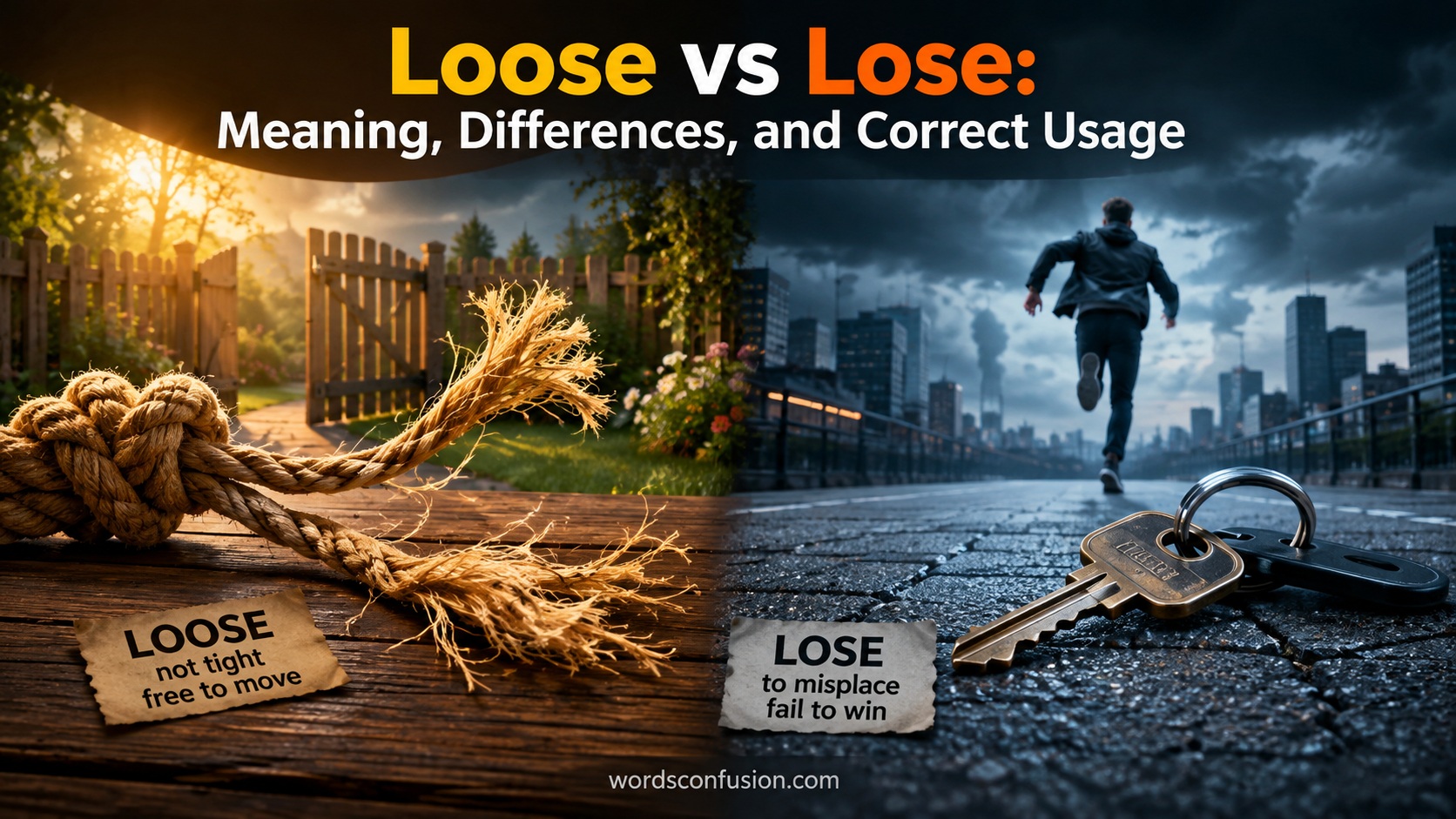
The difference becomes much easier once you connect each word with its main idea. Loose usually describes something that isn’t tight, firmly attached, or restricted. Lose is a verb that means to misplace something, fail to win, or no longer have something.
For example, you might say, “My shirt is loose,” but you should say, “I don’t want to lose my shirt.” The first sentence describes the fit of the shirt. The second describes the possibility of no longer having it.
This guide explains loose vs lose in detail. You’ll learn their meanings, pronunciation, grammar, common mistakes, examples, word forms, and simple tricks that can help you choose the right word every time.
Quick Answer
Loose means not tight, not firmly fixed, or not closely controlled. It can describe clothing, objects, rules, connections, and even animals that have escaped restraint.
Lose is a verb that means to misplace something, fail to win, stop having something, or experience a reduction or loss.
| Word | Meaning | Part of Speech | Example |
| Loose | Not tight or firmly fixed | Adjective; sometimes verb | My shoes are too loose. |
| Lose | Misplace, fail to win, or no longer have | Verb | Don’t lose your keys. |
| Loosen | Make something less tight | Verb | Loosen the knot. |
A simple rule can save you from most mistakes:
Loose = not tight. Lose = something is gone or you don’t win.
Remember that loose has two o’s, while lose has only one.
Comparison Overview
Loose and lose differ in meaning, grammar, pronunciation, and usage even though their spellings look similar.
| Feature | Loose | Lose |
| Main meaning | Not tight or firmly fixed | Misplace, fail to win, or no longer have |
| Common part of speech | Adjective | Verb |
| Pronunciation | /luːs/ | /luːz/ |
| Final sound | S sound | Z sound |
| Example | The button is loose. | Don’t lose the button. |
| Common phrase | loose clothing | lose weight |
| Another common use | loose rules | lose a game |
| Related word | Loosely, loosen | Lost, losing, loses |
The easiest distinction is grammatical. Loose usually describes a condition. Lose describes an action or change.
Think about a shoelace. If the shoelace isn’t tight, it is loose. If you can’t find the shoelace anymore, you lost it.
Main Differences Between Loose vs Lose
The biggest difference between loose vs lose comes down to what each word tells you about a situation.
Loose Means Not Tight
Loose commonly describes something that has too much space or isn’t firmly held in place.
Consider these examples:
- My jacket is loose.
- The screw is loose.
- The dog’s collar is loose.
- One tooth feels loose.
- The lid is loose.
In each sentence, loose describes the condition of something.
A loose screw hasn’t disappeared. It simply isn’t tightly secured. Likewise, loose clothing hasn’t been misplaced. It doesn’t fit closely against the body.
Lose Means Misplace Something
Lose often means that you no longer know where something is.
For example:
- I don’t want to lose my phone.
- She lost her keys.
- He lost his wallet yesterday.
- Don’t lose your passport.
- We might lose the documents.
Here, lose describes an action or situation in which something becomes unavailable or cannot be found.
Lose Means Fail to Win
You also use lose when someone doesn’t win a competition, game, election, or contest.
Examples include:
- Our team could lose the match.
- They lost the championship.
- She doesn’t want to lose the competition.
- The candidate lost the election.
- We played well but still lost.
You wouldn’t use loose in these sentences.
“Our team might loose the game” is incorrect.
The correct sentence is:
“Our team might lose the game.”
Loose Can Mean Free or Unrestricted
Loose can also describe something that isn’t tightly controlled or restricted.
For example:
- The company has loose rules.
- The dog broke loose from its leash.
- The papers were loose inside the folder.
- The artist used a loose interpretation of the original design.
In these examples, the idea of freedom or lack of tight control connects to the basic meaning of loose.
Lose Can Mean No Longer Have Something
Lose doesn’t always involve a physical object.
You can lose:
- Time
- Money
- Confidence
- Interest
- Hope
- Patience
- Control
- A job
- An opportunity
- A relationship
For example:
“Don’t lose confidence after one mistake.”
Nobody physically misplaced confidence. The sentence means that the person shouldn’t allow their confidence to disappear.
What Does “Loose” Mean?
Loose usually describes something that isn’t tight, firmly attached, or closely controlled.**
Loose as an Adjective
The most common use of loose is as an adjective.
An adjective describes a noun. Therefore, loose can tell you about the condition of a person, object, rule, connection, or material.
Examples:
- Loose pants
- Loose shoes
- Loose thread
- Loose screw
- Loose tooth
- Loose connection
- Loose papers
- Loose interpretation
Consider the sentence:
“The handle is loose.”
The word loose describes the handle’s condition. The handle remains attached, but it isn’t secure.
Loose Clothing
Loose clothing doesn’t fit tightly around the body.
Examples include:
- She prefers loose clothes in hot weather.
- These pants are too loose around the waist.
- The shirt feels loose after washing.
This is one of the most common everyday uses of the word.
Loose as a Verb
Although less common, loose can also function as a verb. As a verb, it means to release or set free.
Examples:
- The soldier loosed an arrow.
- They loosed the dogs.
- The rider loosed the horses.
This usage appears more often in literary, historical, or formal writing than in ordinary conversation.
Don’t confuse this verb with lose. They have different meanings.
What Does “Lose” Mean?
Lose is a verb with several important meanings. Its central idea involves no longer having something, failing to win, or experiencing some form of loss.
Lose Something You Can’t Find
This is perhaps the first meaning people learn.
- I lost my keys.
- She lost her phone.
- Don’t lose your ticket.
- He often loses his glasses.
The object still exists somewhere. You simply don’t know where it is.
Lose a Competition
Lose also describes the opposite of winning.
- We lost the game.
- They lost the final.
- She lost the race.
- Our team lost by two points.
Notice the past tense:
Lose → lost
Not:
Lose → loosed
This distinction matters because loosed is a different word form connected with the verb loose.
Lose Weight
Another extremely common expression is lose weight.
The correct phrase is:
“She wants to lose weight.”
The incorrect version is:
“She wants to loose weight.”
Here, lose means to reduce or shed weight.
Lose Control
You can also use lose with abstract ideas.
For example:
- He lost control of the car.
- She lost patience with the situation.
- Don’t lose hope.
- I lost interest in the project.
These expressions don’t involve physically misplacing anything. Instead, something changes or disappears from your possession, experience, or state.
Loose vs Lose Pronunciation
Pronunciation provides another useful clue when distinguishing loose from lose.
How to Pronounce Loose
Loose is pronounced approximately like “loos.”
It ends with an /s/ sound.
Think of the final sound in:
- loose
- goose
- moose
The ending has a clear s sound.
How to Pronounce Lose
Lose sounds approximately like “looz.”
It ends with a /z/ sound.
The final sound is voiced, unlike the s sound in loose.
| Word | Approximate sound | Final sound |
| Loose | Loos | /s/ |
| Lose | Looz | /z/ |
This distinction can help you when speaking. However, spelling and meaning remain the safest ways to identify the correct word in writing.
Why Do People Confuse Loose and Lose?
The confusion mainly comes from their similar spelling and pronunciation.
Both words begin with loo-. Their letters are also arranged similarly.
The extra o in loose creates another visual trap. Many writers remember the sound but don’t remember which spelling belongs to which meaning.
There is also a common mistake where people write loose whenever they mean lose.
For example:
❌ I don’t want to loose my job.
✅ I don’t want to lose my job.
The problem isn’t pronunciation alone. It comes from failing to connect the word with its meaning.
Common Mistakes With Loose and Lose
A few recurring errors account for most mistakes involving these words.
“I Don’t Want to Loose My Phone”
This is incorrect.
The correct sentence is:
“I don’t want to lose my phone.”
The sentence talks about possibly no longer having the phone. Therefore, lose is the correct verb.
“My Shoes Are Too Lose”
This is also incorrect.
The correct sentence is:
“My shoes are too loose.”
The shoes aren’t missing. They simply aren’t tight enough.
“Don’t Loose Your Focus”
Incorrect:
“Don’t loose your focus.”
Correct:
“Don’t lose your focus.”
Here, lose means to stop maintaining your focus.
“The Handle Is Lose”
Incorrect:
“The handle is lose.”
Correct:
“The handle is loose.”
The handle remains there. It simply isn’t firmly attached.
“Our Team Loosed the Match”
Incorrect:
“Our team loosed the match.”
Correct:
“Our team lost the match.”
The past tense of lose is lost.
Loose vs Lose in Sentences
Seeing the words in realistic sentences makes the distinction much easier to remember.
Examples With Loose
- The knot is loose.
- My shirt feels loose.
- One of the screws is loose.
- The dog got loose from the yard.
- She likes wearing loose clothing.
- The connection between the wires is loose.
- The company follows loose guidelines.
Examples With Lose
- Don’t lose your wallet.
- I don’t want to lose this opportunity.
- They could lose the match.
- She lost her keys.
- He doesn’t want to lose his job.
- Try not to lose your temper.
- We lost interest in the project.
Read More: Lay vs Lie: Meaning, Examples, and Correct Usage
Loose vs Lose in Different Contexts
Context often gives you the answer before you even think about spelling.
Everyday Life
Imagine getting ready for work.
Your shoes feel too wide. They are loose.
You leave the house and realize your keys are missing. You lost them.
The difference is simple:
Loose describes the condition. Lose describes the loss.
Work and Business
At work, you might encounter both words in completely different situations.
- The company has loose guidelines.
- The employee doesn’t want to lose the job.
- The connection between two departments is loose.
- The business could lose a major customer.
Sports
Sports provide some of the clearest examples.
- A team’s defense may be loose.
- A player may lose the ball.
- A team may lose the match.
- A goalkeeper may lose focus.
Never write “loose the game” when you mean “lose the game.”
Loose vs Lose vs Loosen
Loosen deserves special attention because it looks closely related to loose and has a different job.
| Word | Meaning | Example |
| Loose | Not tight | The screw is loose. |
| Loosen | Make something less tight | Loosen the screw. |
| Lose | Misplace or no longer have | Don’t lose the screw. |
Here’s an easy way to see the relationship:
Loose → describes a state.
Loosen → changes something so it becomes loose.
Lose → means something is misplaced, gone, or not won.
For example:
The knot is loose.
Loosen the knot further.
Don’t lose the rope.
Those three words look similar. Their meanings couldn’t be more different.
Grammar of Loose and Lose
Understanding their grammatical roles makes the difference much easier to apply.
Loose as an Adjective
Most commonly, loose acts as an adjective.
Examples:
- a loose screw
- loose clothing
- a loose connection
- loose rules
Lose as a Verb
Lose functions as a verb.
Examples:
- I might lose my wallet.
- They could lose the match.
- She lost her phone.
- We are losing time.
A useful test is to ask whether the word describes something or expresses an action.
If it describes something that isn’t tight, choose loose.
If it describes misplacing, failing, or no longer having something, choose lose.
FAQs:
Is “loose” the same as “lose”?
No. Loose usually means not tight or not firmly fixed, while lose means to misplace something, fail to win, or no longer have something.
Is it “lose weight” or “loose weight”?
The correct phrase is “lose weight.”
For example:
“He wants to lose weight.”
Loose weight is incorrect in standard English.
Is it “loose clothing” or “lose clothing”?
The correct phrase is “loose clothing.”
Here, loose describes clothing that doesn’t fit tightly.
Is it “lose a game” or “loose a game”?
The correct phrase is “lose a game.”
For example:
“Our team could lose the game.”
The past tense is lost:
“Our team lost the game.”
Is “loosen” the same as “loose”?
No. Loose describes something that isn’t tight. Loosen means to make something less tight.
For example:
- The belt is loose.
- Loosen the belt.
How can I remember the difference between loose and lose?
Use this simple rule:
Loose = not tight.
Lose = something is gone or you don’t win.
You can also remember that loose has an extra o, which you can associate with extra room.
Why do loose and lose sound different?
Loose ends with an /s/ sound, while lose ends with a /z/ sound.
That difference is subtle but useful when you hear the words spoken aloud.
Conclusion:
Loose vs lose becomes much easier once you stop focusing on their similar spelling and focus on their meanings. Use loose when something isn’t tight, firmly attached, or closely controlled. You can talk about loose clothing, a loose screw, loose rules, or a dog running loose.
Use lose when you misplace something, fail to win, or no longer have something. You can lose your keys, lose a game, lose money, lose confidence, or lose interest. Then there’s loosen, which means to make something less tight.

Andrew Wilson is an experienced language researcher and content writer specializing in WordsConfusion topics. He helps readers understand commonly confused English words, spelling differences, grammar rules, word meanings, and proper usage through clear explanations, practical examples, and easy-to-follow language guides. His goal is to make English learning simple, accurate, and accessible for students, writers, professionals, and everyday learners.