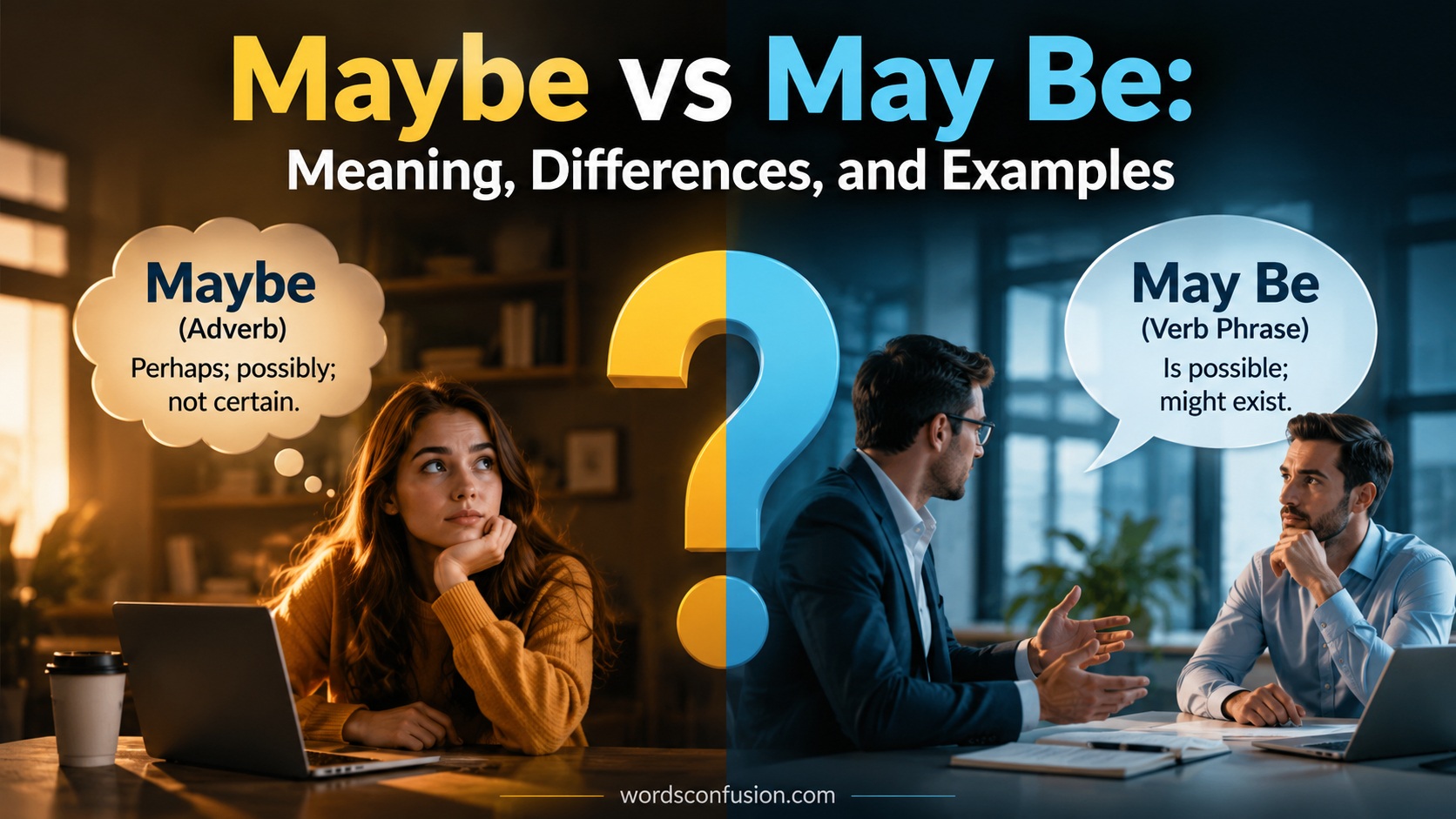
If you’ve ever paused over maybe vs may be, you’re not alone. These two forms sound almost identical, and both can express uncertainty. That similarity creates a small grammatical trap: one word works as an adverb, while the other consists of a modal verb and the verb be.
The difference becomes much easier once you stop listening only to the pronunciation and examine the sentence structure. Maybe means perhaps. May be means that something might be or could be.
That one distinction solves most cases.
Quick Answer: Maybe vs May Be
Maybe is one word and functions as an adverb meaning perhaps or possibly.
- Maybe we’ll go tomorrow.
- Maybe she forgot.
May be is two words: the modal verb may followed by be.
- She may be tired.
- The answer may be wrong.
The fastest way to choose the correct form
- Replace the expression with perhaps. If the sentence still works, use maybe.
- Replace it with might be. If that works, use may be.
Maybe = perhaps
May be = might be
For example:
- Maybe he is at home. → Perhaps he is at home.
- He may be at home. → He might be at home.
Both sentences express possibility. Their grammatical structures differ.
What Does “Maybe” Mean?
Maybe is an adverb that expresses uncertainty, possibility, or hesitation. In simple terms, it means perhaps.
When you say, “Maybe it will rain,” you aren’t stating that rain will definitely come. You’re leaving the door open. The event remains possible, but you don’t have enough certainty to make a firm prediction.
Examples of “Maybe”
- Maybe I’ll call you later.
- Maybe the store is closed.
- Maybe you’re right.
- Maybe we should wait.
- Maybe she forgot the meeting.
- “Are you coming with us?” “Maybe.”
In each example, maybe modifies the idea that follows it or functions as a short answer.
“Maybe” as a Sentence Adverb
A sentence adverb can comment on an entire statement rather than describing only one word.
Consider this sentence:
Maybe the train has already left.
Here, maybe expresses uncertainty about the complete idea: the train has already left.
You could replace it with perhaps:
Perhaps the train has already left.
The meaning remains almost the same.
Common Positions of “Maybe”
Maybe often appears at the beginning of a sentence:
- Maybe we should leave early.
- Maybe he needs more time.
It can also appear as a short answer:
- “Will she come?”
- “Maybe.”
In casual speech, you may also hear it at the end:
- I’ll join you later, maybe.
That final position sounds more conversational and tentative. In formal writing, placing maybe at the beginning often creates a cleaner sentence.
What Does “May Be” Mean?
May be contains two separate words:
- May = a modal auxiliary verb expressing possibility.
- Be = the base form of the verb to be.
Together, may be often means might be or could be.
Examples of “May Be”
- She may be tired.
- He may be the new manager.
- The answer may be incorrect.
- They may be waiting outside.
- The package may be delayed.
- The keys may be in the car.
In every example, be forms part of the verb phrase.
May Be + Adjective
Use may be before an adjective when you want to describe a possible condition or quality.
- The task may be difficult.
- She may be tired.
- The information may be outdated.
- This may be important.
The structure is:
Subject + may be + adjective
May Be + Noun
You can also use may be before a noun or noun phrase.
- He may be the right person.
- That may be the reason.
- She may be a doctor.
- This may be the best option.
Here, be links the subject with a noun or noun phrase.
May Be + Place or Prepositional Phrase
- They may be at home.
- The documents may be in the office.
- She may be on the train.
The phrase after be tells you where someone or something might be.
May Be + Verb-ing
When may be comes before an -ing verb, it forms a possible continuous action.
- She may be working late.
- They may be waiting for us.
- He may be studying right now.
The structure is:
Subject + may be + verb-ing
May Be + Past Participle
May be can also appear in passive constructions.
- The package may be delayed.
- The documents may be misplaced.
- The problem may be caused by a faulty connection.
In these sentences, may expresses possibility while be helps form the passive verb phrase.
Maybe vs May Be: The Core Difference
The clearest difference involves grammar, not pronunciation.
| Form | Grammar Role | Meaning | Example |
| Maybe | Adverb | Perhaps; possibly | Maybe she’ll call. |
| May be | Modal verb + be | Might be; could be | She may be busy. |
Think of them as two different tools.
Maybe comments on a possibility:
Maybe he forgot.
May be builds a verb phrase:
He may be forgetful.
The first sentence begins with an adverb. The second sentence uses may be as part of the predicate.
The “Perhaps” Test for Maybe vs May Be
This is the most useful test for many sentences.
If “Perhaps” Works, Use “Maybe”
- Maybe we should leave.
- Perhaps we should leave.
The substitution works perfectly. Therefore, maybe is correct.
Another example:
- Maybe she knows the answer.
- Perhaps she knows the answer.
Again, the sentence remains grammatical and natural.
“Perhaps” Cannot Usually Replace “May Be”
Consider:
- She may be tired.
Replacing may be with perhaps gives:
- She perhaps tired.
That sentence is incorrect because the verb be has disappeared.
You could restructure the sentence:
- Perhaps she is tired.
However, that isn’t a direct replacement. The original sentence needs a verb phrase, and may be supplies it.
The “Might Be” Test
The second useful test works in the opposite direction.
If you can replace may be with might be, the two-word form is usually correct.
- He may be busy.
- He might be busy.
Both sentences work.
- The answer may be wrong.
- The answer might be wrong.
Again, the structure remains grammatical.
However, don’t treat this as a mechanical rule for every possible sentence. Always examine the role of the words in the sentence.
Maybe vs May Be Examples Side by Side
The difference becomes clearer when similar ideas appear in both forms.
Example: He Is Right
Maybe he is right.
Here, maybe means perhaps.
He may be right.
Here, may be forms the verb phrase.
Both sentences express uncertainty. The speaker simply organizes the sentence differently.
Example: She Is at Work
Maybe she is at work.
This means:
Perhaps she is at work.
She may be at work.
This means:
She might be at work.
The meaning remains very close.
Example: The Store Is Closed
Maybe the store is closed.
The adverb maybe modifies the whole statement.
The store may be closed.
The modal verb may combines with be to create a possible state.
This is why the two forms can feel interchangeable in meaning while remaining grammatically distinct.
Common Grammar Patterns With Maybe
Maybe + Subject + Verb
- Maybe I made a mistake.
- Maybe they need more time.
- Maybe she knows the truth.
- Maybe the plan will work.
This is one of the most common patterns.
Maybe + Complete Clause
- Maybe we should try again.
- Maybe the weather will improve.
- Maybe he misunderstood the question.
The entire clause expresses a possibility.
Maybe as a Short Answer
- “Will you come?”
- “Maybe.”
This use is especially common in conversation. It can express uncertainty, hesitation, or a deliberately noncommittal response.
Common Grammar Patterns With May Be
Subject + May Be + Adjective
- The answer may be correct.
- The journey may be difficult.
- He may be nervous.
Subject + May Be + Noun
- She may be the manager.
- This may be the problem.
- He may be a good candidate.
Subject + May Be + Location
- They may be at school.
- The keys may be in the drawer.
- She may be on the bus.
Subject + May Be + Verb-ing
- He may be sleeping.
- They may be working.
- She may be waiting outside.
Subject + May Be + Past Participle
- The email may be delayed.
- The files may be damaged.
- The order may be cancelled.
These patterns show why may be cannot simply be treated as another spelling of maybe.
Read More: Master vs Mister: Meaning, Differences, and Correct Usag
Maybe vs May Be: Common Mistakes
Mistake: “She Maybe Tired”
Incorrect:
She maybe tired.
Correct:
She may be tired.
Why? Tired is an adjective. The sentence needs the verb be.
You can also rewrite the sentence as:
Maybe she is tired.
Both versions are correct:
- Maybe she is tired.
- She may be tired.
The word placement changes. The meaning remains similar.
Mistake: “May Be We Should Leave”
Incorrect:
May be we should leave.
Correct:
Maybe we should leave.
Why? The sentence needs an adverb meaning perhaps. It doesn’t need a modal verb followed by be.
You could also write:
We may leave.
That sentence has a different structure and may suggest possibility or permission depending on context.
Mistake: “He Maybe the Answer”
Incorrect:
He maybe the answer.
Correct:
He may be the answer.
The subject he needs a verb. Here, may be supplies the verb phrase.
You could also write:
Maybe he is the answer.
That version uses maybe as an adverb.
Maybe vs May Be in Negative Sentences
Negative sentences create another common point of confusion.
“Maybe Not”
Maybe not means perhaps not.
- “Will they come?”
- “Maybe not.”
You can also say:
Maybe he won’t come.
Here, maybe expresses uncertainty about the complete clause.
“May Not Be”
May not be means that something is possibly not a certain condition.
- The answer may not be correct.
- She may not be available.
- This may not be the best solution.
Compare these two sentences:
- Maybe not.
- It may not be true.
The first means perhaps not. The second uses may not be as a modal verb construction.
Maybe vs May Be in Questions
Both forms can appear in questions, but their structures differ.
Questions With Maybe
- Maybe we should ask her?
- Maybe he forgot?
- Maybe you’re right?
These questions often sound conversational. The speaker may be suggesting an idea while seeking confirmation.
Questions With May Be
- What may be causing the problem?
- Who may be responsible?
- Where may be the best place to begin?
In these questions, may be remains part of the verb phrase.
However, modern English often uses more natural alternatives depending on the sentence:
- What might be causing the problem?
- Who might be responsible?
FAQs:
Is “maybe” one word or two?
Maybe is one word when it means perhaps or possibly.
Example:
Maybe we’ll go tomorrow.
Is “may be” always two words?
Yes, when may functions as a modal verb and be functions as the verb.
Example:
She may be late.
Can “maybe” and “may be” mean the same thing?
They can express a similar idea of possibility in some sentences.
Compare:
- Maybe he is right.
- He may be right.
The meaning is close, but the grammar differs.
Is “maybe” more informal than “may be”?
Not necessarily. They aren’t two versions of the same grammatical form.
Maybe is an adverb. May be is a verb phrase.
In formal writing, perhaps may sometimes sound more formal than maybe, but maybe remains standard English.
Which is correct: “Maybe he is right” or “He may be right”?
Both are correct.
- Maybe he is right.
- He may be right.
The first uses maybe as an adverb. The second uses may be as part of the verb phrase.
Is “maybe not” correct?
Yes.
Maybe not means perhaps not.
Example:
“Will they attend?”
“Maybe not.”
Is “he maybe tired” correct?
No, not in standard US English.
Write:
He may be tired.
Or:
Maybe he is tired.
Conclusion:
The difference between maybe and may be looks small on the page. Grammatically, however, the space matters.
Maybe is a one-word adverb that means perhaps or possibly:
Maybe she’ll call later.
May be contains the modal verb may and the verb be:
She may be busy.
When doubt creeps in, use the two simplest tests:
- If perhaps fits, choose maybe.
- If might be fits, choose may be.
Once you recognize whether the sentence needs an adverb or a verb phrase, the confusion largely disappears. One space can change the grammar, but the right test makes the choice surprisingly easy.

Andrew Wilson is an experienced language researcher and content writer specializing in WordsConfusion topics. He helps readers understand commonly confused English words, spelling differences, grammar rules, word meanings, and proper usage through clear explanations, practical examples, and easy-to-follow language guides. His goal is to make English learning simple, accurate, and accessible for students, writers, professionals, and everyday learners.