Have you ever typed “miniscule” because it looked like the obvious spelling? You’re not alone. The words minuscule and miniscule are close enough to confuse even careful writers. They also sound nearly identical in everyday speech, which makes the difference even harder to notice.
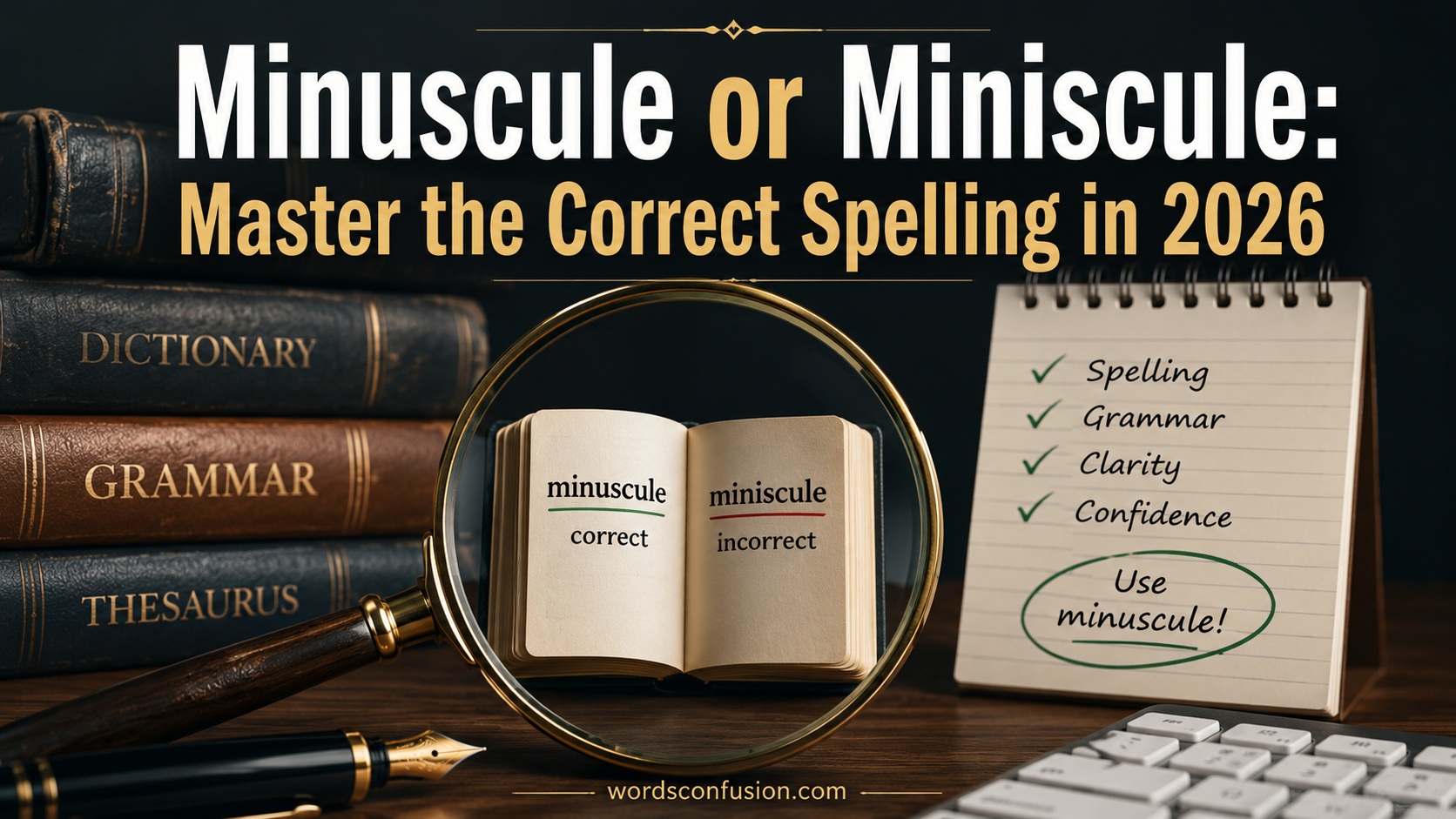
Here’s where things get interesting: minuscule is the traditional and preferred spelling, while miniscule is a widely used spelling variant that many dictionaries recognize but often label as disputed or nonstandard.
That means the answer isn’t quite as simple as saying “miniscule isn’t a word.” It appears regularly in real-world English. However, if you’re writing an essay, article, business report, application, or other polished piece of writing, minuscule is the safest choice.
The spelling also has an interesting history. Unlike what its appearance might suggest, minuscule wasn’t created from the modern word “mini.” Its roots go back to Latin and are connected with the idea of something being smaller.
This guide explains the difference between minuscule or miniscule, why people confuse them, what each form means, where the spelling came from, and how to use the word naturally.
Quick Answer
Minuscule is the preferred and traditional spelling.
Miniscule is a commonly encountered spelling variant, but it remains disputed in standard English. Major dictionaries document it, so calling it a completely nonexistent word isn’t accurate.
If you’re unsure which spelling to use, choose minuscule.
| Spelling | Status | Meaning | Best choice for formal writing |
| Minuscule | Standard/preferred | Extremely small | Yes |
| Miniscule | Disputed variant | Extremely small | Usually avoid |
For example:
- Correct/preferred: The difference was minuscule.
- Variant: The difference was miniscule.
The first sentence is the better choice when you want conventional, polished English.
Comparison Overview
The easiest way to understand minuscule vs. miniscule is to compare their spelling, meaning, history, and usage.
| Feature | Minuscule | Miniscule |
| Correct traditional spelling | Yes | No |
| Common in modern English | Yes | Yes |
| Means “very small” | Yes | Yes when used as the variant |
| Standard dictionary entry | Yes | Documented as a variant |
| Historical spelling | Yes | No |
| Recommended in formal writing | Yes | Generally not |
| Pronunciation | Usually similar | Usually similar |
| Source of confusion | Unusual -usc- spelling | Resembles mini- words |
The biggest point is simple: the two forms generally express the same idea, but minuscule has the stronger standard status.
That distinction matters because English often contains words that people use widely even though style guides or dictionaries don’t treat them equally.
Main Differences Between Minuscule and Miniscule
The most important difference between minuscule and miniscule is their spelling status rather than their basic meaning.
Minuscule Is the Preferred Spelling
Minuscule is the established spelling. It has been part of English for centuries and comes from an older Latin form.
When you need to describe something as extremely small, this is the spelling to reach for.
Examples include:
- The chance of an error was minuscule.
- She found a minuscule crack in the glass.
- The company experienced a minuscule increase in costs.
- Only a minuscule amount of dust remained.
- The difference between the two measurements was minuscule.
Notice how naturally the word works with physical size, quantities, differences, and degrees.
Miniscule Is a Common Variant
Miniscule exists in actual English usage. It isn’t simply a random collection of letters produced by careless writers.
The problem is that many language authorities regard it as a disputed spelling variant.
That creates an important distinction:
A spelling can be widely used without becoming the preferred standard form.
English has many examples of competing spellings. Some eventually become fully accepted. Others remain marked as variants for generations.
Miniscule currently belongs to the latter category in many major reference sources.
The Meaning Usually Doesn’t Change
If someone writes miniscule instead of minuscule, they’re normally trying to communicate the same meaning.
Both forms are associated with the idea of something being extremely small.
Therefore, this isn’t a situation like affect vs. effect, where the two words normally have different grammatical roles and meanings.
The real issue is which spelling you should choose.
For polished writing, the answer is straightforward:
Use minuscule.
What Does Minuscule Mean?
Minuscule is primarily an adjective meaning extremely small or tiny.
It can describe something physical, such as an object or measurement. It can also describe an amount, difference, change, possibility, or degree.
For example:
The scientist detected a minuscule amount of material.
Here, minuscule tells you that the amount was extremely small.
You can also use it figuratively:
The new policy produced only a minuscule improvement.
In this sentence, the improvement wasn’t necessarily physically small. Its degree or effect was very small.
Minuscule Can Describe Physical Size
When you’re talking about an object’s dimensions, minuscule emphasizes how tiny it is.
Examples:
- The insect had minuscule wings.
- A minuscule bead was hidden inside the container.
- The device contains several minuscule components.
- She noticed a minuscule scratch on the screen.
The word usually creates a stronger impression than simply saying small.
Compare:
- The mark was small.
- The mark was minuscule.
The second sentence suggests that the mark was remarkably tiny.
Minuscule Can Describe Amounts
The word also works well with quantities.
Examples:
- Only a minuscule amount of water remained.
- The medication contained a minuscule quantity of the compound.
- The project required a minuscule amount of additional funding.
Here, the focus isn’t necessarily on physical size. Instead, minuscule describes quantity.
Minuscule Can Describe Differences
This is one of the most common modern uses.
For example:
There was a minuscule difference between the two results.
The difference existed, but it was so small that it barely mattered.
Other examples include:
- The temperature change was minuscule.
- Their performance gap was minuscule.
- The price difference is minuscule.
- The error rate showed a minuscule decline.
What Does Miniscule Mean?
Miniscule is generally used as a variant spelling of minuscule.
When writers use it to mean “extremely small,” they normally aren’t trying to introduce a different definition.
For example:
The difference was miniscule.
The writer almost certainly means:
The difference was minuscule.
The spelling became attractive partly because English speakers naturally connect the word with mini, minimum, and miniature.
That association makes miniscule look perfectly logical at first glance.
Unfortunately, English spelling doesn’t always follow modern visual logic.
Why Do People Spell Minuscule as Miniscule?
The spelling confusion makes perfect sense once you look at the word carefully.
The Influence of “Mini”
Consider these familiar words:
- mini
- miniature
- minimum
- minivan
- miniskirt
- minicomputer
The opening mini- commonly signals something small.
Now look at minuscule.
A reader who hasn’t encountered the word often may naturally think:
mini + scule = miniscule
That’s a reasonable guess.
Unfortunately, minuscule doesn’t come from the modern prefix mini-.
Its history is older.
The Unusual “-usc-” Sequence
The spelling minuscule looks unusual to many modern English speakers.
The letters usc don’t immediately reveal how the word developed.
As a result, writers often simplify the spelling into the more familiar-looking miniscule.
This is a classic example of how pronunciation and familiar word patterns can influence spelling.
You know how a song can get stuck in your head even when you’ve heard the words incorrectly? Spelling can behave similarly. Once a familiar pattern feels right, your brain tends to favor it.
The History and Etymology of Minuscule
The history of minuscule explains why its spelling looks different from what modern readers might expect.
The word ultimately traces back to Latin minusculus, a diminutive form related to minus, meaning “less” or “smaller.”
That historical connection gives us the traditional spelling minuscule.
From Latin to English
The Latin root developed through historical forms associated with smallness and smaller writing.
Over time, minuscule became connected with forms of handwriting and lettering that used smaller characters.
Eventually, the word developed its broader modern meaning of extremely small.
So although the modern word can describe almost anything tiny, its history has a strong connection with small letters and writing.
Minuscule Has a Typographical Meaning
There’s another meaning worth knowing.
In historical writing and typography, minuscule can refer to a style of small letters.
This is where the related term majuscule becomes useful.
- Minuscule → small-letter forms
- Majuscule → large or capital-letter forms
This specialized meaning explains why the word has a deeper history than simply being a fancy synonym for “tiny.”
When Did Miniscule Become Common?
The spelling miniscule has appeared in English for well over a century.
Its popularity isn’t mysterious. The spelling resembles a group of familiar words built around the idea of smallness.
As English speakers encountered minuscule, some naturally reshaped it according to the familiar pattern of mini-.
Over time, that variant appeared often enough in published writing to become recognizable.
However, frequency doesn’t automatically settle a spelling dispute.
A form can become common while editors, dictionaries, and style authorities continue to recommend another form.
That’s exactly why miniscule deserves a more careful explanation than simply “wrong.”
Is Miniscule Actually Wrong?
The answer depends on what you mean by wrong.
If “wrong” means the preferred traditional spelling, then yes, miniscule isn’t the form you should normally choose.
If “wrong” means a completely nonexistent English word that nobody uses, then no. That’s too simplistic.
Major dictionaries have documented miniscule as a spelling variant. Some specifically identify it as disputed.
This gives us three useful levels:
| Question | Answer |
| Is minuscule the traditional spelling? | Yes |
| Is miniscule found in real English usage? | Yes |
| Is miniscule the safest formal spelling? | No |
| Should you normally write minuscule? | Yes |
The practical rule is therefore easy:
Recognize miniscule when you see it, but use minuscule when you’re writing.
How to Use Minuscule Correctly
Using minuscule isn’t difficult once you understand its meaning.
It usually appears before a noun as an adjective or after a linking verb.
Before a Noun
Examples:
- a minuscule amount
- a minuscule error
- a minuscule particle
- a minuscule difference
- a minuscule detail
- a minuscule change
These constructions are common because the word efficiently communicates extreme smallness.
After a Linking Verb
You can also use it after verbs such as is, was, seems, and remains.
Examples:
- The difference was minuscule.
- The remaining amount is minuscule.
- The improvement seems minuscule.
- The chance of failure remains minuscule.
Minuscule Doesn’t Always Mean Unimportant
This distinction matters.
Minuscule describes size, amount, or degree. It doesn’t automatically describe importance.
For example:
A minuscule error caused the entire system to fail.
The error itself was tiny. Its consequences were enormous.
That’s a useful reminder that small and unimportant aren’t synonyms.
Read More: Unconsolable or Inconsolable: Correct Usage With Examples for 2026
Minuscule Examples in Everyday English
Here are examples across several contexts.
Science
- The researchers detected a minuscule particle.
- Only a minuscule quantity of the substance remained.
- The sensor can measure minuscule changes in pressure.
Business
- The company reported a minuscule increase in operating costs.
- The difference between the two offers was minuscule.
- The new strategy delivered only a minuscule improvement.
Technology
- The chip contains minuscule components.
- A minuscule error in the code caused an unexpected result.
- The display has minuscule text that can be difficult to read.
Everyday Life
- There was a minuscule crack in the cup.
- A minuscule piece of paper fell from the envelope.
- The apartment has a minuscule kitchen.
Academic Writing
- The study found a minuscule difference between the groups.
- The experimental variation was minuscule.
- Researchers observed only a minuscule change in temperature.
Minuscule in Academic and Professional Writing
Formal writing rewards consistency.
When you write an academic paper, business report, application, or professional article, unusual spelling variants can distract readers. That’s especially true when a conventional alternative exists.
For that reason, minuscule is the better professional choice.
Consider these two sentences:
The variation was miniscule.
The variation was minuscule.
The meaning is essentially identical. Yet the second spelling is more likely to pass unnoticed by an editor.
That’s the goal with spelling. You don’t want readers stopping to wonder whether a word looks unusual.
Common Mistakes With Minuscule
Mistake 1: Writing Miniscule Because of Mini
This is probably the most understandable mistake.
The word looks like it should contain mini because its meaning involves smallness.
However, its historical spelling doesn’t come from that modern pattern.
Remember: minuscule, not miniscule.
Mistake 2: Assuming Minuscule Means Only Physically Tiny
The word can describe more than physical objects.
It can describe:
- amounts
- differences
- changes
- effects
- chances
- variations
- details
- degrees
For example:
The policy produced a minuscule change in productivity.
The change isn’t a physical object. Its degree is extremely small.
Mistake 3: Calling Miniscule a Completely Fake Word
This goes too far.
Because miniscule appears in established dictionaries and real-world writing, it’s more accurate to call it a disputed spelling variant.
Understanding this distinction makes your explanation more precise.
Mistake 4: Assuming Common Means Preferred
A word or spelling can appear millions of times and still face criticism from editors or usage authorities.
English changes through use. Dictionaries record that change. However, not every widely used variant immediately receives equal status.
That is why minuscule remains the better default.
FAQs:
Is minuscule the correct spelling?
Yes. Minuscule is the traditional and preferred spelling when you mean “extremely small.”
Is miniscule a real word?
Yes, miniscule appears in real English usage and is documented by major dictionaries. However, it is commonly treated as a disputed spelling variant rather than the preferred form.
Why is minuscule spelled with “us”?
The spelling reflects its historical development from Latin minusculus, which is related to minus, meaning “less” or “smaller.”
Do minuscule and miniscule mean the same thing?
In ordinary usage, miniscule is generally intended as a variant of minuscule, so the intended meaning is usually the same: extremely small.
Conclusion:
When you’re choosing between minuscule or miniscule, the safest answer is minuscule. Minuscule is the established spelling. It means extremely small and works naturally when describing physical objects, quantities, differences, changes, details, and degrees. Miniscule isn’t simply an imaginary word. It has appeared in English usage for a long time and has received dictionary recognition. However, its status remains disputed in standard usage.
