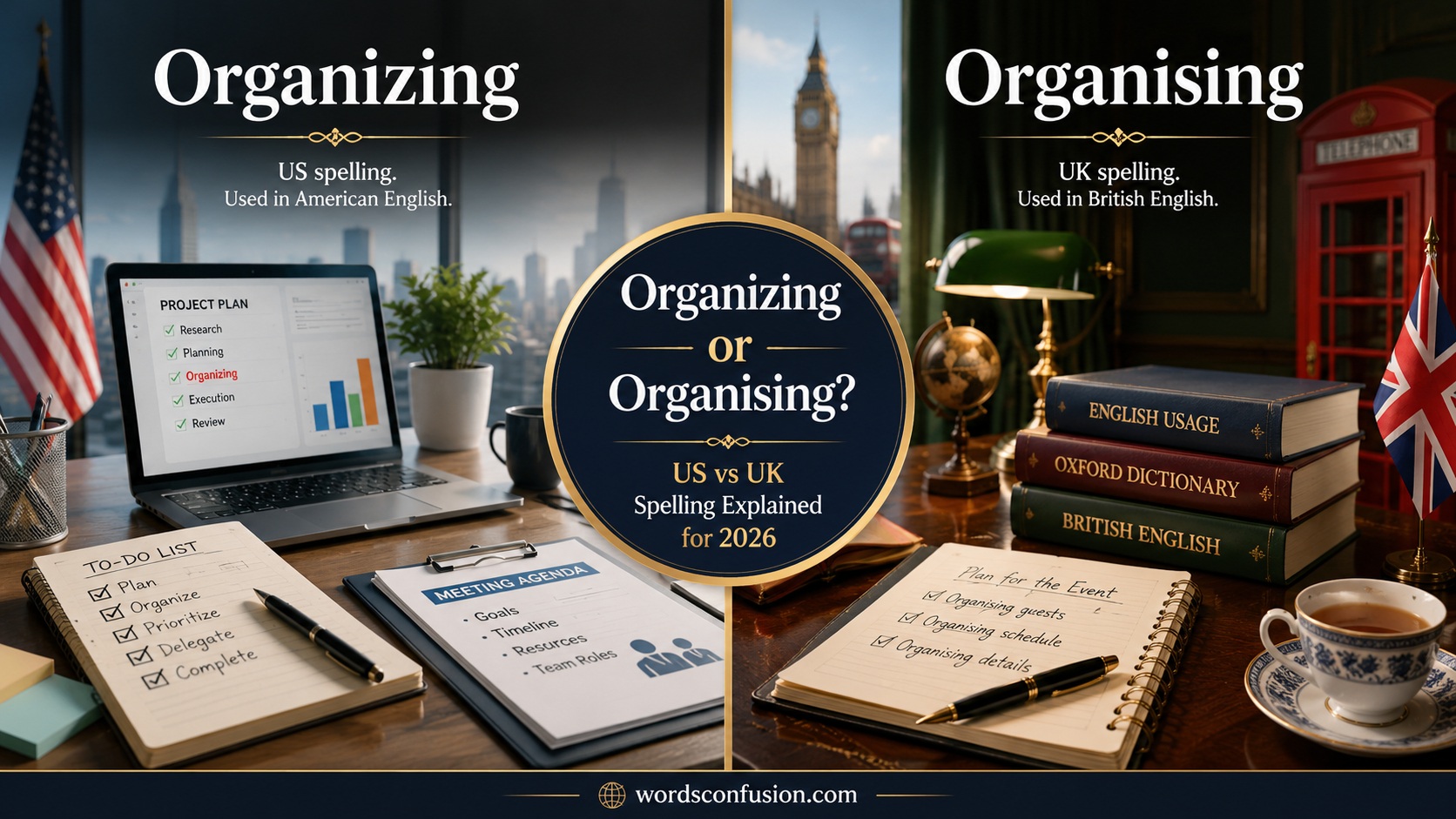
Have you ever typed organizing and wondered whether it should actually be organising? You’re not alone. These two spellings look almost identical, carry the same meaning, and often appear in different versions of English.
The difference comes down to regional spelling conventions. In standard American English, organizing is the preferred spelling. In British English, organising is the common form. Neither spelling changes the meaning of the word.
This small difference matters when you’re writing an academic paper, business document, website, resume, or professional email. Choosing the spelling that matches your audience makes your writing more consistent and polished.
Quick Answer
Organizing is the standard American English spelling, while organising is the common British English spelling. Both words mean the same thing: arranging, planning, or managing people or things in an orderly way.
| Spelling | English Variety | Example |
| Organizing | American English | She is organizing the meeting. |
| Organising | British English | She is organising the meeting. |
The difference is mainly the letter z versus s.
American English generally uses the -ize pattern in words such as organize, recognize, and realize. British English commonly uses -ise in these words, producing organise, recognise, and realise.
However, there’s an important detail: British English isn’t completely limited to -ise spellings. Some British style systems, including Oxford’s, use -ize for certain words. So calling organizing universally “wrong” in British English would be too simplistic.
Comparison Overview
Organizing and organising have the same definition, grammatical role, and pronunciation in normal usage. The primary distinction is the spelling convention associated with different varieties of English.
| Feature | Organizing | Organising |
| Common variety | American English | British English |
| Base form | Organize | Organise |
| Meaning | Arranging or planning | Arranging or planning |
| Present participle | Organizing | Organising |
| Past tense | Organized | Organised |
| Noun | Organization | Organisation |
| Agent noun | Organizer | Organiser |
| Main spelling pattern | -ize | -ise |
| Example | We are organizing the event. | We are organising the event. |
A useful rule is simple: if you’re following standard US spelling, choose organizing. If you’re following common UK spelling, choose organising.
Main Differences Between Organizing and Organising
The biggest difference between organizing and organising is regional spelling. The words don’t describe different activities.
When someone says, “I’m organizing the files,” they mean the same thing as someone who says, “I’m organising the files.” The action remains identical.
Organizing Uses the Letter Z
Organizing follows the American English spelling pattern organize → organizing.
American English commonly retains the z in related forms:
- organize
- organizes
- organized
- organizing
- organization
- organizer
For example:
The manager is organizing the annual conference.
The sentence follows standard American spelling.
You’ll encounter this spelling throughout US newspapers, universities, companies, government documents, and everyday communication.
Organising Uses the Letter S
Organising follows the common British English pattern organise → organising.
Its related forms typically include:
- organise
- organises
- organised
- organising
- organisation
- organiser
For example:
The manager is organising the annual conference.
The meaning hasn’t changed. Only the spelling convention has.
This pattern is common in British English and is also widely associated with other varieties influenced by British spelling, including Australian and New Zealand English.
What Does Organizing or Organising Mean?
Organizing and organising are forms of the verb organize/organise. They can describe several related activities.
At its simplest, the word means putting things, people, or activities into an orderly or planned arrangement.
Consider your desk after a busy week. Papers sit everywhere, files are mixed together, and important notes are difficult to find. When you sort everything into logical groups, you’re organizing your desk.
The same idea applies to much larger situations.
Organizing Things
The word can describe arranging physical or digital items.
Examples include:
- organizing books by subject
- organizing files by date
- organizing photographs into folders
- organizing notes for an exam
- organizing data into categories
I’m organizing my documents before the meeting.
Here, the person is putting documents into a useful order.
Organizing an Event
The word can also describe planning and coordinating an event.
You might organize:
- a conference
- a wedding
- a meeting
- a fundraiser
- a school event
- a workshop
- a birthday party
For example:
Sarah is organizing a charity fundraiser for next month.
She’s not merely putting objects into groups. She’s handling the planning and coordination needed to make the event happen.
Organizing People
Organizing can also refer to bringing people together for a shared purpose.
This meaning appears frequently in social, political, workplace, and community contexts.
For example:
The workers are organizing to negotiate better working conditions.
Here, organizing means bringing people together around a common goal.
Organizing vs Organising in American English
If you’re writing in American English, use organizing.
This spelling fits the standard American pattern:
organize → organizing
The same convention appears in many related words:
| American English | Example |
| organize | We need to organize the files. |
| organizes | She organizes the schedule. |
| organized | He organized the event. |
| organizing | They are organizing a conference. |
| organization | The organization supports students. |
| organizer | The organizer contacted everyone. |
For American readers, organizing will generally look more natural and familiar.
This doesn’t mean an American reader won’t understand organising. They certainly will. However, the s spelling can signal British or another non-American spelling convention.
Organising vs Organizing in British English
In common British English, organising is the traditional and widely used spelling.
The pattern is:
organise → organising
You’ll see this convention across many British publications and institutions.
| British English | Example |
| organise | We need to organise the files. |
| organises | She organises the schedule. |
| organised | He organised the event. |
| organising | They are organising a conference. |
| organisation | The organisation supports students. |
| organiser | The organiser contacted everyone. |
For a British audience, organising will usually be the safest choice when following a conventional British style.
An Important British English Exception
British spelling is more complicated than the simple “S equals British” rule suggests.
Some British English style guides prefer -ize spellings for words such as organize. Oxford style is particularly associated with this approach.
That means organizing can appear in British English without necessarily being a spelling mistake.
This distinction matters because many grammar articles incorrectly claim that British English always requires -ise. It doesn’t.
A better rule is:
Use the spelling system required by your chosen style guide, then apply it consistently.
Organize vs Organise: The Base Verb
Understanding the base verb makes the entire spelling difference much easier.
Organizing comes from organize.
Organising comes from organise.
Once you know the base form, the related spellings become predictable.
| US English | Common UK English |
| organize | organise |
| organizes | organises |
| organized | organised |
| organizing | organising |
| organization | organisation |
| organizer | organiser |
This is why changing only one word can sometimes create an inconsistent style.
For example:
The organization is organising a training session.
The sentence mixes a common American noun spelling with a common British verb spelling.
A consistent British version would be:
The organisation is organising a training session.
A consistent American version would be:
The organization is organizing a training session.
Organization or Organisation?
The same regional difference appears in the noun organization/organisation.
In American English:
The organization opened a new office.
In common British English:
The organisation opened a new office.
Both forms refer to a structured group or the act of organizing something.
The difference follows the same spelling pattern:
organize → organization
organise → organisation
However, as with organize, British style isn’t completely uniform. Some British publications and institutions use organization according to their preferred style.
Why the Noun Matters
If you’re writing a long article, report, or academic paper, consistency becomes more noticeable.
Using:
organizing, organization, organizer
creates a coherent American spelling system.
Using:
organising, organisation, organiser
creates a coherent common British spelling system.
Mixing them unnecessarily can make your writing look edited by different people.
Organizer or Organiser?
The person responsible for planning or coordinating something can be called an organizer or organiser.
American English generally uses:
The event organizer welcomed the guests.
Common British English uses:
The event organiser welcomed the guests.
The pronunciation and meaning remain the same.
Only the spelling changes.
This pattern gives you another useful memory clue:
US: organize → organizer → organizing
UK: organise → organiser → organising
Organizing or Organising in a Sentence
Seeing both spellings in real sentences makes the distinction easier to remember.
American English Examples
- I’m organizing my notes before the exam.
- She is organizing a meeting for Friday.
- They are organizing a community event.
- We’re organizing the files by category.
- He spent the morning organizing his schedule.
- The company is organizing a training program.
- Maria is organizing the conference this year.
Every example follows standard American spelling.
British English Examples
- I’m organising my notes before the exam.
- She is organising a meeting for Friday.
- They are organising a community event.
- We’re organising the files by category.
- He spent the morning organising his schedule.
- The company is organising a training programme.
- Maria is organising the conference this year.
Notice something important in the last example.
British English may differ from American English in several words within the same sentence. For example, programme is common in British English for many non-computing contexts, while American English generally uses program.
That illustrates why regional English is about a system of conventions, not one isolated spelling.
Is Organising Wrong in American English?
Organising isn’t the standard American spelling.
If you’re specifically following American English, use organizing.
An American reader will understand organising immediately. Still, the spelling may look out of place in a document otherwise written in American English.
For example, an American business report might naturally say:
The marketing team is organizing the product launch.
Using organising in the same document would introduce a British-style spelling.
Where American Spelling Matters Most
Use organizing when writing for:
- US schools and universities
- American businesses
- US government audiences
- American customers
- US-focused websites
- American publications
- Standard American resumes and cover letters
The goal isn’t to label the alternative spelling “bad.” It’s to match your audience and style.
Read More: Puting or Putting: Spelling Guide for 2026
Is Organizing Wrong in British English?
Not necessarily.
Organising is the common British spelling, but organizing can also appear in British English, especially in styles that prefer -ize spellings.
This is one reason blanket statements such as “organizing is incorrect in British English” can mislead readers.
If a British publication uses an -ize house style, organizing can fit perfectly well within that system.
The safest approach is to check the style guide you’re required to follow.
If no specific guide applies, organising is the familiar choice for conventional British English.
Why Does American English Use Z While British English Often Uses S?
The -ize/-ise distinction developed through the history of English spelling and different editorial traditions.
Words ending in -ize have roots connected to Greek forms ending in -izein. Over time, English developed competing spelling conventions.
American English strongly standardized many -ize spellings.
British English developed broader use of -ise, although -ize remains accepted in some British styles.
The result is the contrast you see today:
- organize / organise
- recognize / recognise
- realize / realise
- apologize / apologise
- modernize / modernise
The difference isn’t a pronunciation rule. It’s a spelling convention.
Common Words With the Same US and UK Pattern
Once you understand organizing vs organising, several other spelling differences become easier.
| American English | Common British English |
| organizing | organising |
| realizing | realising |
| recognizing | recognising |
| apologizing | apologising |
| emphasizing | emphasising |
| modernizing | modernising |
| analyzing | analysing |
| criticizing | criticising |
This pattern is useful because it helps you recognize the regional style of an entire document.
If you see several -ise spellings, the writer is likely following a British-style convention. If you consistently see -ize, the document may follow American or Oxford-style British conventions.
Organizing or Organising for Academic Writing
Academic writing requires consistency above all else.
If you’re studying at a US institution, organizing will generally fit American English expectations.
If you’re writing for a British institution that follows conventional British spelling, organising is generally appropriate.
The best choice can depend on the institution, publisher, or required style guide.
Before Submitting an Academic Paper
Check these points:
- What English variety does your institution expect?
- Does your professor specify a style guide?
- Does the publication have its own spelling rules?
- Are related words consistent?
- Have you accidentally mixed -ize and -ise forms?
A paper that uses organizing in one paragraph and organising in another may look careless even though both forms are legitimate.
Consistency is the key.
Organizing or Organising for Business Writing
Business writing should match the audience.
Suppose an American company sends a report to US customers. Organizing will usually fit naturally.
A British company preparing a document for a UK audience may prefer organising.
For international companies, the answer depends on the organization’s internal style.
Example
American business style:
The sales department is organizing a customer workshop.
Common British business style:
The sales department is organising a customer workshop.
Neither sentence communicates a different business activity.
The spelling simply reflects the chosen English variety.
Organizing or Organising for Websites and SEO
For websites, spelling can also reflect the audience you’re targeting.
A US-focused website should generally use organizing when following American English.
A UK-focused website can use organising when following conventional British English.
Should a Website Use Both?
Usually, don’t force both spellings into the same article.
For example, repeatedly writing:
organizing or organising
can make an article feel unnatural when the reader only needs one spelling.
Instead, establish the preferred regional form and use it consistently. If the page specifically targets the spelling difference, mention both naturally when explaining the distinction.
Search optimization shouldn’t come at the expense of readability. A useful article answers the reader’s question first.
FAQs:
Is organizing or organising correct?
Both are correct regional spellings. Organizing is standard American English, while organising is the common British English form.
Is organizing American or British?
Organizing is the standard American English spelling. It can also appear in British English styles that prefer -ize spellings.
Is organising British or American?
Organising is the common British English spelling. American English generally uses organizing instead.
Does organizing mean the same as organising?
Yes. Both words have the same meaning. They describe arranging, planning, coordinating, or managing something.
Why does British English use “s” in organising?
Many British English spelling conventions use -ise where American English commonly uses -ize. However, some British style systems use -ize instead.
Conclusion:
The choice between organizing and organising comes down to the variety of English you’re using. Organizing is the standard spelling in American English, while organising is the common spelling in British English.
Both forms have the same meaning. They can describe arranging items, planning an event, managing information, or bringing people together for a shared purpose. The only major difference is the z versus s spelling.
If you’re writing for a US audience, use organizing. For conventional British English, use organising. When a school, publisher, employer, or organization has its own style guide, follow its preferred spelling.
