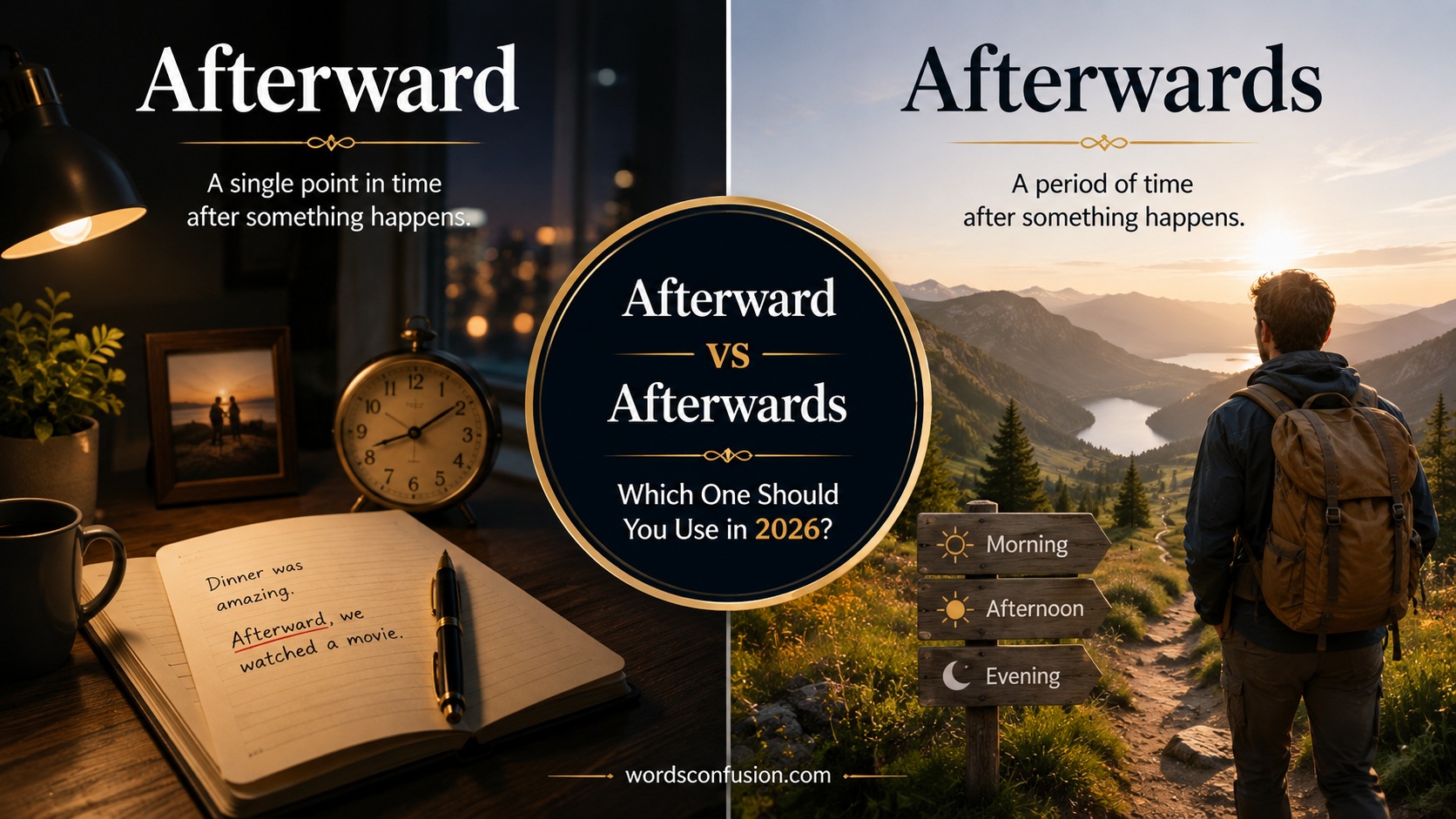
Have you ever written afterward and wondered whether you should add an s? You’re not alone. The difference between afterward and afterwards looks tiny, yet it causes plenty of confusion among English learners, students, bloggers, and professional writers. Here’s the good news: both words are correct. They have the same basic meaning and perform the same grammatical job. The main difference comes down to regional English usage.
In American English, afterward is generally the preferred form. In British English, afterwards is especially common. Neither spelling is automatically wrong, and neither changes the meaning of a sentence.That small distinction becomes important when you’re writing for a particular audience. If you’re creating content for American readers, afterward is usually the better choice. If you’re following British English conventions, afterwards may sound more natural.
Quick Answer
Afterward and afterwards are both correct adverbs that mean “at a later time” or “after something has happened.”
The primary difference is regional preference:
| Form | Common regional preference | Meaning |
| Afterward | American English | At a later time |
| Afterwards | British English | At a later time |
For example:
- American English: We went out for dinner afterward.
- British English: We went out for dinner afterwards.
The meaning doesn’t change. The extra s simply reflects a common regional spelling preference.
If you’re writing in US English, use afterward as your default. If you’re writing in UK English, afterwards is a natural choice.
Comparison Overview
The easiest way to understand afterward vs. afterwards is to look at how the two forms work side by side.
| Feature | Afterward | Afterwards |
| Part of speech | Adverb | Adverb |
| Basic meaning | At a later time | At a later time |
| Refers to | A time following an event | A time following an event |
| Common in | American English | British English |
| Correct spelling? | Yes | Yes |
| Different meaning? | No | No |
| Formal writing | Correct | Correct |
| Informal writing | Common | Common |
| Example | She called afterward. | She called afterwards. |
Notice something important: the grammatical function remains the same.
You can replace afterward with afterwards in many sentences without changing the meaning.
We talked about the problem afterward.
and
We talked about the problem afterwards.
Both sentences tell the reader that the conversation happened at a later time.
The real question isn’t “Which one is correct?” It’s “Which one fits the variety of English you’re using?”
Main Differences Between Afterward and Afterwards
There are only a few meaningful differences between afterward and afterwards, but understanding them can prevent unnecessary mistakes.
Regional Usage Is the Biggest Difference
The strongest distinction involves geography and language variety.
Afterward is especially common in American English. American dictionaries and usage generally favor this form.
Afterwards is particularly common in British English. You’ll also encounter it frequently in other varieties influenced by British English.
For example:
US English:
We discussed the project afterward.
UK English:
We discussed the project afterwards.
Both sentences are perfectly understandable. Neither expresses a different idea.
Both Words Have the Same Meaning
Both afterward and afterwards mean something like:
- at a later time
- after that event
- following what happened
- later, after something else
Consider this sentence:
Maria finished her exam and went home afterward.
The word afterward points back to the exam. It tells you that going home happened later.
You could write:
Maria finished her exam and went home afterwards.
The meaning remains unchanged.
The Extra “S” Doesn’t Change the Grammar
A common misconception is that the s somehow changes the grammatical function of the word.
It doesn’t.
Both forms work as adverbs.
Compare:
He apologized afterward.
He apologized afterwards.
In both examples, the adverb tells you when he apologized.
The difference is stylistic and regional rather than grammatical.
What Does “Afterward” Mean?
Afterward means at a later time or after something has happened.
It usually refers to an event that has already been mentioned or is obvious from the context.
For example:
We had dinner and watched a movie afterward.
The word afterward refers to the period following dinner.
Here are more examples:
- She felt nervous before the interview but relaxed afterward.
- We went to the museum and had coffee afterward.
- He called his parents shortly afterward.
- They argued during the meeting and discussed it afterward.
- I didn’t understand the decision until afterward.
The word works especially well when you want to avoid repeating an event.
Instead of saying:
We finished the meeting. After the meeting, we went to lunch.
You can make the sentence smoother:
We finished the meeting and went to lunch afterward.
That’s one reason afterward appears so often in everyday English.
What Does “Afterwards” Mean?
Afterwards has essentially the same meaning as afterward.
It means at a later time, particularly after an event or action.
For example:
We went for coffee afterwards.
Here, afterwards means after the event previously discussed.
More examples include:
- She regretted her decision afterwards.
- We talked about the movie afterwards.
- They went home shortly afterwards.
- He realized his mistake afterward.
- I’ll explain everything afterwards.
The difference isn’t meaning. It’s primarily regional preference.
British English speakers commonly use afterwards, while American English speakers often prefer afterward.
Afterward or Afterwards in American English
If you’re writing for an American audience, afterward is generally the safest choice.
American English frequently uses the shorter form:
We went home afterward.
She called me afterward.
They talked afterward.
This doesn’t mean Americans never use afterwards. They certainly can. The longer form is understandable and grammatically valid in American English.
However, if you’re trying to maintain a consistent US English style, afterward fits more naturally.
Examples in American English
Everyday conversation:
Let’s grab something to eat afterward.
Business writing:
The team reviewed the results afterward.
Academic writing:
Participants completed a second survey afterward.
Blog writing:
We tested the method and compared the results afterward.
In each case, afterward sounds natural in US English.
Afterward or Afterwards in British English
British English commonly favors afterwards.
For example:
We went to the pub afterwards.
She spoke to her manager afterwards.
They discussed the issue shortly afterwards.
However, afterward isn’t automatically incorrect in British English. You’ll encounter both forms.
That’s an important point because language doesn’t always follow neat borders. Regional preferences describe patterns of usage rather than rigid grammatical laws.
So, don’t think of the distinction like this:
Afterward = American only
Afterwards = British only
A better way to think about it is:
Afterward = more strongly associated with American English
Afterwards = more strongly associated with British English
That distinction is much more accurate.
How to Use “Afterward” in a Sentence
Because afterward functions as an adverb, you can place it in several positions depending on the sentence.
Afterward at the End of a Sentence
This is one of the most common patterns.
We went home afterward.
She apologized afterward.
They talked about it afterward.
The placement feels natural because afterward summarizes what happened following the main event.
Afterward at the Beginning of a Sentence
You can also start a sentence with afterward.
Afterward, we went home.
Afterward, she called her mother.
Afterward, the team reviewed the results.
When afterward begins the sentence, a comma commonly follows it.
Afterward in the Middle of a Sentence
The word can also appear in the middle of a sentence when the structure calls for it.
We afterward discovered that the documents were incomplete.
This construction is grammatically possible, but it can sound less natural than placing afterward at the beginning or end.
For everyday writing, these versions usually flow better:
We discovered afterward that the documents were incomplete.
or:
Afterward, we discovered that the documents were incomplete.
How to Use “Afterwards” in a Sentence
Afterwards follows the same basic grammatical patterns.
Afterwards at the End
We went home afterwards.
She felt better afterwards.
They discussed the issue afterwards.
This position is particularly common in ordinary conversation.
Afterwards at the Beginning
Afterwards, we went home.
Afterwards, she called her sister.
Afterwards, the students completed an assignment.
The comma helps separate the introductory adverb from the main clause.
Read More: Organizing or Organising? US vs UK Spelling Explained for 2026
Afterwards With Time Expressions
You can combine afterwards with words that show how quickly the next event happened.
Common combinations include:
- soon afterwards
- shortly afterwards
- immediately afterwards
- long afterwards
For example:
He received the message and called shortly afterwards.
The company announced the change and explained it soon afterwards.
She remembered the conversation long afterwards.
These combinations add useful detail instead of simply saying that something happened later.
Afterward vs. Afterwards: Example Sentences
Seeing the forms side by side makes the distinction much easier.
| Meaning | US-oriented example | UK-oriented example |
| After a meal | We took a walk afterward. | We took a walk afterwards. |
| After a meeting | We discussed it afterward. | We discussed it afterwards. |
| After an event | They celebrated afterward. | They celebrated afterwards. |
| After an argument | They apologized afterward. | They apologized afterwards. |
| After an exam | She relaxed afterward. | She relaxed afterwards. |
| After a trip | We looked at the photos afterward. | We looked at the photos afterwards. |
The important thing to notice is that the meaning doesn’t change.
Only the preferred form changes.
Afterward vs. Afterwards vs. After
This is where things get more interesting.
Although afterward and afterwards are closely related to after, they don’t always perform the same grammatical job.
After has several grammatical uses. It can function as a preposition, conjunction, adjective, or adverb depending on the sentence.
For example:
We left after dinner.
Here, after comes before the noun phrase dinner.
You could also write:
We left after the meeting ended.
Here, after introduces a clause.
Now compare:
We had dinner and left afterward.
Here, afterward works as an adverb referring back to the earlier event.
“After” Before a Noun
She called me after lunch.
We went home after the concert.
They arrived after the meeting.
The structure is straightforward:
after + noun/event
“After” Before a Clause
We left after the movie ended.
She called after she arrived home.
They celebrated after they won the game.
Here, after introduces a dependent clause.
“Afterward” Refers Back to an Event
We watched the movie and talked about it afterward.
You don’t need to repeat the movie or the event. The word points backward to something already established.
That’s the key difference in many sentences.
Afterward vs. Afterwards vs. Later
Later often overlaps with afterward, but the words aren’t always interchangeable.
Afterward specifically connects a later event to something previously mentioned.
For example:
We finished dinner and went for a walk afterward.
The walk happened after dinner.
Later has a broader meaning:
I’ll call you later.
This doesn’t necessarily tell us what event the call follows. It simply places the call at a future time.
Compare these examples:
She finished work and went shopping afterward.
She went shopping later.
The first sentence creates a clear connection between finishing work and going shopping.
The second simply says that shopping happened at a later time.
Quick Difference
| Word | Main idea |
| Afterward | At a time following a specific event |
| Afterwards | Same meaning as afterward |
| Later | At a subsequent or future time |
This distinction becomes useful when you want precise writing.
Afterward vs. Afterwards vs. Subsequently
Subsequently also means something happened later, but it carries a more formal tone.
Compare:
We discovered the problem afterward.
We subsequently discovered the problem.
Both can work. However, the second sentence sounds more formal and somewhat more detached.
You might encounter subsequently in:
- legal documents
- academic papers
- official reports
- formal business writing
- historical accounts
Meanwhile, afterward and afterwards sound more natural in everyday writing.
A good writer doesn’t choose a complicated word simply because it sounds sophisticated. The right word is the one that fits the context.
FAQs:
Is “afterward” or “afterwards” correct?
Both are correct. They have the same basic meaning: at a later time. The main distinction involves regional preference.
Is “afterward” American or British English?
Afterward is especially common in American English. It also appears in British English, but American writers generally prefer the shorter form.
Is “afterwards” American or British English?
Afterwards is particularly common in British English. American English recognizes the word as well, although afterward is generally more common in US usage.
Can Americans use “afterwards”?
Yes. Afterwards isn’t grammatically wrong in American English. However, afterward is usually the more natural choice when you’re deliberately following US English conventions.
Can British people use “afterward”?
Yes. British English doesn’t prohibit afterward. However, afterwards is a particularly common British form.
Conclusion:
When choosing between afterward or afterwards, the answer is simple: both spellings are correct. They have the same meaning and function as adverbs that describe something happening at a later time.
The main difference is regional usage. Afterward is the preferred form in American English, while afterwards is especially common in British English. Neither form is grammatically wrong.
If you’re writing for a US audience, choose afterward for a natural and consistent style. For British English, afterwards is an equally appropriate choice. The key is to match your audience and remain consistent throughout your writing.
