
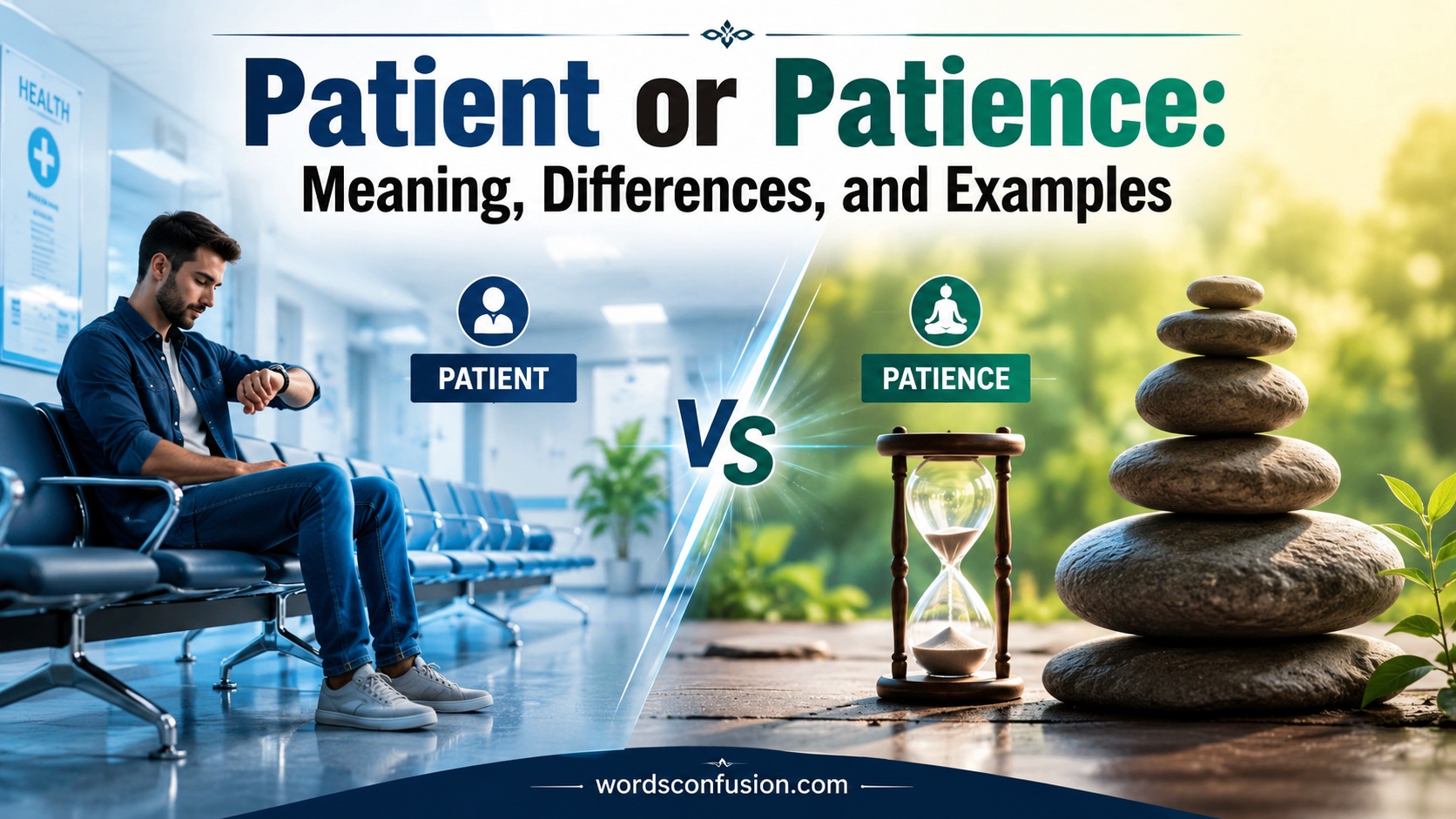
Have you ever written “Please be patience” instead of “Please be patient”? If so, you’re not alone. Patient and patience look and sound remarkably similar, yet they play very different roles in a sentence. One can describe a person, while the other names a quality. To make things even trickier, patient can also refer to someone receiving medical care.
The confusion usually appears in everyday phrases such as “be patient,” “have patience,” “lose patience,” and “thank you for your patience.” Once you understand the grammar behind these expressions, choosing the right word becomes much easier.
This guide explains patient or patience in detail. You’ll learn their meanings, parts of speech, sentence patterns, common mistakes, pronunciation differences, related forms, and practical examples.
Quick Answer
Patient and patience are related words, but they aren’t interchangeable.
- Patient is usually an adjective that describes someone who can wait or handle difficulties calmly.
- Patient can also be a noun meaning someone receiving medical treatment.
- Patience is a noun that means the ability to remain calm while waiting, dealing with problems, or tolerating something difficult.
- Patients is the plural form of the medical noun patient.
- Patiently is the adverb that describes doing something in a calm or tolerant way.
Compare these sentences:
Please be patient.
Please have patience.
Both sentences express a similar idea, but their grammar differs. Patient describes a person, while patience names the quality that person needs.
Comparison Overview
| Word | Part of Speech | Main Meaning | Example |
| Patient | Adjective | Able to wait or tolerate difficulty calmly | “She is very patient.” |
| Patient | Noun | A person receiving medical care | “The patient needs more tests.” |
| Patience | Noun | The ability to remain calm and tolerate difficulty | “Learning requires patience.” |
| Patients | Plural noun | More than one person receiving medical care | “The patients waited outside.” |
| Patiently | Adverb | In a calm or tolerant manner | “He waited patiently.” |
| Impatient | Adjective | Unable or unwilling to wait calmly | “She became impatient.” |
| Impatience | Noun | Lack of patience | “His impatience was obvious.” |
The easiest distinction is patient = person or description and patience = quality.
For example, if you say someone is calm while waiting, that person is patient. If you discuss the ability that allows them to remain calm, you’re talking about patience.
Main Differences Between Patient or Patience
The biggest difference between patient or patience involves grammar and meaning. Although both words relate to calmness and tolerance, they don’t perform the same job in a sentence.
Patient Describes Someone or Something
When patient works as an adjective, it describes a person who can wait without becoming annoyed or frustrated.
For example:
- “Maria is patient with her students.”
- “You need to be patient during the process.”
- “He remained patient despite the delay.”
- “The coach is extremely patient with beginners.”
Here, patient tells you what someone is like.
You can think of it as a personality or behavioral quality. A patient person doesn’t necessarily enjoy waiting. Instead, they can tolerate waiting without reacting with unnecessary frustration.
Patience Names the Quality
Patience turns that quality into a noun.
Consider this sentence:
“Maria has a lot of patience with her students.”
The sentence doesn’t directly describe Maria as patient. Instead, it talks about the quality she possesses.
More examples include:
- “This job requires patience.”
- “You need patience to learn a new language.”
- “His patience impressed the entire team.”
- “The long delay tested my patience.”
A useful question can help you choose between the two:
Are you describing someone or naming the quality?
If you’re describing someone, patient usually works. If you’re naming the quality, use patience.
Patient Also Has a Medical Meaning
There’s another important meaning that makes patient especially interesting.
A patient is a person who receives medical care, examination, diagnosis, or treatment.
For example:
- “The patient spoke with the doctor.”
- “The nurse called the next patient.”
- “The doctor examined three patients this morning.”
- “The patient returned for a follow-up appointment.”
In this use, patient functions as a noun, not an adjective.
That’s why context matters.
Compare:
“The patient doctor explained everything carefully.”
Here, patient is an adjective describing the doctor.
“The patient waited for the doctor.”
Here, patient is a noun referring to the person receiving care.
The spelling stays the same, but the grammatical function changes.
What Does Patient Mean?
The word patient has two major everyday meanings.
Patient as an Adjective
As an adjective, patient describes someone who can remain calm when facing delays, difficulties, mistakes, or annoying situations.
A patient person might wait quietly in a long line. They might explain something several times to a beginner. They might also tolerate a frustrating situation without losing their temper.
For example:
- “My father is very patient with children.”
- “Be patient while the computer updates.”
- “She was patient when the student asked the same question again.”
- “You have to be patient when learning a difficult skill.”
The word often appears with with:
“She is patient with her coworkers.”
It can also appear after be:
“Please be patient.”
Another common structure uses enough:
“He was patient enough to wait another hour.”
Patient as a Noun
As a noun, patient refers to someone under medical care.
Examples:
- “The doctor called the next patient.”
- “The patient arrived early.”
- “The hospital admitted several patients.”
- “Each patient received individual attention.”
The plural form is patients.
This medical meaning has nothing to do with the abstract noun patience.
What Does Patience Mean?
Patience is the ability to remain calm when something takes time or when a situation becomes difficult, frustrating, or annoying.
It describes a quality rather than a person.
For example:
“Teaching young children requires patience.”
The sentence means that teaching children requires the ability to remain calm and tolerant.
Other examples include:
- “She has incredible patience.”
- “The project will require patience.”
- “His patience finally ran out.”
- “Learning to play piano takes patience.”
- “The customer tested my patience.”
Notice that you don’t normally use patience to directly describe a person.
You wouldn’t say:
“She is patience.”
The correct sentence is:
“She is patient.”
However, you can say:
“She has patience.”
That’s the key grammatical distinction.
Common Expressions With Patient and Patience
Certain phrases appear so often that learning them as complete patterns can make the difference much easier to remember.
| Expression | Correct Word | Meaning |
| Be patient | Patient | Remain calm while waiting |
| Patient with someone | Patient | Tolerant toward someone |
| Have patience | Patience | Possess the ability to remain calm |
| Show patience | Patience | Demonstrate calm tolerance |
| Lose patience | Patience | Stop tolerating something calmly |
| Test someone’s patience | Patience | Make someone increasingly frustrated |
| Run out of patience | Patience | No longer have tolerance |
| Thank you for your patience | Patience | Thank someone for waiting calmly |
| Wait patiently | Patiently | Wait in a calm manner |
These expressions provide useful shortcuts when you’re unsure which form belongs in a sentence.
Patient or Patience: How to Choose the Right Word
When you’re stuck between patient or patience, look at what the sentence needs.
Use Patient After “Be”
One of the strongest patterns is:
be + patient
Examples:
- “Please be patient.”
- “Try to be patient.”
- “You need to be patient.”
- “She learned to be patient.”
The verb be commonly connects the subject to an adjective. Since patient functions as an adjective here, the structure works naturally.
That’s why this sentence is incorrect:
“Please be patience.”
The corrected version is:
“Please be patient.”
Use Patience After “Have”
Another useful pattern is:
have + patience
Examples:
- “You need to have patience.”
- “She has patience with beginners.”
- “We need to have patience.”
- “He doesn’t have much patience today.”
Because patience functions as a noun, it works naturally after have.
Use Patience When Naming a Quality
Whenever you talk about patience as an ability or trait, use patience.
For example:
- “Patience is important when teaching.”
- “Her patience helped the child learn.”
- “The situation required patience.”
- “You need patience to finish the project.”
Here, you’re talking about the quality itself rather than describing someone.
Use Patient for Medical Care
When you mean someone receiving medical treatment, use patient.
Examples:
- “The patient is waiting for the doctor.”
- “The doctor examined the patient.”
- “The clinic sees hundreds of patients each week.”
Never use patience for this meaning.
Common Mistakes With Patient and Patience
These two words create several predictable mistakes. Fortunately, each one has a simple correction.
“Please Be Patience”
This is one of the most common errors.
Incorrect:
“Please be patience.”
Correct:
“Please be patient.”
The reason is grammatical. Patient acts as an adjective after be.
“I Need to Be Patience”
Again, the adjective belongs after be.
Incorrect:
“I need to be patience.”
Correct:
“I need to be patient.”
If you want to use the noun, restructure the sentence:
“I need to have patience.”
Both versions work because they use different grammatical structures.
“She Has a Lot of Patient”
This sentence needs the noun patience.
Incorrect:
“She has a lot of patient.”
Correct:
“She has a lot of patience.”
However, patient could be correct in another context:
“The doctor has a lot of patients.”
Here, patients means people receiving medical treatment.
“Thank You for Your Patient”
This phrase causes confusion because your can be followed by different parts of speech depending on the sentence.
The standard expression is:
“Thank you for your patience.”
The sentence thanks someone for remaining calm while waiting.
For example, a company might tell customers:
“Thank you for your patience while we resolve this issue.”
“The Doctor Saw Several Patience”
This sentence confuses patience with the plural form of patient.
Incorrect:
“The doctor saw several patience.”
Correct:
“The doctor saw several patients.”
The word patients refers to multiple people receiving medical care.
Read More: Flys or Flies: Correct English Usage Explained With Examples for 2026
Patient, Patients, and Patience: The Three-Way Confusion
Many spelling mistakes become easier to understand when you compare all three words.
| Word | Meaning | Example |
| Patient | Calm and tolerant | “She is patient.” |
| Patient | A person receiving medical care | “The patient is resting.” |
| Patients | Multiple people receiving medical care | “The patients are waiting.” |
| Patience | Ability to remain calm and tolerant | “He needs patience.” |
The final letters can create confusion, especially when you’re writing quickly.
A simple memory trick helps:
Patient = person or personality
Patients = medical people, plural
Patience = quality
Once you separate these meanings, the spelling becomes much easier to manage.
Patient vs. Patience in Real-Life Examples
The difference becomes clearer when you see both words operating in similar situations.
Waiting in a Long Line
“You need to be patient during the holiday rush.”
Here, patient describes the person.
“The holiday rush requires patience.”
Here, patience names the quality required.
Both sentences communicate almost the same idea. The grammatical structure changes.
Learning a New Skill
“You need to be patient when learning to code.”
The speaker describes the learner’s behavior.
“Learning to code requires patience.”
The second sentence treats patience as a necessary quality.
Teaching a Child
“Good teachers are usually patient with young learners.”
Patient describes the teachers.
“Teaching young learners requires patience.”
Patience identifies the quality required.
Dealing With Customer Complaints
“Customer service representatives need to be patient with frustrated customers.”
“Customer service requires considerable patience.”
Again, both forms work because they perform different grammatical jobs.
“Thank You for Your Patience” vs. “Please Be Patient”
These expressions are closely related, but they aren’t grammatically identical.
Thank You for Your Patience
This expression uses the noun patience.
It means you’re thanking someone for remaining calm or waiting while something takes time.
Examples:
- “Thank you for your patience during the delay.”
- “Thank you for your patience while we investigate the issue.”
- “We appreciate your patience.”
This expression appears frequently in customer service, business communication, technical support, and public announcements.
Please Be Patient
This expression uses the adjective patient.
It asks someone to remain calm or tolerate a delay.
Examples:
- “Please be patient while the page loads.”
- “Please be patient with new employees.”
- “Please be patient during the registration process.”
The distinction is easy:
Thank you for your patience = appreciation for a quality already being shown.
Please be patient = a request for someone to display that quality.
FAQs:
Is it “be patient” or “be patience”?
The correct expression is “be patient.” The word patient functions as an adjective after be.
Is it “have patient” or “have patience”?
The standard expression is “have patience.” Patience is a noun that names the quality of remaining calm.
What is the main difference between patient and patience?
Patient describes someone who can wait or tolerate difficulty calmly. Patience refers to the ability or quality itself.
Is patient a noun or an adjective?
It can be both. As an adjective, it describes someone who remains calm. As a noun, it means a person receiving medical care.
Is patience a noun?
Yes. Patience is an abstract noun that refers to the ability to remain calm while waiting or dealing with difficulty.
Conclusion:
The difference between patient or patience becomes simple once you focus on their grammatical roles. Patient describes someone who can tolerate waiting, frustration, or difficulty calmly. It can also mean a person receiving medical treatment. Patience, on the other hand, names the quality that allows someone to remain calm and tolerant.

Andrew Wilson is an experienced language researcher and content writer specializing in WordsConfusion topics. He helps readers understand commonly confused English words, spelling differences, grammar rules, word meanings, and proper usage through clear explanations, practical examples, and easy-to-follow language guides. His goal is to make English learning simple, accurate, and accessible for students, writers, professionals, and everyday learners.