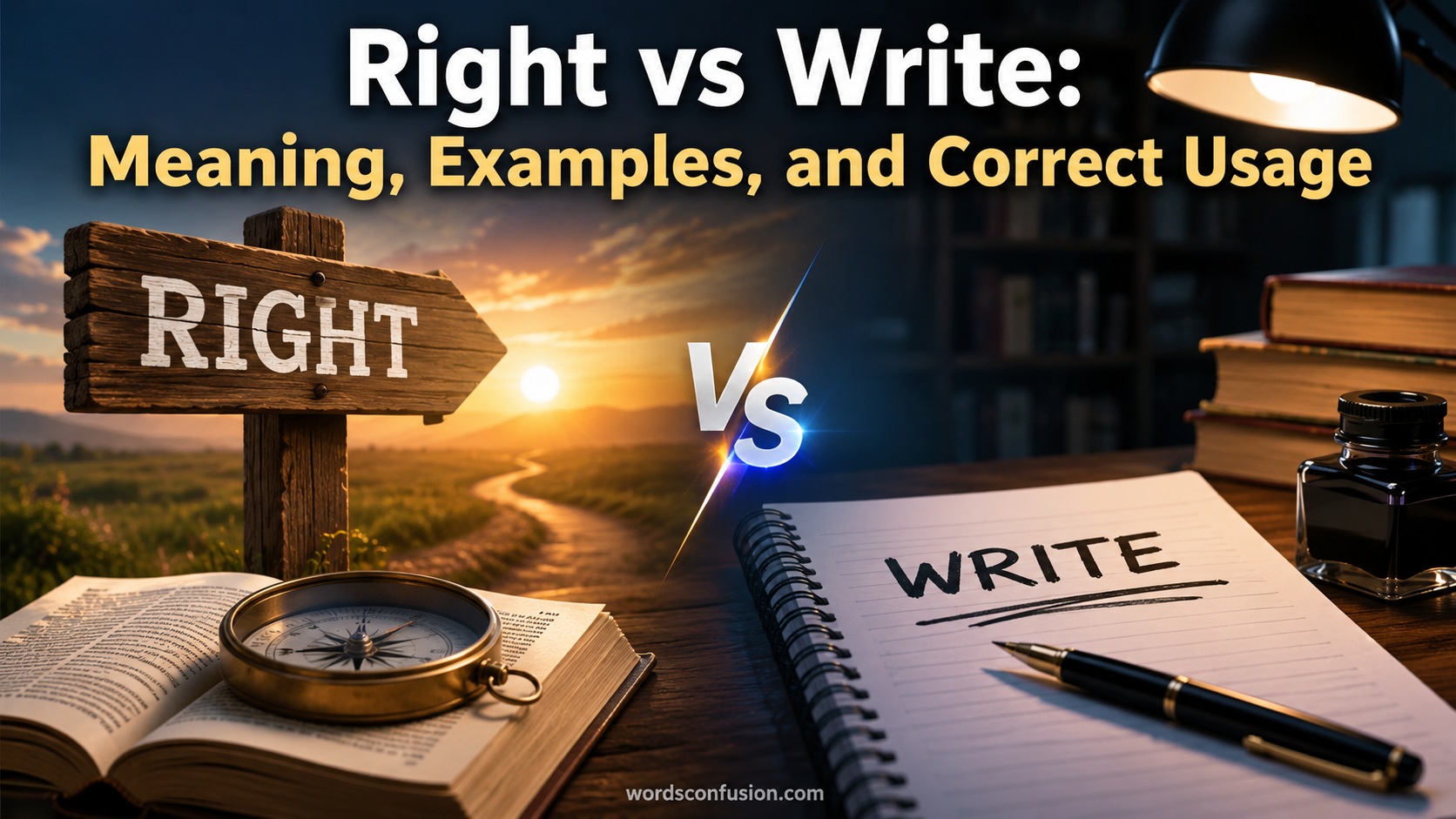
English has plenty of words that sound exactly alike but mean completely different things. Right vs write is one of the most common examples. If you hear someone say, “Write your answer,” or “Your answer is right,” the pronunciation alone won’t tell you which word they mean.
That’s where the confusion begins.
Right can describe something correct, proper, fair, or located on the opposite side from the left. It can also work as a noun, adverb, adjective, or verb. Write, on the other hand, is primarily a verb that means to form words, letters, numbers, or information in written form.
The two words are homophones because they share the same pronunciation but have different spellings and meanings. Once you understand what each word does in a sentence, choosing the correct spelling becomes much easier.
For example:
- You are right. → You are correct.
- Write your name here. → Put your name on the form.
- Turn right at the corner. → Move toward the right-hand side.
- Write a letter to your friend. → Create a letter in written form.
The sound stays the same. The meaning changes completely.
Quick Answer
Right and write sound alike but aren’t interchangeable. Right usually means correct, proper, opposite of left, or an entitlement. Write means to produce words or information in written form.
| Word | Main Meaning | Part of Speech | Example |
| Right | Correct, proper, opposite of left, entitlement | Adjective, adverb, noun, verb | Your answer is right. |
| Write | Produce written words or information | Verb | Write your answer here. |
A simple rule can help:
If you’re putting words on paper or a screen, use “write.” If you’re talking about correctness or direction, use “right.”
There are exceptions because right has several meanings. However, this basic distinction handles most everyday situations.
Comparison Overview
| Feature | Right | Write |
| Pronunciation | /raɪt/ | /raɪt/ |
| Spelling | Right | Write |
| Main function | Describes correctness, direction, entitlement, and more | Describes the act of producing written language |
| Common part of speech | Adjective, adverb, noun, verb | Verb |
| Past tense | Righted | Wrote |
| Past participle | Righted | Written |
| Example | You chose the right answer. | Write your answer below. |
| Opposite/common contrast | Wrong or left, depending on meaning | Read, depending on context |
The biggest difference isn’t pronunciation. It’s meaning and grammatical function.
When you say, “That is right,” you’re talking about correctness. When you say, “Write that down,” you’re asking someone to record information.
Main Differences Between Right vs Write
The difference between right vs write becomes clear when you examine their meanings, grammatical roles, and common sentence patterns.
Right Means Correct
One of the most common meanings of right is correct or accurate.
If someone gives the correct answer to a question, you can say:
- Your answer is right.
- You got the answer right.
- That’s the right answer.
- She was right about the problem.
Here, right has nothing to do with writing or direction. It tells you that something agrees with the facts or with what is considered correct.
For example:
Incorrect: Your answer is write.
Correct: Your answer is right.
The word write would make no sense because nobody is producing written language in that sentence.
Right Means the Opposite of Left
Right also refers to a direction or position.
For example:
- Turn right at the traffic light.
- The store is on your right.
- Raise your right hand.
- The restaurant is on the right side of the road.
This meaning is easy to identify because the sentence usually involves movement, position, or body parts.
Imagine you’re giving directions to a friend. You might say:
“Walk straight for two blocks and turn right.”
You wouldn’t say “turn write.” The word right identifies the direction.
Right Can Mean Morally or Socially Proper
Right can also describe an action that is considered fair, proper, ethical, or acceptable.
Consider these examples:
- Helping someone in trouble is the right thing to do.
- She knew it was right to tell the truth.
- You made the right decision.
- Treating people fairly is right.
In this sense, right contrasts with wrong.
That gives you another useful memory clue:
Right = correct or proper.
Right Can Mean an Entitlement
As a noun, right can refer to something a person is legally, socially, or morally entitled to have or do.
Examples include:
- Everyone has the right to express an opinion.
- You have the right to ask questions.
- Citizens have certain legal rights.
- Employees may have the right to receive certain benefits.
This meaning appears frequently in legal, political, social, and everyday discussions.
Notice the grammatical difference:
You have the right to ask.
Here, right is a noun. It doesn’t mean “correct,” and it certainly doesn’t mean “to produce written words.”
Right Can Function as an Adverb
Right also works as an adverb. Depending on context, it can mean exactly, directly, immediately, or completely.
Examples:
- Come right here.
- The house is right across the street.
- I knew right away.
- She guessed right.
- The answer is right in front of you.
The meaning depends heavily on context.
For example, “Come right here” means come directly here. In “You guessed right,” it means you guessed correctly.
Right Can Function as a Verb
Although less common in everyday conversation, right can also work as a verb.
It can mean to correct, restore, or put something into the proper position.
Examples:
- The workers righted the overturned boat.
- The company tried to right the situation.
- He worked to right the wrong.
The past tense is generally righted.
This makes right particularly flexible because it can serve several grammatical roles.
What Does Write Mean?
Write is a verb that refers to producing written language or recording information.
You can write with a pen, pencil, keyboard, touchscreen, or another writing method.
Examples include:
- Write your name.
- Write a letter.
- Write an email.
- Write a report.
- Write a story.
- Write the answer.
- Write down the address.
The essential idea remains the same: write involves creating or recording something in written form.
Write Means to Put Words Into Written Form
The most basic meaning of write is to form letters, words, sentences, or other symbols.
For example:
Please write your full name on the form.
The person needs to put their name into written form.
Likewise:
She writes in her journal every evening.
The person creates written entries in a journal.
Write Can Mean Create Written Content
Write isn’t limited to handwriting.
You can write:
- articles
- books
- essays
- emails
- reports
- poems
- messages
- scripts
- instructions
- notes
- reviews
Someone typing an article on a laptop is still writing.
That distinction matters because writing doesn’t necessarily involve a pen or paper. Modern writing often happens digitally.
Write Can Mean Record Information
You can also use write when recording information.
For example:
- Write down my phone number.
- Write the address on this paper.
- Please write the date here.
- Write your ideas in your notebook.
The phrase write down is particularly common. It means to record information so you can remember or refer to it later.
Forms of Write
Write is an irregular verb. Its forms don’t follow the regular pattern of simply adding -ed.
| Verb Form | Word | Example |
| Base form | write | I write every day. |
| Third-person singular | writes | She writes clearly. |
| Present participle | writing | He is writing an email. |
| Simple past | wrote | She wrote a letter. |
| Past participle | written | The report was written yesterday. |
This creates another common source of confusion.
You should say:
- I write every day.
- I wrote yesterday.
- I have written three pages.
Not:
- I writed yesterday.
- I have wrote three pages.
The correct forms are write → wrote → written.
Right vs Write: Why Are They Confused?
The main reason is simple: they sound exactly alike in standard pronunciation.
These words belong to a group called homophones.
What Are Homophones?
Homophones are words that have the same pronunciation but different meanings or spellings.
Some familiar examples include:
- right / write
- there / their / they’re
- to / too / two
- hear / here
- knew / new
When you hear right or write, your brain can’t determine the spelling from sound alone.
You need context.
For instance:
“Please write the answer.”
The surrounding words tell you that the sentence concerns producing written information.
Compare that with:
“Your answer is right.”
Here, right clearly means correct.
The Silent W in Write
One useful spelling clue is the w in write.
The w isn’t pronounced. Both write and right sound like /raɪt/.
You can remember:
Write has a silent W because writing is something you do with words.
This isn’t a grammatical rule. It’s simply a memory aid.
Read More: Quiet vs Quite: Meaning, Differences, Examples, and Correct Usage
How to Remember Right vs Write
A good memory trick can prevent repeated mistakes.
Remember Right With Correct
Connect right with correct.
- Right answer = correct answer.
- Right decision = correct or proper decision.
- Right choice = correct choice.
You can also connect right with left:
- right ↔ left
These two clues cover many common uses.
Remember Write With Words
Connect write with words.
Both begin with the idea of putting language into written form:
Write → words → written language
If someone asks you to put something on paper or a screen, write is usually the word you need.
Use the “Put It Down” Test
Ask yourself:
Am I putting words or information into written form?
If yes, choose write.
Please ___ your address here.
You’re recording an address, so:
Please write your address here.
Now ask:
Am I talking about correctness or direction?
If yes, choose right.
You got the answer ___.
The answer is correct, so:
You got the answer right.
This quick test works surprisingly well.
Right vs Write Examples in Sentences
Seeing the words in realistic sentences makes the distinction easier to remember.
Examples With Right
- That’s the right answer.
- Turn right after the bridge.
- You made the right decision.
- She has the right to ask questions.
- Is this the right address?
- He chose the right person for the job.
- The pharmacy is on your right.
- I knew right away that something was wrong.
- You guessed right.
- Doing the right thing isn’t always easy.
Examples With Write
- Write your name at the top.
- Please write your answer below.
- I need to write an email.
- She likes to write short stories.
- He wrote a detailed report.
- They are writing a new book.
- Please write down the instructions.
- I wrote the address in my notebook.
- She has written several articles.
- Don’t forget to write the date.
Right vs Write: Common Mistakes
Because the words sound identical, spelling mistakes are extremely common.
Mistake: Using Write for Correct
Incorrect: Your answer is write.
Correct: Your answer is right.
Why? Because right means correct.
Mistake: Using Right for Writing
Incorrect: Please right your name.
Correct: Please write your name.
Why? Because write means to produce written words.
Mistake: Using Write for Direction
Incorrect: Turn write at the next street.
Correct: Turn right at the next street.
Why? Right identifies the direction.
Mistake: Using Right for a Letter
Incorrect: I need to right a letter.
Correct: I need to write a letter.
Why? A letter is something you write.
Right vs Write: Correct and Incorrect Examples
| Confusing Sentence | Correct Sentence | Explanation |
| Your answer is write. | Your answer is right. | Right means correct. |
| Please right your name. | Please write your name. | Write means produce written words. |
| Turn write at the corner. | Turn right at the corner. | Right indicates direction. |
| I need to right an email. | I need to write an email. | Write means create an email. |
| You are write about that. | You are right about that. | Right means correct. |
| Write is the opposite of left. | Right is the opposite of left. | Right describes direction. |
FAQs:
Is “right” and “write” the same word?
No. Right and write are different words. They sound alike but have different spellings, meanings, and grammatical functions.
What is the difference between right and write?
Right commonly means correct, proper, opposite of left, or an entitlement. Write means to produce words, letters, numbers, or information in written form.
Are right and write homophones?
Yes. Right and write are homophones because they have the same pronunciation but different spellings and meanings.
Is write a verb?
Yes. Write is primarily a verb. It means to produce written words or record information. Its major forms include write, writes, writing, wrote, and written.
Is right a noun or adjective?
Right can be both. It can also function as an adverb or verb.
For example:
- Adjective: the right answer
- Noun: a legal right
- Adverb: guess right
- Verb: right the situation
What is the past tense of write?
The simple past tense of write is wrote.
The past participle is written.
- Present: I write.
- Past: I wrote.
- Perfect: I have written.
What is the difference between right, write, and rite?
Right means correct, proper, directional, or an entitlement. Write means to produce written language. Rite means a formal ceremony or ritual.
How can I remember the difference between right and write?
Associate right with correct or left. Associate write with words and written language.
A simple reminder is:
Write words. Get things right.
Conclusion:
The difference between right vs write is straightforward once you focus on meaning rather than pronunciation. Right has several meanings. It can mean correct, proper, opposite of left, or an entitlement. It can function as an adjective, adverb, noun, or verb.Write is primarily a verb. It means to produce written words or record information.
In that sentence, both words sound alike but perform completely different jobs. Write describes the act of putting the answer into written form. Right describes whether the answer is correct. Once you connect each spelling with its meaning, this common homophone pair becomes much easier to handle.

Andrew Wilson is an experienced language researcher and content writer specializing in WordsConfusion topics. He helps readers understand commonly confused English words, spelling differences, grammar rules, word meanings, and proper usage through clear explanations, practical examples, and easy-to-follow language guides. His goal is to make English learning simple, accurate, and accessible for students, writers, professionals, and everyday learners.