
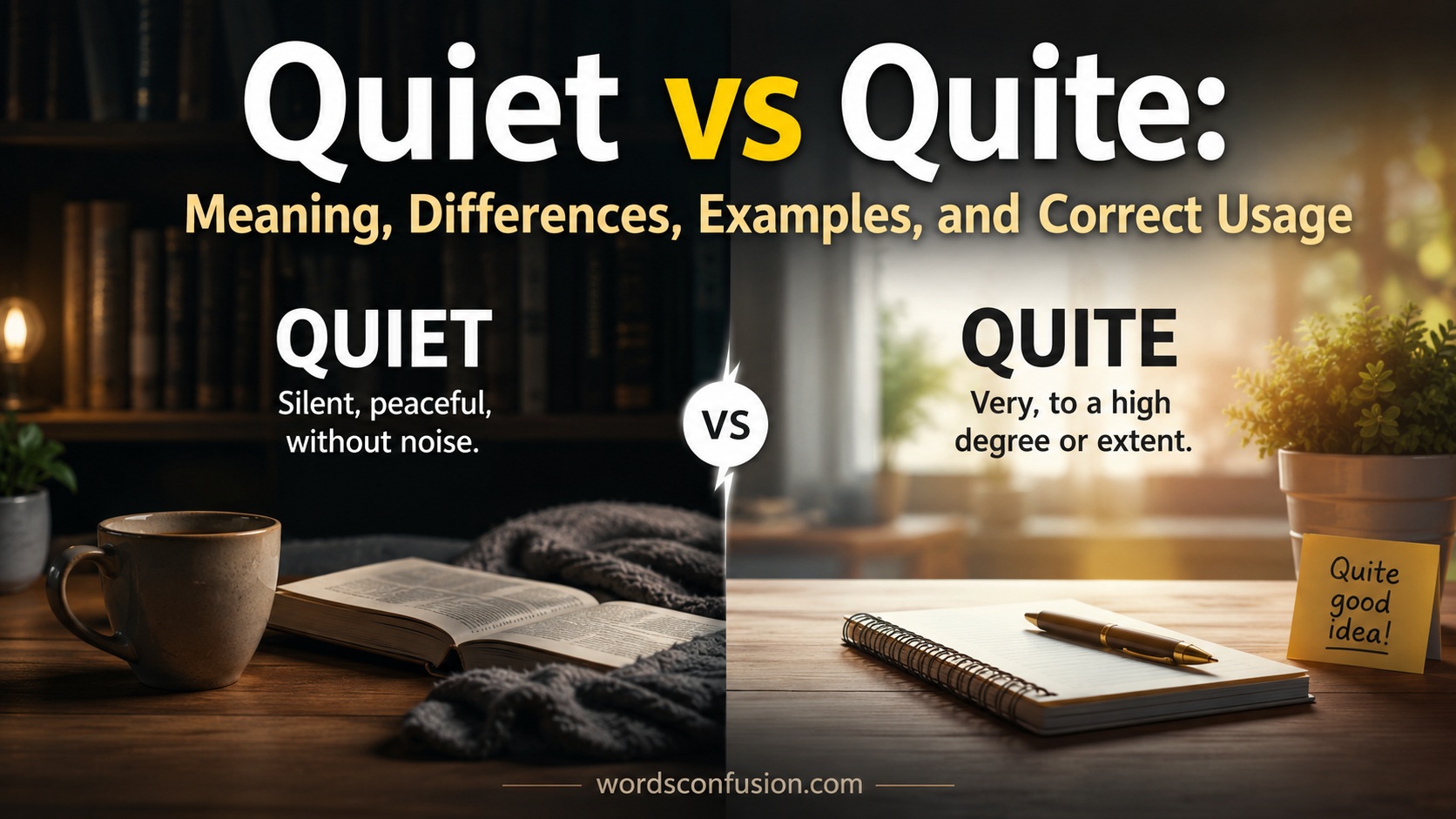
If you’ve ever paused while writing a sentence like “Please be quite” or “The room is quiet interesting,” you’re not alone. Quiet vs Quite is a classic English word confusion because the two words look almost identical. They even begin with the same letters.
The difference, however, is straightforward once you connect each word with its job. Quiet relates to sound, silence, calmness, or a lack of noise. Quite is an adverb that expresses degree, extent, or emphasis.
There’s also a pronunciation difference that makes the distinction easier to remember. Quiet usually has two syllables, while quite has one. So although these words look like close cousins, they behave very differently in a sentence.
Whether you’re writing an email, preparing an essay, chatting with friends, or improving your English vocabulary, knowing when to use quiet and quite can prevent some surprisingly common mistakes.
Quick Answer
Quiet means having little or no noise, being calm, or making something less noisy. It can also describe someone who doesn’t talk much.
Quite is an adverb that usually means fairly, rather, considerably, or completely, depending on the context.
| Word | Meaning | Part of Speech | Example |
| Quiet | Having little or no noise | Adjective | The library is quiet. |
| Quiet | A state of silence or calm | Noun | I enjoy the quiet. |
| Quiet | Make less noisy | Verb | The teacher tried to quiet the class. |
| Quite | Fairly, rather, or considerably | Adverb | The test was quite difficult. |
| Quite | Completely or absolutely in some contexts | Adverb | You’re quite right. |
The easiest rule is:
Quiet is about sound or calmness. Quite is about degree or extent.
Comparison Overview
The quickest way to understand quiet vs quite is to look at what each word does in a sentence.
| Feature | Quiet | Quite |
| Core meaning | Little noise, calm, or silence | Degree, extent, or emphasis |
| Main part of speech | Adjective | Adverb |
| Other grammatical use | Noun and verb | Primarily adverb |
| Pronunciation | /ˈkwaɪ.ət/ | /kwaɪt/ |
| Syllables | Usually 2 | 1 |
| Example | The room is quiet. | The room is quite large. |
| Connected idea | Sound or silence | How much or to what extent |
| Comparative form | Quieter | No comparative form |
| Superlative form | Quietest | No superlative form |
Consider these two sentences:
- The restaurant is quiet.
- The restaurant is quite expensive.
In the first sentence, quiet tells you about the level of noise. In the second, quite tells you about the degree of expense.
That single distinction solves most quiet vs quite questions.
Main Differences Between Quiet vs Quite
The words quiet and quite differ in meaning, grammar, pronunciation, and sentence function. Their similar spelling creates the confusion, but their roles are quite distinct.
Quiet Refers to Sound, Silence, or Calmness
Quiet usually describes something that produces little noise or creates a peaceful environment.
For example:
- The classroom is quiet.
- We found a quiet restaurant.
- She has a quiet voice.
- The neighborhood becomes quiet at night.
You can also use quiet to describe a person who doesn’t speak much.
For example:
He’s a quiet student who prefers listening to speaking.
Here, quiet doesn’t necessarily mean the student makes no sound. Instead, it suggests that the person is reserved or not very talkative.
Quite Refers to Degree or Extent
Quite works differently. It modifies another word and tells you how much, how strongly, or to what extent something is true.
For example:
- The movie was quite interesting.
- The road is quite narrow.
- She speaks quite clearly.
- The exam was quite difficult.
In each sentence, quite modifies another word.
Notice the pattern:
quite + adjective
- quite difficult
- quite useful
- quite expensive
- quite unusual
It can also modify an adverb:
- quite slowly
- quite carefully
- quite easily
- quite quickly
Quiet Can Be an Adjective, Noun, or Verb
One important difference in quiet vs quite is grammatical flexibility.
Quiet commonly appears as an adjective:
It’s a quiet street.
It can also function as a noun:
I enjoy the quiet of the countryside.
As a noun, quiet refers to a state or period without much noise.
It can also function as a verb:
The teacher tried to quiet the students.
Here, quiet means to make someone or something less noisy.
Quite Primarily Functions as an Adverb
Quite normally functions as an adverb.
It modifies adjectives, adverbs, and certain expressions.
Examples include:
- quite good
- quite difficult
- quite slowly
- quite unusual
- quite certain
You wouldn’t normally use quite as an adjective in standard English.
What Does Quiet Mean?
Quiet describes a lack of noise, reduced noise, peacefulness, or limited speech.
Its meaning can shift slightly depending on the context. However, the basic concept remains connected to low sound, calmness, or restraint.
Quiet as an Adjective
The most common use of quiet is as an adjective.
It describes a person, place, object, sound, or situation.
Examples:
- The library is quiet.
- We live on a quiet street.
- The baby finally became quiet.
- He spoke in a quiet voice.
- It was a quiet evening.
A quiet place doesn’t necessarily have absolute silence. There may still be birds, traffic in the distance, or people talking softly.
That’s an important distinction.
Quiet usually means low noise rather than complete silence.
Quiet as a Noun
Quiet can also work as a noun when you mean a period or state of calm silence.
Examples:
- I enjoy the quiet of early mornings.
- After the crowd left, the building returned to quiet.
- She needed some quiet after a stressful day.
The noun often refers to an atmosphere rather than a specific sound.
Quiet as a Verb
As a verb, quiet means to make something or someone less noisy or less agitated.
Examples:
- The teacher tried to quiet the class.
- The mother quietly sang to quiet the crying baby.
- The announcement helped quiet the crowd.
You’ll also see the related verb quieten, especially in British English. In American English, quiet is commonly used as the verb.
Common Meanings of Quiet
Depending on the context, quiet can mean:
- Having little noise
- Free from disturbance
- Calm or peaceful
- Not talkative
- Soft in volume
- Less active than usual
- Made less noisy
For example, a quiet neighborhood may have little traffic. A quiet person may simply speak less than others. A quiet evening may mean a peaceful evening without much activity.
What Does Quite Mean?
Quite expresses degree or extent. It can strengthen or soften the meaning of another word depending on the context.
This is where things become slightly more interesting.
Quite Meaning “Fairly” or “Rather”
In many everyday sentences, quite means something similar to fairly, rather, or reasonably.
Examples:
- The movie was quite good.
- The restaurant is quite expensive.
- She seems quite confident.
- The instructions were quite clear.
Here, quite increases the degree of the adjective without necessarily making it absolute.
For example:
The exam was quite difficult.
This tells you the exam had a substantial level of difficulty.
Quite Meaning “Completely”
In some contexts, especially with certain adjectives, quite can mean completely or entirely.
Examples:
- You’re quite right.
- The answer is quite correct.
- The idea is quite impossible.
- That’s quite different.
The exact force of quite depends heavily on the adjective and the surrounding context.
That’s why simply memorizing quite = very can lead you astray.
Why Quite Changes Meaning With Context
Compare these sentences:
- The movie was quite good.
- The answer is quite correct.
- The situation is quite impossible.
The first sentence can suggest fairly or considerably good. The second can mean completely correct. The third can suggest completely impossible.
Context matters.
This is one reason quite deserves more attention than a simple dictionary definition might suggest.
Quiet vs Quite Examples
Real examples make the distinction much easier to remember.
Examples With Quiet
- The baby is finally quiet.
- We stayed in a quiet hotel.
- The library remained quiet throughout the afternoon.
- She has a quiet personality.
- Please keep quiet during the examination.
- The streets are unusually quiet tonight.
- He prefers quiet places to crowded ones.
In every example, quiet relates to noise, calmness, or limited speech.
Examples With Quite
- The assignment was quite challenging.
- She is quite talented.
- The weather is quite pleasant today.
- That restaurant is quite popular.
- The instructions are quite simple.
- He arrived quite early.
- The answer is quite clear.
Here, quite expresses degree.
Quiet and Quite in the Same Sentence
Yes, you can use both words in one sentence.
For example:
The café is quiet but quite expensive.
Here, quiet describes the noise level. Quite describes the degree of expense.
Another example:
We found a quiet neighborhood that was quite close to downtown.
Again, each word has a completely different function.
A useful trick is to replace quiet with silent and quite with fairly. If the sentence still makes sense, you’ve probably chosen the right word.
Read More: Principal vs Principle: Meaning, Differences, and Examples
Quiet vs Quite Pronunciation
Pronunciation provides another strong clue when you’re trying to distinguish these words while speaking.
How to Pronounce Quiet
Quiet is generally pronounced:
/ˈkwaɪ.ət/
It usually has two syllables:
QUI-et
There’s a small vowel sound between the two parts.
How to Pronounce Quite
Quite is pronounced:
/kwaɪt/
It has one syllable:
QUITE
The word ends with a clear t sound.
Easy Pronunciation Test
Say these aloud:
- quiet → KWY-uht
- quite → KWYT
The difference becomes much clearer when you slow down.
This pronunciation distinction also helps prevent spelling mistakes.
Quiet vs Quite Spelling
The spelling difference looks tiny, but it changes the word completely.
Quiet contains: q-u-i-e-t
Quite contains: q-u-i-t-e
The letters e and t switch positions.
A simple way to remember them is:
Quiet has “ie” in the middle. Quite has “it” in the middle.
Think of the spelling as a visual clue:
- quiet → q-u-i-e-t
- quite → q-u-i-t-e
Quiet vs Quite: Common Mistakes
Even strong English learners sometimes mix these words up.
Mistake: “Please Be Quite”
Incorrect:
Please be quite.
Correct:
Please be quiet.
Why? You’re asking someone to stop making noise. Therefore, quiet is the correct word.
Mistake: “Quite Interesting” Written as “Quiet Interesting”
Incorrect:
The book was quiet interesting.
Correct:
The book was quite interesting.
You’re describing the degree of interest, so you need quite.
Mistake: “The Room Is Quite”
Incorrect:
The room is quite.
Correct:
The room is quiet.
If you’re saying the room has little noise, use quiet.
However, quite can appear after is when another word follows it:
The room is quite large.
Here, quite modifies large.
Mistake: Confusing Quiet With Quietly
Consider:
She closed the door quietly.
Quietly tells you how she closed the door.
Compare that with:
The room was quiet.
Quiet describes the room itself.
These words are related but don’t have the same grammatical function.
Quiet vs Quite vs Quietly
These three words are worth separating because learners often confuse them.
| Word | Function | Meaning | Example |
| Quiet | Adjective | Low in noise or calm | The room is quiet. |
| Quite | Adverb | Fairly, considerably, or completely | The room is quite large. |
| Quietly | Adverb | In a quiet manner | She spoke quietly. |
Here’s an easy way to test them:
- What is something like? → quiet
- To what degree? → quite
- How does an action happen? → quietly
FAQs:
Is it “be quiet” or “be quite”?
The correct expression is “be quiet.”
You use quiet because you’re asking someone to stop making noise or to speak more softly.
Please be quiet during the movie.
Quite would be incorrect in this sentence.
Is quite the opposite of quiet?
No. Quiet and quite aren’t opposites.
They simply have different meanings.
Quiet relates to sound or calmness. Quite expresses degree or extent.
Is quiet an adjective or an adverb?
Quiet is most commonly an adjective, but it can also function as a noun or verb.
For example:
- The room is quiet. — adjective
- I enjoy the quiet. — noun
- The teacher tried to quiet the class. — verb
The adverb form is usually quietly.
Is quite an adjective?
No. Quite is primarily an adverb.
It modifies words such as adjectives and adverbs:
- quite difficult
- quite beautiful
- quite quickly
- quite carefully
How do you pronounce quiet and quite?
Quiet usually has two syllables: /ˈkwaɪ.ət/.
Quite has one syllable: /kwaɪt/.
The pronunciation difference is a useful way to distinguish them in conversation.
What is the main difference between quiet and quite?
The simplest distinction is:
Quiet = little or no noise.
Quite = fairly, considerably, or completely depending on context.
For example:
The library is quiet.
The library is quite large.
Can quiet and quite appear in the same sentence?
Absolutely.
For example:
The hotel is quiet but quite expensive.
Quiet describes the hotel’s noise level. Quite describes its price.
Conclusion:
The difference between quiet vs quite becomes simple when you focus on meaning rather than spelling. Quiet relates to sound, silence, calmness, or limited speech. It can work as an adjective, noun, or verb. Quite is an adverb that expresses degree. Depending on context, it can mean fairly, rather, considerably, or completely.

Andrew Wilson is an experienced language researcher and content writer specializing in WordsConfusion topics. He helps readers understand commonly confused English words, spelling differences, grammar rules, word meanings, and proper usage through clear explanations, practical examples, and easy-to-follow language guides. His goal is to make English learning simple, accurate, and accessible for students, writers, professionals, and everyday learners.