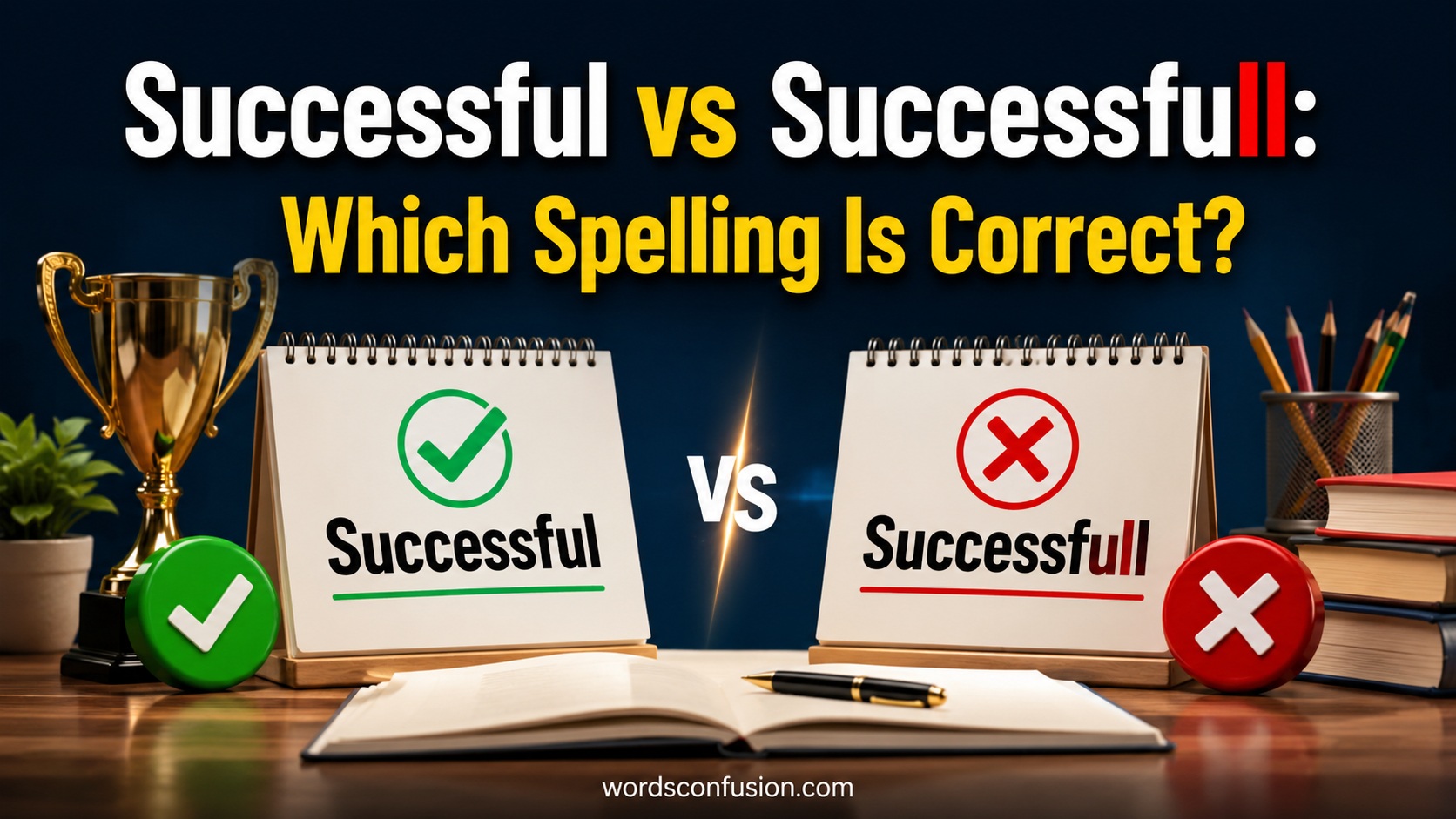
Successful and successfull look almost identical at first glance. Both seem to come from the word success, and the extra l in successfull may seem logical because the standalone word full contains two ls.
However, only one spelling is correct in standard English.
The correct spelling is successful.
Successfull is a common misspelling. It incorrectly adds a second l to the suffix -ful. Once you understand how the word is formed, the spelling becomes much easier to remember.
Quick Answer: Successful or Successfull?
Successful is the correct spelling.
Successfull is incorrect.
The correct word means achieving a desired result, reaching a goal, or producing a favorable outcome.
Correct: She built a successful business.
Incorrect: She built a successfull business.
The spelling follows this simple pattern:
SUCCESS + FUL = SUCCESSFUL
The suffix -ful usually contains only one l when it forms part of another word. Therefore, the correct spelling ends in -ful, not -full.
Successful vs Successfull: Which Spelling Is Correct?
The correct spelling is successful.
The word successful contains the following parts:
success + -ful = successful
The base word success means a favorable result or the achievement of a goal. The suffix -ful means “full of” or “characterized by.”
Together, successful describes someone or something that achieves a positive result.
For example:
- The company launched a successful product.
- She had a successful career.
- The experiment was successful.
- His attempt to solve the problem was successful.
The spelling successfull is incorrect because English does not normally use -full as the suffix in this word.
Successful vs Successfull: Side-by-Side Comparison
| Spelling | Correct? | Meaning | Example |
| Successful | Yes | Achieving a desired result | The project was successful. |
| Successfull | No | Incorrect spelling | Not used in standard English |
If you’re writing an essay, email, blog post, application, report, or professional document, use successful.
What Does Successful Mean?
Successful is an adjective. It describes a person, action, plan, project, business, attempt, or event that achieves the intended result.
The exact meaning can change slightly depending on the context.
Successful Can Mean Achieving a Goal
When someone reaches a goal, that person may be described as successful.
- She was successful in becoming a doctor.
- He successfully completed the training program.
In this context, successful focuses on achievement.
Successful Can Mean Producing a Positive Result
A plan doesn’t need to make someone rich or famous to be successful.
For example:
A small charity campaign that reaches its donation goal can be successful.
Similarly, a scientific experiment, business launch, negotiation, or personal project can succeed without becoming globally famous.
- The meeting was successful.
- The treatment produced a successful result.
- The marketing campaign was successful.
Successful Can Describe a Person’s Career or Life
The word can also describe someone who has achieved considerable success in a particular field.
- She is a successful lawyer.
- He became a successful entrepreneur.
- The author had a successful writing career.
However, successful doesn’t always mean wealthy. A person can be successful because they achieved a personal, professional, academic, or creative goal.
Why Is Successful Spelled With One L?
The main reason people write successfull is simple: they confuse the suffix -ful with the standalone word full.
These two forms look similar, but they serve different purposes.
| Word or Form | Function | Example |
| full | A standalone adjective | The box is full. |
| -ful | A suffix added to another word | She is successful. |
When full stands alone, it has two ls.
When -ful appears as a suffix in words such as helpful, careful, and successful, it normally has one l.
Compare these examples:
- full → The room is full.
- helpful → Your advice was helpful.
- careful → Be careful on the stairs.
- successful → The project was successful.
The extra l belongs to the standalone word full. It doesn’t normally carry over when -ful becomes a suffix.
The Suffix Rule: -ful Usually Has One L
The suffix -ful often means “full of” or “characterized by.”
Here are several common examples:
- help + ful = helpful
- care + ful = careful
- hope + ful = hopeful
- use + ful = useful
- power + ful = powerful
- success + ful = successful
Notice the pattern. Each word ends in -ful with one l.
That makes this spelling rule especially useful:
When -ful acts as a suffix, it is generally spelled with one L.
This rule helps explain why these forms are correct:
- successful
- beautiful
- wonderful
- peaceful
- meaningful
- respectful
- skillful
And these forms are incorrect:
- ❌ successfull
- ❌ beautifull
- ❌ wonderfull
- ❌ peacefull
- ❌ meaningfull
English has exceptions and historical quirks. Still, this rule works extremely well for everyday spelling.
Successful vs Successfull: Understanding the Word Structure
Breaking a difficult word into smaller pieces can make spelling much easier.
Look at successful:
S U C C E S S + F U L
The word contains:
- success — the base word
- -ful — the suffix
Put them together:
SUCCESS + FUL = SUCCESSFUL
The word does not follow this pattern:
SUCCESS + FULL = SUCCESSFULL
That version incorrectly treats the suffix as the complete word full.
A useful memory trick is to imagine the word as a small mathematical formula:
Success + one L = Successful
That may sound simple. Simple is exactly what makes a spelling trick useful.
Successful vs Successfull: Common Spelling Mistakes
The word contains several areas where writers can make mistakes.
Successfull
This is the most direct error.
Incorrect: The company became successfull.
Correct: The company became successful.
The writer has added an unnecessary second l.
Succesful
This version drops one s from the middle of the word.
Incorrect: She had a succesful career.
Correct: She had a successful career.
Remember that success contains two s letters at the end:
s-u-c-c-e-s-s
Therefore, successful keeps the spelling of the base word success.
Sucessful
This spelling removes one of the two c letters.
Incorrect: The project was sucessful.
Correct: The project was successful.
The beginning of the word is:
s-u-c-c-e-s-s
The double c matters.
Sucessfull
This version contains two errors:
- It drops one c.
- It adds an unnecessary second l.
Incorrect: The campaign was sucessfull.
Correct: The campaign was successful.
Quick Correction Table
| Incorrect Spelling | Correct Spelling |
| Successfull | Successful |
| Succesful | Successful |
| Sucessful | Successful |
| Sucessfull | Successful |
How to Use Successful in a Sentence
Because successful is an adjective, it describes a noun.
That noun can be a person, business, plan, project, attempt, event, strategy, or result.
Successful Describing a Person
- She is a successful entrepreneur.
- He became a successful lawyer.
- The successful candidate accepted the position.
Here, successful tells you something about the person.
Successful Describing a Business
- The company became successful within a few years.
- They created a successful online business.
- The restaurant has enjoyed a successful first year.
In business writing, successful often refers to profitability, growth, popularity, or achievement.
Successful Describing a Project
- The team completed a successful project.
- The software launch was successful.
- The construction plan was successful.
Here, the word describes the outcome of an effort.
Successful Describing an Attempt
- Her first attempt wasn’t successful.
- The rescue operation was successful.
- They made a successful attempt to repair the machine.
This use is important because success doesn’t always mean permanent achievement. Sometimes one successful attempt is enough.
Common Word Combinations With Successful
Native speakers commonly use successful with certain nouns.
Some frequent combinations include:
- successful business
- successful career
- successful attempt
- successful project
- successful campaign
- successful strategy
- successful launch
- successful candidate
- successful treatment
- successful outcome
- successful negotiation
- successful experiment
- successful entrepreneur
- successful solution
For example:
The team developed a successful strategy for increasing customer engagement.
The adjective appears before the noun strategy.
You can also use it after linking verbs:
The strategy was successful.
Both structures are correct.
Successful vs Successfully
Successful and successfully come from the same word family. However, they don’t perform the same grammatical job.
Successful Is an Adjective
Use successful to describe a noun.
- It was a successful project.
- She is a successful writer.
- The business became successful.
The word describes what something or someone is like.
Successfully Is an Adverb
Use successfully to describe an action or verb.
- She successfully completed the project.
- The team successfully solved the problem.
- They successfully launched the product.
The word describes how an action happened.
Successful vs Successfully Comparison
| Word | Part of Speech | What It Does | Example |
| Successful | Adjective | Describes a noun | A successful project |
| Successfully | Adverb | Describes an action | They completed it successfully. |
Compare these two sentences:
The project was successful.
The team successfully completed the project.
The first sentence describes the project.
The second sentence describes the completion of the project.
That small difference prevents many grammar mistakes.
Read More: Schedule vs Shedule: Which Spelling Is Correct?
Successful vs Success: Understanding the Word Family
The words success, successful, and successfully share the same root. However, each one has a different role.
| Word | Part of Speech | Meaning | Example |
| Success | Noun | A favorable result | The event was a success. |
| Successful | Adjective | Achieving a favorable result | It was a successful event. |
| Successfully | Adverb | In a successful way | They completed the event successfully. |
Here’s another example:
- Success: Her business became a success.
- Successful: She runs a successful business.
- Successfully: She successfully expanded the business.
Think of these words as members of the same family. They share the same root but have different jobs.
Common Grammar Mistakes With Successful
Spelling isn’t the only possible problem. Writers sometimes use the wrong form of the word.
Mistake 1: Using Successful Instead of Successfully
Incorrect: She successful completed the assignment.
Correct: She successfully completed the assignment.
The word completed is a verb. It needs an adverb to explain how the action happened.
Mistake 2: Using Successfully Before a Noun
Incorrect: It was a successfully project.
Correct: It was a successful project.
The word project is a noun. It needs the adjective successful.
Mistake 3: Confusing Success With Successful
Incorrect: The project was a successful.
Correct: The project was a success.
Or:
Correct: The project was successful.
The noun success and the adjective successful cannot always replace each other.
A Practical Case Study: Choosing the Right Word
Imagine that a company launches a new product.
You could describe the situation in three different ways:
Using Success
The product launch was a success.
Here, success functions as a noun.
Using Successful
The company had a successful product launch.
Here, successful describes the noun launch.
Using Successfully
The company successfully launched the product.
Here, successfully describes the verb launched.
The meaning remains connected. The grammar changes.
This simple example shows why word families matter. A spelling lesson can quickly become a grammar lesson when related forms look so similar.
How to Remember the Correct Spelling of Successful
The easiest memory trick is to separate the word into two parts:
SUCCESS + FUL = SUCCESSFUL
Don’t write:
SUCCESS + FULL
The suffix is -ful with one l.
A Simple Memory Sentence
Success is full of achievement, but successful ends with one L.
Another useful reminder is:
Full stands alone. Ful joins a word.
For example:
- full → The cup is full.
- successful → The plan was successful.
The spelling difference becomes easier once you stop treating -ful as the complete word full.
Successful vs Successfull in American and British English
The spelling successful is standard in both American English and British English.
Unlike words such as color/colour or center/centre, this word doesn’t have a major American-British spelling difference.
The correct spelling remains:
Successful
Whether you’re writing a resume in the United States, an academic paper in the United Kingdom, or a business email for an international audience, successful is the standard form.
Pronunciation of Successful
The word successful is commonly pronounced approximately as:
suk-SES-fuhl
The strongest stress usually falls on the middle syllable:
suc-CESS-ful
Breaking the word into syllables can help you remember its structure:
suc-cess-ful
However, pronunciation alone won’t always reveal spelling. English contains many words whose sounds don’t perfectly explain their written forms.
That is why the visual pattern remains useful:
SUCCESS + FUL
FAQs:
Is “successfull” a correct spelling?
No. Successfull is an incorrect spelling.
The correct form is successful.
Is it successful or successfull?
The correct spelling is successful with one l at the end.
Successfull incorrectly adds a second l.
Why does successful have only one L?
Because -ful is a suffix that is generally spelled with one l.
The correct formation is:
success + ful = successful
The standalone word full has two ls. However, the suffix -ful usually has one.
What is the difference between successful and successfully?
Successful is an adjective.
- She is a successful writer.
Successfully is an adverb.
- She successfully completed the novel.
Use successful to describe a noun. Use successfully to describe an action.
What is the correct spelling of success?
The correct spelling is success.
The word contains:
- one u
- two c letters
- two s letters at the end
The related adjective is successful.
How do you remember the spelling of successful?
Use this formula:
SUCCESS + FUL = SUCCESSFUL
Remember that -ful has one l.
Is “successful” the same in American and British English?
Yes. Successful is the standard spelling in both American and British English.
Can successful describe a person?
Yes.
For example:
She is a successful entrepreneur.
The word can describe someone who achieves significant goals in a particular area.
Conclusion:
When choosing between successful and successfull, use successful every time.
Successful is the correct English spelling. Successfull is a misspelling caused mainly by confusing the suffix -ful with the standalone word full.
The simplest way to remember the word is:
SUCCESS + FUL = SUCCESSFUL
Use success as a noun, successful as an adjective, and successfully as an adverb.
Once you remember that -ful usually ends with one l, the extra letter in successfull becomes easy to spot.

Andrew Wilson is an experienced language researcher and content writer specializing in WordsConfusion topics. He helps readers understand commonly confused English words, spelling differences, grammar rules, word meanings, and proper usage through clear explanations, practical examples, and easy-to-follow language guides. His goal is to make English learning simple, accurate, and accessible for students, writers, professionals, and everyday learners.