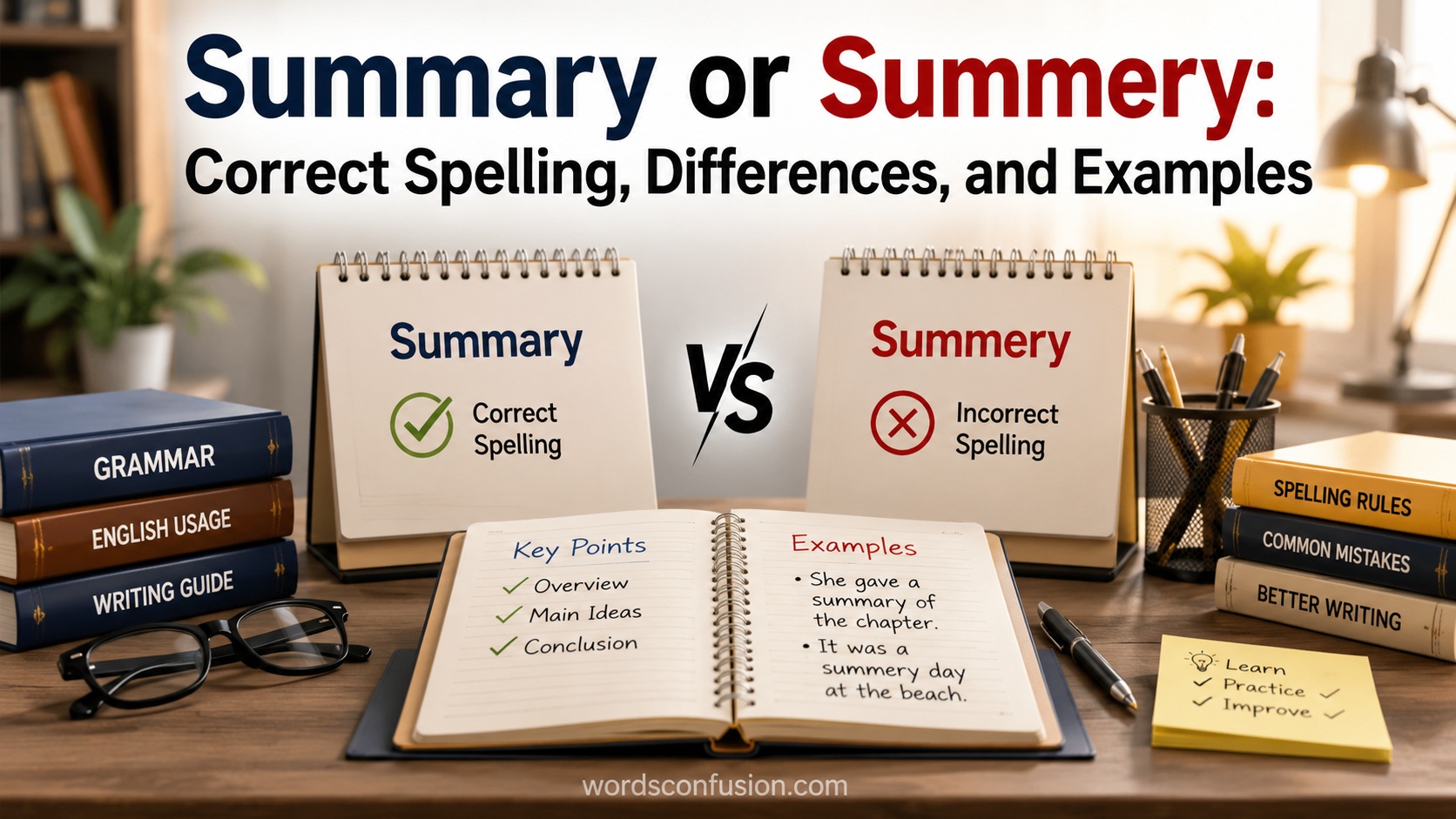
If you’ve ever hesitated between summary and summery, you’re not alone. These two words look almost identical, sound similar, and even share the same first six letters. Yet they describe completely different ideas.
The confusion usually appears when someone wants to describe a short version of a book, article, report, movie, or meeting. In that situation, the correct word is summary. On the other hand, when you want to describe something connected with summer or having a summer-like quality, summery is the right choice.
For example, you might write, “Please give me a summary of the report.” However, you could also say, “She wore a bright, summery dress.”
One letter can change the meaning entirely. That small spelling difference matters, especially in academic, professional, and formal writing.
Quick Answer
Summary and summery are both correct English words, but they have different meanings.
- Summary means a short version that presents the main points of something.
- Summery means related to summer or characteristic of summer.
- Use summary when discussing books, articles, reports, meetings, stories, or information.
- Use summery when describing weather, clothing, colors, settings, moods, or anything that feels like summer.
- The plural of summary is summaries, not summery.
The easiest way to remember them
Summary = sum up information.
Summery = summer-like.
Compare these sentences:
- Correct: I need a summary of the article.
- Correct: The room has a bright, summery atmosphere.
The first sentence refers to condensed information. The second describes something associated with summer.
Comparison Overview
Here’s a quick comparison of summary vs. summery before looking at each word in greater detail.
| Feature | Summary | Summery |
| Part of speech | Usually a noun; sometimes an adjective | Adjective |
| Main meaning | A shortened account of the main points | Related to or resembling summer |
| Common context | Books, reports, articles, meetings, essays | Weather, clothing, colors, atmosphere |
| Basic idea | To condense information | To describe something summer-like |
| Example | She wrote a summary of the chapter. | She wore a summery dress. |
| Plural | Summaries | Usually not used as a noun |
| Memory clue | Sum up | Summer + y |
The distinction becomes simple once you connect each word with its meaning. Summary deals with information. Summery deals with summer.
Main Differences Between Summary or Summery
The biggest difference between summary and summery is what each word describes. Summary relates to information that has been shortened or condensed. Summery describes something that has the qualities or appearance of summer.
Think of them as belonging to two completely different worlds.
A summary takes something long and makes it shorter. A summery description takes something associated with summer and puts that quality into words.
Summary Means a Shortened Account
A summary presents the essential points of something without including every detail.
For example, a 300-page novel might take several hours to read. A summary of that novel could explain its major characters, central conflict, important events, and ending in a few paragraphs.
The summary doesn’t reproduce the entire book. Instead, it compresses the information.
You can think of it like squeezing a large suitcase into a smaller travel bag. The bag doesn’t contain everything from the original suitcase. It contains the most important things you need.
Summery Means Related to Summer
Summery is an adjective. It describes something that feels, looks, or behaves like summer.
You might describe a dress as summery because it’s light, colorful, and suitable for warm weather. You might call an afternoon summery because it feels warm, bright, and pleasant.
For example:
- The beach looked bright and summery.
- She bought a summery yellow dress.
- The café has a relaxed, summery atmosphere.
Here, summery has nothing to do with shortening information.
What Does Summary Mean?
A summary is a shortened presentation of the main points, ideas, events, or information from a longer source.
The source could be almost anything. It might be a book, article, speech, report, movie, research paper, lecture, or meeting.
A good summary focuses on the essential information. It removes unnecessary details while preserving the central message.
For example, imagine that a manager holds a one-hour meeting about a new company project. The meeting covers dozens of details. Later, someone writes a five-paragraph summary containing the key decisions, deadlines, responsibilities, and next steps.
That document gives readers the important information without forcing them to sit through the entire meeting.
Summary as a Noun
The noun summary is by far its most common use.
You can use it when referring to a condensed version of something.
Examples include:
- I read a summary of the novel before class.
- The report contains a summary of the findings.
- Please send me a summary of yesterday’s meeting.
- The teacher asked for a short summary of the article.
- The presentation began with a summary of the research.
Notice the pattern. In each example, summary refers to information that has been reduced to its main points.
Common Types of Summaries
Different situations call for different kinds of summaries.
Book Summary
A book summary briefly explains the major ideas, characters, events, or arguments in a book.
For fiction, it may cover the plot and central conflict. For nonfiction, it usually focuses on the author’s main arguments and supporting ideas.
Article Summary
An article summary identifies the article’s central argument and most important supporting points.
It shouldn’t simply copy sentences from the original article. Instead, it should express the information in a concise way.
Meeting Summary
A meeting summary records the important points discussed during a meeting.
It often includes:
- Key decisions
- Important issues
- Assigned tasks
- Deadlines
- Next steps
Executive Summary
An executive summary gives decision-makers a quick overview of a longer business document.
It often appears at the beginning of reports, proposals, business plans, and research documents.
The goal is simple: help busy readers understand the most important information quickly.
Summary as an Adjective
Although summary commonly functions as a noun, it can also work as an adjective.
As an adjective, summary can describe something that is brief or done without the usual formal process.
For example:
- The report provides a summary statement.
- The document contains summary information.
- The company issued a summary of the findings.
There’s also a more formal use in phrases such as summary judgment and summary execution, where the word carries a specific legal or procedural meaning.
These uses are less common in everyday conversation. For most readers, the noun meaning is the one that matters most.
What Does Summery Mean?
Summery means characteristic of, resembling, or suitable for summer.
It’s an adjective, which means it modifies a noun.
You can describe something as summery when it reminds you of summer through its appearance, feeling, temperature, color, style, or atmosphere.
For example:
- The garden looked wonderfully summery.
- She chose a summery dress for the party.
- The bright colors created a summery mood.
- We enjoyed a warm, summery afternoon.
The word often creates an image in the reader’s mind. Think sunshine, warm air, outdoor gatherings, bright colors, beaches, flowers, and lightweight clothing.
Summery Weather
Weather can have a summery quality even when the calendar isn’t technically in summer.
For example:
The warm sunshine made the October afternoon feel surprisingly summery.
The word doesn’t necessarily mean “summer.” Instead, it means having characteristics associated with summer.
Summery Clothing
Clothing is another common context.
A light dress, shorts, sandals, or a brightly colored shirt might be described as summery.
For example:
- She wore a summery blue dress.
- The store displayed several summery outfits.
- His bright shirt gave the outfit a summery feel.
Summery Colors
Colors can also have a summery quality.
Bright yellow, turquoise, coral, light blue, and fresh green may create a summer-like visual effect.
For example:
The designer chose summery colors for the beach-themed room.
Here, summery describes the visual mood rather than the season itself.
Summery Atmosphere
You can also describe places, events, or experiences as summery.
For example:
The outdoor café had a relaxed, summery atmosphere.
This suggests warmth, brightness, relaxation, and other qualities people commonly associate with summer.
Why Do People Confuse Summary and Summery?
The confusion isn’t surprising. The words look extremely similar.
Both begin with summ-, and both contain similar vowel sounds. The difference becomes particularly easy to miss when you’re typing quickly.
There are three main reasons for the confusion.
The Spellings Are Almost Identical
Compare:
summary
summery
The difference appears mainly in the ending:
- summary → -ary
- summery → -ery
That tiny distinction can cause a surprisingly large change in meaning.
The Words Sound Similar
In ordinary conversation, pronunciation may not make the distinction obvious.
If you hear someone say the words quickly, context often does most of the work.
When writing, however, you need to choose the correct spelling based on what you actually mean.
Both Words Are Real
This is where spell-check can sometimes cause confusion.
Summery isn’t simply a misspelling of summary. It’s a legitimate English adjective.
Therefore, a sentence can contain summery and still pass a spelling checker even when the writer intended summary.
For example:
Please send me a summery of the report.
The problem isn’t that summery is an invented word. The problem is that it doesn’t mean what the writer intends.
The correct sentence is:
Please send me a summary of the report.
Read More: Habbit or Habit: Correct Spelling, Meaning, and Examples
When to Use Summary
Use summary when you want to discuss a shortened version of information.
It’s particularly common in writing, education, business, journalism, and research.
Use Summary for Books
- I wrote a summary of the novel.
- The teacher asked us to summarize the chapter.
- The book’s summary explains the main conflict.
Use Summary for Articles
- Can you give me a summary of this article?
- The summary covers the author’s main argument.
- I read the summary before reading the full report.
Use Summary for Meetings
- She sent a summary after the meeting.
- The meeting summary included the agreed deadlines.
- Please prepare a summary of today’s discussion.
Use Summary for Reports
- The report begins with an executive summary.
- The summary highlights the most important findings.
- Management requested a brief summary of the results.
A useful test is to replace summary with short version.
If the sentence still makes sense, summary is probably the word you need.
For example:
I need a summary of the report.
becomes:
I need a short version of the report.
The meaning remains clear.
When to Use Summery
Use summery when describing something that reminds you of summer.
A simple replacement test works here, too. Try replacing summery with summer-like.
For example:
The garden looks summery.
becomes:
The garden looks summer-like.
The basic meaning remains intact.
Use Summery for Weather
The warm breeze created a summery feeling.
Use Summery for Clothing
She bought a summery dress for her vacation.
Use Summery for Colors
The designer selected bright, summery colors.
Use Summery for Atmosphere
The restaurant has a cheerful, summery atmosphere.
Use Summery for Settings
The resort has a relaxed, summery appearance.
The key idea remains the same: summery describes qualities associated with summer.
Common Mistakes With Summary and Summery
Because these words look so similar, writers sometimes swap them accidentally.
Here are the most common errors.
| Incorrect Sentence | Correct Sentence | Explanation |
| Please send me a summery of the report. | Please send me a summary of the report. | The writer needs a shortened account. |
| I prepared a summery of the book. | I prepared a summary of the book. | A book can have a summary. |
| She wore a summary dress. | She wore a summery dress. | The dress has a summer-like quality. |
| The beach had a summary atmosphere. | The beach had a summery atmosphere. | The atmosphere resembles summer. |
| He gave a summery of the meeting. | He gave a summary of the meeting. | The meeting needs condensed information. |
| The room had a summary feel. | The room had a summery feel. | The feeling is associated with summer. |
These mistakes usually happen because the writer remembers the sound but not the meaning.
That’s why learning the distinction is more useful than memorizing spelling alone.
Summary vs. Summery Examples
Seeing the words in realistic sentences makes the difference much easier to remember.
Examples of Summary
- The teacher asked everyone to write a summary of the story.
- The report includes a detailed summary of the research findings.
- She gave her manager a brief summary of the meeting.
- I read the summary before starting the full article.
- The documentary’s summary explains its central argument.
- Please provide a summary of the project’s progress.
- His summary captured the most important points.
- The final paragraph provides a useful summary of the discussion.
Examples of Summery
- The bright flowers gave the garden a summery appearance.
- She wore a light, summery dress to the outdoor party.
- The warm afternoon felt wonderfully summery.
- The café has a cheerful, summery atmosphere.
- Bright yellow walls gave the room a summery look.
- The designer created a fresh, summery collection.
- We spent the afternoon enjoying the summery weather.
- Her colorful decorations gave the patio a summery feel.
FAQs:
Is Summary or Summery Correct?
Both summary and summery are correct English words. They simply have different meanings.
Use summary for a shortened version of information. Use summery for something associated with or resembling summer.
Is Summery a Real Word?
Yes. Summery is a standard English adjective.
It means characteristic of, resembling, or suitable for summer.
For example:
The bright colors create a summery atmosphere.
Is Summery the Plural of Summary?
No.
The plural of summary is summaries.
For example:
- Singular: I wrote a summary.
- Plural: I wrote several summaries.
Summery is an adjective, not the plural form of summary.
What Is the Difference Between Summary and Summery?
Summary means a condensed account of information.
Summery means having qualities associated with summer.
A simple way to remember the difference is:
Summary = sum up.
Summery = summer-like.
Which Word Should I Use for a Short Version of Something?
Use summary.
For example:
Please send me a summary of the report.
Don’t write:
Please send me a summery of the report.
Conclusion:
The difference between summary and summery is straightforward once you connect each word with its meaning. Summary refers to a shortened version of information. You use it for books, articles, reports, meetings, essays, research, stories, and other material. Summery describes something related to summer or having a summer-like quality. You might use it for clothing, weather, colors, scenery, moods, or atmosphere.
