If you’ve ever typed “habbit” instead of “habit,” you’re not alone. The extra b looks tempting because English has many words with doubled consonants. However, when you mean a repeated action, routine, or behavior, only one spelling is correct: habit.
This small spelling mistake can easily slip into school assignments, emails, blog posts, and everyday messages. Once you understand the correct spelling and why the confusion happens, you’ll have little reason to make the mistake again.
The word habit has a simple spelling, but its meaning is surprisingly broad. It can describe something you do regularly, a personal tendency, or a behavior that becomes almost automatic through repetition. You can develop a good habit, break a bad habit, or get into the habit of doing something.
So, is it habbit or habit? Let’s settle the question and explore how to use the correct word naturally.
Quick Answer
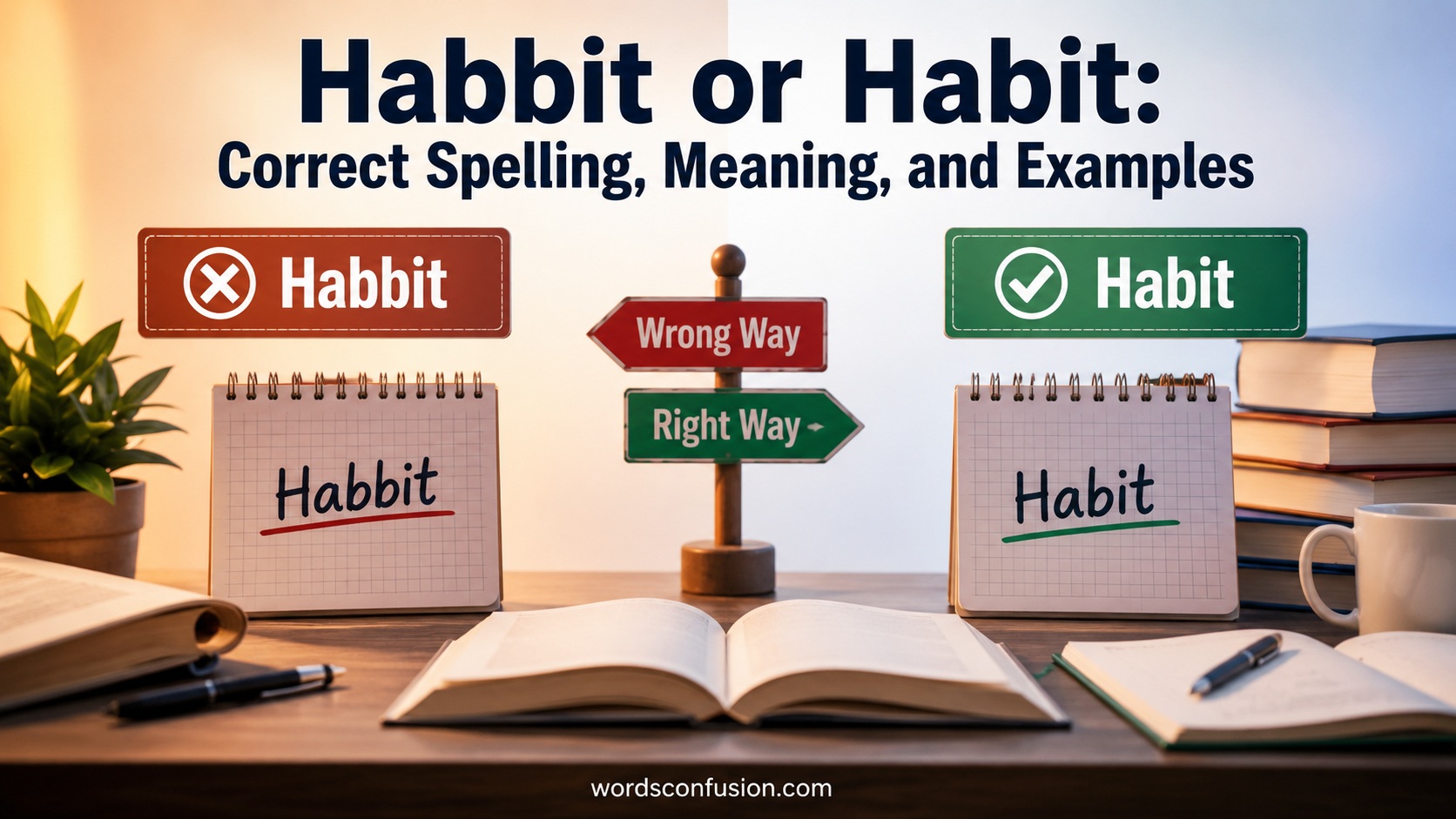
Habit is the correct spelling. Habbit is an incorrect spelling and isn’t the standard English word for a repeated behavior or routine.
- Correct: habit
- Incorrect: habbit
- Correct plural: habits
- Incorrect plural: habbits
- Meaning: a repeated behavior, action, practice, or tendency
Example:
Reading for 20 minutes every night is a healthy habit.
Not:
Reading for 20 minutes every night is a healthy habbit.
The easiest rule to remember is simple: habit has one “b.”
Comparison Overview
The difference between habit and habbit isn’t a difference in meaning. It’s a difference between a standard English spelling and a misspelling.
| Feature | Habit | Habbit |
| Correct spelling | Yes | No |
| Number of B’s | One | Two |
| Standard English word | Yes | No |
| Meaning | Repeated behavior or practice | No standard meaning |
| Singular form | Habit | — |
| Plural form | Habits | Habbits is incorrect |
| Used in formal writing | Yes | No |
| Used in American English | Yes | No |
| Used in British English | Yes | No |
If you’re writing about a routine, behavior, or regular practice, choose habit every time.
Main Differences Between Habbit or Habit
The main difference between habbit or habit is spelling. Habit is the accepted English word, while habbit is simply a misspelling.
Habit Is the Correct Word
Habit is a standard English noun. It refers to something that you do regularly, often enough that it becomes familiar or automatic.
For example:
- She has a habit of checking her phone before bed.
- Exercise became an important part of his daily habits.
- Brushing your teeth is a basic hygiene habit.
- He developed a habit of arriving early.
- Reading regularly can become a valuable habit.
Notice that the word always contains one b:
H-A-B-I-T
Habbit Is a Misspelling
Habbit isn’t the standard spelling of the word. When someone writes habbit, they usually mean habit.
For example:
- She has a bad habbit.
- She has a bad habit.
Another example:
- Good habbits can improve your life.
- Good habits can improve your life.
The extra b doesn’t create a new word. It simply creates a spelling error.
Why the Mistake Looks Natural
The mistake makes sense from a spelling perspective. English contains plenty of familiar words with doubled consonants.
Consider:
- rabbit
- hobby
- bubble
- ribbon
- common
- address
Because doubled consonants appear frequently in English, habbit can look visually believable.
There’s one catch: English spelling doesn’t always follow visual patterns consistently. You can’t assume that a word needs a double consonant simply because another similar-looking word has one.
What Does Habit Mean?
Habit generally means a behavior or action that someone repeats regularly.
The repetition may happen deliberately at first. Over time, however, the behavior can become automatic.
Think of a habit like a path through a field. The more often you walk along the same route, the clearer that path becomes. Repeated behavior works in a similar way.
For example, someone might decide to read every night before sleeping. After several weeks, reaching for a book may feel natural rather than forced.
That repeated behavior has become a habit.
Habit as a Repeated Behavior
This is the most common meaning of the word.
He developed a habit of exercising before breakfast.
Here, habit describes an action that happens repeatedly.
Other examples include:
- Checking messages after waking up.
- Drinking coffee every morning.
- Walking after dinner.
- Writing in a journal before bed.
- Studying at the same time each evening.
Habit as a Regular Practice
A habit doesn’t always describe an automatic personal behavior. It can also describe something you regularly practice.
For example:
She made a habit of reviewing her notes before every class.
The phrase made a habit of suggests that she deliberately turned an action into a regular practice.
Habit as a Personal Tendency
The word can also describe something someone tends to do repeatedly.
For example:
He has a habit of interrupting people during conversations.
The sentence doesn’t necessarily mean he consciously chooses to interrupt. It describes a recurring tendency.
That’s why habit can apply to both deliberate routines and behaviors that happen almost automatically.
Good Habits and Bad Habits
Not every habit is positive. Habits can help you or hold you back depending on the behavior.
Examples of Good Habits
Common positive habits include:
- Exercising regularly
- Reading every day
- Getting enough sleep
- Keeping your workspace organized
- Saving money
- Drinking enough water
- Planning your day
- Reviewing lessons consistently
For example:
Studying for thirty minutes every day is more sustainable than cramming for five hours before an exam.
The value of a habit often comes from consistency rather than intensity.
Examples of Bad Habits
Some repeated behaviors can create problems.
Examples include:
- Procrastinating
- Staying up too late
- Constantly checking social media
- Skipping meals
- Interrupting others
- Spending money impulsively
- Leaving tasks until the last minute
For example:
His habit of delaying important work made deadlines stressful.
A bad habit doesn’t necessarily make someone a bad person. It simply describes a repeated behavior that produces an undesirable result.
How to Use Habit in a Sentence
The word habit appears in several common sentence structures.
Have a Habit of
This structure describes a repeated behavior or tendency.
She has a habit of reading before bed.
He has a habit of checking the door twice.
I have a habit of making notes during meetings.
The pattern is:
have + a habit of + verb-ing
For example:
She has a habit of arriving early.
Not:
She has a habit of arrive early.
Develop a Habit of
Use this structure when someone gradually establishes a repeated behavior.
He developed a habit of exercising every morning.
She developed a habit of saving part of her paycheck.
This phrase emphasizes the process of forming the behavior.
Get Into the Habit of
This expression means to become accustomed to doing something regularly.
Get into the habit of checking your work before submitting it.
I need to get into the habit of waking up earlier.
It often appears in advice and self-improvement discussions.
Break a Habit
Break a habit means to stop a repeated behavior.
She wants to break her habit of checking social media during work.
Breaking an old habit can take patience.
The expression doesn’t mean physically breaking something. It’s an idiom describing the process of stopping a behavior.
Make a Habit of
Make a habit of means to deliberately begin doing something regularly.
Make a habit of reviewing your goals each week.
He made a habit of calling his parents every Sunday.
The phrase usually suggests intentional repetition.
Common Expressions With Habit
English speakers use habit in several familiar expressions.
| Expression | Meaning | Example |
| Get into the habit of | Become accustomed to doing something | Get into the habit of reading daily. |
| Break a habit | Stop a repeated behavior | She broke her habit of procrastinating. |
| Make a habit of | Deliberately do something regularly | He made a habit of exercising. |
| Force of habit | Doing something automatically because you’re accustomed to it | By force of habit, she checked the clock. |
| Kick a habit | Stop an unwanted behavior | He wants to kick his unhealthy habit. |
| Old habits die hard | Familiar behaviors are difficult to change | Old habits die hard when routines become deeply established. |
These expressions show how flexible the word habit can be.
Habit vs. Habbit Examples
Seeing the two spellings side by side makes the difference easier to remember.
| Incorrect | Correct |
| I have a bad habbit. | I have a bad habit. |
| Reading is a useful habbit. | Reading is a useful habit. |
| He developed healthy habbits. | He developed healthy habits. |
| That’s an unusual habbit. | That’s an unusual habit. |
| She wants to change her habbits. | She wants to change her habits. |
| Good habbits take time to build. | Good habits take time to build. |
The pattern is consistent: remove the second b.
Why Do People Spell Habit as Habbit?
Several factors can lead people to write habbit, even though the correct spelling is short and familiar.
Confusion With Double Letters
Words such as rabbit, hobby, and ribbon contain double consonants. That visual pattern may encourage someone to add another b to habit.
However, spelling similarities don’t always indicate the same spelling pattern.
Habit simply uses one b.
Fast Typing
Typing quickly can produce accidental repeated letters. A person may type:
habbit
instead of:
habit
This type of error can happen even when the writer knows the correct spelling.
Memory and Visual Familiarity
Sometimes a misspelled version begins to look correct after repeated exposure.
If you’ve seen habbit many times online, your brain may recognize the shape of the word before checking each letter.
That’s why spelling tools and careful proofreading can help.
Is Habbit a Word?
In standard modern English, habbit isn’t the accepted spelling of the word meaning a repeated behavior.
When you see habbit in ordinary writing, it should generally be corrected to habit.
For example:
Developing good habbits takes discipline.
The corrected version is:
Developing good habits takes discipline.
There’s no special American or British meaning attached to the extra b.
Read More: Partier or Partyer: Which One You Should Use in 2026?
Habit Pronunciation
The standard pronunciation of habit is commonly represented as:
/ˈhæbɪt/
An easy pronunciation guide is:
HAB-it
The first syllable carries the main stress.
Breaking it down:
- hab — stressed first syllable
- it — shorter second syllable
The pronunciation doesn’t require a second b. That can help reinforce the spelling.
Is Habit a Noun or a Verb?
In modern everyday English, habit is most commonly used as a noun.
For example:
Exercise is a healthy habit.
He has a habit of arriving late.
The word has also existed as a verb in English, particularly in older or specialized usage. That verb use relates to clothing or dressing and is uncommon in ordinary modern conversation.
For most everyday writing, you can safely think of habit as a noun.
Singular and Plural Forms of Habit
The singular form is:
habit
The plural form is:
habits
The plural simply adds -s.
| Singular | Plural |
| habit | habits |
| good habit | good habits |
| bad habit | bad habits |
| daily habit | daily habits |
| study habit | study habits |
Remember that habbits is incorrect because the base word itself doesn’t contain two b’s.
Habit vs. Habitat
Don’t confuse habit with habitat. These words look similar, but their meanings are completely different.
| Word | Meaning | Example |
| Habit | A repeated behavior or practice | Reading is a useful habit. |
| Habitat | The natural environment where an organism lives | Wetlands provide a habitat for many birds. |
A habit belongs to behavior.
A habitat belongs to living environments.
For example:
Exercise is a healthy habit.
But:
The forest is a natural habitat for many animals.
The two words share several letters, which makes them easy to confuse when typing quickly.
Habit in Everyday English
You’ll encounter habit in many areas of everyday communication.
In Education
Teachers often talk about study habits.
Good study habits can make learning more organized.
The phrase can refer to reviewing lessons, taking notes, managing time, or preparing consistently.
In the Workplace
Professionals may discuss work habits.
Her organized work habits help her meet deadlines.
Here, habits describes repeated ways of working.
In Health and Fitness
The word frequently appears in discussions about routines.
Regular exercise can become a healthy habit.
Sleeping at consistent times can support a better daily routine.
In Personal Development
Self-improvement content often focuses on forming and changing habits.
Small habits can gradually produce meaningful changes.
The important idea is repetition. A single action isn’t necessarily a habit. A repeated pattern is.
Case Study: How a Routine Becomes a Habit
Imagine a student who rarely reviews class material.
At first, the student decides to spend fifteen minutes reviewing notes every evening. During the first few days, the routine requires conscious effort.
After several weeks, the student begins reviewing notes almost automatically after dinner.
The behavior has moved from an occasional action toward a regular habit.
This example highlights an important distinction:
An action happens once. A habit repeats.
That simple difference helps explain the word’s meaning in real life.
FAQs:
Is habit or habbit correct?
Habit is correct. Habbit is a misspelling.
Is habbit a word?
Habbit isn’t the standard English spelling of the word meaning a repeated behavior or routine.
Does habit have one b or two?
Habit has one b. The correct spelling is H-A-B-I-T.
What is the plural of habit?
The plural is habits.
For example:
Good habits can improve your daily routine.
Habbits is incorrect.
Is habit used in both American and British English?
Yes. Habit has the same spelling in both American and British English.
Conclusion
When choosing between habbit or habit, the correct spelling is always habit. It refers to a repeated behavior, routine, practice, or tendency. The spelling habbit is simply a common misspelling and doesn’t have a separate meaning in standard English.
Remember the simple rule: habit has only one “b.” Whether you’re writing about good habits, bad habits, study habits, or daily routines, use habit in every case. Once you remember its six letters—H-A-B-I-T—this spelling mistake becomes easy to avoid.
