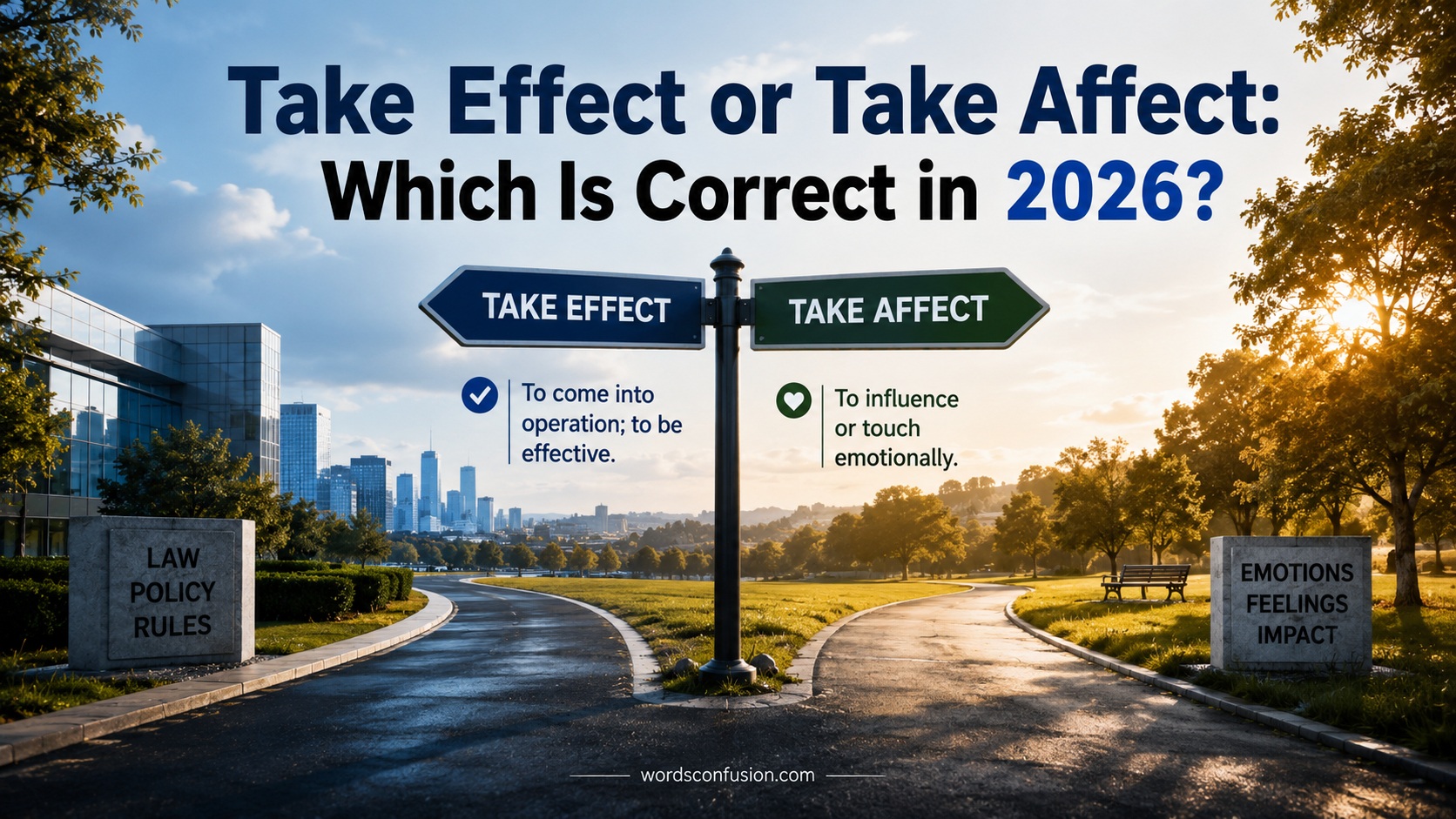
If you’ve ever paused while writing a sentence like “The new policy will take next month,” you’re not alone. Take effect and take affect look almost identical, and the words effect and affect cause confusion for even experienced writers.
Here’s the key: “Take effect” is the correct expression. The phrase means that something becomes active, starts working, or begins producing a result. “Take affect” is not the standard expression when you mean that something becomes active.
For example:
“The new law will take effect on January 1.”
You could also say:
“The new law will go into effect on January 1.”
Both sentences communicate the same basic idea. The spelling affect doesn’t belong in the fixed phrase take effect.
The confusion becomes easier to understand once you see how affect and effect normally work in a sentence. One usually describes an influence or change. The other usually refers to a result. That small grammatical distinction explains why take effect is correct.
Quick Answer
Take effect is correct. Take affect is incorrect in standard English when you mean “become active,” “start working,” or “begin producing a result.”
| Phrase | Correct? | Meaning | Example |
| Take effect | Yes | Become active or start producing a result | The new rule will take effect tomorrow. |
| Take affect | No | Not the standard expression | Avoid this spelling. |
| Go into effect | Yes | Become active or operative | The new rule will go into effect tomorrow. |
The easiest way to remember it is this:
Take effect = become active or produce a result.
Affect = influence or change something.
For example:
“The new policy will take effect next week.”
But:
“The new policy will affect thousands of employees.”
The first sentence describes when the policy becomes active. The second describes whom the policy influences.
Comparison Overview
The difference between take effect or take affect comes down to standard English usage and the normal grammatical roles of effect and affect.
| Feature | Take Effect | Take Affect |
| Standard English | Correct | Incorrect |
| Basic meaning | Become active or operative | Not the standard expression |
| Main word | Effect | Affect |
| Typical grammar | Fixed phrase | Incorrect substitution |
| Used with laws | Yes | No |
| Used with policies | Yes | No |
| Used with medicine | Yes | No |
| Used with contracts | Yes | No |
| Used with schedules | Yes | No |
| Used with regulations | Yes | No |
| Example | The law will take effect Monday. | The law will take affect Monday. |
A useful distinction appears when you place all three structures side by side:
- The rule will take effect.
- The rule will affect employees.
- The rule will have an effect on employees.
These sentences look similar, yet each performs a different grammatical job.
Take effect tells you that something becomes active.
Affect tells you that something influences another thing.
Have an effect tells you that something produces a result.
Once you recognize those patterns, the confusion largely disappears.
Main Differences Between Take Effect or Take Affect
The biggest difference is simple: take effect is an established English expression, while take affect isn’t the standard phrase.
The word effect in take effect works as part of an idiomatic expression. You aren’t simply choosing between two interchangeable words. English has established the phrase take effect, just as it has established expressions such as take place, take action, and take responsibility.
Consider this sentence:
“The new regulations will take effect next month.”
The regulations aren’t physically “taking” an effect. Instead, take effect means they will become operative.
By contrast, affect usually functions as a verb:
“The new regulations will affect local businesses.”
Here, affect means influence or change.
Take Effect Means “Become Active”
When something takes effect, it becomes active or officially begins to operate.
This usage appears frequently with:
- Laws
- Regulations
- Policies
- Rules
- Agreements
- Contracts
- Schedules
- Government measures
- Price changes
- Workplace procedures
For example:
“The new traffic rules will take effect next month.”
The sentence doesn’t mean the rules will influence something. It means the rules will officially begin to apply.
That distinction matters. If you replace effect with affect, you change the grammatical structure and create an incorrect phrase.
Take Effect Can Also Mean “Start Working”
The phrase isn’t limited to laws and policies.
You can use take effect when something begins producing a noticeable result.
For example:
“The medicine began to take effect after 30 minutes.”
Here, take effect means the medicine started working.
You can use the phrase in contexts involving:
- Medicine
- Treatments
- Strategies
- Safety measures
- Financial changes
- Environmental measures
- Technology
- Emergency procedures
The central idea remains the same: something moves from being inactive or ineffective to producing its intended result.
Take Affect Isn’t the Standard Expression
Take affect is generally a spelling and usage error caused by confusion between two commonly confused words.
A writer might know that affect and effect are related to change and results. Because the words sound similar, it’s easy to select the wrong one.
However, standard English uses:
take effect
Not:
take affect
This isn’t a matter of American English versus British English. Take effect is the standard expression in both varieties.
What Does “Take Effect” Mean?
Take effect means to become active, become operative, start working, or begin producing a result.
The exact shade of meaning depends on the context.
When you’re talking about a law, take effect usually means the law officially becomes applicable.
“The new law takes effect on July 1.”
When you’re talking about medicine, it usually means the medicine begins working.
“The medication should take effect within an hour.”
When you’re talking about a strategy, it can mean the strategy begins producing noticeable results.
“The company’s new marketing strategy finally began to take effect.”
So, while the contexts differ, the underlying concept stays consistent: something begins to operate or produce its intended outcome.
Why Is “Take Affect” Incorrect?
The confusion starts with the two words themselves.
Affect Is Usually a Verb
In everyday English, affect most commonly functions as a verb meaning to influence, change, or have an impact on something.
For example:
“The storm affected air travel.”
The storm influenced air travel.
Another example:
“Lack of sleep can affect your concentration.”
Lack of sleep can change or influence your concentration.
That is the normal role of affect.
Effect Is Usually a Noun
Effect most commonly functions as a noun meaning a result, consequence, or outcome.
For example:
“The storm had a major effect on air travel.”
Here, effect refers to the result of the storm.
Another example:
“The new policy had little effect on sales.”
The policy produced a particular result.
Why “Take Effect” Works
Now consider the phrase:
“The new policy will take effect tomorrow.”
The phrase describes the point at which the policy becomes operative.
English conventionally expresses that idea with effect, not affect.
That’s why the correct sentence is:
“The new policy will take effect tomorrow.”
Not:
“The new policy will take affect tomorrow.”
Take Effect vs. Affect: What’s the Difference?
Understanding take effect vs. affect is one of the fastest ways to stop making this mistake.
| Word or Phrase | Usual Function | Meaning | Example |
| Take effect | Idiomatic phrase | Become active or start working | The law will take effect Friday. |
| Affect | Verb | Influence or change | The law will affect businesses. |
| Effect | Noun | Result or consequence | The law will have an effect on businesses. |
Look at the following examples:
The new rule will take effect next week.
The rule becomes active.
The new rule will affect employees.
The rule influences employees.
The new rule will have an effect on employees.
The rule produces a result for employees.
The subject can remain exactly the same. What changes is the relationship between the words.
Take Effect vs. Have an Effect
These expressions are related, but they don’t mean exactly the same thing.
Take Effect
Take effect means become active or begin producing a result.
“The new policy will take effect on Monday.”
The policy officially becomes active.
Have an Effect
Have an effect means produce a result or influence something.
“The new policy will have an effect on employee attendance.”
The focus is on the result produced by the policy.
Affect
Affect means influence or change something.
“The new policy will affect employee attendance.”
The meaning is similar to have an effect on, but the grammatical structure differs.
A simple pattern can help:
| Pattern | Meaning |
| take effect | become active |
| affect something | influence something |
| have an effect on something | produce a result for something |
Think of these as three different grammatical doors leading to closely related ideas.
Common Situations Where You Should Use “Take Effect”
The phrase appears in many areas of everyday and professional English.
Laws and Regulations
Legal and governmental writing uses take effect constantly.
“The new tax law will take effect in January.”
“The regulation took effect immediately.”
“The revised safety standards will take effect next year.”
In these examples, take effect indicates when a rule becomes officially applicable.
Company Policies
Businesses often use the phrase when announcing internal changes.
“The updated vacation policy will take effect next month.”
“The new attendance rules take effect Monday.”
This wording sounds clear and professional without being overly formal.
Contracts and Agreements
Contracts can also take effect once certain conditions are met.
“The agreement will take effect after both parties sign it.”
“The revised contract took effect on August 1.”
The phrase describes when the agreement becomes legally or practically operative.
Medicine and Treatment
Medicine provides another common use.
“The pain medication took effect within 20 minutes.”
“The treatment began to take effect after several weeks.”
Here, the phrase means start working rather than become legally active.
Schedules and Procedures
You can also use take effect for changes to schedules and procedures.
“The new train schedule will take effect tomorrow.”
“The updated procedure takes effect immediately.”
The meaning remains consistent: the new arrangement begins operating.
Prices and Financial Changes
Businesses may use the phrase when announcing price changes.
“The new prices will take effect next month.”
This tells customers exactly when the new prices begin to apply.
Read More: To Bad or Too Bad: Correct Usage Explained for 2026
15+ Correct Examples of “Take Effect”
Seeing the phrase in different contexts makes its meaning much easier to recognize.
Laws, Rules, and Policies
- The new law will take effect next month.
- The revised regulations took effect on Monday.
- The parking restrictions will take effect at midnight.
- The company’s new policy takes effect tomorrow.
- The updated workplace rules will take effect immediately.
Medicine and Treatment
- The medicine should take effect within an hour.
- The painkiller took effect after about 20 minutes.
- The treatment gradually began to take effect.
- The anesthetic took effect quickly.
Business and Contracts
- The new contract will take effect after approval.
- The salary changes will take effect next month.
- The revised pricing structure took effect last week.
- The agreement takes effect once both parties sign it.
Everyday Changes
- The new schedule takes effect tomorrow.
- The changes will take effect at the beginning of the year.
- The safety measures took effect immediately.
- The new system began to take effect across the organization.
Notice how naturally take effect fits each sentence. Whether you’re discussing a law, medicine, a contract, or a schedule, the basic meaning remains intact.
Incorrect Examples: “Take Affect” vs. Correct Examples
One of the easiest ways to spot the error is to compare incorrect and corrected versions.
| Incorrect | Correct |
| The new law will take affect Monday. | The new law will take effect Monday. |
| The policy will take affect tomorrow. | The policy will take effect tomorrow. |
| The medicine took affect quickly. | The medicine took effect quickly. |
| The changes will take affect next week. | The changes will take effect next week. |
| The agreement takes affect immediately. | The agreement takes effect immediately. |
| The new schedule takes affect in September. | The new schedule takes effect in September. |
| The regulations took affect last year. | The regulations took effect last year. |
The mistake usually doesn’t come from misunderstanding the entire sentence. It comes from choosing the wrong member of the affect/effect pair.
When the intended meaning is “become active” or “start working,” remember the fixed expression:
take effect
Take Effect or Take Affect in Professional Writing
Professional writing demands precision. A small spelling error can make an otherwise polished document look careless.
You’ll often see take effect in:
- Employment policies
- Legal agreements
- Government notices
- Corporate announcements
- Financial documents
- Academic writing
- Healthcare communication
- Customer notices
- Terms and conditions
- Administrative documents
Consider this announcement:
“The revised refund policy will take effect on September 1.”
That’s concise and precise.
Now compare it with:
“The revised refund policy will take affect on September 1.”
The second version contains a standard usage error.
In professional writing, these small distinctions matter because readers shouldn’t have to stop and decode what a sentence means.
“Take Effect” vs. “Go Into Effect”
Take effect and go into effect are both standard expressions.
They often communicate nearly the same idea.
| Expression | Meaning | Example |
| Take effect | Become active or operative | The rule will take effect Monday. |
| Go into effect | Become active or operative | The rule will go into effect Monday. |
Both are natural:
“The new law will take effect on January 1.”
“The new law will go into effect on January 1.”
The choice usually comes down to style and sentence flow. Neither requires affect.
You don’t need to avoid take effect simply because go into effect also works.
FAQs:
Is it “take effect” or “take affect”?
Take effect is correct. It means something becomes active, starts working, or begins producing a result. Take affect isn’t the standard expression.
What does “take effect” mean?
Take effect means to become operative, become active, start working, or begin producing a result.
“The new policy will take effect next month.”
Why is “take affect” wrong?
The phrase uses effect, not affect. Affect usually works as a verb meaning to influence or change something. Effect commonly functions as a noun meaning a result, and take effect is an established expression.
Is “take effect” the same as “go into effect”?
In many situations, yes. Both expressions can mean that something becomes active or operative.
“The new law will take effect Monday.”
“The new law will go into effect Monday.”
Both are standard.
Can you use “take effect” for medicine?
Yes. In medical contexts, take effect commonly means that a medicine or treatment starts working.
“The medication should take effect within an hour.”
Can you use “take effect” for a law?
Yes. This is one of the most common uses.
“The new law will take effect on January 1.”
Conclusion:
When choosing between take effect or take affect, the correct expression is take effect. Use it when something becomes active, starts working, or begins producing a result. For example, “The new policy will take effect next month.”
Remember the simple distinction: affect usually means to influence or change something, while effect usually refers to a result. That’s why you can say “The policy will affect employees” or “The policy will have an effect on employees,” but you should write “The policy will take effect.”
