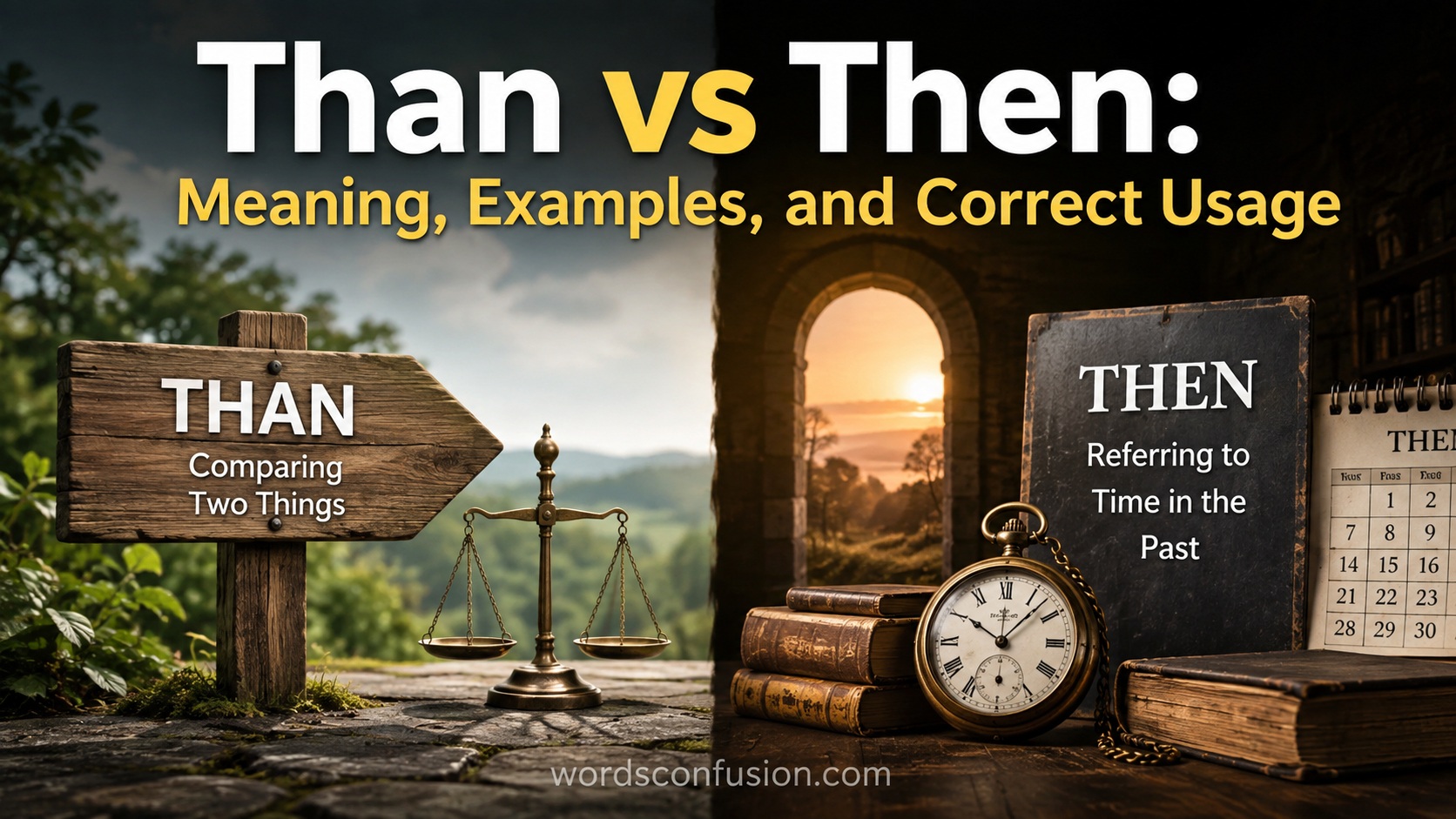
Than vs Then is one of those small English distinctions that can trip up almost anyone. The two words look almost identical, sound similar in casual speech, and often appear in the same kinds of sentences. However, their meanings and grammatical jobs are completely different.
Use than when you compare people, things, quantities, actions, or qualities. Use then when you talk about time, sequence, or a result.
That sounds simple. Yet phrases such as better than, more than, rather than, back then, until then, and if…then make the distinction worth learning properly.
Once you understand the role each word plays, the confusion largely disappears. You won’t need to guess based on spelling. Instead, you’ll know exactly which word fits the sentence.
Quick Answer
Than is used mainly for comparisons.
- Maria is taller than Anna.
- This laptop costs less than that one.
- I’d rather walk than wait.
Then is used mainly for time, sequence, or consequence.
- We ate dinner and then watched a movie.
- I lived there then.
- If you’re ready, then we can begin.
Easy memory trick
Think of it this way:
Than = comparison
Then = time, order, or result
If you’re comparing two things, choose than. If you’re talking about what happened next or what happens at a particular time, choose then.
Comparison Overview
| Word | Main Use | Meaning | Example |
| Than | Comparison | Shows a difference between two things | James is older than David. |
| Then | Time | Refers to a particular time | I lived there then. |
| Then | Sequence | Shows what happens next | Finish this then call me. |
| Then | Result | Shows a consequence | If it rains, then we’ll stay home. |
| Than | Quantity | Compares amounts | More than 100 people came. |
| Than | Preference | Shows one choice over another | I’d rather read than watch TV. |
The easiest distinction is based on function rather than appearance. Ask what the sentence is doing.
If the sentence puts two things against each other, than usually belongs there. If the sentence moves through time, describes the next action, or introduces a consequence, then is usually correct.
Main Differences Between Than vs Then
The biggest difference between than vs then is their meaning. Although they differ by only one letter, they perform very different grammatical functions.
Than Is Used for Comparisons
Than introduces the second part of a comparison. It often follows comparative adjectives or adverbs.
For example:
- My car is faster than yours.
- This book is more interesting than the last one.
- Sarah runs faster than Tom.
- Today feels colder than yesterday.
In each example, the sentence compares two things.
The comparison might involve size, quality, speed, price, age, quantity, ability, preference, or another measurable difference.
Then Is Used for Time
Then can refer to a particular time in the past or future.
Consider these examples:
- I was living in New York then.
- Things were different back then.
- I’ll see you then.
- Until then, keep practicing.
Here, then doesn’t compare anything. Instead, it points to a time.
Then Shows Sequence
Then can also tell readers what happens next.
For example:
- First, wash the vegetables. Then chop them.
- She finished her homework and then went outside.
- Open the file, then select the option you need.
Think of then as a signpost pointing from one event to the next.
First → next → then
That simple sequence explains why sentences such as First we ate than we left are incorrect. The correct version is:
First we ate. Then we left.
Then Can Show a Result
Then also appears in conditional sentences and can mean something close to in that case.
- If you’re tired, then take a break.
- If the store is closed, then we’ll come tomorrow.
- If you know the answer, then tell us.
The first part establishes a condition. Then introduces the consequence.
Notice the difference:
She is taller than me.
This is a comparison.
She finished her work and then went home.
This is a sequence.
The words look similar. The jobs they perform are worlds apart.
What Does “Than” Mean?
Than is a word used primarily to establish a comparison. It commonly appears after comparative forms such as better, bigger, smaller, faster, older, more, less, fewer, and worse.
Than With Comparative Adjectives
Comparative adjectives often take than when you compare two things.
Examples include:
- My house is bigger than yours.
- This route is shorter than the other one.
- Her explanation was clearer than mine.
- Winter is colder than autumn in this region.
- The second test was harder than the first.
The structure is often:
comparative adjective + than + comparison
For example:
A cheetah is faster than a horse.
The word than connects the quality faster with the thing being compared.
Than With More, Less, and Fewer
Than also follows words that compare quantities.
- More than 500 people attended.
- Less than an hour remains.
- Fewer than ten students were absent.
- The project took more than two weeks.
These sentences compare amounts rather than qualities.
A common mistake is writing more then when the intended phrase is more than.
Correct:
The article has more than 2,000 words.
Incorrect:
The article has more then 2,000 words.
Than With Preferences
You can also use than when expressing preference.
Common structures include:
- rather than
- sooner than
- better than
Examples:
- I’d rather stay home than go out.
- She chose tea rather than coffee.
- I’d sooner apologize than argue.
In these cases, than helps establish a choice or contrast.
What Does “Then” Mean?
Then usually relates to time, sequence, or consequence. It can function as an adverb and can take on slightly different meanings depending on the sentence.
Then Refers to a Time
When then refers to time, it often means at that time.
- I didn’t understand it then.
- She was a teacher then.
- Things were cheaper back then.
- We lived in Texas then.
It can point to a specific moment already mentioned.
For example:
I met Daniel in 2018. I was working in Boston then.
Here, then means in 2018.
Then Shows What Happens Next
This is one of the most common uses of then.
- Take a seat and then wait for your name.
- First, add the flour. Then add the milk.
- We went shopping and then had lunch.
The word creates an order between events.
Imagine giving someone directions:
Turn left. Then cross the bridge.
The first action happens before the second one.
Then Means “In That Case”
In conditional sentences, then can introduce a logical consequence.
- If you don’t need it, then give it to someone else.
- If that’s your decision, then we’ll support you.
- If the weather improves, then we’ll go outside.
Here, then has a meaning similar to in that case.
This use explains why if…then is such a familiar structure.
Than vs Then Examples
Seeing the two words side by side makes the distinction much easier.
Examples Using Than
- My brother is younger than me.
- This phone is cheaper than that model.
- She works harder than anyone else on the team.
- The blue bag is heavier than the black one.
- We received more applications than expected.
- I’d rather save money than spend it.
- The new road is safer than the old one.
Every sentence involves comparison or preference.
Examples Using Then
- We finished dinner and then watched television.
- I lived there then.
- First, read the instructions. Then begin.
- I’ll call you then.
- If you’re ready, then let’s start.
- Back then, smartphones weren’t common.
- She smiled and then walked away.
These examples involve time, order, or consequence.
Than vs Then in Sentences
The fastest way to spot the difference is to examine incorrect and correct examples.
| Incorrect Sentence | Correct Sentence | Explanation |
| She is taller then me. | She is taller than me. | The sentence compares height. |
| I finished work than went home. | I finished work then went home. | The sentence shows sequence. |
| This costs more then that. | This costs more than that. | The sentence compares prices. |
| First study than take the test. | First study then take the test. | Then shows the next action. |
| I’d rather stay then leave. | I’d rather stay than leave. | Than follows the preference structure. |
| If you’re tired, than rest. | If you’re tired, then rest. | Then introduces the result. |
| He was happier then than now. | He was happier then than now. | Both words are correct because they perform different jobs. |
That final example is especially useful.
He was happier then than now.
The first then refers to a past time. The second than introduces a comparison.
This shows why context matters. A sentence can legitimately contain both words.
Read More: Stationary vs Stationery: Meaning, Examples, and Correct Usage
How to Remember Than vs Then
A few simple memory tricks can keep these words straight.
Remember the “A” in Than
Think:
ThAN = comparison
You can connect the A in than with another thing being compared.
For example:
This is better than that.
You have one thing and another thing.
Remember the “E” in Then
Think of then as being connected with events.
First this happens. Then another event happens.
You can also associate then with time.
Ask Yourself One Question
Before choosing the word, ask:
Am I comparing something?
If yes, use than.
This exam is harder than the previous one.
If you’re talking about when something happened, what happens next, or what follows a condition, use then.
Finish the exam and then submit it.
This question works remarkably well because it focuses on meaning instead of spelling.
Common Mistakes With Than and Then
These mistakes appear frequently in casual writing, text messages, social media posts, and even formal documents.
“Better Then” Instead of “Better Than”
Incorrect:
This option is better then the other one.
Correct:
This option is better than the other one.
The word better creates a comparison. Therefore, than follows it.
“More Then” Instead of “More Than”
Incorrect:
More then 200 people attended.
Correct:
More than 200 people attended.
Whenever you compare a quantity using more, less, or fewer, than often follows.
“First This Than That”
Incorrect:
First mix the ingredients than bake the cake.
Correct:
First mix the ingredients then bake the cake.
The sentence describes a sequence. It doesn’t compare the ingredients with the cake.
“Rather Then” Instead of “Rather Than”
Incorrect:
I’d rather walk then drive.
Correct:
I’d rather walk than drive.
The expression is rather than.
It’s a fixed and extremely common structure for expressing alternatives or preferences.
Than vs Then in Formal and Informal Writing
Neither word is inherently informal. Both are standard English words used across everyday conversation, academic writing, journalism, business communication, and professional documents.
The problem isn’t formality. The problem is choosing the wrong word.
Consider a professional email:
The revised proposal is more detailed than the original.
That’s perfectly appropriate.
Now consider:
We’ll review the proposal and then contact the client.
That’s also perfectly appropriate.
In formal writing, correct usage matters because a small spelling mistake can distract the reader or make an otherwise polished sentence look careless.
Rather Than vs Rather Then
Rather than is correct when you express preference, substitution, or an alternative.
Examples:
- We walked rather than drove.
- She chose to wait rather than complain.
- Use a pencil rather than a pen.
- He decided to stay home rather than travel.
Rather then is incorrect when you’re expressing this meaning.
However, then can appear nearby in a different role:
I’d rather stay home than leave, and then watch a movie.
Here, than introduces the alternative while then introduces the next action.
FAQs:
Is it “better than” or “better then”?
The correct expression is better than.
This option is better than the previous one.
Better creates a comparison. Therefore, than follows it.
Is it “more than” or “more then”?
The correct expression is more than when you’re comparing a quantity.
The box weighs more than 20 pounds.
More then is incorrect in this context.
Is it “rather than” or “rather then”?
The correct expression is rather than.
I’d rather walk than drive.
Use than when expressing preference or an alternative.
What is the easiest way to remember than vs then?
Remember:
Than = comparison.
Then = time or sequence.
You can also associate the A in than with comparison and the E in then with events.
Can “then” mean “in that case”?
Yes. Then can introduce a result or consequence.
If you don’t want it, then give it away.
Here, then means something like in that case.
Conclusion:
The difference between than vs then becomes straightforward once you focus on meaning. When you’re unsure, stop and ask what the sentence is doing. Is it comparing something? Choose than. Is it showing when something happens, what happens next, or what follows a condition? Choose then. Once that distinction becomes second nature, common expressions such as more than, rather than, back then, until then, and if…then become much easier to use correctly.

Andrew Wilson is an experienced language researcher and content writer specializing in WordsConfusion topics. He helps readers understand commonly confused English words, spelling differences, grammar rules, word meanings, and proper usage through clear explanations, practical examples, and easy-to-follow language guides. His goal is to make English learning simple, accurate, and accessible for students, writers, professionals, and everyday learners.