Have you ever written “stationary” when you meant paper, envelopes, or other writing supplies? You’re not alone. Stationary vs stationery is one of those word pairs that can trip up even careful writers because the two words look almost identical and sound the same in standard American English.
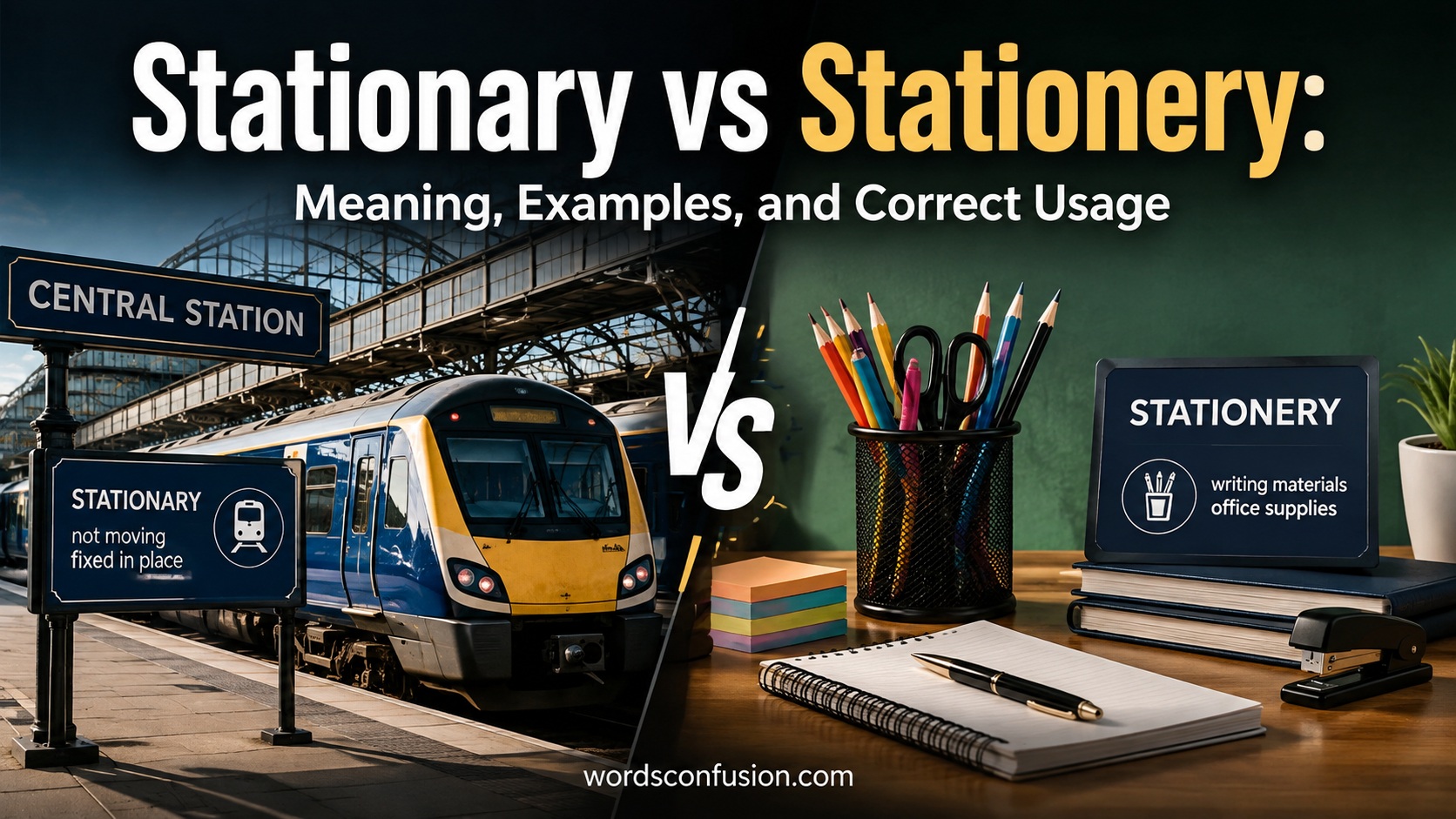
The difference, however, is quite straightforward once you connect each spelling with its meaning. Stationary describes something that isn’t moving or changing position. Stationery refers to writing materials such as paper, envelopes, letterhead, and cards.
That single letter can completely change the meaning of a sentence. If you write, “The car remained stationery,” you’re talking about writing supplies rather than a motionless vehicle. On the other hand, “She bought expensive stationary” suggests she purchased something that doesn’t move.
This guide breaks down stationary vs stationery with clear definitions, examples, comparisons, common mistakes, memory tricks, and practical usage.
Quick Answer
Stationary means not moving or staying in one position.
The train remained stationary for several minutes.
Stationery means writing materials, especially paper, envelopes, letterhead, cards, and similar items.
She ordered personalized stationery for her business.
The easiest way to remember
- Stationary = still
- Stationery = writing materials
- Stationary has an A
- Stationery has an E
- Think of the E in stationery as the E in envelope.
So if you’re describing something that isn’t moving, choose stationary. If you’re talking about paper and writing supplies, choose stationery.
Comparison Overview
The easiest way to understand stationary vs stationery is to put the two words side by side. Their spellings are nearly identical, but their meanings and grammatical roles differ.
| Feature | Stationary | Stationery |
| Part of speech | Adjective | Noun |
| Meaning | Not moving or remaining in one place | Writing materials |
| Main use | Describes position or lack of movement | Describes paper, envelopes, cards, and related materials |
| Example | The bus remained stationary. | She bought new stationery. |
| Memory clue | A = at rest | E = envelope |
| Common phrase | Stationary vehicle | Office stationery |
The distinction is important because these words aren’t interchangeable. Changing the final vowel changes the meaning entirely.
For example:
- The truck was stationary. → The truck wasn’t moving.
- The truck had new stationery. → The truck had new writing materials.
The first sentence makes sense because stationary describes the truck’s position. The second sentence is possible grammatically, but its meaning would be unusual unless the truck carried or used writing materials.
Main Differences Between Stationary vs Stationery
The biggest difference between stationary vs stationery comes down to movement versus writing materials.
Stationary is an adjective. It tells you that a person, object, vehicle, or other thing remains in one place.
Stationery is a noun. It refers to materials used for writing, printing, correspondence, or formal communication.
Here’s the simplest distinction:
Stationary = staying still.
Stationery = writing materials.
Consider these two sentences:
The bicycle remained stationary.
The company ordered new stationery.
In the first sentence, stationary describes the bicycle. In the second, stationery identifies a collection of writing materials.
Stationary Refers to Lack of Movement
When something remains in one position, you can describe it as stationary.
The word can describe:
- Cars
- Buses
- Trains
- Bicycles
- People
- Machines
- Objects
- Equipment
- Physical positions
- Objects being observed or measured
For example:
The car remained stationary at the intersection.
The workers stood stationary while they waited for instructions.
The camera captured the stationary object clearly.
The key idea is always the same: there’s no movement from one position to another.
Stationery Refers to Writing Materials
Stationery refers to materials people use for writing or correspondence.
Common examples include:
- Letter paper
- Envelopes
- Letterhead
- Writing pads
- Notepaper
- Greeting cards
- Thank-you cards
- Business correspondence materials
- Personalized writing sets
- Invitations
For example:
The office ordered new stationery with its updated logo.
She used elegant stationery to write the invitation.
The school provides basic stationery to students.
Here, the word has nothing to do with movement. It belongs to the world of writing, correspondence, and printed communication.
What Does Stationary Mean?
Stationary means remaining in one place or not moving. It functions primarily as an adjective.
When you use stationary, you’re describing the physical state or position of something.
Imagine a car parked at a curb. The car isn’t traveling anywhere. It’s stationary.
Now imagine a person standing completely still during a photograph. That person can also be described as stationary.
Stationary Definition
The core meaning of stationary is:
Not moving, traveling, or changing position.
It can describe something that stays fixed while other things move around it.
For example:
The train was stationary at the platform.
Keep the camera stationary during the exposure.
The cyclist stopped and remained stationary.
The word can also appear in technical contexts. In science and engineering, stationary can describe something that remains unchanged in position or condition within a particular frame of reference.
Stationary Examples
Here are several examples showing how the word works naturally:
- The bus remained stationary during the inspection.
- The dog stood stationary near the gate.
- The machine must remain stationary while technicians examine it.
- The boat appeared stationary from the shore.
- The car stayed stationary despite the traffic around it.
- The object remained stationary on the table.
Notice that stationary always describes something connected with remaining still or fixed.
Stationary in Everyday Situations
You’ll often encounter stationary when people describe vehicles or objects.
The vehicle remained stationary while the driver checked the map.
The elevator was stationary between floors.
The ball stayed stationary on the ground.
These examples make the meaning easy to visualize. Something starts in a position and doesn’t move from it.
Stationary in Science and Technical Writing
The word also has a more technical role.
In physics and engineering, an object may be described as stationary relative to a particular reference frame. That last part matters because motion depends on perspective.
For example, a passenger sitting inside a moving train may be stationary relative to another passenger while moving relative to the ground.
That distinction shows why technical writing sometimes treats stationary more carefully than everyday conversation does.
What Does Stationery Mean?
Stationery is a noun referring to writing materials and related paper products.
Unlike stationary, it doesn’t describe movement at all. Think of the items you might place on a desk before writing a letter.
Stationery Definition
Stationery generally includes paper, envelopes, letterhead, cards, and other materials designed for writing or correspondence.
For example:
I bought some new stationery for writing letters.
The company uses professional stationery for official correspondence.
Her wedding stationery matched the invitations and envelopes.
The word can refer to plain materials or customized products.
Common Types of Stationery
Stationery can include many different products depending on the setting.
Personal stationery:
- Personalized letter paper
- Envelopes
- Thank-you cards
- Note cards
- Writing pads
Business stationery:
- Letterhead
- Branded envelopes
- Correspondence cards
- Printed business forms
- Official writing materials
Event stationery:
- Wedding invitations
- RSVP cards
- Place cards
- Thank-you cards
- Event envelopes
The exact contents vary by context, but the central idea remains writing and correspondence materials.
Stationary vs Stationery Examples
Examples are often the fastest way to understand this confusing pair. The sentences below show how each word works in context.
Examples With Stationary
The car remained stationary throughout the inspection.
The train was stationary for nearly ten minutes.
Please keep the camera stationary while taking the photograph.
The runner became stationary after crossing the finish line.
The machine must remain stationary during maintenance.
The boat looked stationary from the distant shore.
In every example, the word describes something that isn’t moving.
Examples With Stationery
She purchased beautiful stationery for her new office.
The company printed its logo on official stationery.
He wrote the letter on personalized stationery.
The invitation arrived with matching stationery.
The school supplied students with basic stationery.
She keeps her favorite stationery in a desk drawer.
Here, the word refers to writing materials.
Side-by-Side Examples
| Correct Word | Example | Meaning |
| Stationary | The car remained stationary. | The car didn’t move. |
| Stationery | She bought new stationery. | She bought writing materials. |
| Stationary | The bicycle stayed stationary. | The bicycle stayed still. |
| Stationery | The office needs more stationery. | The office needs writing supplies. |
| Stationary | The camera must remain stationary. | The camera shouldn’t move. |
| Stationery | The invitation came with matching stationery. | The invitation included related printed materials. |
Common Phrases With Stationary
Certain combinations make the meaning of stationary immediately recognizable.
Remain Stationary
The vehicle must remain stationary during the test.
This phrase means continue to stay still.
Stationary Object
The scientist observed the movement of a ball relative to a stationary object.
Here, stationary contrasts with something that moves.
Stationary Vehicle
The officer approached the stationary vehicle.
The vehicle isn’t traveling.
Stationary Position
Hold the equipment in a stationary position.
This means keeping it fixed in one place.
Stationary Bike
She exercises on a stationary bike every morning.
A stationary bike stays in one location while you pedal. This phrase is especially useful because people sometimes mistakenly write stationery bike.
Stationery bike is incorrect when you’re referring to exercise equipment.
Common Phrases With Stationery
Stationery appears frequently in business, personal correspondence, education, and event planning.
Office Stationery
The company ordered new office stationery.
This can include letterhead, envelopes, writing paper, and related materials.
Business Stationery
The firm redesigned its business stationery after changing its logo.
Business stationery often reinforces a company’s visual identity.
Personalized Stationery
She gave her friend a set of personalized stationery.
Personalized stationery may feature a person’s name, initials, address, or design.
Wedding Stationery
The couple selected matching wedding stationery.
Wedding stationery can include invitations, RSVP cards, envelopes, and thank-you cards.
Stationery Supplies
The store sells a wide range of stationery supplies.
This phrase commonly refers to materials used for writing and correspondence.
Read More: Rise vs Raise: Meaning, Differences, Examples, and Correct Usage
Why Do People Confuse Stationary and Stationery?
The confusion isn’t surprising. Both words begin with station-, have almost identical spelling, and are pronounced the same in standard American English.
The final letters create the crucial distinction.
- Stationary → ends in -ary
- Stationery → ends in -ery
Because pronunciation doesn’t provide a reliable clue, spelling becomes especially important.
There’s also a useful historical connection behind stationery. The word developed from stationer, a term for someone who sold books and writing materials. That connection eventually led to stationery as a word for writing materials.
So although the spellings look nearly interchangeable, their meanings developed along different paths.
Stationary vs Stationery Memory Tricks
A good memory trick can save you from making the same spelling mistake repeatedly.
Remember Stationary With A
Think:
Stationary = At rest
Both A words point toward the idea of something staying put.
The car is stationary.
You can picture the car sitting at a red light. It isn’t traveling.
Remember Stationery With E
Think:
Stationery = Envelope
Both words contain the letter E.
She bought new stationery.
Picture a stack of envelopes sitting beside sheets of writing paper.
The One-Line Rule
Stationary stays still. Stationery helps you write.
That’s the simplest rule to keep in your mental toolbox.
Common Mistakes With Stationary and Stationery
These words frequently appear in spelling mistakes because writers rely on sound rather than meaning.
“I Bought New Stationary”
If you’re talking about paper or writing materials, this spelling is incorrect.
Incorrect:
I bought new stationary for my office.
Correct:
I bought new stationery for my office.
The office isn’t buying something that stays still. It’s buying writing materials.
“The Car Was Stationery”
This mistake reverses the problem.
Incorrect:
The car was stationery.
Correct:
The car was stationary.
The car wasn’t writing a letter. It simply wasn’t moving.
“Stationery Bike”
This is another common spelling error.
Incorrect:
I bought a new stationery bike.
Correct:
I bought a new stationary bike.
The exercise bike is called stationary because it remains fixed in one place while you exercise.
FAQs:
What is the difference between stationary and stationery?
Stationary means not moving or remaining in one position. Stationery refers to writing materials such as paper, envelopes, letterhead, and cards.
Is it stationary or stationery for writing paper?
The correct word is stationery.
She ordered new stationery for her office.
Is a stationary bike spelled with an A or E?
It’s spelled stationary bike with an A.
The bike stays fixed in one place while you pedal.
How do you remember the spelling of stationery?
Remember the E in stationery by connecting it with envelope.
Stationery = E = envelope.
Is stationery a noun or an adjective?
Stationery is a noun. It names writing materials and related correspondence supplies.
Conclusion:
The difference between stationary vs stationery is simple once you focus on meaning rather than sound. Stationary describes something that doesn’t move.
The car remained stationary.
Stationery refers to writing materials.
She bought elegant stationery.
When spelling the words, remember two quick clues:
Stationary → A → at rest
Stationery → E → envelope
So the next time you hesitate between these two words, ask yourself one question: Am I talking about something staying still or something used for writing? If it stays still, choose stationary. If you write on it or use it for correspondence, choose stationery.

Andrew Wilson is an experienced language researcher and content writer specializing in WordsConfusion topics. He helps readers understand commonly confused English words, spelling differences, grammar rules, word meanings, and proper usage through clear explanations, practical examples, and easy-to-follow language guides. His goal is to make English learning simple, accurate, and accessible for students, writers, professionals, and everyday learners.