
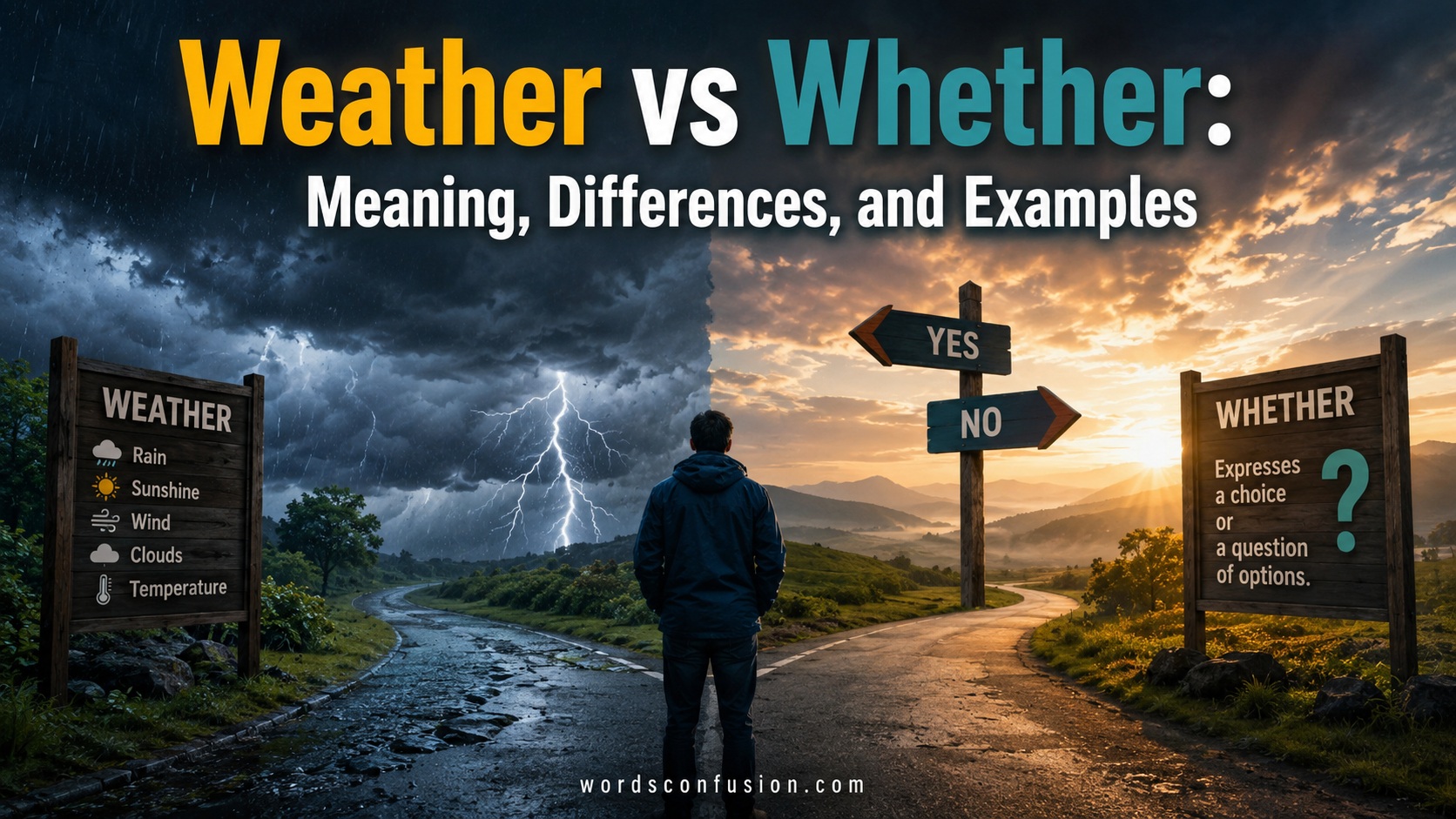
English has plenty of words that sound identical but mean completely different things. Weather vs whether is one of the most common examples. If you hear either word in conversation, you may know what the speaker means from context. On paper, however, choosing the wrong spelling can change the meaning of the sentence completely.
Weather usually relates to the atmosphere, including rain, sunshine, wind, temperature, and storms. Whether, on the other hand, introduces uncertainty, alternatives, or a choice between possibilities.
The confusion becomes even more interesting because weather can also work as a verb. In that role, it means to survive, endure, or successfully get through something difficult.
For example:
- The weather is cold today.
- I don’t know whether she’ll come.
- The company weathered a difficult financial period.
These words sound alike in many varieties of English, but their grammatical jobs are worlds apart. Once you understand what each word does, the difference becomes much easier to remember.
Quick Answer
Weather refers mainly to atmospheric conditions such as rain, wind, heat, cold, and storms. Whether is used when you’re talking about uncertainty, alternatives, or two or more possibilities.
| Word | Meaning | Example |
| Weather | Conditions in the atmosphere | The weather is beautiful today. |
| Weather | To endure or survive something | The company weathered the crisis. |
| Whether | Expresses uncertainty or alternatives | I don’t know whether he’ll come. |
A simple memory trick works well:
You check the weather, but you decide whether to go.
If you’re talking about what’s happening outside, you probably need weather. If you’re talking about which possibility is true, you probably need whether.
Comparison Overview
The easiest way to understand weather vs whether is to look at their meanings, grammatical roles, and sentence patterns side by side.
| Feature | Weather | Whether |
| Pronunciation | Usually pronounced like “whether” | Usually pronounced like “weather” |
| Main meaning | Atmospheric conditions | Uncertainty or alternatives |
| Common part of speech | Noun and verb | Conjunction |
| Talks about rain or temperature | Yes | No |
| Introduces a choice | No | Yes |
| Can mean “endure” | Yes | No |
| Common expression | bad weather | whether or not |
| Example | The weather changed quickly. | I don’t know whether he’ll come. |
The two words are homophones. Homophones are words that sound the same but have different meanings and spellings.
Other familiar homophones include there and their, to and too, and right and write. In each case, pronunciation alone doesn’t tell you which spelling to use.
Context does the heavy lifting.
Main Differences Between Weather vs Whether
The biggest difference between weather and whether comes down to meaning. Weather describes atmospheric conditions or, as a verb, the ability to endure something. Whether introduces uncertainty or alternatives.
Weather Describes Atmospheric Conditions
When you talk about rain, sunshine, wind, temperature, snow, humidity, clouds, or storms, weather is the correct word.
Consider these examples:
- The weather is warm today.
- Bad weather delayed our flight.
- We canceled the picnic because of the weather.
- The weather forecast predicts heavy rain.
- Cold weather can make driving dangerous.
Here, weather describes what’s happening in the atmosphere.
You can think of it as the condition of the air and sky at a particular time and place.
Whether Expresses Uncertainty or Choice
Whether has a completely different job. It introduces uncertainty or presents alternatives.
For example:
- I don’t know whether he’s coming.
- She asked whether the store was open.
- We’re deciding whether to stay.
- He hasn’t said whether he’ll accept the offer.
In each sentence, whether introduces something that isn’t certain.
You aren’t describing the sky. You’re considering a possibility.
Weather Can Also Mean “Endure”
There’s another important distinction that many learners overlook.
Weather can function as a verb meaning to survive, endure, or successfully get through a difficult situation.
For example:
- The company weathered the economic downturn.
- The old bridge weathered several severe storms.
- She weathered intense criticism from the public.
- The team weathered a difficult first half of the season.
This use comes from the idea of something standing against harsh weather and remaining intact.
So weather doesn’t always have something to do with sunshine or rain.
What Does Weather Mean?
Weather refers to the condition of the atmosphere at a particular time and place. It includes several measurable and observable elements.
These can include:
- Temperature
- Rainfall
- Snow
- Wind
- Cloud cover
- Humidity
- Air pressure
- Thunderstorms
- Fog
- Hail
For example, if you say, “The weather is terrible today,” you could mean that it’s raining heavily, extremely cold, dangerously windy, or experiencing another unpleasant atmospheric condition.
The exact meaning depends on the context.
Weather as a Noun
The noun weather is by far its most common use.
Examples:
The weather is perfect for a picnic.
The weather became colder overnight.
We had terrible weather during our vacation.
The flight was canceled because of severe weather.
Notice that weather usually refers to atmospheric conditions as a general concept. You don’t normally need to make it plural when using it in this sense.
A common mistake is writing weathers when you simply mean different atmospheric conditions. In ordinary usage, weather is generally treated as an uncountable noun.
Weather as a Verb
As a verb, weather means to withstand or survive something difficult.
This meaning appears frequently in news writing, business discussions, history, and everyday speech.
For example:
The business weathered the recession.
The sentence doesn’t mean that the business stood outside in the rain. It means the business survived the recession.
Another example:
The house has weathered decades of harsh winters.
Here, the meaning is literal. The house survived exposure to difficult weather conditions.
The same word can therefore move from a literal physical meaning to a figurative one.
Common Expressions With Weather
Several English expressions use weather in interesting ways.
Under the weather means feeling sick or unwell.
I’m feeling a little under the weather today.
Weather the storm means to survive a difficult period.
The company managed to weather the storm.
Weather permitting means if the weather conditions allow something to happen.
We’ll play outside tomorrow, weather permitting.
Fair-weather friend describes someone who supports you only when circumstances are easy.
A true friend stays with you during hard times instead of acting like a fair-weather friend.
These expressions are common enough to recognize in everyday English.
What Does Whether Mean?
Whether is used to introduce uncertainty, alternatives, or possibilities. It often appears when someone doesn’t know which of two possibilities is true.
Consider:
I don’t know whether she is coming.
The speaker doesn’t know if she will come. The word whether introduces that uncertainty.
You can also use it when the alternatives are clearly stated:
We need to decide whether to drive or take the train.
Here, the two possibilities are drive and take the train.
Whether for Alternatives
One of the clearest patterns is:
whether + option A + or + option B
Examples:
- I can’t decide whether to stay or leave.
- She doesn’t know whether to accept or reject the offer.
- We’re discussing whether to travel by car or train.
- He hasn’t decided whether he wants tea or coffee.
The alternatives don’t always have to appear explicitly.
For example:
I don’t know whether he’ll come.
The sentence leaves the second possibility unstated. The implied alternatives are roughly he’ll come or he won’t come.
Whether or Not
The expression whether or not is extremely common.
It emphasizes that the outcome applies regardless of which possibility turns out to be true.
Examples:
Whether or not it rains, we’ll leave tomorrow.
I’m going whether you come or not.
You must finish the work whether or not you feel ready.
In these sentences, the speaker isn’t making the action dependent on the result.
That’s an important distinction.
Whether Before an Infinitive
A particularly useful grammatical structure is:
whether + to + verb
Examples include:
- I don’t know whether to stay.
- She couldn’t decide whether to accept the job.
- We’re discussing whether to postpone the meeting.
- He isn’t sure whether to call her.
This construction provides a powerful clue when you’re choosing between whether and weather.
If you see a structure such as whether to go, whether to stay, or whether to accept, you need whether.
Never write:
I don’t know weather to stay.
The correct sentence is:
I don’t know whether to stay.
Weather vs Whether Examples
Seeing the words in realistic sentences makes the difference much easier to absorb.
Examples of Weather
- The weather is unusually warm today.
- We stayed home because of the bad weather.
- The weather forecast says it may snow tonight.
- The storm produced dangerous weather conditions.
- Warm weather attracts more visitors to the beach.
- The weather changed within a few hours.
- The farmers are watching the weather carefully.
- Heavy weather disrupted transportation.
Examples of Whether
- I don’t know whether he’s available.
- She asked whether we needed help.
- They haven’t decided whether to move.
- I’m not sure whether this is the right choice.
- We need to determine whether the plan will work.
- He wondered whether she knew the truth.
- Tell me whether you agree or disagree.
- They discussed whether to continue the project.
Weather and Whether in the Same Sentence
Here’s where the distinction becomes especially clear.
Both words can appear in the same sentence because they perform completely different jobs.
I don’t know whether the weather will improve.
Whether introduces uncertainty. Weather refers to atmospheric conditions.
Another example:
Check the weather before deciding whether to travel.
Again, weather describes the conditions outside while whether introduces a decision.
More examples:
- We don’t know whether the weather will remain sunny.
- Whether the weather is hot or cold, the event will continue.
- She checked the weather before deciding whether to fly.
- I’m not sure whether the weather will affect our plans.
These examples are worth studying because they show that the words aren’t interchangeable.
Weather vs Whether: Common Sentence Patterns
Recognizing patterns can help you choose the right spelling without stopping to think about the dictionary definition.
| Pattern | Correct Word | Example |
| ___ is sunny | Weather | The weather is sunny. |
| ___ forecast | Weather | Check the weather forecast. |
| bad ___ | Weather | The bad weather canceled the game. |
| ___ or not | Whether | Whether or not he agrees, we’ll continue. |
| ___ to go | Whether | I don’t know whether to go. |
| don’t know ___ | Whether | I don’t know whether she’s coming. |
| decide ___ | Whether | We must decide whether to stay. |
| ___ the storm | Weather | The company weathered the storm. |
These patterns are useful because English often relies on familiar word combinations. Once you’ve seen them repeatedly, the correct spelling starts to feel natural.
Weather vs Whether vs If
The confusion doesn’t stop with weather and whether. Many writers also struggle with whether vs if.
The two words sometimes overlap.
For example:
- I don’t know whether she’s coming.
- I don’t know if she’s coming.
Both sentences can be correct. Both express uncertainty about her arrival.
However, whether becomes especially useful when you present explicit alternatives or use an infinitive.
Compare:
I don’t know whether to stay or leave.
You can’t naturally replace whether with if in this construction:
I don’t know if to stay or leave.
That version is not standard English.
Another example:
We need to decide whether to accept the offer.
The whether + infinitive structure makes the choice clear.
If for Conditions
If commonly introduces a condition.
If it rains, we’ll stay home.
This means the decision depends on a condition.
Compare it with:
I don’t know whether it will rain.
Here, the speaker expresses uncertainty about two possibilities.
The difference becomes clearer in these examples:
| Sentence | Meaning |
| If it rains, we’ll stay home. | A condition controls the result. |
| I don’t know whether it will rain. | The speaker is uncertain about the possibility. |
| We’ll go whether or not it rains. | The result won’t change regardless of the weather. |
This distinction matters in formal writing because if and whether aren’t always interchangeable.
Read More: To vs Too: Meaning, Differences, and Correct Usage
Common Mistakes With Weather and Whether
Small spelling mistakes can completely change a sentence’s meaning.
Mistake: Using Weather for Uncertainty
Incorrect:
I don’t know weather she’ll come.
Correct:
I don’t know whether she’ll come.
The sentence expresses uncertainty rather than atmospheric conditions. Therefore, whether is required.
Mistake: Using Whether for Atmospheric Conditions
Incorrect:
The whether is terrible today.
Correct:
The weather is terrible today.
You’re describing atmospheric conditions. That calls for weather.
Mistake: Writing Weather or Not
Incorrect:
Weather or not you agree, we’ll continue.
Correct:
Whether or not you agree, we’ll continue.
The phrase whether or not expresses an alternative or possibility.
Mistake: Forgetting the Verb Meaning of Weather
Some learners think weather can only describe rain or sunshine.
That’s not true.
The organization weathered several difficult years.
Here, weathered means survived or endured.
Mistake: Confusing Whether With If
Incorrect in standard usage:
I don’t know if to accept the offer.
Better:
I don’t know whether to accept the offer.
When to + verb follows the expression, whether is the natural choice.
FAQs:
Is weather and whether the same word?
No. Weather and whether are different words with different meanings. They sound alike in many varieties of English, which makes them homophones.
What is the difference between weather and whether?
Weather refers to atmospheric conditions or can mean to endure something difficult. Whether introduces uncertainty, alternatives, or a choice between possibilities.
Is whether a conjunction?
Yes. Whether commonly functions as a conjunction that introduces an indirect question or alternative possibilities.
For example:
I don’t know whether he’ll come.
Can weather be a verb?
Yes. As a verb, weather means to withstand, endure, or survive something difficult.
The company weathered the economic crisis.
What does whether or not mean?
Whether or not introduces alternatives and often emphasizes that something will happen regardless of which possibility is true.
We’ll go whether or not it rains.
Conclusion:
Understanding weather vs whether becomes much easier when you focus on their meanings rather than their pronunciation. Weather refers to atmospheric conditions such as rain, wind, temperature, and storms. It can also work as a verb meaning to survive or endure a difficult situation. Whether, however, expresses uncertainty, alternatives, or a choice between possibilities. A simple way to remember the difference is: you check the weather, but you decide whether to go. Once you recognize the context and sentence pattern, choosing the correct word becomes quick and natural.

Andrew Wilson is an experienced language researcher and content writer specializing in WordsConfusion topics. He helps readers understand commonly confused English words, spelling differences, grammar rules, word meanings, and proper usage through clear explanations, practical examples, and easy-to-follow language guides. His goal is to make English learning simple, accurate, and accessible for students, writers, professionals, and everyday learners.