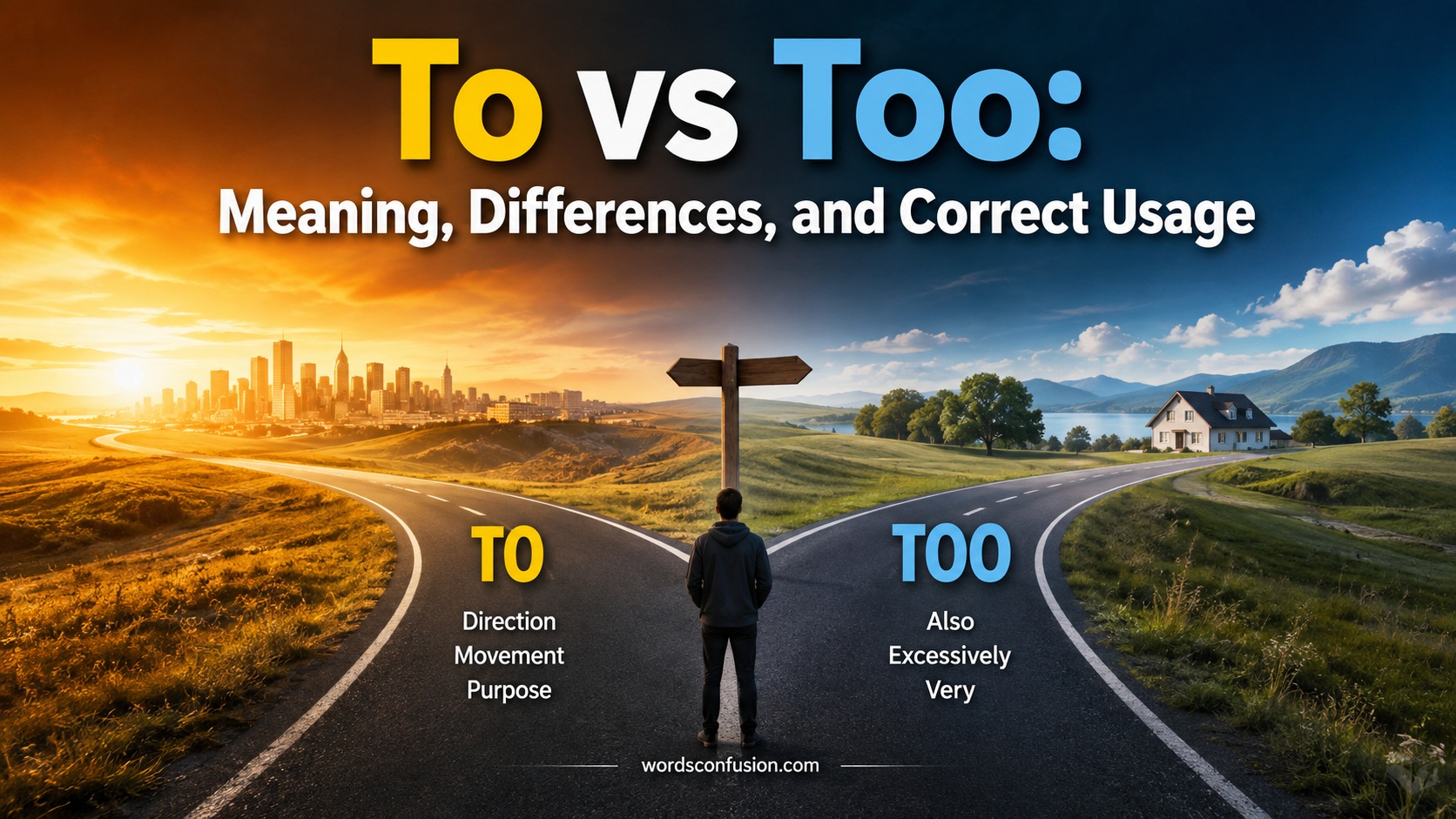
If you’ve ever paused while writing a sentence and wondered whether you need to or too, you’re not alone. These two words sound exactly alike in many varieties of English, yet they perform completely different jobs in a sentence. One small letter can change the meaning or make a sentence grammatically incorrect.
The confusion becomes even greater because to appears everywhere. You use it to show direction, introduce an infinitive, identify a recipient, and express purpose. Too, meanwhile, usually means “also” or “more than necessary.”
Consider these sentences:
- I want to learn English.
- I want to learn English too.
- The lesson is too difficult.
- She walked to school.
- She went to school too.
The pronunciation doesn’t tell you which spelling to choose. The meaning and grammatical role do.
This guide explains to vs too in detail, including their meanings, grammatical functions, common patterns, mistakes, examples, and practical ways to remember the difference. It also covers to, too, and two, since these three words often get mixed up.
Quick Answer
To usually shows direction, connection, purpose, or forms an infinitive before a verb. Too usually means “also” or “more than necessary.”
| Word | Main Function | Meaning | Example |
| To | Preposition / infinitive marker | Direction, connection, purpose, or infinitive | I want to leave. |
| Too | Adverb | Also / excessively | I want to leave too. |
| Two | Number | The number 2 | I bought two books. |
A quick test can help:
- If you mean also, use too.
- If you mean more than necessary or desirable, use too.
- If you’re showing direction or using to + verb, use to.
- If you mean the number 2, use two.
For example, “I want too go” is incorrect because go is a verb that requires the infinitive marker to.
“I want to go too” is correct because to introduces the verb go while too means also.
Comparison Overview
The easiest way to understand to vs too is to look at the job each word performs. Although they sound alike, their grammar and meanings are quite different.
| Feature | To | Too |
| Part of speech | Preposition or infinitive marker | Adverb |
| Main meanings | Direction, relationship, purpose, infinitive | Also, excessively |
| Can come before a verb? | Yes | No, not as an infinitive marker |
| Can mean “also”? | No | Yes |
| Can mean “more than necessary”? | No | Yes |
| Example | She went to work. | She came too. |
| Example with a verb | I need to study. | Incorrect: I need too study. |
| Example of excess | Not applicable | It’s too expensive. |
The key isn’t pronunciation. It’s function.
Think of to as a word that often points somewhere or connects something. Too adds something to the meaning, either by saying “also” or by indicating an excessive degree.
Main Differences Between To vs Too
The biggest difference between to vs too is grammatical function. To commonly works as a preposition or infinitive marker, while too works as an adverb.
To Shows Direction
When to indicates movement toward a destination, it functions as a preposition.
Examples:
- We drove to the airport.
- She walked to the library.
- They moved to Texas.
- He ran to the door.
- I sent the package to my friend.
Here, to establishes a relationship between the action and the destination.
In “She walked to the library,” the word to connects walked with the library. It tells you where she went.
To Introduces an Infinitive
One of the most common uses of to appears before the base form of a verb.
This structure is called the to-infinitive:
to + base verb
Examples:
- to eat
- to sleep
- to write
- to understand
- to improve
- to travel
- to communicate
You can see this pattern in complete sentences:
- I want to learn.
- She needs to study.
- We decided to leave.
- They hope to win.
- He plans to travel.
In these sentences, to isn’t showing physical direction. Instead, it helps form the infinitive.
Too Means “Also”
The first major meaning of too is “also” or “in addition.”
For example:
I like chocolate too.
This means:
I also like chocolate.
Other examples include:
- She wants to come too.
- I watched the movie too.
- He speaks Spanish too.
- We enjoyed the concert too.
- They invited Sarah too.
This use often appears at the end of a sentence.
However, too doesn’t have to stay at the end. In some structures, writers place it before the main adjective or adverb for emphasis.
For example:
- The decision was too difficult to make.
- She was too tired to continue.
Here, too no longer means “also.” It expresses excess.
Too Means “More Than Necessary”
The second major meaning of too is excessively or more than is wanted, needed, suitable, or possible.
Consider:
The coffee is hot.
This simply tells you that the coffee has a high temperature.
Now compare:
The coffee is too hot.
That sentence suggests the coffee is hotter than you want or can comfortably drink.
That distinction matters.
Examples:
- The bag is too heavy.
- The room is too cold.
- The music is too loud.
- The test was too difficult.
- The car is too expensive.
- He talks too quickly.
In each case, too suggests that the degree has gone beyond an acceptable or useful point.
What Does “To” Mean?
The word to has several important grammatical uses. It doesn’t have just one fixed meaning.
To as a Preposition
As a preposition, to can show direction, destination, movement, or a relationship between people or things.
Examples:
- She went to school.
- We traveled to California.
- He walked to the store.
- Give the book to James.
- Send the email to your manager.
The exact meaning depends on the sentence.
In “Give the keys to Maria,” to identifies the person who receives the keys.
In “Drive to Chicago,” to identifies the destination.
To Shows a Recipient
You can use to when something moves from one person to another.
Examples:
- I gave the money to my brother.
- She sent a message to her teacher.
- He handed the documents to the manager.
- We offered the seat to an elderly passenger.
Here, to establishes the recipient.
To Shows a Range or Endpoint
To can also indicate an endpoint or range.
Examples:
- Monday to Friday
- 9:00 a.m. to 5:00 p.m.
- Pages 10 to 20
- Temperatures from 60 to 70 degrees
The word identifies where something ends.
To Shows Purpose
Another common use involves purpose.
Examples:
- I went outside to get some air.
- She called to ask a question.
- He studied hard to pass the exam.
- We stopped to buy groceries.
In these sentences, to + verb explains why someone performed an action.
For example:
She went to the store to buy milk.
The first to identifies the destination. The second to introduces the purpose.
What Does “Too” Mean?
Unlike to, too is an adverb. Its two major meanings are “also” and “excessively.”
Too Meaning “Also”
When too means also, it adds another person, thing, or situation to an existing statement.
Examples:
- I want pizza too.
- She likes reading too.
- We need a copy too.
- He wants to participate too.
Consider this short conversation:
“I’m going to the party.”
“I’m going too.”
The second speaker means:
“I’m also going.”
That’s the simplest use of too.
Too Meaning “Excessively”
When too indicates excess, it usually appears before an adjective or adverb.
Examples:
- too expensive
- too slow
- too fast
- too complicated
- too noisy
- too difficult
For example:
The shoes are too expensive.
This doesn’t merely mean the shoes cost a lot. It suggests that their price exceeds what the speaker considers reasonable or affordable.
Too vs Very
One of the most useful distinctions is the difference between too and very.
Very increases the degree of something.
Too suggests that the degree has crossed a limit.
Compare:
| Sentence | Meaning |
| The soup is very hot. | The soup has a high temperature. |
| The soup is too hot. | The soup is hotter than desirable. |
| The box is very heavy. | The box weighs a lot. |
| The box is too heavy. | The box is heavier than someone can comfortably handle. |
| The movie is very long. | The movie has a long duration. |
| The movie is too long. | The movie lasts longer than desired. |
This is more than a minor vocabulary distinction. Too often carries a negative or limiting implication.
To vs Too Examples
Seeing the words in realistic sentences makes the difference much easier to recognize.
Examples With “To”
- I need to finish my work.
- She went to the market.
- He gave the phone to his sister.
- We decided to stay.
- They moved to Florida.
- I called to confirm the appointment.
- She wants to become a doctor.
Examples With “Too”
- I want some too.
- She is coming too.
- This jacket is too expensive.
- The coffee is too cold.
- He drives too quickly.
- There are too many people here.
- We have too little time.
Examples With Both To and Too
This is where the difference becomes especially clear.
- I want to go too.
- She went to the store too.
- It’s too late to call.
- He wants to participate too.
- The box is too heavy to lift.
- They traveled to New York too.
Notice how each word has its own job.
In “I want to go too,” the first to belongs to the infinitive to go. The final too means also.
To vs Too in the Same Sentence
Don’t assume that a sentence must use only one of these words. In fact, many perfectly normal sentences use to and too together.
Consider:
She wants to come too.
Break it apart:
- wants = main verb
- to come = infinitive
- too = also
Another example:
The water is too cold to swim in.
Here:
- too cold = colder than desirable
- to swim = infinitive
The same sentence therefore contains both major uses of too and to.
More Examples
| Sentence | First word | Second word | Meaning |
| I want to go too. | To = infinitive | Too = also | I also want to go. |
| It’s too late to leave. | Too = excessively | To = infinitive | It is later than suitable for leaving. |
| She went to school too. | To = destination | Too = also | She also went to school. |
| He is too tired to work. | Too = excessively | To = infinitive | His tiredness prevents him from working. |
Read More: Their vs There: Meaning, Examples, and Correct Usage
To vs Too: Too Much, Too Many, Too Few, and Too Little
The word too also appears in several important quantity expressions.
Too Much
Use too much with uncountable nouns.
Examples:
- too much water
- too much sugar
- too much money
- too much noise
- too much information
Example:
There is too much sugar in this coffee.
Sugar isn’t normally counted as individual units in this context.
Too Many
Use too many with plural countable nouns.
Examples:
- too many books
- too many people
- too many questions
- too many cars
- too many mistakes
Example:
There are too many cars on this road.
You can count cars individually.
Too Little
Use too little with uncountable nouns.
Examples:
- too little time
- too little water
- too little money
- too little information
Example:
We have too little time to finish the project.
Too Few
Use too few with plural countable nouns.
Examples:
- too few students
- too few chairs
- too few workers
- too few opportunities
Example:
There are too few chairs for everyone.
The following table summarizes the pattern:
| Expression | Noun Type | Example |
| Too much | Uncountable | too much water |
| Too many | Countable plural | too many books |
| Too little | Uncountable | too little time |
| Too few | Countable plural | too few chairs |
FAQs:
Is it “I want to” or “I want too”?
Use “I want to” when another verb follows.
For example:
- I want to learn English.
- I want to visit New York.
- I want to improve my writing.
Here, to introduces the infinitive verb.
However, use too when you mean “also.”
- I want to go too.
- I want some too.
A useful trick is to ask whether you could replace too with also. If the answer is yes, too is usually the right choice.
Is it “me too” or “me to”?
The correct expression is “me too” when you mean “me also.”
For example:
“I love this song.”
“Me too.”
The response means “I also love this song.” In informal English, me too is a standard and natural short response.
Me to would normally be incorrect when you mean “also.”
Does “too” always mean “also”?
No. Too has two major everyday uses.
It can mean “also”:
- I want to come too.
- She likes coffee too.
It can also mean “more than necessary, wanted, suitable, or enough”:
- The coffee is too hot.
- The bag is too heavy.
- This car is too expensive.
Cambridge Dictionary also notes that too can occur before adjectives and adverbs to express an excessive degree.
What is the easiest way to remember to vs too?
Use three simple tests.
First, try “also.”
If the sentence still makes sense, use too.
I want to come too.
I also want to come.
Second, check for an infinitive.
If you have to + base verb, use to.
I want to study.
Third, check for excess.
If something is beyond a suitable or desired level, use too.
The room is too cold.
You can also remember the extra o in too as a reminder of something extra.
What is the difference between too much and too many?
Use too much with uncountable nouns and too many with countable plural nouns.
Examples:
- too much water
- too much sugar
- too much time
- too many books
- too many students
- too many questions
For example:
There is too much noise in this room.
But:
There are too many people in this room.
The same pattern applies to too little and too few. Use too little with uncountable nouns and too few with plural countable nouns.
Conclusion:
The difference between to vs too is simple once you understand what each word does. Use to for direction, purpose, recipients, or before a verb in the infinitive form, as in “I want to learn.” Use too when you mean “also” or “more than necessary,” as in “I want to come too” or “The coffee is too hot.” Remember that two refers to the number 2. Although these words sound alike, their meanings and grammatical roles are completely different. When you’re unsure, don’t rely on pronunciation. Look at the meaning and function of the word in the sentence.

Andrew Wilson is an experienced language researcher and content writer specializing in WordsConfusion topics. He helps readers understand commonly confused English words, spelling differences, grammar rules, word meanings, and proper usage through clear explanations, practical examples, and easy-to-follow language guides. His goal is to make English learning simple, accurate, and accessible for students, writers, professionals, and everyday learners.