Have you ever paused while writing a sentence and wondered whether to use who’s or whose? You’re not alone. These two words sound exactly the same, which makes them one of the most commonly confused pairs in English. Even experienced writers occasionally stop to double-check which one fits the sentence.
The good news is that the difference is simple once you understand the grammar behind each word. Who’s is a contraction, while whose shows possession. Knowing this one rule can help you avoid mistakes in emails, school assignments, business writing, and everyday conversations.
In this guide, you’ll learn the meaning of who’s vs whose, discover the grammar rules behind each word, compare them side by side, and practice with plenty of real-world examples. By the end, you’ll know exactly when to use each word with confidence.
Quick Answer
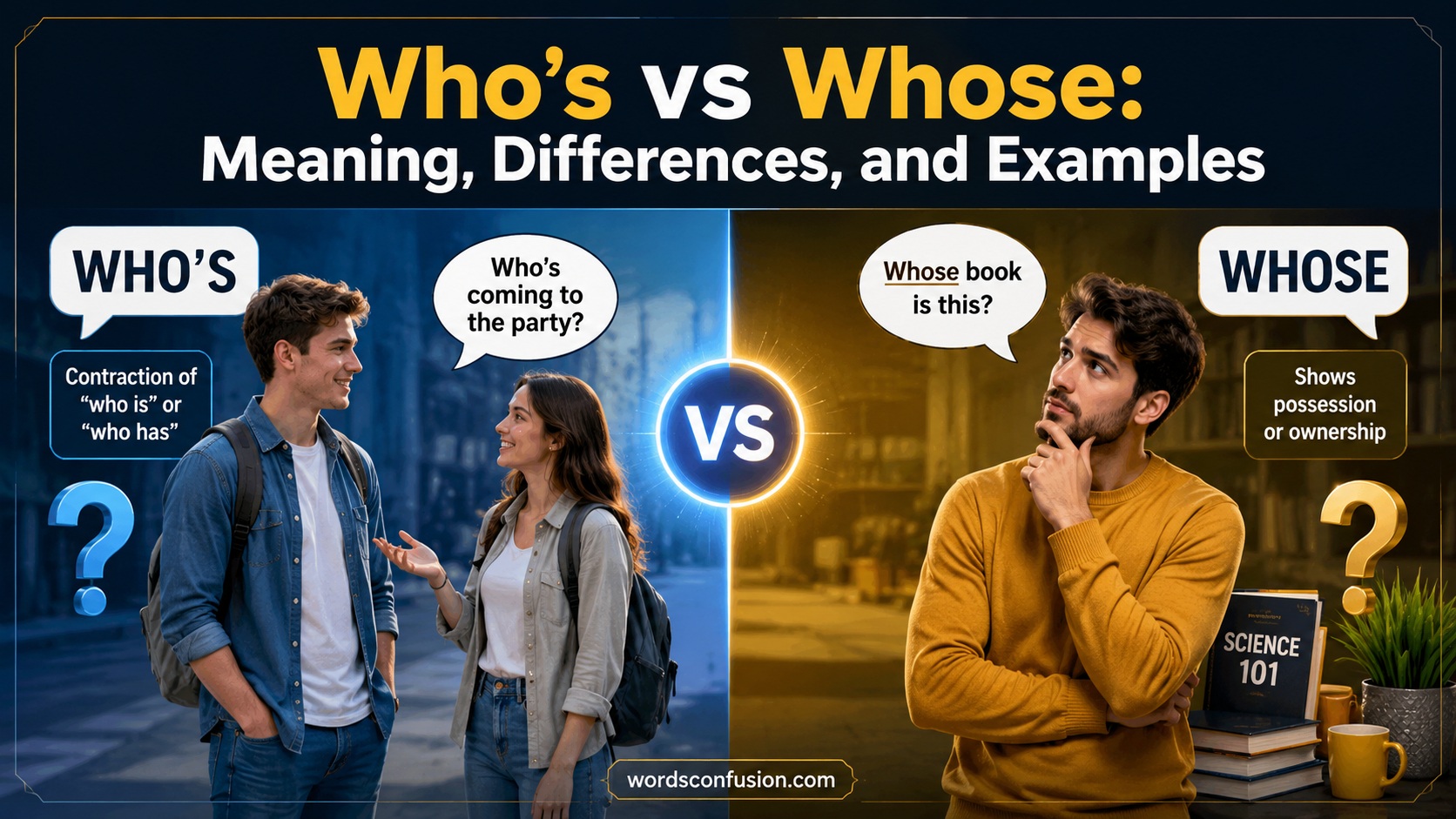
- Who’s = Who is or Who has
- Whose = Shows ownership or possession
Examples:
- Who’s coming to dinner? (Who is coming to dinner?)
- Who’s finished the report? (Who has finished the report?)
- Whose laptop is on the desk?
- Whose idea was selected?
A simple trick works almost every time. Replace who’s with who is or who has. If the sentence still makes sense, who’s is correct. If it doesn’t, use whose.
Who’s vs Whose at a Glance
| Feature | Who’s | Whose |
| Meaning | Who is or who has | Belonging to whom |
| Part of Speech | Contraction | Possessive determiner or pronoun |
| Shows Ownership | No | Yes |
| Contains an Apostrophe | Yes | No |
| Can Be Expanded | Yes | No |
What Does “Who’s” Mean?
Who’s is a contraction. It combines two words into one by replacing missing letters with an apostrophe.
It can mean:
- Who is
- Who has
The apostrophe replaces the missing letter or letters.
For example:
- Who’s knocking at the door?
- Who’s responsible for this project?
- Who’s already submitted the assignment?
- Who’s been waiting the longest?
Each example can be expanded.
- Who is knocking at the door?
- Who is responsible for this project?
- Who has already submitted the assignment?
- Who has been waiting the longest?
If the expanded version sounds natural, who’s is the correct choice.
When to Use “Who’s”
Use who’s whenever you can replace it with who is or who has.
Common situations include:
- Asking questions
- Starting conversations
- Referring to someone’s actions
- Identifying a person
- Discussing completed actions
Examples:
- Who’s your favorite author?
- Who’s leading today’s meeting?
- Who’s interested in volunteering?
- Who’s already eaten lunch?
- Who’s planning the event?
These examples all expand naturally.
Examples of “Who’s” in Sentences
Everyday Conversation
- Who’s calling this late?
- Who’s at the front door?
- Who’s making coffee?
School
- Who’s presenting first?
- Who’s finished the homework?
- Who’s answering the next question?
Workplace
- Who’s managing this client?
- Who’s available this afternoon?
- Who’s signed the agreement?
Formal Writing
- Who’s authorized to approve the budget?
- Who’s responsible for quality assurance?
Common Mistakes with “Who’s”
Many people mistakenly use who’s before a noun that shows ownership.
Incorrect:
- Who’s jacket is this?
- Who’s car is parked outside?
- Who’s phone keeps ringing?
Correct:
- Whose jacket is this?
- Whose car is parked outside?
- Whose phone keeps ringing?
The reason is simple. These sentences ask about ownership, not who is or who has.
What Does “Whose” Mean?
Whose is the possessive form of who. It asks or tells who owns something or who something belongs to.
Unlike who’s, whose is not a contraction. That’s why it doesn’t contain an apostrophe.
You use whose whenever ownership, possession, or association is involved.
Examples include:
- Whose notebook is this?
- Whose shoes are by the door?
- Whose turn is it?
- Whose opinion matters most?
In every example, the sentence asks who owns or is connected to something.
When to Use “Whose”
Use whose whenever you are asking about ownership or identifying the owner of something.
It works with:
- People
- Animals
- Organizations
- Objects
- Ideas
Examples:
- Whose bicycle is parked outside?
- Whose dog barked all night?
- Whose company developed this software?
- Whose responsibility is customer support?
Examples of “Whose” in Sentences
Everyday Examples
- Whose wallet is on the table?
- Whose headphones are these?
- Whose coffee is getting cold?
Academic Examples
- Whose research won the award?
- Whose paper received the highest grade?
Workplace Examples
- Whose proposal was approved?
- Whose department handles payroll?
Family Examples
- Whose birthday is next?
- Whose room needs cleaning?
Common Mistakes with “Whose”
The biggest mistake is replacing whose with who’s because both words sound identical.
Incorrect:
- Who’s backpack is this?
- Who’s decision changed the project?
- Who’s responsibility is customer service?
Correct:
- Whose backpack is this?
- Whose decision changed the project?
- Whose responsibility is customer service?
Whenever a noun follows the word and ownership is implied, whose is almost always the correct choice.
The Main Difference Between Who’s and Whose
The difference between who’s vs whose comes down to one idea.
- Who’s is a shortened form of who is or who has.
- Whose shows ownership or possession.
Although they sound exactly alike, they perform completely different grammatical jobs.
Think of it this way.
If you can replace the word with who is or who has, choose who’s.
If you’re asking “Who owns this?” or describing ownership, choose whose.
Who’s vs Whose Comparison Table
| Feature | Who’s | Whose |
| Meaning | Who is or who has | Belonging to whom |
| Grammar Type | Contraction | Possessive word |
| Apostrophe | Yes | No |
| Indicates Ownership | No | Yes |
| Expansion Possible | Yes | No |
| Example | Who’s coming today? | Whose keys are these? |
Quick Comparison Examples
| Sentence | Correct Word | Reason |
| ___ ready for the trip? | Who’s | Means who is. |
| ___ backpack is on the chair? | Whose | Shows ownership. |
| ___ already finished the report? | Who’s | Means who has. |
| ___ idea won the competition? | Whose | Asks about possession. |
| ___ waiting outside? | Who’s | Means who is. |
Grammar Tip: If replacing the word with who is or who has sounds natural, use who’s. If you’re talking about ownership, always use whose.
The Apostrophe Test for Who’s vs Whose
One of the easiest ways to choose between who’s and whose is to use the apostrophe test. It takes only a few seconds and works in most situations.
Here’s how it works:
- Replace who’s with who is.
- If that doesn’t fit, try who has.
- If neither version makes sense, the correct word is whose.
This simple test helps you avoid one of the most common grammar mistakes in English.
Examples of the Apostrophe Test
| Original Sentence | Replace with “Who is” or “Who has” | Correct Word |
| ___ coming with us? | Who is coming with us? | Who’s |
| ___ already completed the task? | Who has already completed the task? | Who’s |
| ___ coat is hanging there? | Who is coat? | Whose |
| ___ keys are on the counter? | Who has keys are…? | Whose |
| ___ been waiting longest? | Who has been waiting longest? | Who’s |
Whenever the expanded version sounds awkward or incorrect, you’re almost certainly looking for whose.
Read More: Wander vs Wonder: Meaning, Differences, and Examples
Grammar Rules for Who’s vs Whose
Understanding the grammar behind these words makes them much easier to remember.
Why “Who’s” Has an Apostrophe
An apostrophe often shows that letters have been removed from a word.
In who’s, the apostrophe replaces the missing letters in who is or who has.
Examples:
- Who’s ready?
- Who’s been here before?
- Who’s speaking next?
Each sentence contains a contraction.
Why “Whose” Has No Apostrophe
Many people assume every possessive word needs an apostrophe. English doesn’t work that way.
Possessive pronouns and possessive determiners usually don’t use apostrophes.
Examples include:
- my
- your
- his
- her
- our
- their
- its
- whose
Notice that none of these words contains an apostrophe.
Compare Similar Grammar Pairs
| Contraction | Possessive |
| it’s | its |
| you’re | your |
| they’re | their |
| who’s | whose |
This pattern appears throughout English grammar. Once you recognize it, you’ll make fewer mistakes with similar word pairs.
Examples of Who’s vs Whose in Everyday English
You don’t need complicated grammar books to understand these words. You’ll hear and read them every day.
Everyday Conversation
Who’s
- Who’s making dinner tonight?
- Who’s driving?
- Who’s at the door?
- Who’s calling you?
Whose
- Whose umbrella is this?
- Whose phone keeps buzzing?
- Whose turn is it?
- Whose jacket did you borrow?
Workplace Examples
Professional writing should always use the correct word.
Who’s
- Who’s leading today’s meeting?
- Who’s available after lunch?
- Who’s approved the proposal?
Whose
- Whose report needs revision?
- Whose client requested the update?
- Whose department manages payroll?
School Examples
Students often confuse these words in essays and exams.
Who’s
- Who’s presenting first?
- Who’s answered every question?
Whose
- Whose notebook is missing?
- Whose project won first place?
Email Examples
Correct grammar leaves a stronger impression.
Correct:
- Who’s joining tomorrow’s video call?
- Whose signature is required?
- Who’s responsible for the presentation?
- Whose schedule should we follow?
FAQs:
Is who’s always a contraction of who is?
No. Who’s can be a contraction of who is or who has.
Examples:
- Who’s coming to the party? (Who is coming to the party?)
- Who’s finished the assignment? (Who has finished the assignment?)
If you can replace who’s with either who is or who has without changing the meaning, you’ve used it correctly.
When should I use whose instead of who’s?
Use whose whenever you’re talking about ownership, possession, or association.
Examples:
- Whose phone is ringing?
- Whose idea was chosen?
- Whose bicycle is parked outside?
A simple rule is to ask yourself, “Does something belong to someone?” If the answer is yes, use whose.
Can whose refer to things as well as people?
Yes. Although whose traditionally refers to people, modern English also uses it to refer to animals, organizations, places, and things.
Examples:
- The company whose products won several awards expanded internationally.
- The house whose roof was damaged has been repaired.
- The dog whose collar was missing found its owner.
This usage is widely accepted in both formal and informal English.
Why doesn’t whose have an apostrophe?
Many writers assume possessive words always need an apostrophe. However, whose is a possessive pronoun/determiner, not a contraction.
Other possessive words follow the same pattern:
- his
- hers
- its
- yours
- ours
- theirs
None of these words uses an apostrophe, and whose follows the same grammar rule.
What’s the easiest way to remember the difference between who’s and whose?
The quickest memory trick is the substitution test.
- Replace who’s with who is or who has.
- If the sentence still makes sense, who’s is correct.
- If it doesn’t, choose whose.
For example:
- Who’s ready? → Who is ready?
- Whose backpack is this? → Who is backpack is this?
This simple test works in almost every situation.
Conclusion:
Understanding who’s vs whose becomes easy once you know the role each word plays. Who’s is always a contraction of who is or who has, while whose shows ownership or possession. Although they sound identical, they serve completely different grammatical purposes.
Whenever you’re unsure, use the substitution test. Replace who’s with who is or who has. If the sentence still reads naturally, you’ve chosen the right word. If not, whose is the correct option.
Mastering this small grammar rule can make a noticeable difference in your writing. Whether you’re sending an email, writing a blog post, completing a school assignment, or preparing a business document, using who’s and whose correctly makes your writing clearer, more professional, and easier to understand. With regular practice and the examples in this guide, choosing the right word will soon become second nature.

Andrew Wilson is an experienced language researcher and content writer specializing in WordsConfusion topics. He helps readers understand commonly confused English words, spelling differences, grammar rules, word meanings, and proper usage through clear explanations, practical examples, and easy-to-follow language guides. His goal is to make English learning simple, accurate, and accessible for students, writers, professionals, and everyday learners.