
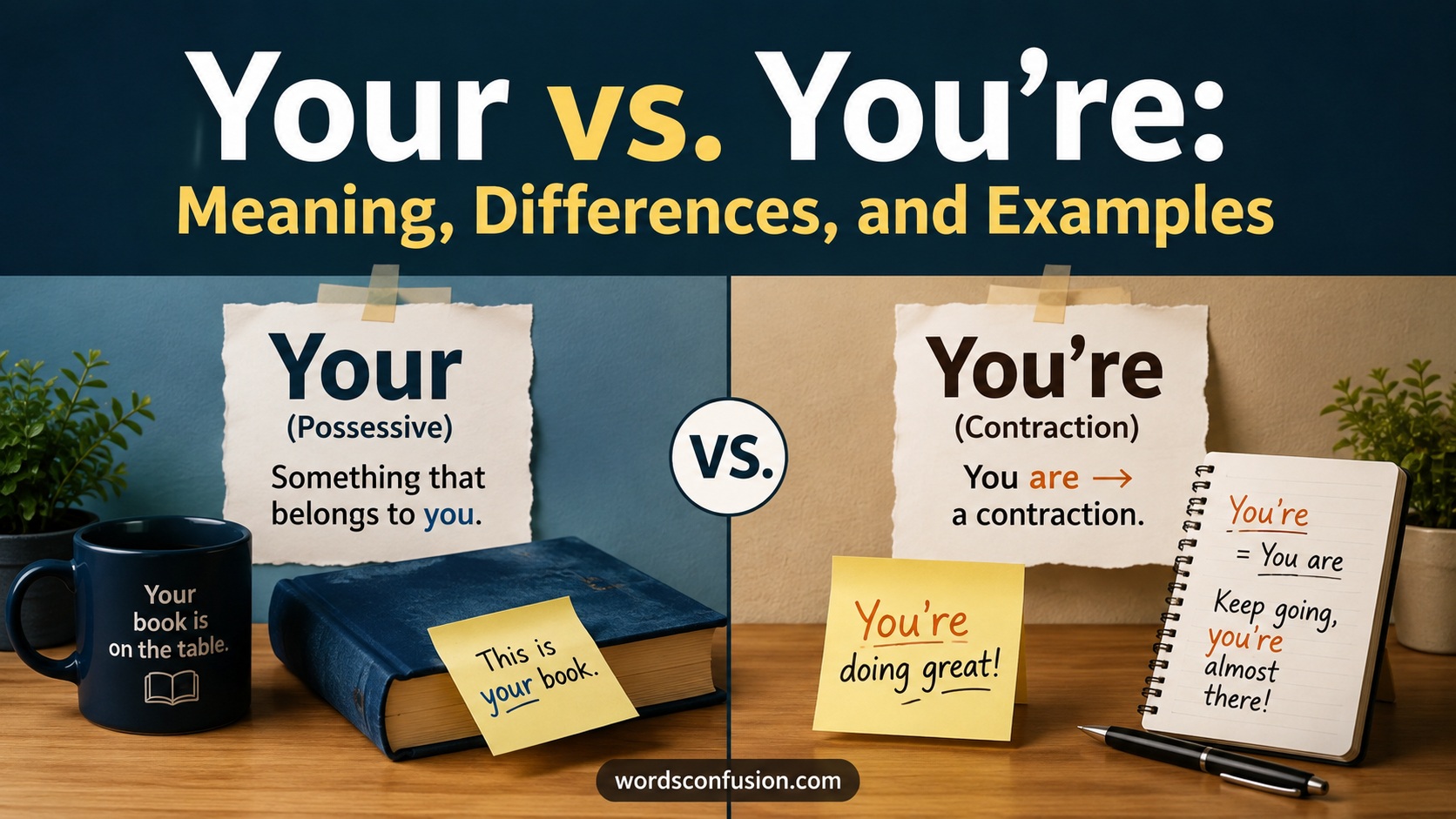
Your vs. you’re is one of the most common word-choice problems in English. The two words sound the same or nearly the same in many varieties of English, yet they perform completely different jobs in a sentence.
That small apostrophe creates a big grammatical difference. Your shows that something belongs or relates to you, while you’re is the contraction of you are.
For example:
- Your phone is on the table.
- You’re using your phone.
- Your answer is correct.
- You’re correct.
The good news is that you don’t need to memorize dozens of complicated grammar rules. Once you understand what each word does, you can usually choose the right one in seconds.
This guide explains your vs. you’re with clear definitions, practical examples, comparison tables, common mistakes, sentence patterns, tricky cases, and a simple test that makes the difference easy to remember.
Quick Answer
Your is a possessive determiner that shows something belongs to or is associated with you. You’re is a contraction that means you are.
| Word | Meaning | Function | Example |
| Your | Belonging or relating to you | Possessive determiner | Your car is outside. |
| You’re | You are | Contraction | You’re very kind. |
The fastest way to choose between them is the “you are” test.
If you can replace you’re with you are and the sentence still makes sense, use you’re.
You’re ready. → You are ready. ✓
If the sentence refers to something belonging or relating to you, use your.
Your bag is heavy. ✓
Remember this simple rule:
Your = belongs to or relates to you
You’re = you are
Comparison Overview
The difference between your and you’re becomes much clearer when you look at their grammatical roles side by side.
| Feature | Your | You’re |
| Word type | Possessive determiner | Contraction |
| Full form | No expanded form | You are |
| Main meaning | Belonging or relating to you | You are |
| Usually followed by | A noun or noun phrase | Adjective, verb form, noun phrase, or other complement |
| Apostrophe | No | Yes |
| Example | Your house is beautiful. | You’re very helpful. |
| Quick test | Does it show a relationship or possession? | Can it become “you are”? |
Consider these two sentences:
Your teacher is waiting.
Here, your tells us which teacher is being discussed. The teacher is associated with you.
Now look at:
You’re waiting for your teacher.
Here, you’re means you are.
The words may sound similar when spoken, but their grammatical jobs are completely different.
Main Differences Between Your vs. You’re
The biggest difference between your vs. you’re is meaning. One identifies a relationship with something, while the other describes a state, action, identity, or situation involving you.
Your Shows Possession or Association
Your normally comes before a noun or noun phrase.
Examples include:
- your book
- your house
- your sister
- your idea
- your opinion
- your responsibility
- your favorite movie
- your phone
Importantly, your doesn’t always mean literal ownership.
For example:
Your opinion matters.
You don’t “own” an opinion in the same physical sense that you own a phone. Instead, the opinion belongs to or is associated with you.
Likewise:
Your teacher is here.
The teacher doesn’t necessarily belong to you. The word your simply identifies the relationship between you and the teacher.
So a more accurate way to think about your is:
Your = belonging to you or connected with you.
You’re Means You Are
You’re is simply a shortened form of you are.
The apostrophe represents omitted letters.
You are → you’re
For example:
You’re happy.
means:
You are happy.
Similarly:
You’re learning quickly.
means:
You are learning quickly.
Because you’re contains a verb, it can function as part of the predicate of a sentence.
Examples:
- You’re right.
- You’re tired.
- You’re talented.
- You’re working hard.
- You’re my best friend.
- You’re in the right place.
- You’re going to enjoy this.
Your Usually Comes Before a Noun
One of the easiest clues is what comes after the word.
When your is followed by a noun, it often identifies something connected to you.
Examples:
- your car
- your name
- your answer
- your computer
- your family
- your decision
Look at the sentence:
I really like your idea.
The noun idea follows your. The word tells us whose idea we’re talking about.
You’re Can Often Become “You Are”
With you’re, the replacement test usually settles the matter immediately.
You’re late.
Change it to:
You are late.
The sentence still works perfectly.
Therefore, you’re is correct.
Try another:
You’re doing a great job.
Replace the contraction:
You are doing a great job.
Again, it works.
That simple substitution is one of the most reliable ways to distinguish the two words.
What Does “Your” Mean?
Your is used to show possession, association, connection, or relationship with the person being addressed.
In modern grammar, your is generally called a possessive determiner.
Traditional grammar books may call it a possessive adjective, but the important point isn’t the terminology. What matters is how the word works in a sentence.
Examples of Your
Consider these examples:
Your jacket is on the chair.
The jacket belongs to or is associated with you.
I read your article.
The article is associated with you as its writer.
Your answer was correct.
The answer is associated with you because you provided it.
Please call your mother.
The word identifies the relationship between you and your mother.
Your favorite restaurant is nearby.
The restaurant is associated with your preference.
In each sentence, your helps identify a noun.
Your Does Not Always Mean Ownership
This distinction matters because learners sometimes think your must indicate physical possession.
That’s too narrow.
Consider:
- your country
- your opinion
- your name
- your responsibility
- your future
- your family
- your school
You don’t necessarily own these things in a literal sense. Instead, they have some connection with you.
A useful mental shortcut is:
Your points toward something connected to you.
That connection may involve ownership, relationship, responsibility, identity, authorship, preference, or association.
What Does “You’re” Mean?
You’re is the contraction of you are.
That’s its entire basic meaning.
The apostrophe is important because it signals that letters have been removed from the original phrase.
You are → You’re
For example:
- You’re funny. = You are funny.
- You’re busy. = You are busy.
- You’re correct. = You are correct.
- You’re studying. = You are studying.
- You’re a good friend. = You are a good friend.
You’re Before an Adjective
One common pattern is:
You’re + adjective
Examples:
- You’re smart.
- You’re patient.
- You’re early.
- You’re honest.
- You’re ready.
- You’re responsible.
In each sentence, you’re can be expanded to you are.
You’re Before an -ing Verb
Another common structure is:
You’re + verb ending in -ing
Examples:
- You’re running.
- You’re reading.
- You’re working.
- You’re learning.
- You’re improving.
- You’re making progress.
For example:
You’re studying for the exam.
becomes:
You are studying for the exam.
The meaning remains unchanged.
You’re Before a Noun Phrase
You can also use you’re before a noun phrase.
Examples:
- You’re a good student.
- You’re the person I need.
- You’re my closest friend.
- You’re an excellent writer.
Again, replace you’re with you are and the sentence still works.
Your vs. You’re Examples
The quickest way to understand this distinction is to see the words working in real sentences.
| Sentence | Correct Word | Reason |
| Your phone is ringing. | Your | The phone is associated with you. |
| You’re late. | You’re | You are late. |
| I like your shirt. | Your | The shirt is associated with you. |
| You’re wearing a new shirt. | You’re | You are wearing it. |
| Your answer is correct. | Your | The answer belongs to you. |
| You’re correct. | You’re | You are correct. |
| Where is your brother? | Your | It identifies your relationship. |
| You’re my best friend. | You’re | You are my best friend. |
| Your car looks great. | Your | The car is associated with you. |
| You’re driving too fast. | You’re | You are driving too fast. |
Notice the pattern. Your connects to a noun. You’re represents you are.
Read More: Who vs. Whom: Meaning, Examples, and Correct Usage
Common Mistakes With Your and You’re
These mistakes appear frequently in emails, social media posts, text messages, school assignments, and everyday writing.
“Your Going to Love It”
Incorrect:
Your going to love this movie.
Correct:
You’re going to love this movie.
Why?
Expand you’re:
You are going to love this movie.
That sentence makes perfect sense.
However, your going to love this movie doesn’t identify anything belonging to you. The phrase requires a subject and verb combination, so you’re is the correct choice.
“You’re Book Is on the Table”
Incorrect:
You’re book is on the table.
Correct:
Your book is on the table.
Why?
The word book is a noun. We need a word that identifies whose book we’re talking about.
Your book = the book associated with you.
You’re book would effectively mean you are book, which doesn’t make grammatical sense.
“I Like You’re Idea”
Incorrect:
I like you’re idea.
Correct:
I like your idea.
The noun idea needs a possessive determiner.
Your idea means an idea associated with you.
“Your Right”
Incorrect:
Your right.
Correct:
You’re right.
Apply the test:
You are right.
That works perfectly.
Therefore:
You’re right.
“Your Welcome”
Incorrect:
Your welcome.
Correct:
You’re welcome.
The phrase means:
You are welcome.
This is one of the most recognizable examples of the difference between your and you’re.
Your vs. You’re in Questions
Questions can make the distinction easier because sentence structure often exposes the correct choice.
Examples:
Is this your phone?
Here, your modifies phone.
Are you coming?
Notice that the sentence doesn’t require you’re.
A common mistake is:
Are you’re coming?
That’s incorrect because you’re already means you are. The sentence would effectively contain two forms of the same subject structure.
Correct:
Are you coming?
You can use you’re in a different construction:
You’re coming, aren’t you?
Here, you’re means you are.
Other examples include:
- Is this your seat?
- Where is your bag?
- Did you bring your notebook?
- Why are you late?
- Are you ready?
- You’re ready, aren’t you?
The exact position of the word matters.
Your vs. You’re in Negative Sentences
Negative sentences create another useful contrast.
Examples:
You’re not ready.
This means:
You are not ready.
Now compare:
This isn’t your responsibility.
Here, your identifies the relationship between the responsibility and you.
Other examples:
- You’re not listening.
- You’re not wrong.
- You’re not alone.
- That isn’t your problem.
- This isn’t your decision.
- I don’t have your number.
The apostrophe in you’re doesn’t indicate possession. It creates the contraction you are.
Your vs. You’re in Formal and Informal Writing
Both your and you’re are standard English. Neither is inherently incorrect or informal.
However, writers sometimes choose you are instead of you’re in formal writing for emphasis or tone.
For example:
You are responsible for submitting the application.
This can sound slightly more deliberate than:
You’re responsible for submitting the application.
The contraction isn’t grammatically wrong. It simply creates a more conversational tone.
You might see you are more often in:
- formal notices
- legal writing
- official instructions
- academic prose
- highly formal correspondence
In everyday communication, you’re is completely normal.
The important distinction is this:
You’re is a contraction of you are.
Your isn’t a formal version of you’re.
They aren’t interchangeable.
FAQs:
Is “your” short for “you are”?
No. Your isn’t a contraction of you are. You’re is the contraction of you are.
Is “you’re” possessive?
No. You’re means you are. Your is the form used to show possession or association.
Is “your” a pronoun?
In modern grammatical terminology, your is generally classified as a possessive determiner. Traditional grammar may call it a possessive adjective.
Can “your” and “you’re” sound the same?
Yes. In many varieties of English, they sound the same or very similar. That’s one major reason writers confuse them.
Which is correct: “your welcome” or “you’re welcome”?
You’re welcome is correct because it means you are welcome.
Conclusion:
Understanding your vs. you’re becomes easy once you remember what each word does. Your shows possession or a connection with someone, as in “your book” or “your opinion.” You’re, on the other hand, is simply a contraction of “you are,” as in “you’re right” or “you’re doing well.” Whenever you’re unsure, replace you’re with “you are.” If the sentence still makes sense, you’re is the correct choice. Otherwise, if the word introduces something connected to you, choose your.

Andrew Wilson is an experienced language researcher and content writer specializing in WordsConfusion topics. He helps readers understand commonly confused English words, spelling differences, grammar rules, word meanings, and proper usage through clear explanations, practical examples, and easy-to-follow language guides. His goal is to make English learning simple, accurate, and accessible for students, writers, professionals, and everyday learners.