
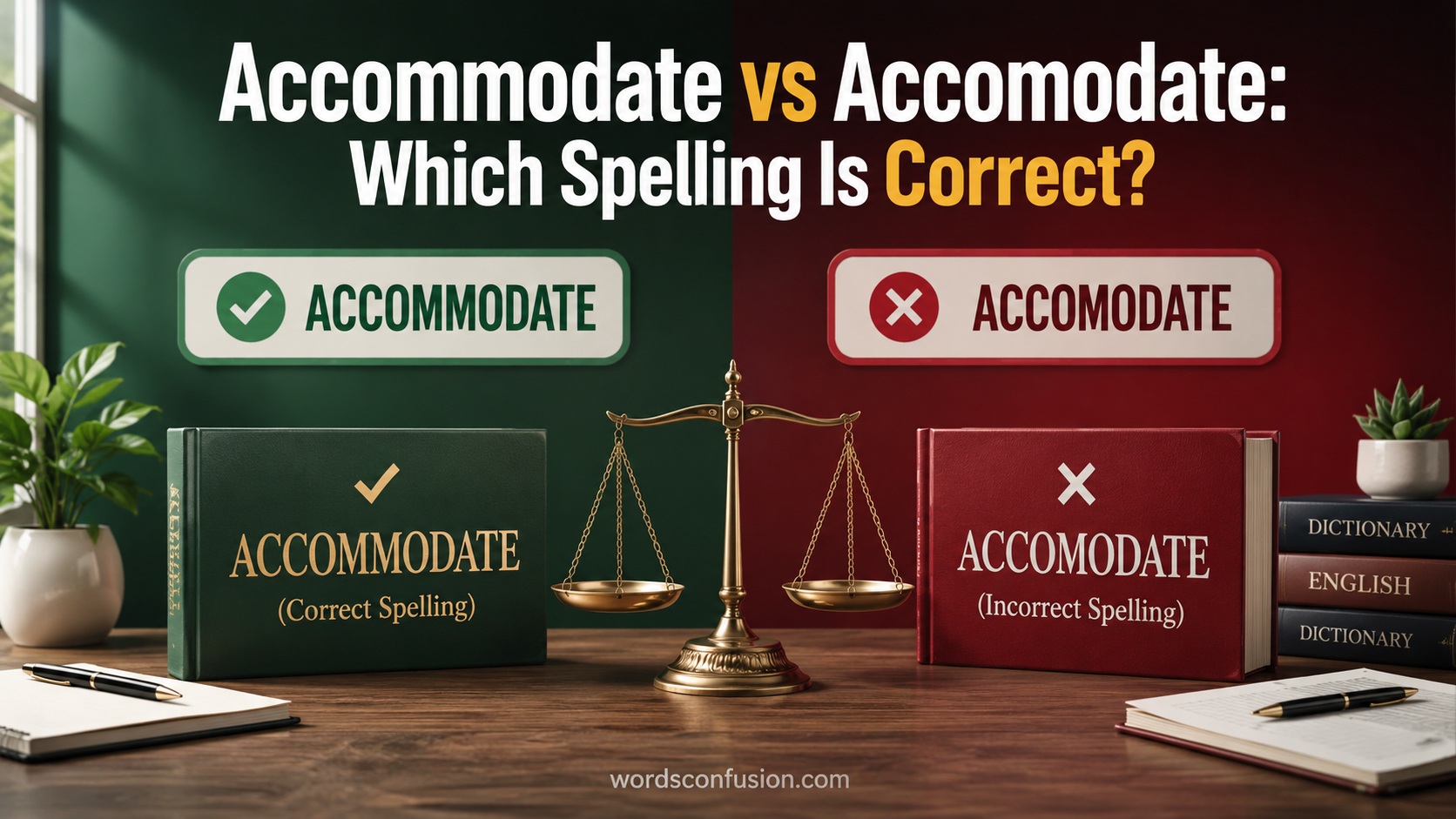
Learning English spelling can feel like solving a puzzle. Some words follow clear patterns while others seem determined to confuse even experienced writers. One of the most commonly misspelled words is accommodate. Many people accidentally write accomodate, believing it is correct because it sounds almost identical when spoken.
The truth is simple. Accommodate is the only correct spelling in both American and British English. The version accomodate is always a spelling mistake.
Whether you’re writing a business email, a school assignment, a resume, or a social media post, using the correct spelling helps you communicate more professionally. A single spelling error can distract readers and weaken your credibility.
In this guide, you’ll learn the difference between accommodate vs accomodate, why people often misspell the word, how to remember the correct spelling forever, and how to use accommodate confidently in everyday writing. You’ll also find practical examples, grammar tips, comparison tables, and common mistakes to avoid.
Quick Answer
If you’re in a hurry, here’s the answer.
| Word | Correct? | Meaning |
| Accommodate | Yes | To provide space, adjust, help, fit, or meet someone’s needs |
| Accomodate | No | Incorrect spelling |
The correct spelling is always “accommodate.”
The word contains:
- Two C’s
- Two M’s
Many writers accidentally leave out one C or one M, resulting in accomodate, but dictionaries do not recognize this spelling.
Correct example:
The hotel can accommodate more than 300 guests.
Incorrect example:
The hotel can accomodate more than 300 guests.
If you remember only one thing from this article, remember this:
Accommodate has two C’s and two M’s.
What Does “Accommodate” Mean?
The verb accommodate has several related meanings. In every case, the idea is the same: making room, adjusting, or providing what is needed.
Depending on the situation, accommodate can mean:
- Provide space for people or things
- Adapt to someone’s needs
- Help someone by making adjustments
- Hold or contain a certain number of people or objects
- Accept or fit changing circumstances
Although these meanings differ slightly, they all revolve around the idea of making something fit comfortably.
Dictionary Definition
Accommodate (verb) means:
- To provide lodging or sufficient space.
- To make suitable for someone.
- To adjust or adapt.
- To meet a request or requirement.
Origin of the Word
The word accommodate comes from the Latin word accommodare, which means to make fit, adapt, or adjust.
The word entered English centuries ago and has kept its original meaning remarkably well. While pronunciation has changed slightly over time, the spelling has remained consistent.
That consistency explains why accomodate has never been accepted as an alternative spelling.
Different Meanings of Accommodate
One reason this word appears so often is its flexibility. It works in many situations, from travel and education to business and healthcare.
To Provide Space or Lodging
This is perhaps the most familiar meaning.
Hotels, apartments, homes, and event venues often accommodate guests.
Examples:
- The hotel can accommodate 450 visitors.
- Our vacation rental accommodates eight people comfortably.
- The conference center accommodates large corporate events.
Here, accommodate simply means to provide enough space.
To Adjust for Someone’s Needs
Sometimes people need special arrangements.
Schools, workplaces, and organizations often accommodate individual needs.
Examples:
- The teacher accommodated the student’s learning disability.
- The company accommodated flexible working hours.
- The restaurant accommodated the customer’s food allergy.
In these examples, accommodate means to make adjustments.
To Fit or Hold Something
Objects and places can also accommodate things.
Examples:
- The cabinet accommodates dozens of files.
- This parking lot accommodates over 500 vehicles.
- The backpack accommodates a laptop and several books.
The meaning here is to contain or fit.
To Adapt to New Circumstances
Life changes constantly. Sometimes people must accommodate those changes.
Examples:
- The schedule was changed to accommodate bad weather.
- The software accommodates different operating systems.
- Our plans accommodated the unexpected delay.
This meaning focuses on flexibility.
Why Do People Misspell “Accommodate”?
Despite being common, accommodate consistently ranks among the most misspelled English words.
Why?
Several factors contribute to the mistake.
Double Letters Create Confusion
The biggest reason is the unusual letter pattern.
Many English words contain one double letter.
Examples include:
- Address
- Success
- Committee
However, accommodate contains two different double letters.
Many writers remember one pair but forget the other.
They might write:
- Accomodate
- Accomodate
- Acommodate
- Accomodate
Only one spelling is correct.
Pronunciation Doesn’t Help
When spoken aloud, accommodate doesn’t strongly emphasize either pair of double letters.
As a result, people spell the word based on how it sounds rather than how it is written.
That’s a common cause of spelling errors in English.
Typing Quickly
Fast typing often leads to dropped letters.
Even experienced writers occasionally type:
- accomodate
- acomodate
Spell-check usually catches the mistake, but not every writing platform has automatic correction.
Memory Overload
Words containing several repeated letters require stronger visual memory.
Compare these words:
| Easy Word | Harder Word |
| Travel | Accommodate |
| Visit | Accommodation |
| Help | Recommend |
| Begin | Necessary |
Many of English’s most frequently misspelled words share this pattern of repeated letters.
How to Remember the Correct Spelling
Fortunately, remembering accommodate isn’t difficult once you learn a few memory tricks.
Remember Two C’s and Two M’s
Say it aloud.
Two C’s. Two M’s.
Repeat it several times until it becomes automatic.
Think of Accommodation
Many people already know the word accommodation.
Since both words share the same beginning, remembering one helps you remember the other.
Accommodation
Accommodate
Both start with:
Accomm…
The Hotel Trick
Imagine a hotel.
A hotel has:
- Two comfortable chairs (CC)
- Two mattresses (MM)
Hotels accommodate guests.
This simple mental picture makes the spelling surprisingly easy to recall.
Break the Word into Smaller Parts
Instead of reading it as one long word, divide it into chunks.
Ac
Com
Modate
Or even better:
Ac
Com
Mo
Date
Breaking long words into smaller sections improves memory.
Write It Several Times
Writing strengthens muscle memory.
Try writing:
- Accommodate
- Accommodate
- Accommodate
After a few repetitions, your brain begins recognizing the correct letter pattern automatically.
Pronunciation Guide
Although spelling causes confusion, pronunciation is much easier.
IPA Pronunciation
American English
/əˈkɑː.mə.deɪt/
Syllable Breakdown
ac
com
mo
date
The stress falls on the second syllable.
ac-COM-mo-date
Avoid rushing through the middle of the word. Saying each syllable clearly often makes spelling easier to remember.
When to Use “Accommodate”
Knowing the correct spelling is only half the battle. You also need to understand when the word fits naturally in a sentence.
Fortunately, accommodate is versatile. It appears in conversations, emails, academic writing, travel guides, legal documents, and customer service interactions.
Use “Accommodate” When Providing Space
This is the most common use.
Whenever something has enough room for people or objects, accommodate is usually the right verb.
Examples:
- The theater accommodates nearly 2,000 people.
- The new warehouse accommodates larger deliveries.
- Our dining table accommodates ten guests comfortably.
- The classroom accommodates thirty students.
Notice that each sentence focuses on capacity.
Use “Accommodate” When Adjusting Plans
Life rarely goes exactly as planned. Sometimes schedules, policies, or arrangements need to change.
That’s another situation where accommodate works perfectly.
Examples:
- We changed the meeting time to accommodate everyone’s schedule.
- The company accommodated remote employees during the renovation.
- The airline accommodated passengers after the delayed flight.
- The event organizers accommodated last-minute requests.
In each example, someone made adjustments to help others.
Use “Accommodate” When Meeting Individual Needs
Schools, hospitals, employers, and businesses frequently use this meaning.
Examples:
- The teacher accommodated students with visual impairments.
- The restaurant accommodated gluten-free diets.
- Our office accommodates employees who need flexible schedules.
- The software accommodates different accessibility settings.
Here, the focus shifts from physical space to supporting people’s needs.
Use “Accommodate” When Something Fits or Holds Something Else
Sometimes accommodate simply means to fit, contain, or hold something.
You’ll often see this meaning when talking about buildings, furniture, vehicles, storage, or equipment.
Examples:
- This suitcase accommodates enough clothes for a week-long trip.
- The garage accommodates two cars.
- The bookshelf accommodates more than 300 books.
- The conference hall accommodates large audiences.
- The refrigerator accommodates oversized food containers.
In each example, the object has enough capacity for something else.
Read More: Government vs Goverment: What’s the Difference?
Examples of “Accommodate” in Everyday English
The best way to master a word is to see it in real-life situations. Below are examples from different settings where accommodate fits naturally.
At Home
Families constantly make adjustments for one another.
Examples:
- We rearranged the living room to accommodate the new sofa.
- Our guest room accommodates two visitors.
- The pantry accommodates all our kitchen supplies.
- We accommodated Grandma by moving her bedroom downstairs.
At School
Teachers and schools often accommodate students’ learning needs.
Examples:
- The school accommodated students with extended exam time.
- The teacher accommodated different learning styles.
- The classroom accommodates interactive group activities.
- The library accommodates both quiet study and collaborative work.
At Work
Businesses frequently use accommodate in emails, meetings, and customer service.
Examples:
- We can accommodate your request by Friday.
- Our office accommodates hybrid work schedules.
- The manager accommodated an urgent deadline.
- The company accommodated the client’s last-minute changes.
While Traveling
Hotels, airlines, and tour companies regularly use this word.
Examples:
- The hotel accommodates families with young children.
- The shuttle accommodates wheelchair users.
- The cruise ship accommodates more than 4,000 passengers.
- The airline accommodated travelers after the canceled flight.
In Healthcare
Healthcare professionals often accommodate patients with different medical needs.
Examples:
- The clinic accommodated patients who required wheelchair access.
- The hospital accommodates dietary restrictions.
- The medical staff accommodated additional appointment requests.
- The facility accommodates both adults and children.
In Technology
Technology companies also use this word frequently.
Examples:
- The application accommodates multiple languages.
- The platform accommodates millions of users every day.
- The software accommodates several file formats.
- The website accommodates screen readers for accessibility.
Common Phrases Using “Accommodate”
Native English speakers use accommodate in many common expressions. Learning these phrases helps your writing sound more natural.
Accommodate a Request
This means agreeing to someone’s request by making changes.
Example:
We were happy to accommodate your request.
Accommodate Guests
Hotels, restaurants, and homeowners often use this phrase.
Example:
The resort accommodates guests from around the world.
Accommodate Special Needs
Schools, businesses, and public facilities commonly use this expression.
Example:
The museum accommodates visitors with special needs.
Accommodate Growth
Businesses and cities often talk about future expansion this way.
Example:
The new office was built to accommodate future growth.
Accommodate Demand
Companies use this phrase when demand increases.
Example:
The factory expanded production to accommodate customer demand.
Accommodate Change
Organizations often need to adjust when circumstances change.
Example:
The software was updated to accommodate new security requirements.
Accommodate in Different Tenses
Like most English verbs, accommodate changes form depending on tense.
| Tense | Form | Example |
| Base Form | accommodate | We accommodate every customer. |
| Third-Person Singular | accommodates | The hotel accommodates large groups. |
| Present Participle | accommodating | The staff is accommodating every request. |
| Simple Past | accommodated | The airline accommodated stranded passengers. |
| Past Participle | accommodated | They have accommodated every visitor. |
Notice that the spelling remains consistent in every form.
The double C and double M never disappear.
FAQs:
Is accomodate ever the correct spelling?
No. Accomodate is always a misspelling. The only correct spelling is accommodate, which contains two C’s and two M’s. This spelling is accepted in both American and British English.
Why is accommodate so difficult to spell?
Many people misspell accommodate because it has two sets of double letters. Since the pronunciation doesn’t clearly emphasize the double C and double M, writers often leave out one of those letters. Remembering that accommodate has two C’s and two M’s is the easiest way to avoid the mistake.
Is accommodate spelled differently in American and British English?
No. The spelling is exactly the same in both varieties of English. Whether you’re writing in the United States, the United Kingdom, Canada, or Australia, accommodate is always the correct spelling.
What is the difference between accommodate and accommodation?
Accommodate is a verb, so it describes an action, such as providing space, making adjustments, or meeting someone’s needs.
Accommodation is a noun, referring to a place to stay or an arrangement made for someone.
Examples:
- The hotel can accommodate 250 guests.
- We booked our accommodation several weeks before the trip.
How can I remember how to spell accommodate?
A simple memory trick is to think of a hotel. A hotel has two comfortable chairs (CC) and two mattresses (MM) for its guests. Since hotels accommodate people, remember that the word contains two C’s and two M’s.
Conclusion:
When comparing accommodate vs accomodate, the answer is straightforward. Accommodate is the only correct spelling, while accomodate is always incorrect. Although the word is commonly misspelled because of its double C and double M, a few simple memory tricks can make it much easier to remember.
Beyond correct spelling, understanding how to use accommodate properly will strengthen your writing. Whether you’re describing a hotel that accommodates guests, a business that accommodates customer requests, or a teacher who accommodates different learning needs.

Andrew Wilson is an experienced language researcher and content writer specializing in WordsConfusion topics. He helps readers understand commonly confused English words, spelling differences, grammar rules, word meanings, and proper usage through clear explanations, practical examples, and easy-to-follow language guides. His goal is to make English learning simple, accurate, and accessible for students, writers, professionals, and everyday learners.