
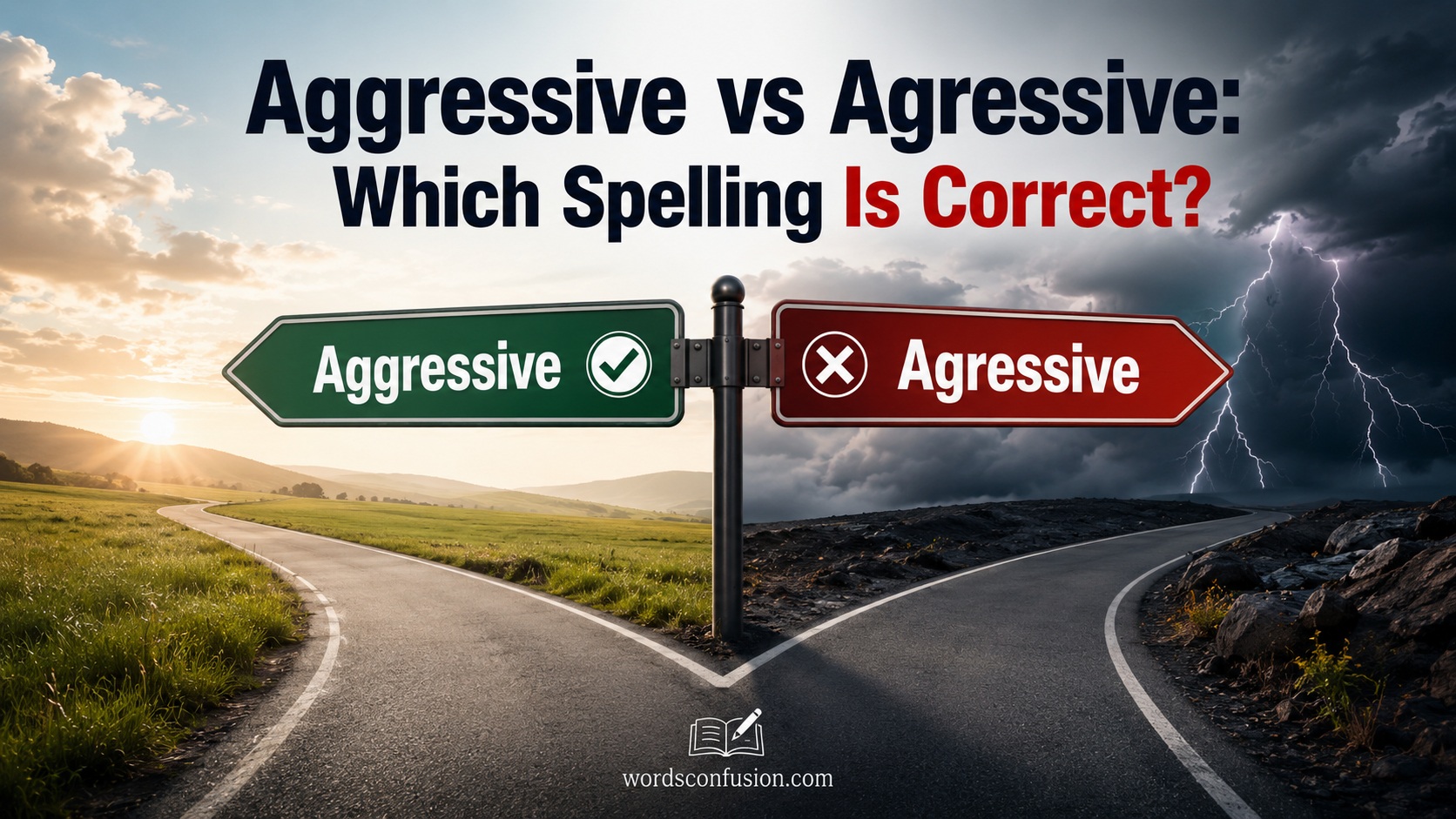
English spelling can be tricky, especially when a single missing letter changes whether a word is correct or incorrect. One common example is the confusion between aggressive vs agressive.
You may have seen people write “agressive” online, in messages, or even in professional documents. At first glance, it looks like a reasonable spelling because the pronunciation does not clearly reveal that the word contains two g’s. However, only one spelling is accepted in standard English.
The correct spelling is aggressive.
The incorrect spelling agressive is a common mistake caused by dropping one of the repeated consonants. This happens often in English because many words contain double letters that we cannot easily hear when we pronounce them.
Understanding the difference between aggressive and agressive helps you write more accurately in school, work, emails, and everyday conversations.
In this guide, you’ll learn:
- Which spelling is correct
- Why agressive is wrong
- What aggressive means in different situations
- How to remember the correct spelling
- Common examples and mistakes
- The difference between aggressive and similar words like assertive
Quick Answer
The correct spelling is aggressive.
The spelling agressive is incorrect and should not be used in formal or informal writing.
| Word | Correct or Incorrect? | Meaning |
| Aggressive | Correct | Showing forceful, hostile, competitive, or determined behavior |
| Agressive | Incorrect | A misspelling of aggressive |
The reason many people confuse these two spellings is simple: aggressive has two g’s, but the second g is easy to forget.
A useful memory trick is:
Aggression has two G’s, so aggressive has two G’s too.
If you remember the related word aggression, you’ll almost always spell aggressive correctly.
Aggressive vs Agressive: What Is the Difference?
When comparing aggressive vs agressive, there is actually no difference in meaning because only one of them is a real English word.
Aggressive is the standard spelling used in dictionaries, books, news articles, academic writing, and professional communication.
Agressive is simply a spelling error.
The confusion usually happens because English speakers often pronounce words based on sound rather than spelling. When someone says “aggressive,” the two g’s do not sound separate. Because of this, writers may naturally leave one out.
For example:
- Correct: The dog became aggressive when it felt threatened.
- Incorrect: The dog became agressive when it felt threatened.
The meaning is clear in both sentences, but only the first sentence follows correct English spelling rules.
Why Is “Agressive” Incorrect?
The spelling agressive is incorrect because the English word follows the spelling pattern of its root words.
The word aggressive comes from the Latin root related to aggress, meaning “to approach” or “to attack.” English kept the double g when forming related words.
The word family includes:
| Word | Part of Speech | Meaning |
| Aggress | Verb | To attack or move against someone |
| Aggression | Noun | Hostile or forceful behavior |
| Aggressive | Adjective | Showing aggression or force |
| Aggressively | Adverb | Acting in an aggressive way |
Because these related words contain double letters, the spelling remains consistent.
For example:
- Aggression → two g’s
- Aggressive → two g’s
- Aggressor → two g’s
Dropping one g breaks the spelling pattern.
What Does Aggressive Mean?
The word aggressive describes someone or something that acts with force, intensity, or strong determination.
However, the exact meaning depends on the situation. Sometimes it has a negative meaning, while other times it can describe ambition or strong effort.
Aggressive as Negative Behavior
Most people associate aggressive behavior with anger, hostility, or threatening actions.
Examples:
- A person who constantly starts arguments may be described as aggressive.
- A driver who ignores traffic rules and intimidates others may have an aggressive driving style.
- An animal that attacks without warning may show aggressive behavior.
Example sentence:
“The player received a penalty because of his aggressive actions during the match.”
Here, aggressive suggests behavior that went too far.
Aggressive as Strong Determination
The word does not always mean violent or harmful. In business, sports, and personal goals, aggressive can mean highly motivated or ambitious.
Examples:
- An aggressive marketing campaign tries to reach many customers quickly.
- An aggressive fitness plan involves intense training.
- An aggressive sales strategy focuses on rapid growth.
Example sentence:
“The company created an aggressive plan to increase sales by 50% within a year.”
In this context, aggressive means bold and ambitious.
How to Pronounce Aggressive
The correct pronunciation of aggressive is:
uh-GRESS-iv
Phonetically:
/əˈɡresɪv/
The word has three syllables:
ag – gres – sive
The first syllable is weak, while the second syllable receives more emphasis.
Many spelling mistakes happen because pronunciation does not highlight the double g. When people hear the word, they usually hear one strong “g” sound rather than noticing the spelling.
Compare:
- Aggressive → uh-GRESS-iv
- Aggression → uh-GRESH-un
Both words share the same spelling pattern.
Why Does Aggressive Have Two G’s?
The double g in aggressive comes from its word history.
The word developed from Latin roots connected to aggressus, which meant moving toward something or attacking. English borrowed and adapted the word while keeping the double consonant pattern.
Many English words keep double letters because they help preserve connections between related words.
For example:
| Base Word | Related Word |
| Aggress | Aggressive |
| Commit | Committed |
| Refer | Referred |
| Begin | Beginning |
The repeated letter often remains when adding endings or creating related forms.
This pattern makes spelling easier once you recognize the connection.
Easy Ways to Remember Aggressive Spelling
Remembering aggressive vs agressive becomes much easier with a few simple tricks.
Connect It With Aggression
The easiest method is linking the adjective to the noun.
Think:
Aggression → Aggressive
Both words contain:
- Two g’s
- Two s’s
If you know how to spell aggression, you already know how to spell aggressive.
Break the Word Into Parts
Instead of trying to memorize the whole word, divide it:
Ag + gress + ive
The middle section gress contains the double g.
Use a Visual Memory Trick
Picture the word like this:
A GG ressive
The two capital G’s act like a reminder that the word needs both letters.
Practice With Sentences
Writing the word repeatedly in meaningful sentences helps your brain remember it naturally.
Examples:
- The salesman used an aggressive approach.
- The dog looked aggressive.
- The team played an aggressive style of football.
Examples of Aggressive in Sentences
Seeing the word in different situations makes its meaning clearer.
Everyday Examples
- My neighbor’s dog becomes aggressive when strangers approach.
- The child apologized after displaying aggressive behavior.
- He used an aggressive tone during the argument.
Workplace Examples
- The company set an aggressive growth target for the next quarter.
- She took an aggressive approach to solving the problem.
- The manager wants an aggressive marketing strategy.
Sports Examples
- The team played an aggressive attacking style.
- The coach encouraged aggressive defense.
- The athlete’s aggressive performance helped the team win.
Business Examples
- The brand launched an aggressive advertising campaign.
- Investors liked the company’s aggressive expansion plan.
- The startup followed an aggressive strategy to compete with larger companies.
In each example, the meaning changes slightly depending on context. It can describe harmful behavior or strong ambition.
Common Words People Misspell Alongside Aggressive
The spelling mistake in agressive is not unusual. English has many words with repeated letters that people often simplify by removing one letter.
These mistakes happen because our brains naturally try to make words easier to write. When a letter appears twice but sounds like it appears once, writers often forget the repetition.
Here are some similar examples:
| Correct Spelling | Common Incorrect Spelling | Reason for Confusion |
| Aggressive | Agressive | The second “g” is easy to miss |
| Aggression | Agression | The double “g” sound is not obvious |
| Aggressor | Agressor | Writers often remove repeated letters |
| Accommodation | Accomodation | Double “c” and double “m” cause confusion |
| Necessary | Neccessary | The repeated consonant pattern is tricky |
| Recommend | Reccomend | The “c” and “m” combination is often reversed |
Learning these patterns can improve your overall spelling accuracy. When you notice a word with a double letter, take a moment to check whether its related words follow the same pattern.
For example:
- Aggression → Aggressive
- Competition → Competitive
- Creation → Creative
Word families often act like spelling clues.
Aggressive vs Assertive: What Is the Difference?
Many people confuse aggressive with assertive because both words describe someone who expresses strong opinions or takes action.
However, they have very different meanings.
An assertive person communicates confidently while respecting other people. An aggressive person may push too hard, ignore boundaries, or act in a hostile way.
| Aggressive | Assertive |
| Can appear threatening | Appears confident |
| May ignore others’ feelings | Respects others’ opinions |
| Often connected with anger | Usually connected with confidence |
| Pushes ideas onto others | Clearly communicates ideas |
| Can create conflict | Helps solve problems |
Example: Workplace Situation
Imagine a manager needs an employee to complete a project faster.
An aggressive approach:
“You better finish this today. I don’t care what problems you’re having.”
An assertive approach:
“This project needs to be completed today. Let’s discuss what support you need to finish it on time.”
Both managers want the same result, but the communication style is completely different.
Read More: Accommodate vs Accomodate: Which Spelling Is Correct?
Example: Personal Boundaries
Aggressive:
“You’re wrong. Stop doing that.”
Assertive:
“I don’t agree with that approach. I’d prefer we try another solution.”
The key difference is respect. Assertive communication focuses on confidence without attacking others.
Synonyms and Antonyms of Aggressive
Understanding similar and opposite words helps you use aggressive correctly.
Synonyms of Aggressive
Depending on the context, aggressive can mean different things.
| Synonym | Meaning |
| Forceful | Showing strong energy or determination |
| Hostile | Unfriendly or threatening |
| Combative | Ready to fight or argue |
| Fierce | Strong, intense, or powerful |
| Competitive | Trying hard to win |
| Pushy | Trying too hard to get what you want |
| Bold | Confident and willing to take risks |
However, these words are not always interchangeable.
For example:
- “She has an aggressive sales strategy” could mean bold or ambitious.
- “The dog showed aggressive behavior” means hostile or dangerous.
The surrounding context determines the best meaning.
Antonyms of Aggressive
| Antonym | Meaning |
| Calm | Peaceful and controlled |
| Gentle | Soft and kind |
| Passive | Not taking strong action |
| Peaceful | Free from conflict |
| Friendly | Kind and welcoming |
| Cooperative | Willing to work with others |
Example:
- Aggressive: “The player aggressively challenged his opponent.”
- Gentle: “The player used a gentle approach to avoid conflict.”
Grammar Notes for Aggressive
The word aggressive is an adjective. It describes a person, action, behavior, or approach.
Adjective
Aggressive describes something.
Examples:
- She has an aggressive personality.
- The company launched an aggressive campaign.
- The animal became aggressive.
Related Words
| Word | Type | Example |
| Aggress | Verb | The army planned to aggress against the enemy. |
| Aggression | Noun | His aggression caused problems. |
| Aggressive | Adjective | His aggressive behavior worried others. |
| Aggressively | Adverb | The team played aggressively. |
Although aggress exists as a verb, it is rarely used in everyday English. Most people use related words like attack, confront, or act aggressively instead.
Common Mistakes to Avoid With Aggressive
Even people who know the correct spelling sometimes misuse the word.
Here are common mistakes to watch for.
Writing Agressive Instead of Aggressive
This is the biggest spelling error.
Incorrect:
The customer became agressive.
Correct:
The customer became aggressive.
Remember the double g.
Confusing Aggressive With Angry
Aggressive behavior can involve anger, but the words do not mean exactly the same thing.
Someone can be angry without being aggressive.
Example:
- Angry: “She felt angry after losing the competition.”
- Aggressive: “She yelled at others and started a fight after losing.”
Anger is an emotion. Aggression is an action or behavior.
Using Aggressive When You Mean Assertive
Sometimes people describe confident behavior as aggressive when it is actually assertive.
Example:
Incorrect:
“He was aggressive because he clearly explained his opinion.”
Correct:
“He was assertive because he clearly explained his opinion.”
Confidence alone does not equal aggression.
Overusing the Word
Because aggressive has strong meaning, using it too often can make writing sound exaggerated.
Instead of saying:
“The company had an aggressive idea.”
Consider the exact meaning:
- ambitious idea
- bold idea
- risky idea
- competitive idea
Choosing the right word creates clearer communication.
Is “Agressive” Ever Accepted?
No. Agressive is not an accepted spelling in standard English.
You may still find it online because spelling mistakes spread quickly on the internet. However, major dictionaries and professional writing standards recognize only:
Aggressive
The incorrect spelling should be avoided in:
- School assignments
- Business emails
- Reports
- Resumes
- Articles
- Academic papers
- Professional communication
A small spelling mistake can affect how readers view your writing. Correct spelling shows attention to detail and improves credibility.
For example:
A job application that says:
“I am an agressive problem solver.”
contains a spelling error that could distract the reader.
The correct version:
“I am an aggressive problem solver.”
looks polished and professional.
FAQs:
Is “agressive” a correct spelling?
No, agressive is not a correct English spelling. The correct spelling is aggressive with two g’s.
The incorrect version happens because many people forget the second g when writing the word. Since the pronunciation does not strongly highlight the double letter, the mistake is common.
Correct:
The dog became aggressive.
Incorrect:
The dog became agressive.
Why does aggressive have two g’s?
The word aggressive has two g’s because of its connection with related words like aggression and aggressor.
These words share the same root and spelling pattern:
- Aggress
- Aggression
- Aggressive
- Aggressor
Remembering the word family makes the spelling much easier.
Is aggressive always a negative word?
No, aggressive does not always have a negative meaning.
In some situations, it describes harmful or hostile behavior.
Example:
The player became aggressive during the argument.
However, in business, sports, or goal-setting, it can mean ambitious, energetic, or highly determined.
Example:
The company created an aggressive plan to increase profits.
The context decides whether the word sounds positive or negative.
What is the difference between aggressive and assertive?
Aggressive and assertive both describe strong behavior, but they are not the same.
An aggressive person may ignore other people’s feelings or boundaries. An assertive person expresses thoughts confidently while respecting others.
Example:
Aggressive:
“Do what I said right now.”
Assertive:
“I believe this approach will work best. Let’s discuss it.”
Assertiveness focuses on confidence, while aggression often involves force or hostility.
How can I remember the spelling of aggressive?
The easiest way to remember aggressive is to connect it with aggression.
Both words contain two g’s:
- Aggression
- Aggressive
You can also break the word apart:
A + GG + ressive
The double G in the middle is the key spelling feature.
Conclusion:
When comparing aggressive vs agressive, the answer is simple: aggressive is the only correct spelling.
The word agressive is a common mistake, but it is not accepted in standard English. The correct spelling includes two g’s, just like related words such as aggression and aggressor.
The meaning of aggressive depends on the situation. It can describe hostile behavior, such as someone acting in a threatening way, or it can describe determination, such as an aggressive

Andrew Wilson is an experienced language researcher and content writer specializing in WordsConfusion topics. He helps readers understand commonly confused English words, spelling differences, grammar rules, word meanings, and proper usage through clear explanations, practical examples, and easy-to-follow language guides. His goal is to make English learning simple, accurate, and accessible for students, writers, professionals, and everyday learners.