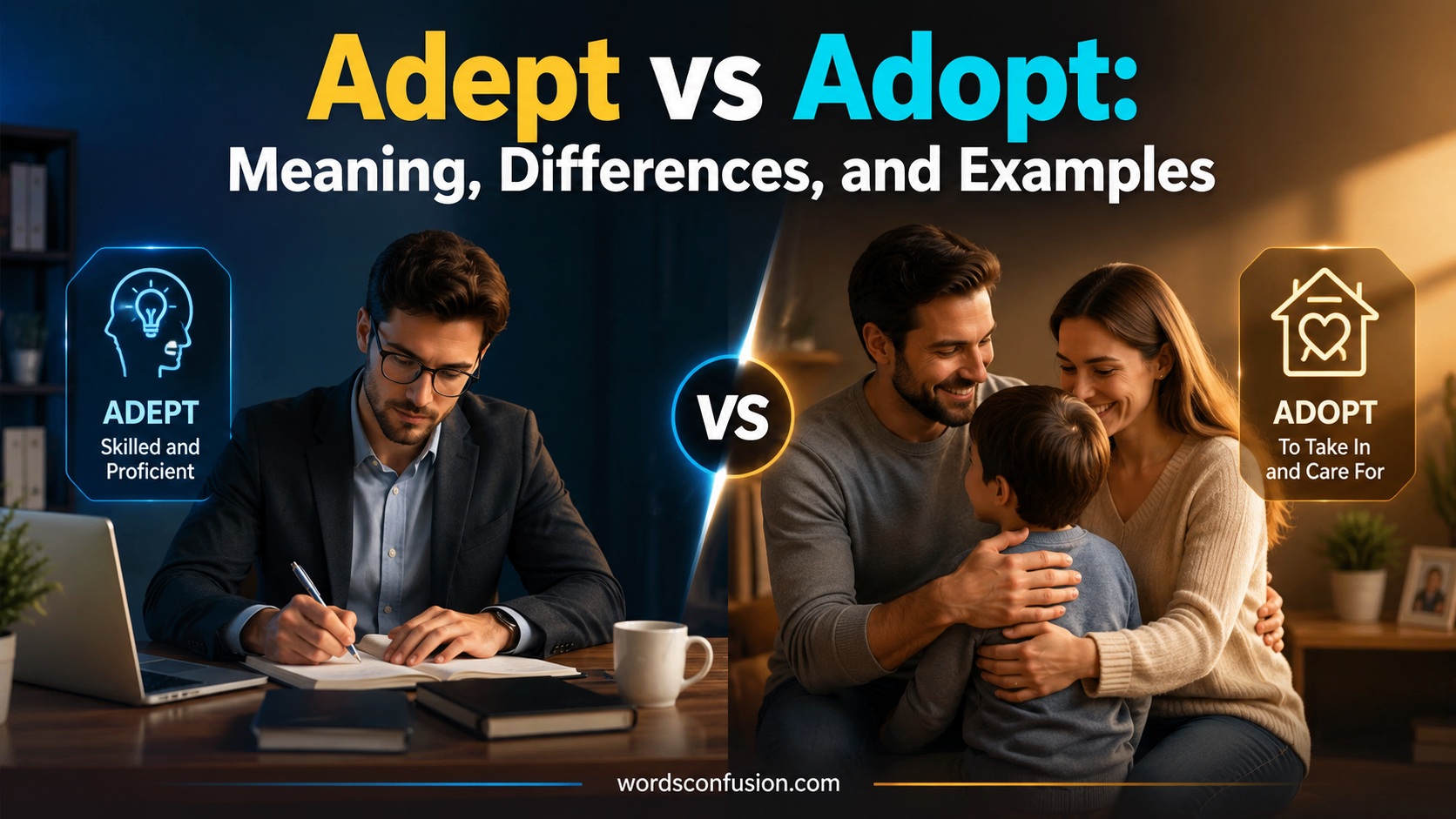
Adept vs adopt can confuse even experienced English speakers. The words look similar, sound somewhat alike, and often appear in formal writing. However, their meanings are completely different.
Adept describes someone who is highly skilled at something. Adopt is a verb that means to take something on, accept it, begin using it, or legally take a child into a family.
That small difference matters. If you write “She is adopt at solving problems,” the sentence contains the wrong word. The correct version is “She is adept at solving problems.” On the other hand, if a company decides to use a new policy, it adopts the policy.
The easiest way to remember the distinction is simple: adept relates to ability, while adopt relates to taking or choosing something.
Quick Answer: Adept vs Adopt
Adept is an adjective meaning highly skilled, capable, or proficient.
Maria is adept at solving complex problems.
Adopt is a verb meaning to take up, accept, choose, begin using, or legally take a child into a family.
The company adopted a new marketing strategy.
The couple decided to adopt a child.
The Main Difference Between Adept and Adopt
| Word | Part of Speech | Meaning | Example |
| Adept | Adjective | Highly skilled or proficient | He is adept at coding. |
| Adopt | Verb | To take up, accept, choose, or legally take a child into a family | The company adopted a new policy. |
Memory trick:
- Adept = Ability
- Adopt = Accept or take on
If you’re talking about what someone can do well, use adept. If you’re talking about choosing or taking something on, use adopt.
What Does Adept Mean?
Adept means very skilled, capable, or proficient at doing something. It usually describes a person who has developed strong ability through talent, experience, training, or practice.
For example:
James is adept at repairing vintage cars.
This sentence tells you that James has considerable skill in repairing vintage cars. It doesn’t mean that he chose vintage cars or accepted them. It describes his ability.
The word often appears when someone handles a task with confidence and competence. Think of an adept person as someone who knows how to navigate a difficult situation without constantly bumping into the walls.
Examples of Adept in Sentences
- She is adept at explaining complicated ideas in simple language.
- The engineer is adept at finding practical solutions.
- He became adept at using the new software after months of practice.
- Our manager is particularly adept at handling difficult negotiations.
- The technician is adept with specialized tools.
- They are adept at adapting to changing market conditions.
In each example, adept describes skill or proficiency.
Common Grammar Patterns With Adept
The most common structure is:
be + adept + at + noun or gerund
Examples:
- She is adept at writing.
- He is adept at managing teams.
- The analyst is adept at interpreting data.
You can also use adept with in or with in certain contexts:
- She is adept in financial analysis.
- He is adept with computer systems.
However, adept at is usually the most natural choice when you’re describing a specific skill or activity.
Related Forms of Adept
| Word | Part of Speech | Meaning | Example |
| Adept | Adjective | Highly skilled | She is adept at negotiation. |
| Adeptly | Adverb | In a skillful way | He adeptly handled the crisis. |
| Adeptness | Noun | Skill or proficiency | Her adeptness impressed the team. |
The adjective adept remains the most common form in everyday and professional English.
What Does Adopt Mean?
Adopt is a verb with several related meanings. At its core, it means to take something as your own, choose it, accept it, or begin using it.
The word also has a specific legal and family-related meaning: to legally take a child into your family and raise that child as your own.
For example:
The company adopted a new safety policy.
Here, the company chose to accept and use the policy.
The couple adopted a child.
Here, adopted refers to the legal process of taking a child into the family.
The Main Meanings of Adopt
To Legally Take a Child Into Your Family
This is one of the most familiar meanings of adopt.
- They decided to adopt a child.
- The family adopted a baby from another country.
- She was adopted as an infant.
In these sentences, adopt refers to a legal family relationship.
To Begin Using an Idea, Method, or Policy
People and organizations can adopt ideas or systems.
- The school adopted a new grading system.
- The company adopted a four-day workweek.
- The government adopted stricter environmental standards.
Here, adopt means to officially accept or begin using something.
To Take On an Attitude or Approach
You can also adopt a way of thinking or behaving.
- He adopted a more positive attitude.
- The team adopted a cautious approach.
- She adopted a practical mindset after the experience.
The idea is that a person chooses to take on a particular attitude or approach.
To Choose Something as Your Own
You can adopt a name, style, identity, or position.
- The artist adopted a new stage name.
- The organization adopted a new mission statement.
- He adopted a different position during the debate.
Related Forms of Adopt
| Word | Meaning | Example |
| Adopt | To take up or accept | They adopted a new strategy. |
| Adopted | Past tense or adjective | The policy was adopted last year. |
| Adopting | Present participle | The company is adopting new technology. |
| Adoption | The act or process of adopting | The adoption took several months. |
| Adoptive | Related to adoption | She visited her adoptive parents. |
Adept vs Adopt: The Core Difference
The simplest way to understand adept vs adopt is to focus on the type of information each word expresses.
Adept describes ability.
She is adept at graphic design.
This means she is highly skilled at graphic design.
Adopt describes a choice or action.
She adopted a new graphic design program.
This means she chose to begin using the program.
The two words may appear in the same sentence, but they perform different jobs:
The company was adept at developing software and quickly adopted a new programming system.
In this sentence:
- Adept describes the company’s skill.
- Adopted describes the company’s decision to use something new.
A Simple Comparison
| If you mean… | Use… | Example |
| Skilled | Adept | He is adept at negotiation. |
| Proficient | Adept | She is adept at using the software. |
| Choose | Adopt | They adopted a new plan. |
| Accept | Adopt | The board adopted the proposal. |
| Begin using | Adopt | The company adopted new technology. |
| Legally take a child into a family | Adopt | They adopted a child. |
Adept vs Adopt in Grammar
Grammar provides another reliable way to separate these words.
How to Use Adept in a Sentence
Adept functions as an adjective. It describes a person, group, or sometimes an ability.
The most common sentence pattern is:
Subject + be + adept + at + activity
Examples:
- Lena is adept at public speaking.
- The designer is adept at creating clean layouts.
- Our team is adept at solving technical problems.
You can also place adept before a noun in some formal contexts:
She is an adept negotiator.
Here, adept describes the negotiator.
How to Use Adopt in a Sentence
Adopt functions as a verb. It shows an action.
Common patterns include:
Subject + adopt + object
The board adopted the proposal.
Subject + adopt + a policy or approach
The company adopted a flexible work policy.
Subject + adopt + a child
The couple adopted a child.
Because adopt is a verb, it can change tense:
- Present: They adopt new methods.
- Past: They adopted a new method.
- Continuous: They are adopting new methods.
- Future: They will adopt a new method.
Common Mistakes With Adept and Adopt
Because both words are legitimate English words, spell-check software may not catch a mistake. That makes understanding the meaning especially important.
Incorrect: She Is Adopt at Writing
Incorrect:
She is adopt at writing.
Correct:
She is adept at writing.
Why? The sentence describes her skill. Therefore, the adjective adept fits.
Incorrect: The Company Is Adept a New Policy
Incorrect:
The company is adept a new policy.
Correct:
The company adopted a new policy.
The sentence describes the company’s decision to accept and use a policy. That requires the verb adopt.
Incorrect: They Are Adept a Child
Incorrect:
They are adept a child.
Correct:
They adopted a child.
The word adopt describes the legal act of taking a child into a family.
Incorrect: He Adopted at Solving Puzzles
Incorrect:
He adopted at solving puzzles.
Correct:
He is adept at solving puzzles.
The phrase adept at is used to describe skill.
Adept vs Adopt vs Adapt
A third word often enters the picture: adapt.
These three words look similar, but each has a distinct meaning.
| Word | Meaning | Example |
| Adept | Highly skilled | She is adept at negotiation. |
| Adapt | Adjust to new conditions | Animals adapt to their environments. |
| Adopt | Take up, accept, choose, or legally take a child into a family | The company adopted a new system. |
The Three-Word Memory Trick
Remember:
- Adept = Ability
- Adapt = Adjust
- Adopt = Accept or take on
Consider this example:
The skilled engineer adapted to the new software and helped the company adopt it.
You could also write:
The engineer was adept at adapting to new technology, so the company adopted her recommended system.
That sentence uses all three words correctly:
- Adept = skilled
- Adapting = adjusting
- Adopted = accepted or began using
Read More: Adapt vs Adopt: Meaning, Differences, and Examples
Adept vs Adopt in Professional Writing
Both words appear frequently in business, academic, technical, and professional writing. However, they serve different purposes.
Using Adept in the Workplace
Use adept when describing professional ability.
Examples:
- The candidate is adept at managing large teams.
- She is adept at identifying operational risks.
- The analyst is adept at interpreting complex data.
- He is an adept communicator.
In a résumé or professional profile, adept can emphasize competence. Still, it works best when you identify the specific skill that follows.
Compare:
She is adept.
This is grammatically correct but vague.
She is adept at managing cross-functional teams.
This gives the reader useful information.
Using Adopt in Business and Organizations
Businesses often adopt:
- policies
- strategies
- technologies
- methods
- standards
- procedures
- systems
- frameworks
- approaches
Examples:
The company adopted a new cybersecurity framework.
The school adopted a digital learning platform.
The team adopted a more flexible approach to project management.
In these examples, adopt means that an organization chose to accept or use something.
Adept vs Adopt in Everyday English
The difference becomes easier when you compare everyday situations.
Imagine someone who loves cooking. You might say:
She is adept at preparing complicated meals.
That means she cooks skillfully.
Now imagine that she decides to follow a vegetarian diet:
She adopted a vegetarian lifestyle.
That means she chose to take on a new lifestyle.
Another example:
David is adept at learning languages, so he adopted a daily study routine.
David’s ability is described with adept. His choice to begin using a routine is described with adopted.
The distinction is subtle only when you look at the spelling. Once you focus on the meaning, the confusion largely disappears.
Common Collocations With Adept
A collocation is a group of words that commonly appear together. Learning common combinations can make your writing sound more natural.
Common expressions include:
- adept at problem-solving
- adept at handling pressure
- adept at communication
- adept at using technology
- adept at negotiation
- adept at managing teams
- highly adept
- particularly adept
- become adept
Examples:
The manager is highly adept at resolving workplace conflicts.
After years of practice, she became adept at playing the violin.
Common Collocations With Adopt
Common combinations with adopt include:
- adopt a policy
- adopt a strategy
- adopt an approach
- adopt a method
- adopt an attitude
- adopt a lifestyle
- adopt new technology
- adopt a child
- formally adopt
- widely adopted
Examples:
The organization adopted a new environmental policy.
Many companies have adopted cloud-based software.
He adopted a more careful attitude toward financial decisions.
FAQs:
What is the main difference between adept and adopt?
Adept means highly skilled or proficient at something. Adopt means to accept, choose, take up, begin using something, or legally take a child into a family.
- She is adept at solving problems.
- The company adopted a new strategy.
Is it “adept at” or “adopt at”?
The correct phrase is adept at when you want to describe someone’s skill or ability.
Correct: He is adept at writing.
Incorrect: He is adopt at writing.
Adopt is a verb and doesn’t describe skill.
What is the difference between adept, adapt, and adopt?
These three words have different meanings:
- Adept = highly skilled
- Adapt = adjust to new conditions
- Adopt = accept, choose, take up, or legally take a child into a family
For example:
She is adept at adapting to change, so she quickly adopted the new system.
Can adept and adopt be used in the same sentence?
Yes. Both words can appear in the same sentence when they express different ideas.
The manager is adept at identifying problems and quickly adopts effective solutions.
Here, adept describes skill while adopts describes choosing or taking on something.
How can I easily remember the difference between adept and adopt?
Use this simple memory trick:
Adept = Ability
Adopt = Accept or take on
If you’re talking about someone who is skilled at something, use adept. If you’re talking about choosing, accepting, or beginning to use something, use adopt.
Conclusion:
The difference between adept vs adopt is simple once you focus on what each word means.
Adept describes skill, ability, or proficiency:
She is adept at managing difficult projects.
Adopt describes an action involving acceptance, choice, or taking something on:
The company adopted a new policy.
It can also refer to legally taking a child into a family:
They decided to adopt a child.
When you’re unsure, remember the quick rule: adept means skilled, adapt means adjust, and adopt means accept or take on. That small distinction will help you choose the right word and avoid one of English’s most common spelling and usage mix-ups.

Andrew Wilson is an experienced language researcher and content writer specializing in WordsConfusion topics. He helps readers understand commonly confused English words, spelling differences, grammar rules, word meanings, and proper usage through clear explanations, practical examples, and easy-to-follow language guides. His goal is to make English learning simple, accurate, and accessible for students, writers, professionals, and everyday learners.