Have you ever written “adapt a new policy” when you meant “adopt a new policy”? Or perhaps you’ve wondered whether people adapt to change or adopt to change. These two words look almost identical, sound similar, and both often appear in conversations about change. That similarity creates plenty of confusion.
However, adapt and adopt don’t mean the same thing.
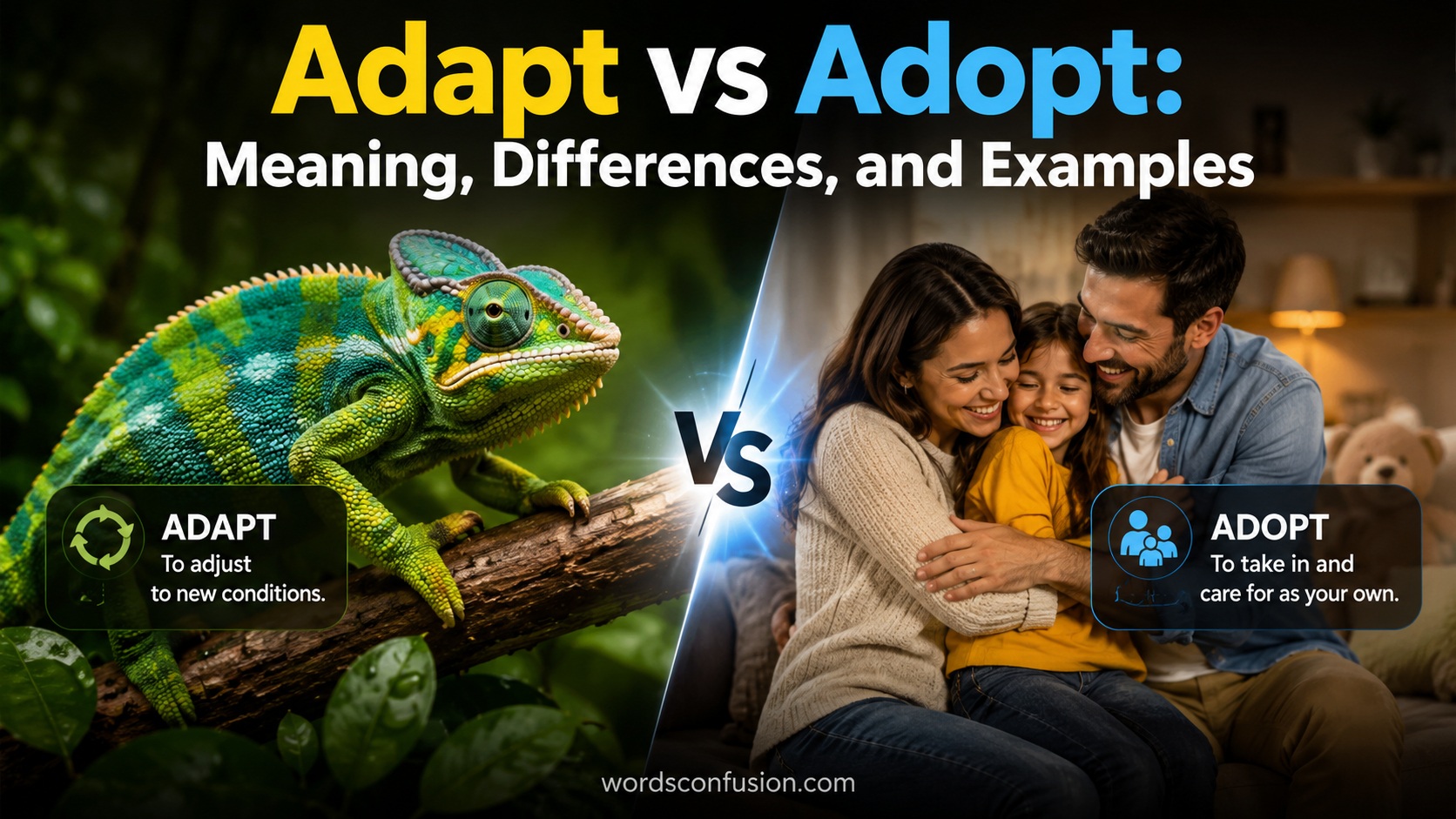
Adapt means to change or adjust something so it fits a new situation, environment, purpose, or need. Adopt means to accept, choose, approve, or begin using something. In simple terms, adapt means adjust, while adopt means accept or take on.
The distinction becomes much easier once you see how each word works in real sentences. A company might adopt a new strategy and then adapt that strategy to suit a particular market. A person might adopt a healthier lifestyle and then adapt to a new daily routine.
One word focuses on modification. The other focuses on acceptance or selection.
Quick Answer: Adapt vs Adopt
Adapt means to adjust or modify something so it works in a new situation. Adopt means to accept, choose, approve, or start using something.
| Word | Meaning | Example |
| Adapt | To adjust or modify | The company adapted its strategy to changing market conditions. |
| Adopt | To accept, choose, or begin using | The company adopted a new marketing strategy. |
A simple memory trick can help:
Adapt = Adjust
Adopt = Accept
So, you adapt to a new environment, but you adopt a new policy.
Adapt vs Adopt: The Main Difference
The main difference between adapt and adopt lies in what happens after a change or decision.
When you adapt, you make something fit. You adjust yourself, a plan, a system, a method, or an idea because the circumstances require a change.
When you adopt, you accept or choose something. You may begin using a new method, approve a proposal, take on a new habit, or legally take a child into your family.
Consider this example:
The company adopted a new software system and adapted it to meet its specific needs.
Here, the company first adopted the software. In other words, it chose to use it. Then it adapted the software by modifying or customizing it.
That single sentence captures the difference perfectly.
Adapt means “make it fit.”
- She adapted to her new job.
- The teacher adapted the lesson for younger students.
- The company adapted its product for international customers.
Adopt means “take it on.”
- The school adopted a new curriculum.
- He adopted a healthier lifestyle.
- The committee adopted the proposal.
The easiest question to ask yourself is this:
Are you changing something to fit a new situation, or are you accepting or choosing something?
If you’re changing it to fit, use adapt. If you’re accepting or taking it on, use adopt.
What Does Adapt Mean?
Adapt is a verb that means to change, adjust, or modify something so it works in different conditions or serves a different purpose.
It can describe a person adjusting to a new situation. It can also describe an organization changing its strategy or a writer transforming a story for another format.
Examples of Adapt in Sentences
- People must adapt to changes in technology.
- The company adapted its business model after customer preferences changed.
- Animals adapt to their environments in different ways.
- The teacher adapted the lesson for students with different learning needs.
- The filmmaker adapted the novel for the screen.
- She quickly adapted to her new surroundings.
Notice how adapt often involves some form of adjustment. Something changes because the original version no longer works perfectly in a new situation.
Adapt to Means “Adjust to”
One of the most common patterns is:
adapt to + noun or gerund
Examples include:
- adapt to change
- adapt to a new environment
- adapt to new technology
- adapt to a different culture
- adapt to working from home
- adapt to living in a new city
For example:
After moving to a new country, Maria had to adapt to a different culture and climate.
She didn’t simply accept the culture. She adjusted her behavior, expectations, and routines to function comfortably in a new environment.
Adapt Something for a Purpose
You can also use adapt when you modify something for a particular purpose or audience.
Examples:
- The publisher adapted the story for young readers.
- The engineers adapted the machine for use in extreme conditions.
- The teacher adapted the activity for beginners.
Here, the original thing changes. The goal is to make it more suitable.
Adapt Something From an Original Source
Another common structure is:
adapt something from something
For example:
- The movie was adapted from a bestselling novel.
- The lesson was adapted from an older teaching program.
In this use, adapt means to transform an original work or idea into a new form.
What Does Adopt Mean?
Adopt means to accept, choose, approve, or begin using something. It can also mean to legally take a child into your family.
Unlike adapt, adopt doesn’t necessarily mean that you change the thing you accept. You simply decide to take it on.
Adopt an Idea, Plan, or Method
Organizations and individuals often adopt ideas, plans, systems, and methods.
Examples:
- The company adopted a new business strategy.
- The school adopted a different teaching method.
- The government adopted new environmental regulations.
- She adopted a practical approach to solving the problem.
In each example, someone chooses or accepts something.
Adopt a Habit, Lifestyle, or Attitude
You can also adopt something as part of your behavior or daily life.
Examples:
- He adopted a healthier diet.
- She adopted a more positive attitude.
- Many people adopt new habits at the beginning of the year.
- The team adopted a more cautious approach.
If you begin following a new habit or attitude, adopt usually fits.
Adopt a Child
The word also has an important legal and family-related meaning.
The couple decided to adopt a child.
In this context, adopt means to legally take responsibility for a child and become the child’s parent or parents.
This meaning is completely different from adapt, even though the words look similar.
Adapt vs Adopt: Side-by-Side Examples
The best way to understand the difference is to compare the words in similar situations.
| Situation | Adapt | Adopt |
| A plan | Adapt the plan to fit new circumstances. | Adopt the plan as the official strategy. |
| A method | Adapt the method for younger students. | Adopt the method throughout the school. |
| A policy | Adapt the policy to local conditions. | Adopt the policy officially. |
| A lifestyle | Adapt to a healthier routine. | Adopt a healthier lifestyle. |
| Technology | Adapt the software for mobile devices. | Adopt the software across the company. |
| A strategy | Adapt the strategy after market conditions change. | Adopt a new strategy. |
The difference becomes clear when you focus on the action.
Adapt changes the form or use of something.
Adopt chooses or accepts something.
For example:
The school adopted a new curriculum and adapted it for different age groups.
The school accepted and began using the curriculum. Then it modified the curriculum for specific students.
Adapt vs Adopt: The Easiest Memory Trick
If you struggle to remember the difference, connect each word with a simpler word.
Adapt = Adjust
Both words begin with the idea of making something fit.
- Adapt to a new environment.
- Adjust to a new environment.
Adopt = Accept
Both words involve taking something on or agreeing to use it.
- Adopt a new policy.
- Accept a new policy.
Another useful analogy involves clothing.
Imagine buying a jacket.
If you adopt the jacket, you choose to take it and use it. If the jacket doesn’t fit properly, you adapt it by having it altered.
Adopt means you take the jacket. Adapt means you change the jacket so it fits.
That distinction works surprisingly well in everyday situations.
Grammar Patterns: How to Use Adapt Correctly
Understanding the grammar patterns behind adapt can prevent many common mistakes.
Adapt to Something
Use:
adapt to + noun
Examples:
- adapt to change
- adapt to pressure
- adapt to a new environment
You can also use a gerund after to:
- adapt to working remotely
- adapt to living alone
- adapt to using new software
Example:
Employees had to adapt to working with a new digital system.
Adapt Something to Something
Use this structure when you modify one thing to suit another:
adapt something to suit something
Examples:
- The company adapted its services to customer needs.
- The designer adapted the product to suit local preferences.
Adapt Something for Something
Use for when you modify something for a particular purpose or audience.
Examples:
- The book was adapted for children.
- The program was adapted for mobile devices.
- The course was adapted for beginners.
Adapt Something From Something
Use from when something comes from an original source.
Examples:
- The film was adapted from a novel.
- The play was adapted from a historical account.
Grammar Patterns: How to Use Adopt Correctly
Adopt usually takes a direct object.
The basic structure is:
adopt + something
Examples:
- adopt a policy
- adopt a strategy
- adopt a habit
- adopt an approach
- adopt a method
- adopt a lifestyle
You generally don’t say “adopt to something” when you mean accept or begin using something.
Adopt a Policy or Plan
- The board adopted the proposal.
- The city adopted new safety rules.
- The organization adopted a long-term strategy.
Here, adopt suggests formal acceptance or approval.
Adopt an Attitude or Approach
- She adopted a calm attitude.
- The team adopted a more flexible approach.
- He adopted a practical perspective.
Here, the word means to take on a particular way of thinking or behaving.
Adopt a Child
- They decided to adopt a child.
The context determines the meaning of adopt. It can refer to a formal decision, a personal behavior, an organizational policy, or a legal family relationship.
Read More: Writing vs Writting: Which Spelling Is Correct?
Common Mistakes With Adapt and Adopt
Mistake: “Adopt to the New Environment”
This is incorrect when you mean adjust.
Incorrect: Animals adopt to their environment.
Correct: Animals adapt to their environment.
Animals adjust to environmental conditions. They don’t “adopt” the environment.
Mistake: “Adapt a New Policy”
This is usually incorrect if you mean accept or officially begin using the policy.
Incorrect: The company adapted a new policy.
Correct: The company adopted a new policy.
However, adapt a policy can be correct if you mean modify it.
The company adapted the policy to meet local legal requirements.
The company didn’t create or accept the policy in this sentence. It changed the policy.
Mistake: Confusing Adapted and Adopted
Compare these two sentences:
The plan was adapted.
This means someone changed or modified the plan.
The plan was adopted.
This means someone accepted or approved the plan.
The difference is small in spelling but significant in meaning.
Mistake: Thinking Adopt Only Relates to Children
Many people first associate adopt with adoption.
However, the word appears constantly in business, education, technology, government, and everyday life.
You can:
- adopt a policy
- adopt a strategy
- adopt a habit
- adopt a method
- adopt an attitude
- adopt a lifestyle
- adopt a technology
- adopt a child
Adapt vs Adopt in Different Contexts
Business and the Workplace
Businesses often need to do both.
A company may adopt new technology because it believes the technology will improve productivity. Then it may adapt the technology to fit its existing workflow.
Example:
The company adopted cloud-based software and adapted its internal processes to use it effectively.
The company chose the software. It then adjusted its working methods.
Education
Schools and teachers also use both words.
A school might adopt a new curriculum. Teachers may then adapt individual lessons for different students.
For example:
The school adopted a new reading program, but teachers adapted the lessons for students at different skill levels.
The school accepted the program. Teachers modified its application.
Technology
Technology provides some of the clearest examples.
- Consumers adopt new technologies.
- Developers adapt software for different devices.
- Businesses adopt digital tools.
- Companies adapt those tools to meet specific needs.
For example:
Many businesses adopted video-conferencing platforms and adapted their communication practices around them.
Biology and Nature
Adapt is the natural choice when discussing organisms and environments.
Animals and plants adapt to environmental conditions. They adjust over time to survive and reproduce in changing circumstances.
Examples:
- Some animals adapt to extreme temperatures.
- Plants adapt to limited water supplies.
- Species must adapt to changes in their habitats.
You generally wouldn’t use adopt to describe this biological adjustment.
Government and Law
Governments and official organizations often adopt laws, policies, regulations, and proposals.
Examples:
- The council adopted a new zoning policy.
- The government adopted stricter safety regulations.
Officials may later adapt those policies to meet specific regional conditions.
Personal Life
In everyday life, the distinction remains straightforward.
You might:
- adopt a healthier habit.
- adopt a new lifestyle.
- adapt to a new routine.
- adapt to a new workplace.
- adapt to a major life change.
Example:
After adopting a healthier lifestyle, she had to adapt to a completely different daily routine.
Adapt vs Adopt vs Adept
A third word often joins this confusion: adept.
These words look remarkably similar, but their meanings differ.
| Word | Meaning | Example |
| Adapt | Adjust or modify | She adapted to the new system. |
| Adopt | Accept, choose, or begin using | She adopted the new system. |
| Adept | Highly skilled | She is adept at using the new system. |
The word adept describes ability.
He is adept at solving complex technical problems.
This means he is skilled at solving them. It doesn’t mean he adjusted to them or chose them.
Adapt vs Adopt: Word Families
Learning related forms can strengthen your understanding.
Adapt Word Family
- Adapt — to adjust or modify
- Adapted — changed or adjusted
- Adaptation — the process or result of adapting
- Adaptive — able to adjust
- Adaptable — able to change easily according to circumstances
Examples:
The adaptation changed several parts of the original story.
Her adaptable personality helped her succeed in a new environment.
Adopt Word Family
- Adopt — to accept or take on
- Adopted — accepted or taken on
- Adoption — the act or process of adopting
- Adoptive — related to adoption
Examples:
The adoption of digital tools changed the company’s workflow.
The organization adopted a more flexible policy.
FAQs:
What is the main difference between adapt and adopt?
Adapt means to adjust or modify something so it fits a new situation, purpose, or environment. Adopt means to accept, choose, approve, or begin using something.
For example, you adapt to a new job, but you adopt a new work strategy.
Is it “adapt to change” or “adopt to change”?
The correct phrase is adapt to change when you mean adjusting to changing circumstances.
Example: Businesses must adapt to changes in technology.
Adopt to change is incorrect in this context. However, adopt change can be correct when you mean accept or embrace a change.
Is it “adapt a new policy” or “adopt a new policy”?
The correct phrase is usually adopt a new policy.
Example: The company adopted a new remote-work policy.
Use adapt a policy when you mean modify an existing policy to suit a particular situation.
Example: The company adapted the policy to meet local requirements.
Is it “adapt a new habit” or “adopt a new habit”?
The correct phrase is adopt a new habit.
Example: She adopted the habit of exercising every morning.
Use adapt to a habit or routine when you mean becoming accustomed to it.
Example: It took him several weeks to adapt to his new routine.
Can adapt and adopt be used in the same sentence?
Yes. Both words can appear together when they describe different actions.
Example: The company adopted new software and adapted it to fit its specific business needs.
Here, adopted means the company chose and began using the software. Adapted means the company modified the software to suit its needs.
Conclusion:
The difference between adapt and adopt is simple once you focus on their core meanings. Adapt means adjust or modify something to fit new conditions. You can adapt to change, adapt to a new environment, or adapt a plan for a specific purpose.
Adopt means accept, choose, approve, or begin using something. You can adopt a policy, adopt a strategy, adopt a habit, or adopt a new lifestyle.
The easiest way to remember the difference is:
Adapt = Adjust
Adopt = Accept
So, you adapt to a new situation, but you adopt a new idea. Once you remember that small distinction, choosing between these two commonly confused words becomes much easier.

Andrew Wilson is an experienced language researcher and content writer specializing in WordsConfusion topics. He helps readers understand commonly confused English words, spelling differences, grammar rules, word meanings, and proper usage through clear explanations, practical examples, and easy-to-follow language guides. His goal is to make English learning simple, accurate, and accessible for students, writers, professionals, and everyday learners.