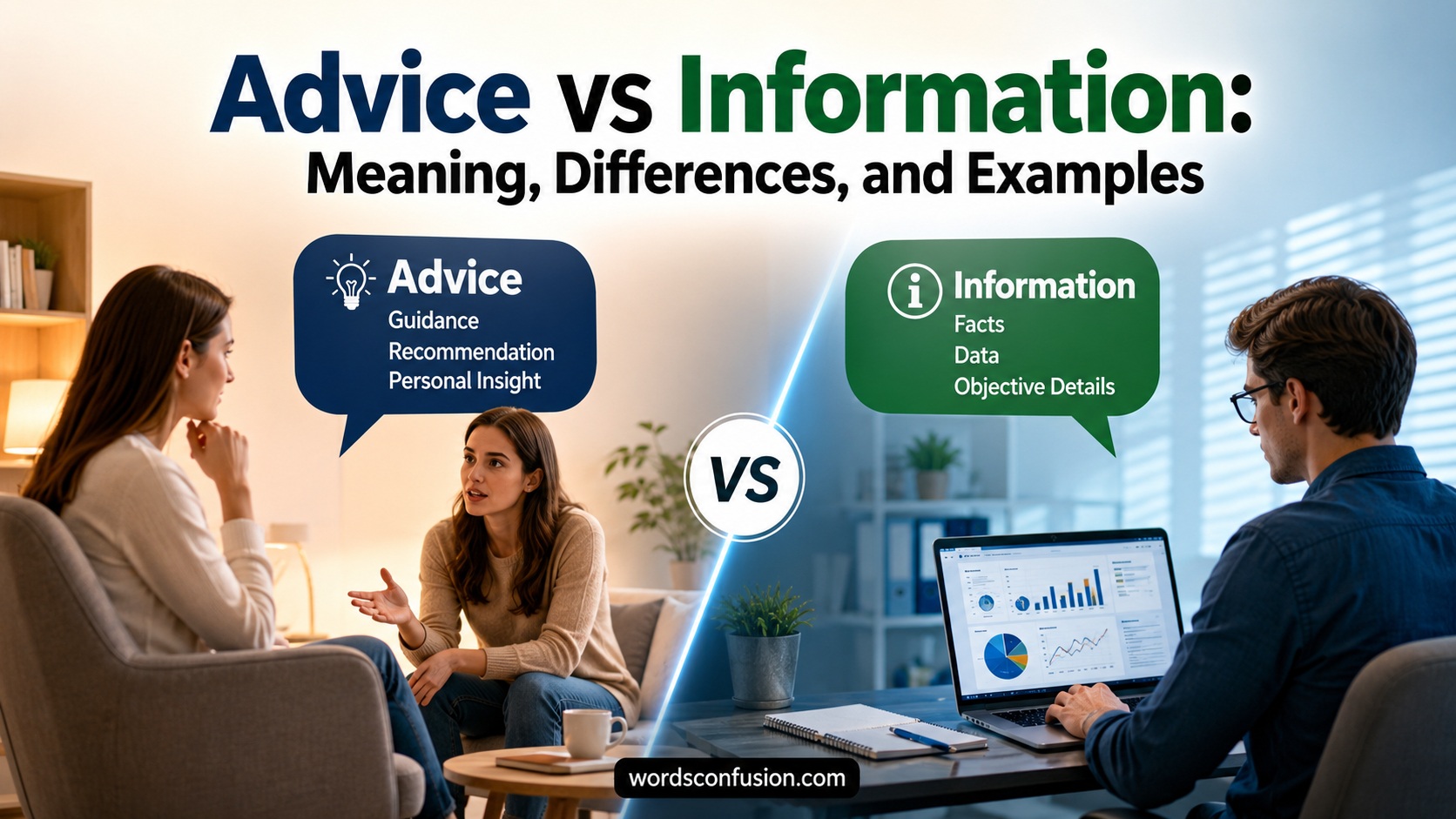
Understanding the difference between advice vs information is essential because the two words often appear in similar situations even though they serve different purposes. Many English learners use them interchangeably, which can lead to misunderstandings in conversations, emails, workplaces, and academic writing.
Here’s the simplest way to think about it. Information tells you something, while advice tells you what you should do. Information presents facts, details, or data. Advice offers guidance, recommendations, or opinions that help someone make a decision.
For example, if someone says, “The store closes at 9 PM,” they are giving you information. If they say, “You should go before 8 PM to avoid the crowd,” they are giving you advice.
Learning this distinction will make your English sound more natural and help you communicate with greater confidence.
Quick Answer
| Advice | Information |
| Gives guidance or recommendations | Provides facts or details |
| Based on opinions, experience, or expertise | Based on facts, observations, or data |
| Helps someone decide what to do | Helps someone understand something |
| Usually answers “What should I do?” | Usually answers “What happened?” or “What do I need to know?” |
| Example: You should save more money. | Example: The bank opens at 9 AM. |
In short:
- Advice = Guidance
- Information = Facts
What Is Advice?
Advice is guidance or a recommendation offered to help someone make a decision or solve a problem. It often comes from personal experience, professional expertise, or careful judgment.
Unlike facts, advice suggests a course of action rather than simply describing a situation.
Definition
Advice is an uncountable noun that means an opinion or recommendation about what someone should do.
Examples:
- My teacher gave me useful advice.
- You should ask for legal advice.
- His financial advice saved me thousands of dollars.
When to Use Advice
Use advice whenever someone recommends an action or helps another person make a decision.
Common situations include:
- Career guidance
- Medical recommendations
- Financial planning
- Parenting
- Education
- Relationships
Example:
“Wear comfortable shoes during your trip.”
This is advice because it recommends an action.
Why Advice Is Uncountable
One of the most common grammar mistakes is saying:
- an advice
- many advices
Both are incorrect.
Correct forms include:
- some advice
- a piece of advice
- lots of advice
- useful advice
Common Examples
| Sentence | Correct? |
| She gave me excellent advice. | ✔ |
| I need some advice. | ✔ |
| He offered valuable advice. | ✔ |
| She gave me an advice. | ✘ |
What Is Information?
Information refers to facts, knowledge, or details that help people understand a subject, event, or situation.
Unlike advice, information does not tell someone what they should do.
Definition
Information is an uncountable noun meaning facts, data, or knowledge about something.
Examples:
- The website contains useful information.
- We collected information about the project.
- Please send more information.
When to Use Information
Use information whenever you are sharing facts or explaining something.
Examples include:
- Weather reports
- News articles
- Maps
- User manuals
- Scientific research
- Company policies
Example:
“The museum opens at 10 AM.”
This is information because it simply states a fact.
Why Information Is Uncountable
Like advice, information cannot normally be counted.
Incorrect:
- an information
- informations
Correct:
- some information
- a piece of information
- important information
Common Examples
| Sentence | Correct? |
| Can you give me more information? | ✔ |
| The brochure contains useful information. | ✔ |
| I found valuable information online. | ✔ |
| She sent me an information. | ✘ |
Advice vs Information: The Key Difference
The biggest difference between advice vs information is purpose.
Information helps you understand something.
Advice helps you decide something.
Imagine you’re planning a vacation.
Someone tells you:
- Flights cost $400.
- The hotel has free breakfast.
- The weather will be sunny.
These are pieces of information.
Now imagine they say:
- Book your flight early.
- Stay near the city center.
- Pack sunscreen.
Those are pieces of advice.
Comparison Table
| Feature | Advice | Information |
| Meaning | Guidance | Facts |
| Purpose | Recommend action | Share knowledge |
| Based On | Experience or opinion | Evidence or observation |
| Answers | What should I do? | What should I know? |
| Action Required | Usually yes | Not necessarily |
| Can Be Verified | Sometimes | Usually yes |
| Example | Save more money. | Interest rates increased. |
Advice vs Information in Simple Words
A useful way to remember the difference is this:
Think of information as a map.
Think of advice as someone telling you which road to take.
The map shows facts.
The recommendation tells you which choice might be better.
That simple comparison makes the distinction much easier to remember.
When Should You Use Advice?
You should use advice whenever someone needs help making a decision.
Everyday Situations
Examples include:
- Choosing a college
- Buying a car
- Starting a business
- Losing weight
- Learning English
Workplace
Managers often give advice about:
- Career growth
- Leadership
- Communication
- Productivity
Education
Teachers give advice about:
- Study techniques
- Exam preparation
- Time management
Healthcare
Doctors provide advice such as:
- Exercise regularly.
- Drink more water.
- Reduce sugar intake.
Personal Relationships
Friends often offer advice during difficult situations involving:
- Family
- Marriage
- Friendships
- Parenting
When Should You Use Information?
Use information when sharing knowledge rather than recommendations.
Research and Learning
Books and academic journals provide information supported by evidence.
News and Reports
News organizations report information about current events.
Business
Companies share information about:
- Products
- Services
- Pricing
- Policies
Travel
Travel websites provide information about:
- Flight schedules
- Hotel locations
- Tourist attractions
Technology
Software manuals contain information explaining how products work.
Can Information Become Advice?
Yes. Information can support advice, but it is not advice by itself.
For example:
Information
This laptop has 16 GB of RAM.
Advice
Buy this laptop if you edit videos regularly.
The first sentence presents a fact.
The second sentence recommends an action based on that fact.
This difference matters in business, education, healthcare, and everyday conversations.
Advice and Information in Communication
Clear communication depends on choosing the correct word.
Imagine receiving this message:
Traffic is heavy downtown.
That is information.
Now imagine another message:
Take the highway instead.
That is advice.
Mixing the two can confuse readers because facts and recommendations serve different purposes.
Why Confusing Them Can Change Meaning
Suppose a doctor says:
Your blood pressure is high.
That is information.
If the doctor says:
Reduce your salt intake.
That becomes advice.
One explains the situation.
The other suggests an action.
Read More: Lose vs Loss: Meaning, Differences, and Correct Usage
Choosing the Right Word for Your Message
Ask yourself:
- Am I sharing facts?
- Or am I recommending an action?
Your answer determines which word fits best.
Common Mistakes People Make
Many learners confuse these words because both often appear together.
Treating Advice as Facts
Advice may come from experts, but it still recommends an action.
Example:
You should invest early.
This is advice.
Using Information Instead of Advice
Incorrect:
My teacher gave me information about improving my writing.
Correct:
My teacher gave me advice about improving my writing.
Assuming Every Recommendation Is Advice
Recommendations usually count as advice.
Facts remain information even if they influence decisions.
Advice vs Information in Grammar
Although both words are uncountable nouns, they function differently.
Parts of Speech
| Word | Part of Speech |
| Advice | Uncountable noun |
| Information | Uncountable noun |
Countable or Uncountable?
Neither word normally takes a plural form.
Correct expressions include:
- some advice
- a piece of advice
- some information
- a piece of information
Common Collocations
Advice
- Give advice
- Offer advice
- Seek advice
- Ignore advice
- Professional advice
Information
- Share information
- Reliable information
- Detailed information
- Accurate information
- Personal information
Common Phrases With Advice
These expressions appear frequently in spoken and written English.
- Ask for advice
- Follow advice
- Give advice
- Offer advice
- Sound advice
- Legal advice
- Medical advice
- Financial advice
- Career advice
Common Phrases With Information
These combinations are equally common.
- General information
- Useful information
- Reliable information
- Updated information
- Background information
- Personal information
- Public information
- Contact information
Example Sentences
Advice in Sentences
- My mentor gave me excellent career advice.
- You should follow your doctor’s advice.
- She asked for legal advice before signing the contract.
- Good advice can prevent expensive mistakes.
- His advice helped me find a better job.
Information in Sentences
- The website contains detailed information.
- We collected information from reliable sources.
- The report provides accurate information.
- Customers requested additional information.
- The guide includes travel information.
Side-by-Side Examples
| Advice | Information |
| Save your money. | Inflation increased by 3%. |
| Wear a helmet. | Helmets reduce injury risk. |
| Study every day. | The exam begins Monday. |
| Leave early. | Traffic is heavy. |
FAQs:
Is advice the same as information?
No. Advice recommends an action, while information provides facts or details without telling someone what to do.
Can information become advice?
Information can support advice, but it does not become advice unless it includes a recommendation or guidance.
Why are advice and information uncountable nouns?
Both represent abstract concepts rather than individual objects. That is why English uses expressions like some advice, some information, or a piece of advice instead of plural forms.
Can advice be based on incorrect information?
Yes. If the facts behind the recommendation are inaccurate or outdated, the advice may also be poor or misleading.
Which word should I use in professional writing?
Use information when presenting facts, reports, or data. Use advice only when offering recommendations, guidance, or professional opinions.
Conclusion:
Understanding the difference between advice vs information helps you communicate more clearly and avoid common English mistakes. Although these words often appear in similar situations, they have different purposes. Information gives you facts, details, or knowledge, while advice offers guidance or recommendations about what you should do.
A simple way to remember the difference is this: information helps you understand, whereas advice helps you decide. Once you keep that distinction in mind, choosing the correct word becomes much easier in conversations, emails, academic writing, and professional communication.

Andrew Wilson is an experienced language researcher and content writer specializing in WordsConfusion topics. He helps readers understand commonly confused English words, spelling differences, grammar rules, word meanings, and proper usage through clear explanations, practical examples, and easy-to-follow language guides. His goal is to make English learning simple, accurate, and accessible for students, writers, professionals, and everyday learners.