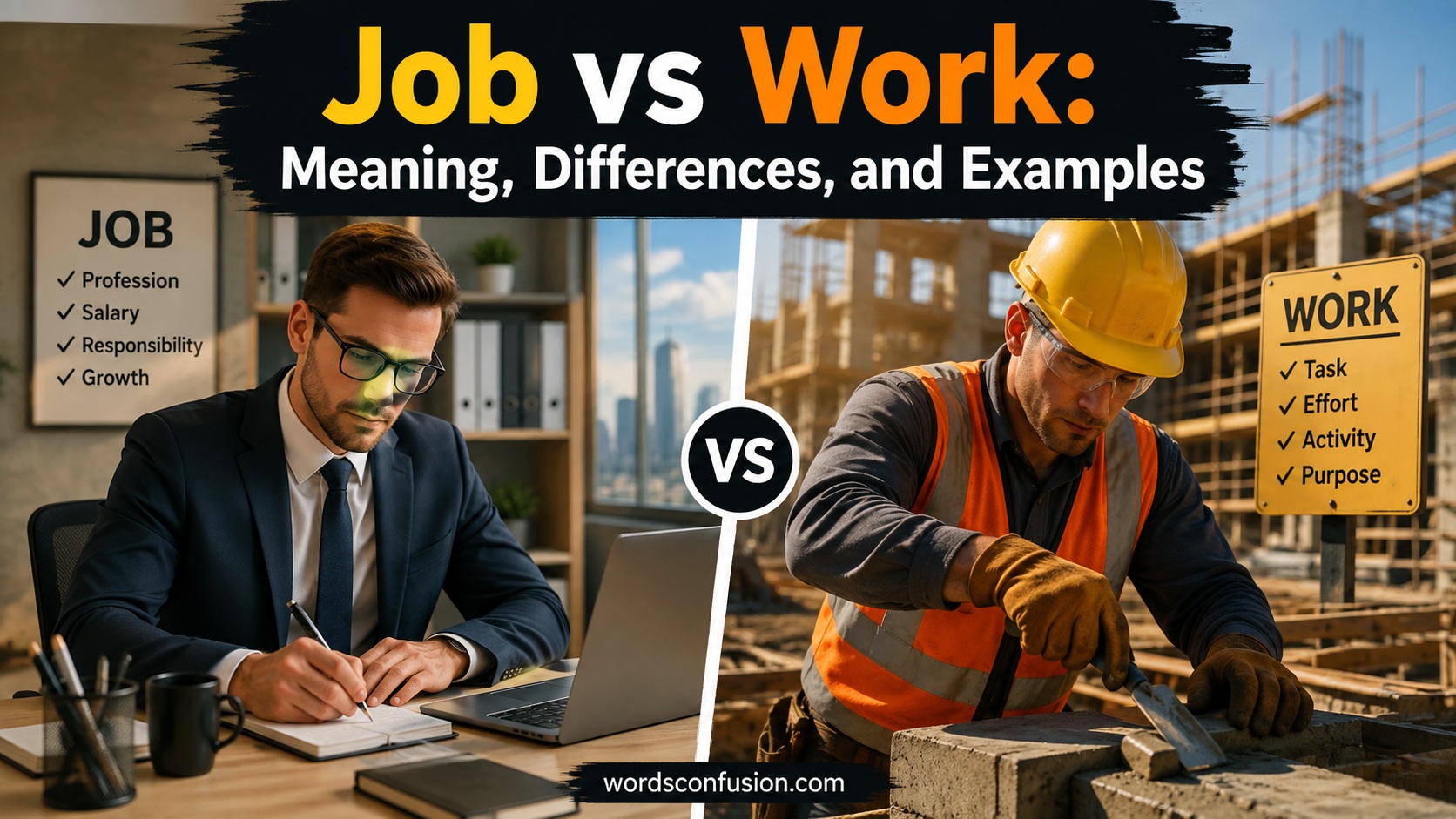
Understanding the difference between job vs work can make your English sound more natural and accurate. Although many people use these words interchangeably, they do not always mean the same thing. In fact, using the wrong word can change the meaning of your sentence or make it sound unnatural to native speakers.
A job usually refers to a specific position or task, while work is a broader word that describes activities involving effort or employment in general. Once you learn the difference, you’ll know exactly when to say “I have a job,” “I’m at work,” or “I have work to do.”
This guide explains the meaning of job vs work, their grammar rules, common mistakes, examples, collocations, and practical tips so you can use both words confidently in everyday English.
Quick Answer
The main difference between job and work is simple:
- Job is a countable noun that refers to a specific position, role, or task.
- Work is usually an uncountable noun that refers to effort, duties, or employment in general.
For example:
| Correct | Incorrect |
| I have a new job. | I have a new work. |
| I have a lot of work today. | I have many works today. |
| She found a good job. | She found good work. (Possible, but different meaning.) |
| I’m at work. | I’m at job. |
If you’re talking about a position someone holds, use job. If you’re talking about the activities or effort involved, use work.
What Is a Job?
Definition of Job
A job is a specific position that someone does in exchange for payment. It can also refer to a particular task or piece of work that needs to be completed.
Because job is countable, you can say:
- a job
- one job
- two jobs
- several jobs
Examples:
- She got a new job last month.
- My brother has two jobs.
- Finding a good job takes time.
Key Characteristics of a Job
A job usually has these features:
- It is a specific position.
- It is often paid.
- It has defined responsibilities.
- It may be full-time or part-time.
- One person can have multiple jobs.
Common Examples of a Job
Some common jobs include:
- Teacher
- Doctor
- Engineer
- Accountant
- Police officer
- Graphic designer
- Software developer
- Sales manager
- Electrician
- Chef
Each of these is a specific employment position rather than the work itself.
What Is Work?
Definition of Work
Work refers to physical or mental effort done to achieve a purpose. It can also describe employment in general or the activities you perform while doing your job.
Unlike job, work is usually an uncountable noun.
Examples:
- I have a lot of work today.
- She enjoys her work.
- They finished their work before lunch.
Key Characteristics of Work
Work generally:
- Describes effort or activity.
- Is usually uncountable.
- Includes paid and unpaid activities.
- Refers to employment in general.
- Covers tasks, duties, and responsibilities.
Common Examples of Work
Examples of work include:
- Writing reports
- Cleaning the house
- Preparing presentations
- Fixing a car
- Studying for exams
- Painting a room
- Answering emails
- Completing assignments
Notice that many of these activities are not jobs. However, they are all forms of work.
Job vs Work: Quick Comparison Table
| Feature | Job | Work |
| Meaning | A specific position or task | Effort, duties, or employment in general |
| Part of Speech | Countable noun | Usually an uncountable noun |
| Countability | Countable | Usually uncountable |
| Payment | Usually paid | May be paid or unpaid |
| Purpose | Refers to a position | Refers to activities or effort |
| Duration | Can be temporary or permanent | Can be short or ongoing |
| Common Question | What’s your job? | How’s work? |
| Example | I found a new job. | I have too much work. |
The Main Differences Between Job and Work
Meaning and Purpose
A job identifies a person’s employment position.
Example:
Sarah’s job is teaching mathematics.
Work describes the activities Sarah performs.
Example:
Sarah has a lot of work before the exams.
Grammar and Countability
This is one of the biggest grammar differences.
Job is countable.
- a job
- two jobs
- several jobs
Work is generally uncountable.
- much work
- little work
- more work
Not:
- many works
- a work
Payment and Employment
Most jobs involve payment.
However, work does not always involve money.
Examples:
- Caring for children is work.
- Volunteer work helps communities.
- Household work never really ends.
Scope and Usage
A job is only one part of work.
Think of it this way:
- Job = Position
- Work = Activity
Every job includes work, but not all work is a job.
Formal vs Informal Context
Both words appear in formal and informal English.
Examples:
Formal:
- He accepted a government job.
- Her work received international recognition.
Informal:
- I’m looking for a new job.
- I have too much work today.
Temporary vs Long-Term Use
Jobs may change throughout life.
Work continues in many different forms regardless of your employment status.
For example:
- A retired person may not have a job.
- A retired person may still have plenty of work around the house.
Is “Work” Countable or Uncountable?
Many English learners struggle with this rule.
When Work Is Uncountable
Most of the time, work is uncountable.
Examples:
- I have a lot of work.
- She finished her work.
- We need more work.
When “Works” Is Correct
The plural works exists, but it has different meanings.
It may refer to:
- Literary works
- Works of art
- Engineering works
- Public works
Examples:
- Shakespeare’s works are famous worldwide.
- The museum displays Picasso’s works.
Why “A Work” Usually Sounds Incorrect
Native speakers rarely say:
- I have a work.
Instead, they say:
- I have work.
- I have a job.
- I have a task.
When to Use Job
Talking About Employment
Use job whenever you refer to someone’s occupation.
Examples:
- He got a new job.
- She loves her job.
- My dream job is becoming a pilot.
Referring to a Specific Task
Sometimes job also means a particular task.
Examples:
- Painting the fence was a difficult job.
- Good job!
- That was an excellent job.
Common Expressions with Job
Common phrases include:
- Get a job
- Find a job
- Lose a job
- Quit a job
- Apply for a job
- Dream job
- Full-time job
- Part-time job
- Job interview
- Job offer
When to Use Work
Talking About Activities
Examples:
- I need to finish my work.
- She started work early.
Talking About Employment in General
Examples:
- He is looking for work.
- She’s back at work.
Talking About Workplaces
Examples:
- I’m at work.
- He left work late.
Common Expressions with Work
Popular collocations include:
- Hard work
- Teamwork
- Work experience
- Work schedule
- Work environment
- Remote work
- Work from home
- Work overtime
- Work hard
- Go to work
Job vs Work in Everyday English
At the Office
- I started a new job.
- I have too much work today.
At School
Teachers assign work.
Students do schoolwork.
Teaching is the teacher’s job.
At Home
Cleaning, cooking, and gardening are all forms of work.
They are not usually considered jobs unless someone is hired to perform them.
In Business Conversations
Professionals often ask:
- What do you do for work?
- What’s your job?
Although both questions are acceptable, they focus on slightly different ideas.
In Casual Conversations
Friends commonly say:
- How’s work?
- Do you like your job?
Each sounds natural because they ask about different aspects of employment.
Side-by-Side Sentence Examples
| Job | Work |
| I found a new job yesterday. | I found work yesterday. |
| She enjoys her job. | She enjoys her work. |
| His job requires travel. | His work requires attention to detail. |
| They offered me a better job. | I have too much work today. |
| She quit her job. | She finished her work early. |
Read More: Advice vs Information: Meaning, Differences, and Examples
Common Mistakes and How to Avoid Them
Saying “I Have Many Works”
Incorrect:
I have many works.
Correct:
I have a lot of work.
Confusing Job with Task
Incorrect:
My work is a doctor.
Correct:
My job is a doctor.
Using Work as a Countable Noun
Incorrect:
She has three works.
Correct:
She has three jobs.
Mixing Employment and Activity
Incorrect:
I got new work at Google.
Correct:
I got a new job at Google.
Job vs Work in American and British English
Both American and British English use job and work in almost the same way.
There are no major grammar differences.
However, certain workplace vocabulary may differ.
For example:
| American English | British English |
| Vacation | Holiday |
| Resume | CV |
| Apartment | Flat |
| Elevator | Lift |
Even so, the distinction between job and work remains consistent in both varieties of English.
Popular Collocations
Common Collocations with Job
- Job satisfaction
- Job description
- Job opportunity
- Job market
- Job security
- Job interview
- Job application
- Job opening
- Job offer
- Job search
Common Collocations with Work
- Hard work
- Work ethic
- Work schedule
- Work experience
- Work permit
- Work culture
- Work environment
- Work hours
- Work routine
- Work-life balance
FAQs:
Is a job the same as work?
No. A job is a specific employment position, while work refers to the effort, duties, or activities someone performs.
Can I say “I have a work”?
No. In standard English, work is usually uncountable. Say I have work or I have a job instead.
Why is “work” usually uncountable?
Because it describes effort or activity rather than individual items. That’s why native speakers say a lot of work instead of many works.
Can unpaid activities be called work?
Yes. Housework, volunteer work, studying, and caring for family members are all forms of work even if they aren’t paid.
What is the difference between work, job, career, and profession?
- Work is the effort or activity you do.
- Job is a specific paid position.
- Career is your long-term professional journey.
- Profession is an occupation that usually requires specialized education, training, or licensing.
Conclusion:
Understanding job vs work becomes much easier once you remember one key idea: a job is a specific position, while work is the effort or activity you perform. Although these words often appear together, they serve different purposes in English grammar and everyday conversation.
When discussing employment, use job for a particular role such as teacher, engineer, or accountant. Use work when referring to duties, tasks, effort, or employment in general. Knowing this distinction will help you avoid common mistakes like saying “I have a work” or “many works.”

Andrew Wilson is an experienced language researcher and content writer specializing in WordsConfusion topics. He helps readers understand commonly confused English words, spelling differences, grammar rules, word meanings, and proper usage through clear explanations, practical examples, and easy-to-follow language guides. His goal is to make English learning simple, accurate, and accessible for students, writers, professionals, and everyday learners.