
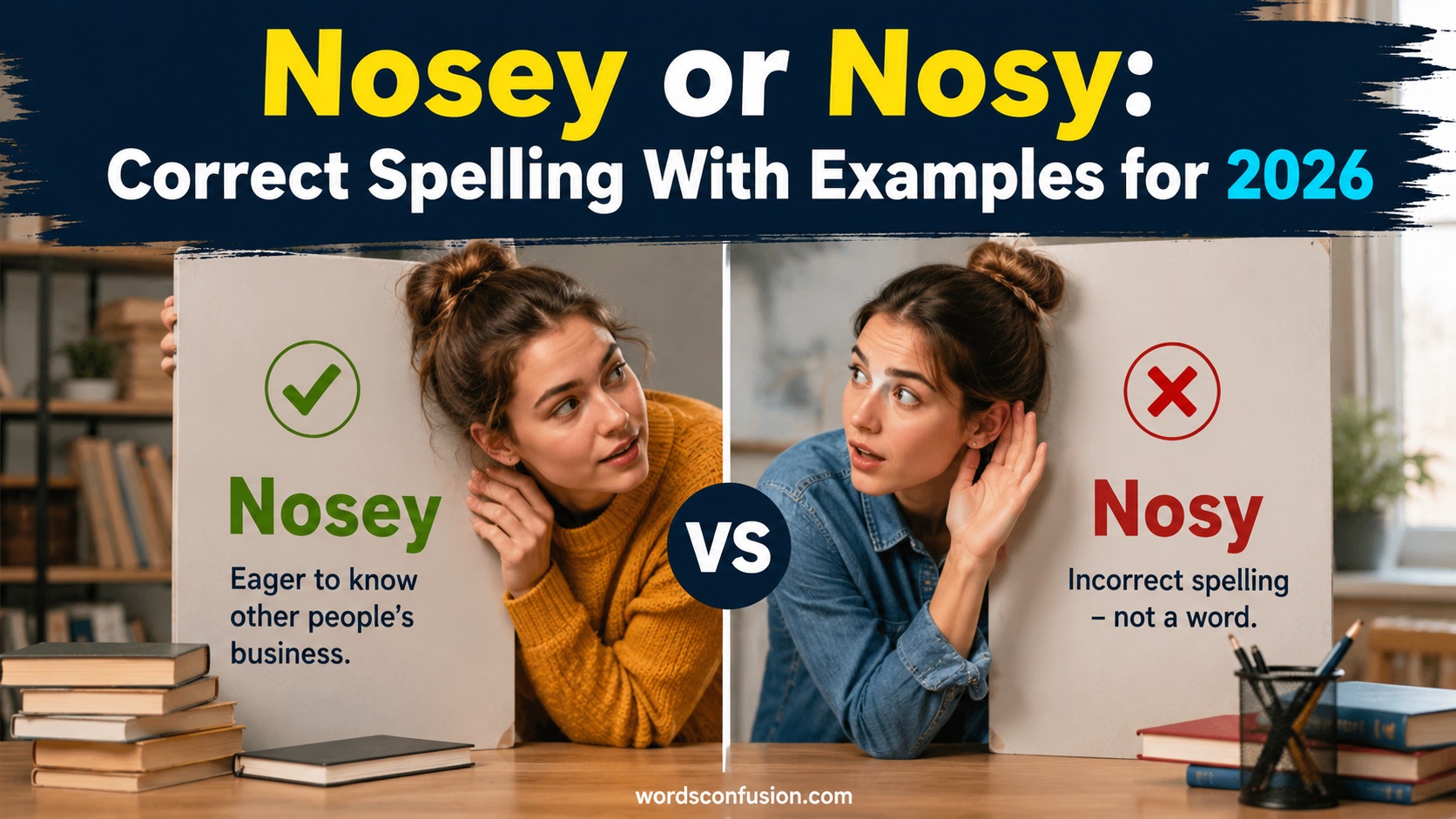
If you’ve ever paused while writing “nosy” and wondered whether it should actually be “nosey,” you’re not alone. Both spellings appear in English, and both refer to the same kind of behavior. That makes this little spelling question more confusing than it first seems.
The good news is that you don’t have to choose between a correct word and a completely wrong one. Both “nosy” and “nosey” are accepted spellings. However, they aren’t equally common in every style of writing. Nosy is generally the better default choice, especially in US English.
The confusion makes sense, too. The word comes from the idea of sticking your nose into other people’s business. Because of that connection, nosey looks perfectly logical.
This guide explains nosey vs. nosy in detail. You’ll learn what each spelling means, which version you should use, how the word works in sentences, and how nosy differs from words such as curious, inquisitive, and intrusive.
Quick Answer
Both “nosy” and “nosey” are correct spellings. They have the same meaning, pronunciation, and grammatical function.
However, nosy is the better default spelling for most US English writing. Nosey is an accepted variant, so seeing it in a sentence doesn’t automatically mean the writer made a spelling mistake.
| Spelling | Correct? | Meaning | Best default for US English |
| Nosy | Yes | Too interested in other people’s private affairs | Yes |
| Nosey | Yes | Too interested in other people’s private affairs | Acceptable variant |
| The simplest rule is this: Use “nosy” when you’re unsure. | |||
| For example: |
My neighbor is very nosy.- Stop being so nosy.
- That was a nosy question.
You could replace nosy with nosey in each sentence without changing the basic meaning.
Comparison Overview
The difference between nosy and nosey is mainly a matter of spelling preference. Neither word represents a separate meaning.
| Feature | Nosy | Nosey |
| Part of speech | Adjective | Adjective |
| Meaning | Excessively curious about other people’s affairs | Excessively curious about other people’s affairs |
| Pronunciation | Usually /ˈnoʊzi/ | Usually /ˈnoʊzi/ |
| Meaning difference | None | None |
| Accepted spelling | Yes | Yes |
| Common US choice | Yes | Less common |
| Comparative | Nosier | Noseier is possible but less preferred |
| Superlative | Nosiest | Noseiest is possible but less preferred |
| Noun form | Nosiness | Noseiness is also encountered |
| The important point is that “nosey” isn’t simply a typo for “nosy.” It has a legitimate place in English usage. | ||
| Still, if you’re writing an article, essay, email, or other polished US English content, nosy is usually the cleaner choice. |
Main Differences Between Nosey or Nosy
At first glance, the extra e seems significant. In practice, it doesn’t create a difference in meaning.
Meaning
Both nosy and nosey describe someone who takes too much interest in matters that aren’t their business.
For example:
My coworker is nosy about everyone’s salary.
The sentence suggests that the coworker asks questions or seeks information that should probably remain private.
You could also write:
My coworker is nosey about everyone’s salary.
The meaning stays the same.
Spelling
The only obvious difference is the spelling:
- nosy → n-o-s-y
- nosey → n-o-s-e-y
The second spelling keeps the e from nose. That makes nosey visually connected to the word nose, which helps explain why many writers naturally choose it.
Usage Preference
Although both forms are legitimate, nosy is generally the stronger choice when you want the standard, straightforward spelling in American English.
Think of it as choosing the default setting. Nosey still works, but nosy is the form to reach for first.
Pronunciation
There isn’t a meaningful pronunciation difference between the two spellings in ordinary English.
Both are generally pronounced like “NOH-zee.”
So changing nosy to nosey doesn’t change how the word sounds.
What Does Nosy Mean?
Nosy is an adjective that describes someone who is overly interested in other people’s private lives, personal affairs, or business.
The key idea is excessive curiosity.
Being curious isn’t necessarily bad. In fact, curiosity can help you learn, investigate problems, and understand the world. The word nosy, however, usually carries a negative or disapproving tone.
Consider these two sentences:
- Emma was curious about how the machine worked.
- Emma was nosy about her neighbor’s divorce.
The first sentence describes useful or harmless interest. The second suggests that Emma is asking about something personal that doesn’t concern her.
That’s the heart of the word.
Examples of Nosy
Here are several natural examples:
- Our new neighbor is surprisingly nosy.
- Don’t be nosy about my personal life.
- He asked a nosy question about my salary.
- Her nosy relatives wanted to know when she planned to marry.
- I wasn’t trying to be nosy.
- The reporter became too nosy during the interview.
Notice that nosy often appears around situations involving privacy, relationships, money, family, work, or personal decisions.
What Does Nosey Mean?
Nosey means the same thing as nosy. It describes someone who shows too much interest in another person’s private affairs.
For example:
- She’s always been nosey about her neighbors.
- That was a pretty nosey question.
- Why are you being so nosey?
- His nosey behavior annoyed everyone at the table.
The spelling may look different, but the underlying word doesn’t change.
Major English dictionaries recognize nosey as a variant of nosy, which is why it shouldn’t be treated as an outright spelling error.
Why Does Nosey Look So Natural?
There’s a simple reason nosey feels intuitive.
The word nose is strongly associated with the idea of interfering in someone’s affairs. English even has the expression “stick your nose into something,” meaning to interfere in something that doesn’t concern you.
So nosey visually reinforces that connection:
nose → nosey
At the same time, English usage has established nosy as the common alternative spelling.
Is “Nosey” Wrong?
No. “Nosey” isn’t wrong.
This distinction matters because writers sometimes assume that only nosy is legitimate. That’s too strong a claim.
Nosey appears in established dictionaries as a variant spelling. Therefore, calling it a misspelling would be misleading.
However, there’s an important difference between correct and preferred.
A word can have more than one accepted spelling while one form remains more common or more suitable for a particular audience.
For example:
Don’t be so nosy about their relationship.
This is the safest choice for general US English.
But this sentence is also acceptable:
Don’t be so nosey about their relationship.
If you’re choosing between the two without any special reason to use the variant, nosy is the better pick.
Which Spelling Should You Use in American English?
For most American English writing, choose nosy.
That recommendation works especially well in:
- School assignments
- Blog articles
- Business writing
- News-style writing
- General web content
- Professional emails
- Educational material
- Grammar and vocabulary articles
Why choose it? Nosy is the more familiar default form.
Readers won’t stop to question it, and it fits naturally into modern American English.
Nosey remains perfectly understandable and accepted. You simply don’t need the extra e unless you’re following a particular source’s spelling preference or preserving someone’s original wording.
Nosy vs. Curious: What’s the Difference?
This is where word choice becomes more interesting.
Nosy and curious overlap, but they don’t carry the same tone.
| Word | Basic meaning | Typical tone |
| Curious | Wanting to know or learn something | Neutral or positive |
| Nosy | Too interested in another person’s private affairs | Usually negative |
| Inquisitive | Eager to ask questions or gain knowledge | Usually positive or neutral |
| Intrusive | Interfering with someone’s privacy or personal space | Strongly negative |
| Consider this example: |
Lena was curious about the history of the old house.
There’s nothing wrong with Lena’s interest.
Now compare it with:
Lena was nosy about the owner’s divorce.
Here, the subject involves someone’s private life. The word nosy tells you that Lena’s interest has crossed a social boundary.
Curious Doesn’t Always Mean Nosy
A child asking, “Why is the sky blue?” is curious.
A coworker asking, “How much money do you make?” may be nosy.
The difference isn’t simply the act of asking questions. Context and boundaries matter.
That’s why replacing nosy with curious can sometimes soften the meaning considerably.
Common Examples of Nosy Behavior
The word becomes much easier to understand when you see it in realistic situations.
Nosy Questions
A nosy question usually asks for information that someone doesn’t need to know.
Examples include:
- How much did you pay for your house?
- Why aren’t you married yet?
- How much money do you make?
- Are you having problems with your spouse?
- Why did you leave your previous job?
None of these questions is automatically nosy in every situation. Context changes everything.
A close friend asking about your new job may simply be showing concern. A stranger demanding your salary might cross the line.
Nosy Neighbors
The phrase nosy neighbor is particularly common.
A nosy neighbor might:
- Watch who visits your home.
- Ask personal questions about your family.
- Comment on your daily routine.
- Want details about your finances.
- Gossip about other residents.
For example:
Our nosy neighbor somehow knows everyone’s business before anyone else does.
The humor comes from exaggeration, but the meaning remains clear.
Nosy Relatives
Family members can also act nosy, especially when they ask repeated questions about relationships, careers, children, or money.
For example:
My aunt gets nosy whenever someone mentions marriage.
The word doesn’t necessarily mean the person is cruel. It simply suggests that their curiosity has become intrusive.
Nosy Coworkers
Workplaces create plenty of opportunities for unwanted questions.
A coworker might ask about:
- Your salary
- Your promotion
- Your relationship
- Your plans to leave the company
- Another employee’s performance
For example:
I like him, but he gets nosy whenever we discuss promotions.
Here, nosy communicates mild criticism without necessarily describing the coworker as malicious.
Read More: Afterward or Afterwards: Which Spelling Should You Use in 2026?
How to Use “Nosy” in a Sentence
Because nosy is an adjective, it usually describes a person, question, attitude, or behavior.
Nosy Before a Noun
This is one of the most common patterns.
Examples:
- She asked a nosy question.
- He’s a nosy neighbor.
- That was a nosy comment.
- My nosy coworker keeps asking personal questions.
Here, nosy directly modifies a noun.
Nosy After a Linking Verb
You can also place the adjective after verbs such as be, seem, become, sound, and get.
Examples:
- You’re being nosy.
- He seems nosy.
- She became nosy after hearing the rumor.
- That question sounds nosy.
- My neighbor is getting nosy.
This pattern is especially common in everyday conversation.
Nosy in Negative Statements
People frequently use nosy to criticize unwanted curiosity.
Examples:
- Don’t be nosy.
- I wasn’t trying to be nosy.
- You don’t have to be so nosy.
- Sorry if I’m being nosy.
The last example is interesting because it softens the criticism. Saying “Sorry if I’m being nosy” acknowledges that a question might be too personal.
How to Use “Nosey” in a Sentence
Nosey follows the same grammatical patterns as nosy because the two spellings represent the same adjective.
Examples:
- My neighbor is nosey.
- That was a nosey question.
- Why are you being so nosey?
- Her nosey behavior irritated her coworkers.
- I don’t mean to sound nosey, but what happened?
If you’re writing for an American audience, however, nosy will usually look more conventional.
Nosy or Nosey: Example Sentences
Here are practical examples showing how the word works in everyday English.
| Example | What it shows |
| Don’t be so nosy. | Direct criticism |
| She asked a nosy question. | Adjective before a noun |
| My neighbor is incredibly nosy. | Description of a person |
| I wasn’t trying to be nosy. | Polite qualification |
| His nosy behavior caused problems. | Description of behavior |
| Why are you getting so nosy? | Increasing curiosity |
| That sounds a little nosy. | Mild criticism |
| Her relatives were nosey about her plans. | Variant spelling |
| He has always been nosey. | Variant spelling |
| The reporter’s questions seemed nosy. | Context-specific judgment |
| These examples also show something important: nosy doesn’t always describe extreme behavior. | |
| Sometimes it’s playful. | |
| Sometimes it’s mildly critical. | |
| Sometimes it’s openly negative. | |
| The surrounding context determines the strength. |
Common Mistakes With Nosy and Nosey
Mistake: Saying “Nosey” Is Always Wrong
This is the biggest misconception.
Nosey is an accepted variant. It isn’t accurate to label every occurrence as a spelling mistake.
If you’re correcting someone’s writing, consider the context before marking it wrong.
Mistake: Thinking Nosy Means Curious in Every Situation
Although the meanings overlap, nosy usually carries a negative sense.
Compare:
I’m curious about your new project.
with:
I’m nosy about your personal finances.
The first sounds friendly. The second sounds intrusive.
Mistake: Confusing Nosy With Nose
The noun nose refers to the body part used for smelling and breathing.
Nosy is an adjective describing intrusive curiosity.
For example:
- My nose hurts.
- My neighbor is nosy.
These words are related in appearance and origin, but they don’t serve the same grammatical purpose.
Mistake: Assuming the Extra “E” Changes Pronunciation
It doesn’t normally create a different pronunciation.
Nosy and nosey are generally pronounced the same way.
Nosy Word Forms
The adjective has several useful related forms.
| Form | Word | Example |
| Base adjective | nosy | She’s nosy. |
| Comparative | nosier | He’s getting nosier. |
| Superlative | nosiest | She’s the nosiest person here. |
| Noun | nosiness | His nosiness annoyed everyone. |
| Adverb | nosily | She asked nosily about the decision. |
| These forms follow familiar English spelling patterns. | ||
| When nosy changes to a comparative or superlative form, the y changes to i: |
nosy → nosier- nosy → nosiest
The same pattern appears in many English adjectives ending in -y.
For example: - happy → happier → happiest
- busy → busier → busiest
- noisy → noisier → noisiest
Nosy, Nosier, and Nosiest: Examples
Nosy
My nosy cousin asked why I hadn’t bought a new car.
Nosier
The questions became nosier as the conversation continued.
Nosiest
He was the nosiest person at the family gathering.
Nosiness
Her constant nosiness made everyone uncomfortable.
These forms describe different degrees or aspects of the same general behavior.
FAQs:
Is “nosy” or “nosey” correct?
Both are correct. Nosy is generally the better default choice in US English, while nosey is an accepted variant.
Is “nosey” a real word?
Yes. Nosey is a legitimate English word and a recognized spelling variant of nosy.
Is “nosey” a spelling mistake?
No. You shouldn’t automatically mark nosey as incorrect. It is an accepted variant spelling.
Which is more common, nosy or nosey?
Nosy is generally the more common and preferred form in American English.
What does nosy mean?
Nosy means being overly interested in another person’s private affairs or business.
Conclusion:
When choosing between nosey or nosy, both spellings are correct and carry the same meaning. They describe someone who shows too much interest in other people’s private affairs. The main difference comes down to spelling preference rather than meaning or pronunciation.
For US English, nosy is the best default choice. It’s widely recognized, concise, and fits naturally in both casual and formal writing. Nosey is also an accepted variant, so you don’t need to treat it as an error.
The easiest rule to remember is simple: Use “nosy” when you’re unsure, but don’t assume “nosey” is wrong. Whether you write “Don’t be so nosy” or “Don’t be so nosey,” the message remains the same.

Andrew Wilson is an experienced language researcher and content writer specializing in WordsConfusion topics. He helps readers understand commonly confused English words, spelling differences, grammar rules, word meanings, and proper usage through clear explanations, practical examples, and easy-to-follow language guides. His goal is to make English learning simple, accurate, and accessible for students, writers, professionals, and everyday learners.