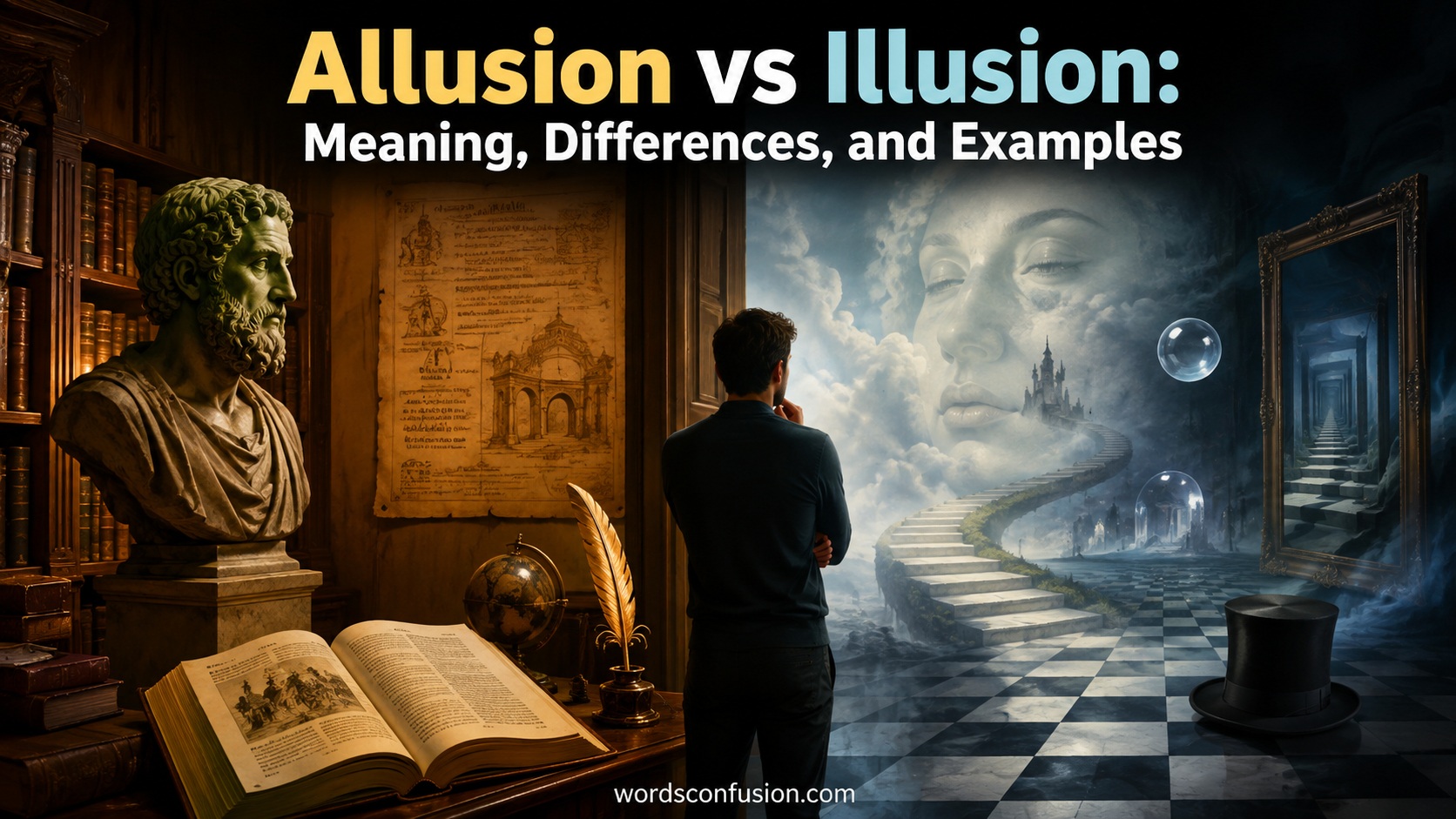
Choosing between allusion and illusion can be confusing because the two words look and sound similar. However, they have completely different meanings. Mixing them up can change the meaning of a sentence and make your writing less accurate.
An allusion is an indirect reference to a person, event, book, or idea that the reader is expected to recognize. An illusion, on the other hand, is a false impression or something that deceives your senses or mind.
If you write essays, stories, emails, or professional content, understanding the difference between allusion vs illusion will help you communicate more clearly. This guide explains each word with simple definitions, practical examples, comparison tables, memory tricks, and common mistakes so you’ll know exactly when to use each one.
Quick Answer
The difference between allusion and illusion is simple:
- Allusion means an indirect reference to something well known.
- Illusion means a false appearance or something that tricks your senses or mind.
| Word | Meaning | Example |
| Allusion | An indirect reference | The novel contains an allusion to Greek mythology. |
| Illusion | A false perception or deceptive appearance | The magician created the illusion of floating in the air. |
Remember: An allusion points to something. An illusion fools you into believing something that isn’t real.
What Is an Allusion?
An allusion is an indirect mention of a person, event, place, literary work, historical moment, or cultural idea without explaining it in detail. Writers expect readers to recognize the reference through their own knowledge.
Instead of describing something completely, an author can make an allusion that instantly adds meaning and emotion.
For example:
“He met his Waterloo during the final interview.”
This sentence alludes to Napoleon’s defeat at the Battle of Waterloo. Even though Napoleon isn’t mentioned directly, readers familiar with history understand the comparison.
Definition
Allusion (noun): An indirect reference to a famous person, place, event, story, or work of literature.
How Allusions Work in Writing
An allusion creates a shortcut between the writer and the reader. Rather than explaining every detail, it relies on shared knowledge.
For example:
- Calling someone Einstein suggests they’re intelligent.
- Referring to a difficult task as climbing Mount Everest emphasizes its challenge.
- Mentioning Romeo and Juliet suggests a tragic romance.
These references enrich writing without lengthy explanations.
Common Types of Allusions
Literary Allusions
References to novels, poems, or plays.
Example:
His ambition became his own Macbeth.
Historical Allusions
References to important historical events.
Examples:
- Waterloo
- Pearl Harbor
- The Great Depression
Biblical Allusions
Many English expressions come from the Bible.
Examples include:
- Good Samaritan
- Garden of Eden
- David and Goliath
- Forbidden fruit
Mythological Allusions
Greek and Roman mythology appears frequently in English.
Examples:
- Achilles’ heel
- Pandora’s box
- Midas touch
- Trojan horse
Cultural and Pop Culture Allusions
Modern writers often reference movies, celebrities, music, and television.
Examples:
- Sherlock Holmes
- Harry Potter
- Star Wars
- Superman
What Is an Illusion?
An illusion is something that appears to be real but actually isn’t. It tricks your eyes, ears, or brain into believing something false.
Illusions are common in science, psychology, magic shows, and everyday life.
Definition
Illusion (noun): A false idea, deceptive appearance, or misleading perception.
How Illusions Work
Your brain constantly interprets information from your senses. Sometimes it interprets that information incorrectly.
That’s when an illusion happens.
For example:
- A straight stick looks bent in water.
- A mirage makes water appear in a desert.
- A magician appears to make objects disappear.
The objects haven’t changed. Your perception has.
Types of Illusions
Optical Illusions
These trick your eyes.
Examples include:
- Impossible triangles
- Moving image illusions
- Size comparison illusions
Auditory Illusions
These fool your hearing.
Examples:
- Phantom sounds
- Speech illusions
- Musical illusions
Cognitive Illusions
These affect the way your brain processes information.
Examples include:
- Memory distortions
- Decision-making biases
- False assumptions
Tactile Illusions
These affect your sense of touch.
For example, crossed fingers can make one object feel like two.
Allusion vs Illusion: The Key Difference
Although the spellings differ by only one letter, their meanings are unrelated.
| Feature | Allusion | Illusion |
| Meaning | Indirect reference | False appearance |
| Purpose | Adds meaning through reference | Creates deception or mistaken perception |
| Field | Literature, speech, writing | Psychology, science, magic |
| Related Verb | Allude | Illude (rare), deceive |
| Reader’s Role | Recognizes the reference | Experiences the deception |
| Example | An allusion to Shakespeare | An illusion created by mirrors |
The easiest way to remember the difference is this:
- Allusion = Reference
- Illusion = Deception
Allusion vs Illusion Explained with Simple Examples
Examples make the distinction much easier to understand.
Examples of “Allusion” in Sentences
- The speech included an allusion to Abraham Lincoln.
- The poem contains an allusion to Greek mythology.
- Her comment was an allusion to yesterday’s meeting.
- The novel makes several allusions to Shakespeare.
- His joke included an allusion that only history students understood.
Examples of “Illusion” in Sentences
- The magician created the illusion of flying.
- The mirror produced an amazing illusion.
- The road ahead gave the illusion of being wet.
- Wealth can create the illusion of happiness.
- The artist painted an illusion of depth.
Why People Confuse Allusion and Illusion
These words confuse many English learners and even native speakers.
Here are the main reasons.
Similar Spelling
Both words:
- Start with all-
- End with -usion
- Have nearly identical lengths
Only one letter separates them.
Similar Pronunciation
They sound alike in casual conversation.
- Allusion: /əˈluːʒən/
- Illusion: /ɪˈluːʒən/
The beginning vowel sound changes, yet many people overlook it.
Different Meanings and Contexts
The words belong to completely different ideas.
| Word | Connected With |
| Allusion | Literature, language, communication |
| Illusion | Perception, psychology, magic |
Understanding the context usually reveals the correct choice.
Memory Trick to Remember the Difference
A simple memory trick can prevent mistakes.
Easy Mnemonic
Allusion contains “allude.”
If someone alludes to something, they’re making an indirect reference.
Visual Association
Imagine this:
- Allusion → A writer pointing toward another story.
- Illusion → A magician making a rabbit disappear.
One references.
The other deceives.
When to Use Allusion
Use allusion whenever you’re referring indirectly to something famous.
In Literature
Authors use allusions to:
- Add symbolism
- Build deeper meaning
- Reward knowledgeable readers
In Everyday Conversations
People make allusions more often than they realize.
Examples:
- “He’s a real Sherlock Holmes.”
- “Don’t open Pandora’s box.”
- “That project became my Everest.”
In Academic Writing
Essays frequently include literary and historical allusions to strengthen arguments.
In Media and Advertising
Brands often reference popular culture because audiences recognize familiar ideas quickly.
For example, advertisements may allude to superheroes or classic fairy tales.
When to Use Illusion
Use illusion whenever discussing false appearances or mistaken perceptions.
In Science and Psychology
Researchers study illusions to understand how the human brain processes information.
Optical illusions reveal that vision depends on interpretation as much as eyesight.
In Magic and Entertainment
Professional illusionists design performances that appear impossible.
Their success depends on psychology, timing, attention, and misdirection rather than supernatural abilities.
In Everyday Speech
People also use illusion figuratively.
Examples:
- The illusion of control
- The illusion of safety
- The illusion of certainty
These phrases describe beliefs that feel true but are not supported by reality.
Common Mistakes to Avoid
Many writers accidentally substitute one word for the other.
Here are the most common errors.
Using “Allusion” Instead of “Illusion”
Incorrect:
The mirrors created an allusion.
Correct:
The mirrors created an illusion.
Mirrors deceive perception rather than reference something.
Using “Illusion” Instead of “Allusion”
Incorrect:
The author included several illusions to Greek mythology.
Correct:
The author included several allusions to Greek mythology.
The writer references mythology instead of creating visual deception.
Read More: Hear vs Listen: Meaning, Differences, Usage, and Examples
Allusion vs Illusion in Literature
Literature uses both words, though in different ways.
Famous Examples from Classic Literature
Writers often use allusions to enrich storytelling.
Examples include references to:
- Greek mythology
- The Bible
- Shakespeare
- Roman history
- Arthurian legends
Recognizing these references helps readers uncover hidden meanings and themes.
Modern Examples in Movies, TV Shows, and Songs
Today’s entertainment frequently includes allusions.
Examples include:
- Superhero films referencing earlier comic books.
- Songs mentioning famous historical figures.
- Television shows quoting classic literature.
- Animated films referencing older fairy tales.
Illusions also appear frequently in fiction through dream sequences, magical worlds, and visual effects that blur the line between reality and imagination.
Grammar and Usage Tips
Understanding grammar helps you avoid confusing these words.
Is “Allusion” Always Intentional?
Yes.
An allusion is generally intentional because the writer or speaker deliberately refers to something else.
Can “Illusion” Be Figurative?
Absolutely.
An illusion doesn’t have to involve eyesight.
Examples include:
- Illusion of freedom
- Illusion of perfection
- Illusion of choice
These describe mistaken beliefs rather than visual tricks.
Common Word Combinations
Common Collocations with “Allusion”
- literary allusion
- biblical allusion
- historical allusion
- subtle allusion
- direct allusion
- classical allusion
Common Collocations with “Illusion”
- optical illusion
- visual illusion
- create an illusion
- illusion of movement
- illusion of control
- shattered illusion
Related Word Pairs You Shouldn’t Confuse
Many English words look similar but have different meanings.
| Word Pair | Difference |
| Allude vs Elude | Allude means to refer indirectly. Elude means to escape or avoid. |
| Delusion vs Illusion | Delusion is a false belief. Illusion is a false perception. |
| Reference vs Allusion | A reference is direct. An allusion is indirect. |
| Reality vs Illusion | Reality is genuine. An illusion only appears real. |
Learning these pairs together helps expand your vocabulary while reducing common mistakes.
FAQs:
Is an allusion the same as a reference?
No. A reference is direct and explicit. An allusion is indirect and relies on the audience recognizing the connection without explanation.
Is an illusion always visual?
No. While optical illusions are the most familiar, illusions can also affect hearing, touch, memory, and thinking.
Can an allusion be indirect?
Yes. In fact, indirectness is what defines an allusion. The writer hints at another work, person, or event instead of naming it outright.
What is the difference between illusion and delusion?
An illusion is a false perception caused by the senses. A delusion is a false belief that someone continues to hold despite clear evidence to the contrary.
Why are allusion and illusion commonly confused?
They have similar spellings and nearly identical pronunciations. However, their meanings are completely different, which makes context essential.
Which word is more common in everyday English?
Illusion appears more often in everyday conversations because people discuss appearances, magic, and false impressions regularly. Allusion is more common in literature, education, journalism, and formal writing.
Conclusion:
Understanding the difference between allusion vs illusion becomes much easier once you focus on what each word actually means. An allusion is an indirect reference to a well-known person, event, book, or idea that adds depth to writing without explaining everything. An illusion, by contrast, is a false appearance or mistaken perception that tricks your senses or mind.
Although these words look and sound similar, they belong in completely different contexts. Writers use allusions to enrich stories, speeches, and articles, while illusions are commonly discussed in science, psychology, art, and entertainment.

Andrew Wilson is an experienced language researcher and content writer specializing in WordsConfusion topics. He helps readers understand commonly confused English words, spelling differences, grammar rules, word meanings, and proper usage through clear explanations, practical examples, and easy-to-follow language guides. His goal is to make English learning simple, accurate, and accessible for students, writers, professionals, and everyday learners.