
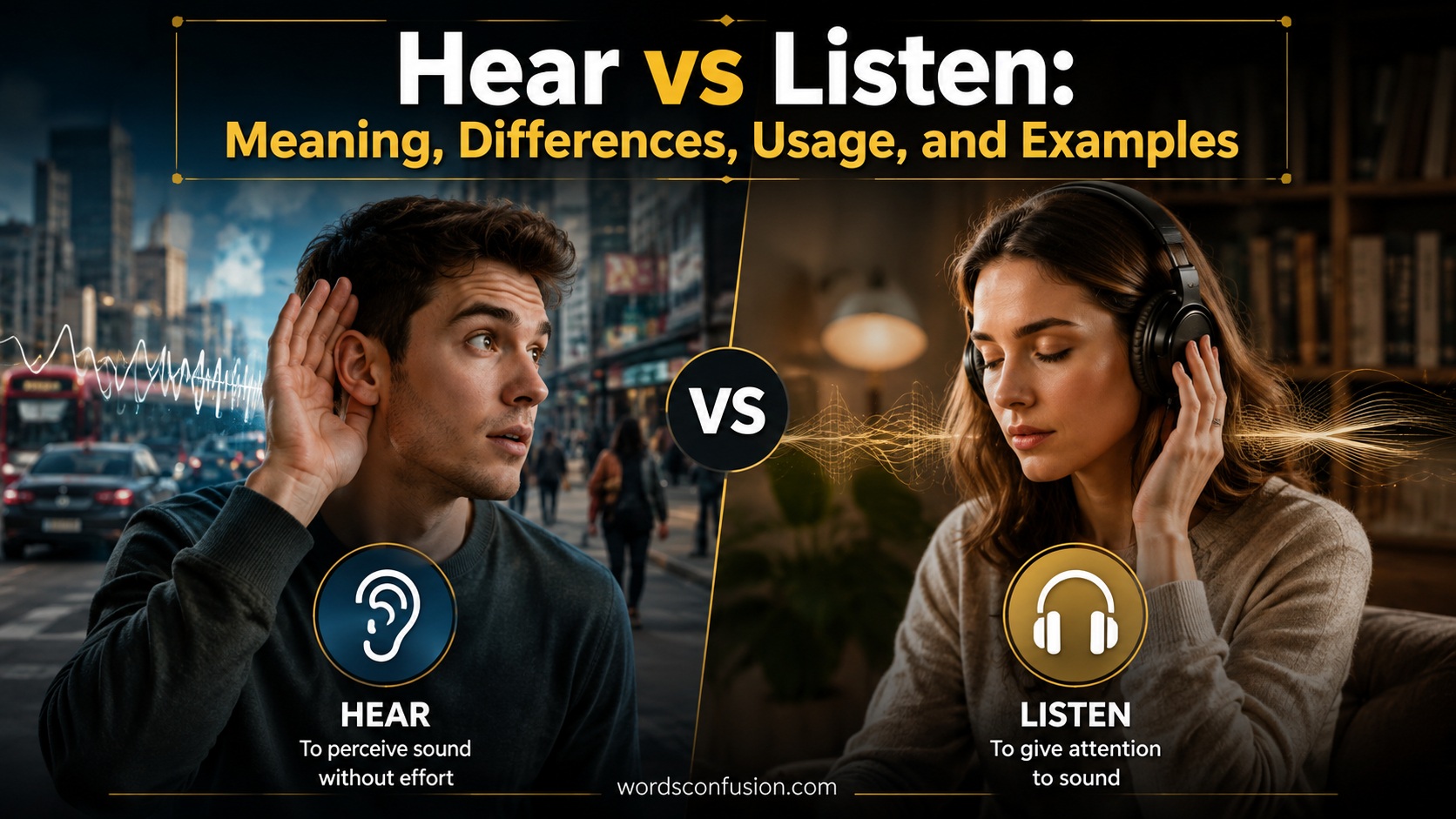
Have you ever stopped and wondered whether you should say “I hear music” or “I listen to music”? At first glance, these two verbs seem almost identical. Both relate to sound, conversations, and communication. However, they describe two very different actions.
The difference between hear vs listen is one of the most common grammar challenges for English learners. Native speakers use both words naturally, yet many learners mix them up because both involve sound. Choosing the wrong one can make a sentence sound awkward or even change its meaning.
Here’s the good news. Once you understand one simple rule, you’ll rarely confuse these words again.
In this guide, you’ll learn the exact difference between hear and listen, discover when each word is correct, explore grammar rules, study dozens of practical examples, avoid common mistakes, and test your knowledge with a short quiz.
Quick Answer
The difference between hear and listen is simple:
- Hear means you notice a sound naturally. It happens automatically without making an effort.
- Listen means you pay attention to a sound intentionally.
Examples:
- I can hear someone knocking at the door.
- Please listen to what I’m saying.
A simple way to remember it is this:
You hear with your ears. You listen with your mind.
Hear vs Listen at a Glance
| Feature | Hear | Listen |
| Meaning | Notice sounds naturally | Pay attention to sounds |
| Requires attention | No | Yes |
| Intentional | No | Yes |
| Action | Passive | Active |
| Common preposition | Usually none | Usually to |
| Example | I heard a loud noise. | I listened to the podcast. |
What Does “Hear” Mean?
Hear means to become aware of a sound through your ears without making a conscious effort.
If a dog suddenly barks outside your window, you don’t decide to hear it. Your ears simply detect the sound.
When to Use Hear
Use hear whenever sound reaches your ears naturally.
Common situations include:
- Hearing thunder
- Hearing birds sing
- Hearing someone call your name
- Hearing a phone ring
- Hearing unexpected news
- Hearing an announcement
Examples
- I heard the baby crying.
- She hears music from the next apartment every evening.
- We heard an explosion downtown.
- Did you hear what happened yesterday?
Notice that none of these examples require active concentration.
What Does “Listen” Mean?
Listen means giving your attention to sounds on purpose.
Unlike hearing, listening requires effort. You choose to focus.
Imagine you’re in a crowded restaurant. You hear many conversations, but you only listen to the person sitting across from you.
When to Use Listen
Use listen when attention is involved.
Examples include:
- Listening to music
- Listening to a teacher
- Listening to advice
- Listening carefully during a meeting
- Listening to a podcast
- Listening for important information
Examples
- Please listen to the instructions.
- She enjoys listening to jazz.
- Listen carefully before answering.
- We listened to the entire lecture.
The Main Difference Between Hear and Listen
The easiest way to understand hear vs listen is by thinking about choice.
Hearing happens automatically. Listening happens intentionally.
| Situation | Correct Word | Why |
| A siren passes by | Hear | You notice it automatically |
| A teacher explains a lesson | Listen | You pay attention |
| Rain falls outside | Hear | No effort needed |
| Your favorite song plays | Listen | You focus on it |
Think about this example.
You may hear someone talking in another room.
However, if you move closer because you want to understand every word, you listen to the conversation.
Hear vs Listen Comparison Table
| Aspect | Hear | Listen |
| Basic meaning | Detect sound | Focus on sound |
| Requires effort | No | Yes |
| Conscious action | No | Yes |
| Usually followed by | Direct object | “to” + object |
| Everyday use | Hearing noises | Paying attention |
| Example | I heard thunder. | I listened to the weather report. |
Hear vs Listen in Grammar
Understanding the grammar behind these verbs makes using them much easier.
Verb Forms
| Base Form | Past Simple | Past Participle | Present Participle |
| Hear | Heard | Heard | Hearing |
| Listen | Listened | Listened | Listening |
How “Hear” Works
Hear usually takes a direct object.
Examples:
- I heard music.
- She heard footsteps.
- They heard the announcement.
How “Listen” Works
Listen almost always requires the preposition to before the object.
Examples:
- Listen to me.
- Listen to your parents.
- Listen to the radio.
This small grammar rule causes many mistakes among English learners.
Why “Listen To” Is Correct
Many learners say:
- Listen me.
- Listen music.
These are incorrect.
The correct forms are:
- Listen to me.
- Listen to music.
- Listen to your teacher.
The verb listen normally needs to before the thing receiving your attention.
Correct Examples
- Listen to your doctor.
- Listen to the podcast.
- Listen to the birds.
Incorrect Examples
- Listen me.
- Listen music.
- Listen the teacher.
When to Use Hear
Use hear in situations where sounds naturally reach your ears.
Hearing Sounds
- I heard thunder.
- We heard fireworks.
Hearing Someone Speak
- I heard my mother calling me.
- He heard the manager speaking.
Hearing News
- Have you heard the news?
- She heard about the promotion.
Hearing From Someone
This expression means receiving communication.
Examples:
- I haven’t heard from Alex this week.
- We heard from our customers yesterday.
Hearing About Something
Examples:
- Have you heard about the new movie?
- I heard about the accident this morning.
Legal Meaning
In legal English, judges hear cases.
Example:
- The court heard the evidence before making a decision.
When to Use Listen
Use listen whenever you actively pay attention.
Listening to Music
- I listen to classical music while working.
- They listened to the new album.
Listening to Instructions
- Listen to your teacher.
- Listen carefully before starting.
Listening During Conversations
Good communication requires active listening.
Examples:
- She always listens carefully.
- He listened without interrupting.
Listening for Specific Sounds
Sometimes you listen because you’re expecting something.
Examples:
- Listen for your flight number.
- Listen for the alarm.
Common Expressions with Hear
English contains many useful expressions using hear.
| Expression | Meaning | Example |
| Hear from | Receive communication | I heard from my cousin yesterday. |
| Hear about | Learn news | Did you hear about the event? |
| Hear of | Know something exists | I’ve heard of that author. |
| Hear someone out | Listen completely | Please hear me out first. |
| Hear voices | Perceive voices | He thought he heard voices. |
| Hear the difference | Notice different sounds | Can you hear the difference? |
Common Expressions with Listen
These expressions appear frequently in spoken English.
| Expression | Meaning | Example |
| Listen to | Pay attention | Listen to your coach. |
| Listen carefully | Pay close attention | Listen carefully to the instructions. |
| Listen closely | Focus carefully | Listen closely for changes. |
| Listen in | Secretly hear a conversation | Someone was listening in. |
| Listen out for | Stay alert for a sound | Listen out for your name. |
| Listen up | Informal way to get attention | Listen up, everyone. |
Hear vs Listen in Everyday Situations
Understanding real-life situations makes the difference much easier.
At School
You hear students talking in the hallway.
You listen to your teacher during class.
At Work
You hear office phones ringing.
You listen carefully during meetings.
During Conversations
You hear many voices in a crowded room.
You listen to the person speaking directly to you.
While Driving
You hear traffic around you.
You listen to GPS directions.
While Watching TV
You hear background music.
You listen to the dialogue to understand the story.
While Learning English
You hear English everywhere.
You listen carefully to improve pronunciation and comprehension.
Hear vs Listen: Real-Life Examples
Example One
Sarah walks through a park.
She hears birds singing.
Then she sits on a bench and listens to the birds because she enjoys the sounds.
Example Two
Mike hears his phone ringing while cooking.
He answers it and listens carefully because it’s an important business call.
Example Three
Emma hears the airport announcement.
She listens closely because she’s waiting for her boarding gate.
These examples show that hearing often happens first. Listening follows when attention becomes intentional.
Common Mistakes English Learners Make
Learning from mistakes is one of the fastest ways to improve.
| Incorrect | Correct |
| Listen me. | Listen to me. |
| Listen music. | Listen to music. |
| I listened a noise. | I heard a noise. |
| Did you listen the news? | Did you hear the news? |
| I hear to music every day. | I listen to music every day. |
Read More: Look vs See: Meaning, Differences, and Examples
Mistake One: Forgetting “to”
Always remember:
Listen + to
Mistake Two: Using Hear for Attention
Incorrect:
I heard the teacher carefully.
Correct:
I listened to the teacher carefully.
Mistake Three: Using Listen for Unexpected Sounds
Incorrect:
I listened a loud bang.
Correct:
I heard a loud bang.
Tips to Remember the Difference
These simple memory tricks can help you choose the correct word every time.
Remember This Formula
Hear = Sound reaches you.
Listen = You reach the sound with your attention.
Ask Yourself One Question
Did you choose to pay attention?
- Yes → Listen
- No → Hear
Easy Memory Trick
Think of hearing as your ears working automatically.
Think of listening as your brain joining your ears.
Practice Quiz
Choose the correct answer.
Questions
- I could _____ someone knocking on the door.
- Please _____ to the instructions carefully.
- Did you _____ about the new restaurant?
- We _____ the concert from outside the stadium.
- Always _____ to your parents.
Answers
- hear
- listen
- hear
- heard
- listen
FAQs:
Is hearing the same as listening?
No. Hearing is automatic because sounds enter your ears naturally. Listening requires attention and concentration.
What is the difference between hear and listen?
The biggest difference is intention. You hear sounds without trying, while you listen because you want to understand or enjoy them.
Can you say “listen me”?
No. Standard English requires the preposition to. The correct phrase is listen to me.
Why do we say “listen to” instead of “listen”?
The verb listen normally requires the preposition to before its object. This is a fixed grammar pattern in English.
Is hearing automatic while listening is intentional?
Yes. Hearing happens naturally whenever sounds reach your ears. Listening is an active process that requires focus.
Can I use hear and listen interchangeably?
No. Although both relate to sound, they describe different actions. Using the wrong one can change the meaning of a sentence.
Which is more formal, hear or listen?
Neither verb is more formal than the other. The correct choice depends entirely on whether the action is automatic (hear) or intentional (listen).
Conclusion:
Understanding hear vs listen is easier than many learners expect. The key difference comes down to one idea: hearing is automatic while listening is intentional.
Whenever sounds naturally reach your ears, use hear. When you actively focus on those sounds, use listen. This simple distinction will help you speak and write English more naturally.
As you practice, pay attention to everyday situations. You hear birds outside your window, traffic on the street, and your phone ringing. You listen to your favorite songs, your teacher’s explanation, a friend’s story, or an important announcement.

Andrew Wilson is an experienced language researcher and content writer specializing in WordsConfusion topics. He helps readers understand commonly confused English words, spelling differences, grammar rules, word meanings, and proper usage through clear explanations, practical examples, and easy-to-follow language guides. His goal is to make English learning simple, accurate, and accessible for students, writers, professionals, and everyday learners.