
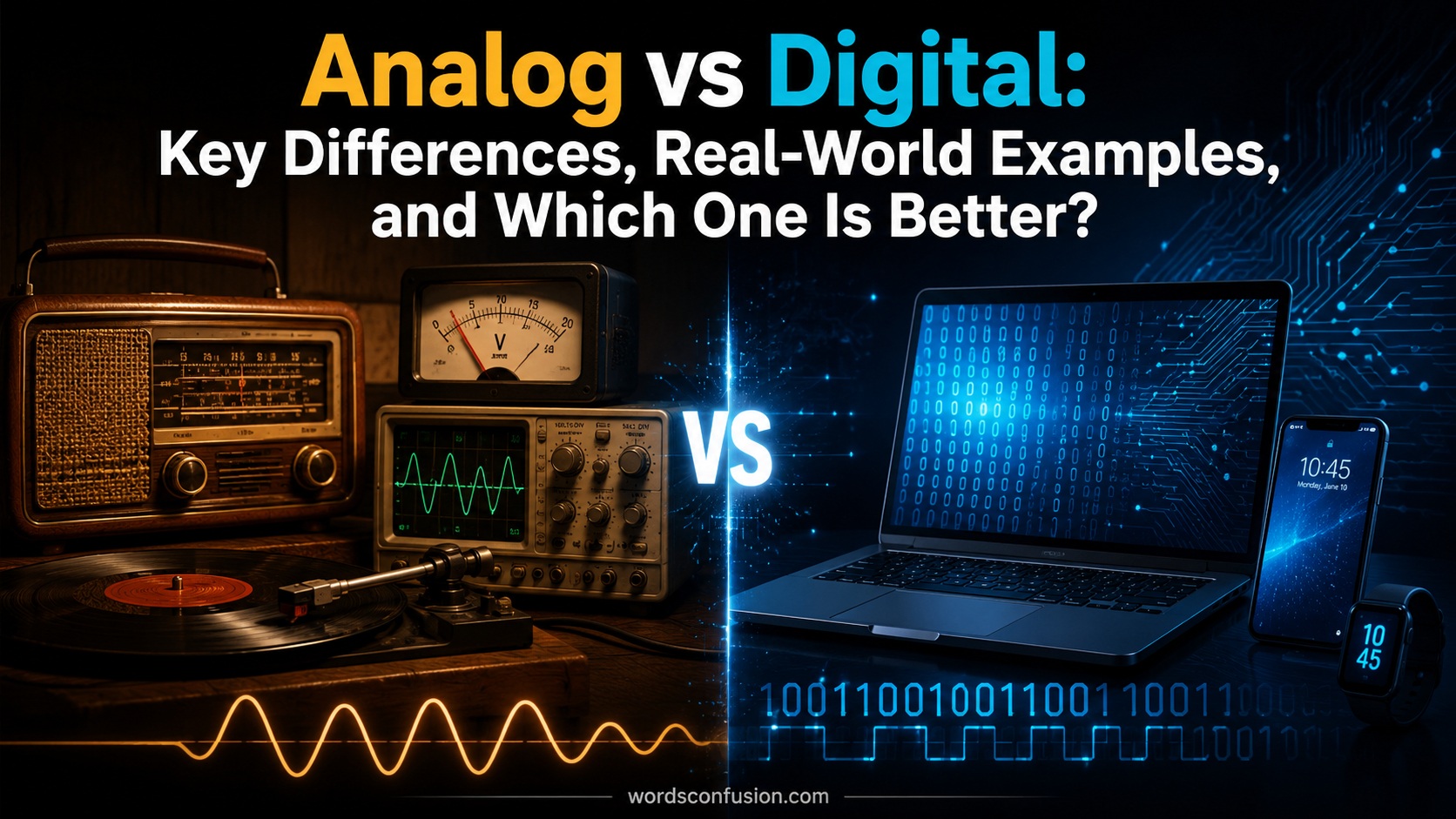
Every day, you interact with analog and digital technology without giving it much thought. You wake up to a digital alarm clock, stream music on your smartphone, check the weather online, and perhaps glance at an analog wall clock before leaving home. Although both technologies serve the same purpose—capturing, processing, storing, or transmitting information—they do so in fundamentally different ways.
That difference shapes everything from sound quality and image resolution to internet speed and medical equipment. It also explains why some photographers still prefer film cameras, why musicians continue recording on analog tape, and why digital devices dominate modern homes and businesses.
Many people assume that digital is always better because it’s newer. Others believe analog delivers superior quality because it represents information continuously. The truth isn’t that simple. Each technology has strengths, limitations, and ideal use cases.
In this guide, you’ll learn exactly what analog and digital mean, how they work, where they’re used, their advantages and disadvantages, and which one makes the most sense depending on your needs. Along the way, you’ll see practical examples, easy-to-understand comparisons, and real-world applications that remove the confusion once and for all.
Analog vs Digital: Quick Answer
The main difference between analog and digital lies in how they represent information.
Analog technology uses continuous signals that can take on any value within a given range. Since the signal changes smoothly, it closely mirrors real-world phenomena such as sound, temperature, pressure, and light.
Digital technology, on the other hand, uses discrete values, typically represented as binary digits (0s and 1s). Instead of recording every tiny variation continuously, it samples information and stores it as numerical data.
For example:
- A vinyl record stores music as continuous grooves, making it an analog format.
- An MP3 file stores music as binary data that a computer can process, making it a digital format.
- A traditional mercury thermometer is analog.
- A digital thermometer displays temperature using electronic sensors and numbers.
Although digital technology dominates today’s world because of its speed, accuracy, and storage capabilities, analog systems remain valuable in specialized fields such as professional audio engineering, industrial instrumentation, and scientific measurement.
Analog vs Digital at a Glance
| Feature | Analog | Digital |
| Data Representation | Continuous | Binary (0s and 1s) |
| Signal Type | Continuous waveform | Discrete values |
| Noise Resistance | Lower | Higher |
| Copy Quality | Degrades over time | Nearly identical copies |
| Storage | Physical media | Electronic storage |
| Editing | More difficult | Easy and flexible |
| Processing Speed | Slower | Extremely fast |
| Accuracy | Depends on equipment | High precision |
| Examples | Vinyl records, film cameras | Smartphones, computers, streaming services |
| Common Uses | Audio equipment, sensors, analog meters | Computing, networking, smartphones, cloud storage |
What Is Analog?
Analog refers to any system that represents information using continuous physical values. Instead of breaking information into separate steps, analog devices capture every tiny change naturally.
Think about turning the volume knob on an old stereo. The sound increases gradually rather than jumping between fixed levels. That’s analog in action.
Because nature itself is continuous, analog technology often represents real-world signals very accurately without converting them into numbers first.
How Analog Signals Work
An analog signal changes smoothly over time.
Imagine watching ocean waves. The water rises and falls without sudden jumps. Analog signals behave in much the same way.
Characteristics of analog signals include:
- Continuous values
- Infinite possible signal levels
- Smooth transitions
- Direct representation of physical events
Examples include:
- Human speech
- Temperature changes
- Heartbeat signals
- Radio broadcasts
- Electrical voltage variations
Since analog signals are continuous, they preserve subtle variations. However, they also pick up unwanted interference, known as noise.
Everyday Examples of Analog Technology
Although digital devices dominate modern life, analog technology still exists around us.
Common examples include:
- Vinyl record players
- Film cameras
- Analog wristwatches
- Mercury thermometers
- Speedometers with needles
- AM and FM radio broadcasts
- Traditional pressure gauges
- Analog microphones
Many industries continue using analog sensors because they respond naturally to physical changes without requiring complex digital processing.
What Is Digital?
Digital technology represents information using binary numbers. Every piece of data becomes a sequence of zeros and ones that computers can process rapidly and accurately.
Whether you’re watching a movie, sending a text message, or saving photos to the cloud, digital systems convert information into binary code before storing or transmitting it.
This method allows computers to perform billions of calculations every second with remarkable precision.
How Digital Signals Work
Unlike analog signals, digital signals only recognize specific values.
Most systems use binary, where every piece of information consists of combinations of:
- 0
- 1
A microphone, for example, converts your voice into electrical signals. An Analog-to-Digital Converter (ADC) samples that signal thousands of times each second and converts each sample into binary numbers.
Those numbers can then be:
- Stored
- Edited
- Copied
- Encrypted
- Shared worldwide
Because digital systems regenerate data rather than amplifying the original signal, copies remain virtually identical to the source.
Everyday Examples of Digital Technology
Digital devices are everywhere.
Examples include:
- Smartphones
- Laptops
- Tablets
- Smart TVs
- Digital cameras
- Streaming platforms
- GPS navigation systems
- Smartwatches
- USB flash drives
- Cloud storage services
Nearly every connected device today depends on digital communication.
The History of Analog and Digital Technology
Long before computers existed, analog systems powered communication, navigation, and scientific discovery.
Mechanical clocks, telegraphs, early radios, and telephone networks all relied on analog signals. These inventions transformed society by allowing information to travel farther and faster than ever before.
The digital revolution began during the mid-20th century with the development of programmable computers. Engineers quickly realized that binary data offered several advantages over continuous analog signals. Digital information could be copied repeatedly without losing quality, processed at incredible speeds, and transmitted across vast distances with fewer errors.
By the 1980s and 1990s, digital technology had expanded into personal computers, compact discs, digital cameras, and mobile phones. Today, cloud computing, artificial intelligence, streaming platforms, and smart devices all depend on digital systems.
Even so, analog technology hasn’t disappeared. It continues to play an important role wherever continuous measurement or signal generation is essential.
Analog vs Digital: Detailed Comparison
Choosing between analog and digital depends on the task rather than popularity.
The table below highlights the most important differences.
| Feature | Analog | Digital |
| Signal | Continuous | Discrete |
| Precision | Naturally continuous | Quantized but highly accurate |
| Noise | Easily affected | Strong resistance |
| Storage | Physical | Electronic |
| Editing | Limited | Simple |
| Duplication | Quality decreases | No noticeable loss |
| Transmission | Signal weakens | Signal regenerated |
| Security | Minimal | Supports encryption |
| Automation | Limited | Excellent |
| Maintenance | Higher | Lower |
| Scalability | Difficult | Easy |
| Processing | Slower | Extremely fast |
| Integration | Limited | Excellent with modern systems |
Signal Representation
Analog captures every fluctuation continuously.
Digital samples information at specific intervals and converts it into numbers.
Accuracy and Precision
Many people believe analog is always more accurate because it’s continuous.
In practice, modern digital systems often deliver higher precision thanks to sophisticated sensors, error correction, and high sampling rates.
Noise and Interference
Analog signals weaken over distance and pick up electrical interference.
Digital systems detect and correct many transmission errors before users notice them.
Storage
Analog recordings require physical media such as magnetic tape or vinyl.
Digital files fit onto tiny storage devices capable of holding millions of documents.
Editing
Editing analog recordings often requires physically cutting tape.
Digital software lets creators edit instantly with almost unlimited flexibility.
Analog vs Digital Signals Explained
Signals carry information from one place to another. Whether you’re listening to music, making a phone call, or measuring temperature, a signal transfers that information. The biggest difference between analog and digital technology lies in how each type of signal carries data.
What Is an Analog Signal?
An analog signal changes continuously over time. It doesn’t jump between fixed values. Instead, it flows smoothly, just like the real-world events it represents.
Imagine speaking into a microphone. Your voice creates sound waves with tiny changes in pitch and volume every moment. An analog microphone converts those waves into a continuous electrical signal that closely matches the original sound.
Common characteristics of analog signals include:
- Continuous waveform
- Infinite possible values
- Natural representation of physical phenomena
- Greater sensitivity to electrical interference
- Smooth transitions without abrupt changes
Examples of analog signals include:
- Human speech
- Radio broadcasts
- ECG heart monitoring
- Temperature measurements
- Pressure sensors
What Is a Digital Signal?
A digital signal represents information using discrete values, usually binary digits (0 and 1).
Instead of recording every tiny variation continuously, digital systems sample the original signal thousands or even millions of times each second. Each sample becomes a number that computers can process.
This approach offers remarkable consistency. Even after copying a digital file hundreds of times, the final version remains almost identical to the original.
Characteristics of digital signals include:
- Binary representation
- High resistance to noise
- Easy storage and transmission
- Excellent compatibility with computers
- Reliable long-distance communication
Analog vs Digital Signal Diagram
Analog Signal
Amplitude
^
| ~~~~~~~
| ~~~~ ~~~~
| ~~~ ~~~
|~~~ ~~~
+——————————–> Time
Digital Signal
Amplitude
^
| ┌─────┐ ┌──────┐
| │ │ │ │
| │ └──────┘ └─────
|─┘
+——————————–> Time
Analog vs Digital Communication
Communication systems rely on signals to transfer information. Over the past several decades, digital communication has largely replaced analog methods because it delivers better reliability and efficiency.
How Analog Communication Works
Analog communication transmits continuous electrical waves from one point to another.
Traditional telephone networks, AM radio, and early television broadcasting all relied on analog communication.
Advantages include:
- Simple hardware
- Continuous signal transmission
- Low processing requirements
Limitations include:
- Signal quality decreases with distance.
- Electrical noise affects clarity.
- Difficult to encrypt securely.
How Digital Communication Works
Digital communication converts information into binary code before transmission.
Routers, satellites, mobile towers, and fiber-optic cables move these binary signals rapidly across the globe.
Benefits include:
- Better error correction
- Faster transmission
- Improved security
- Efficient compression
- Higher data capacity
Today’s technologies that depend on digital communication include:
- 5G networks
- Wi-Fi
- Fiber internet
- Video conferencing
- Cloud computing
- Streaming platforms
Analog vs Digital Electronics
Electronic circuits generally fall into two categories.
Analog Electronics
Analog circuits process continuously changing electrical signals.
Examples include:
- Audio amplifiers
- Radio receivers
- Oscillators
- Voltage regulators
- Microphone preamps
These circuits excel when dealing with naturally changing electrical signals.
Digital Electronics
Digital circuits process binary information.
Examples include:
- CPUs
- Memory chips
- Smartphones
- Digital watches
- Microcontrollers
- Gaming consoles
Nearly every modern electronic device combines both analog and digital circuitry.
For instance, your smartphone records your voice using analog microphones before converting it into digital data for processing.
Analog vs Digital Audio
Audio remains one of the most debated areas in the analog versus digital discussion.
How Analog Audio Works
Analog recordings capture sound as continuous waveforms.
Examples include:
- Vinyl records
- Magnetic cassette tapes
- Reel-to-reel tape
Many listeners describe analog recordings as:
- Warm
- Rich
- Natural
- Smooth
These qualities result partly from subtle distortions that people often find pleasing.
How Digital Audio Works
Digital audio converts sound into numerical samples.
Common digital formats include:
- MP3
- WAV
- FLAC
- AAC
Professional recording studios often use sampling rates such as:
| Format | Sample Rate |
| CD Audio | 44.1 kHz |
| DVD Audio | 48 kHz |
| Studio Recording | 96 kHz |
| High-End Recording | 192 kHz |
Higher sampling rates preserve more detail from the original sound.
Vinyl vs Streaming
Many music lovers enjoy vinyl because it creates a unique listening experience.
Streaming services, however, offer:
- Instant access
- Millions of songs
- Minimal storage needs
- Consistent playback quality
The best choice depends more on personal preference than technical superiority.
Read More: Voltage vs Current: What’s the Difference? Definitions, Formula, Examples, and Comparison
Analog vs Digital Photography
Photography illustrates the shift from analog to digital perfectly.
Analog Photography
Film cameras expose light-sensitive film.
Each photograph exists physically on the film until it’s developed in a darkroom.
Advantages include:
- Classic appearance
- Natural grain
- Wide dynamic range
- Artistic character
Disadvantages include:
- Film costs
- Limited exposures
- Longer workflow
- Physical storage
Digital Photography
Digital cameras use image sensors instead of film.
Benefits include:
- Instant previews
- Easy editing
- High-resolution images
- Large storage capacity
- Quick sharing
Professional photographers now rely almost entirely on digital cameras for commercial work because of their efficiency.
Analog vs Digital Clocks
Although both clocks measure time, they display it differently.
Analog Clocks
Features include:
- Hour hand
- Minute hand
- Second hand
- Circular dial
Many educators still use analog clocks to teach children how to understand time intervals.
Digital Clocks
Digital clocks display time using numbers.
Advantages include:
- Easier reading
- Better visibility
- Extra functions
- Alarm integration
Examples include:
- Smartphones
- Smartwatches
- Microwave displays
- Computer taskbars
Analog vs Digital Thermometers
Thermometers demonstrate how digital technology improves measurement.
| Feature | Analog | Digital |
| Reading | Manual | Automatic |
| Speed | Slower | Faster |
| Accuracy | Good | Very High |
| Display | Scale | Numeric |
| Memory | None | Often available |
Hospitals increasingly use digital thermometers because they provide quick, highly accurate readings while reducing human error.
Analog vs Digital Computers
Many people don’t realize that analog computers existed before modern digital machines.
Analog Computers
Analog computers solved mathematical problems using continuously changing electrical or mechanical values.
They were particularly useful for:
- Flight simulation
- Scientific calculations
- Engineering design
- Industrial control
Digital Computers
Digital computers process binary information.
Examples include:
- Desktop PCs
- Laptops
- Smartphones
- Tablets
- Servers
- Supercomputers
Modern digital processors perform trillions of calculations every second, making them suitable for artificial intelligence, financial modeling, weather forecasting, and scientific research.
Why Analog Computers Became Rare
Digital computers eventually replaced analog systems because they offered:
- Greater flexibility
- Better accuracy
- Easier programming
- Lower operating costs
- Smaller hardware
- Massive storage capabilities
Interestingly, researchers have renewed interest in analog computing for specialized artificial intelligence and energy-efficient applications. While these systems won’t replace digital computers anytime soon, they may complement them in solving highly specialized problems.
FAQs:
Is analog better than digital?
Neither is universally better. Analog excels at representing continuous real-world signals and offers a unique experience in areas like music and photography. Digital provides higher accuracy, easier storage, faster processing, and better reliability, making it the preferred choice for most modern applications.
Why is digital replacing analog?
Digital technology stores, processes, and transmits information more efficiently. It offers better resistance to noise, supports error correction, allows perfect copies, and integrates seamlessly with computers, cloud services, and artificial intelligence. These advantages have made digital systems the standard across most industries.
Can analog and digital work together?
Yes. Most modern devices combine both technologies. For example, your smartphone records your voice as an analog sound wave, converts it into digital data for processing, and then converts it back into an analog signal when you listen through speakers or headphones.
Why do some professionals still prefer analog equipment?
Many musicians, photographers, and audio engineers appreciate the distinctive characteristics of analog equipment. Vinyl records, film cameras, and analog amplifiers can produce textures and tonal qualities that some people find more natural or artistically appealing.
What is the biggest difference between analog and digital?
The biggest difference is how they represent information. Analog uses continuous signals that change smoothly over time, while digital uses discrete binary values (0s and 1s). This difference affects everything from storage and editing to transmission quality and long-term reliability.
Conclusion:
The debate over analog vs digital isn’t about declaring a single winner. It’s about understanding which technology best fits a particular purpose.
Analog systems excel at representing continuous real-world signals and remain valuable in professional audio, scientific instruments, industrial controls, and creative fields. Their smooth, natural characteristics continue to appeal to musicians, photographers, and engineers who appreciate their unique qualities.
Digital technology, however, has become the backbone of modern life. Its speed, precision, reliability, security, and ability to store and process enormous amounts of information have transformed communication, healthcare, education, entertainment, transportation, and business. From smartphones and cloud computing to artificial intelligence and smart homes, digital systems power the connected world we rely on every day.

Andrew Wilson is an experienced language researcher and content writer specializing in WordsConfusion topics. He helps readers understand commonly confused English words, spelling differences, grammar rules, word meanings, and proper usage through clear explanations, practical examples, and easy-to-follow language guides. His goal is to make English learning simple, accurate, and accessible for students, writers, professionals, and everyday learners.