
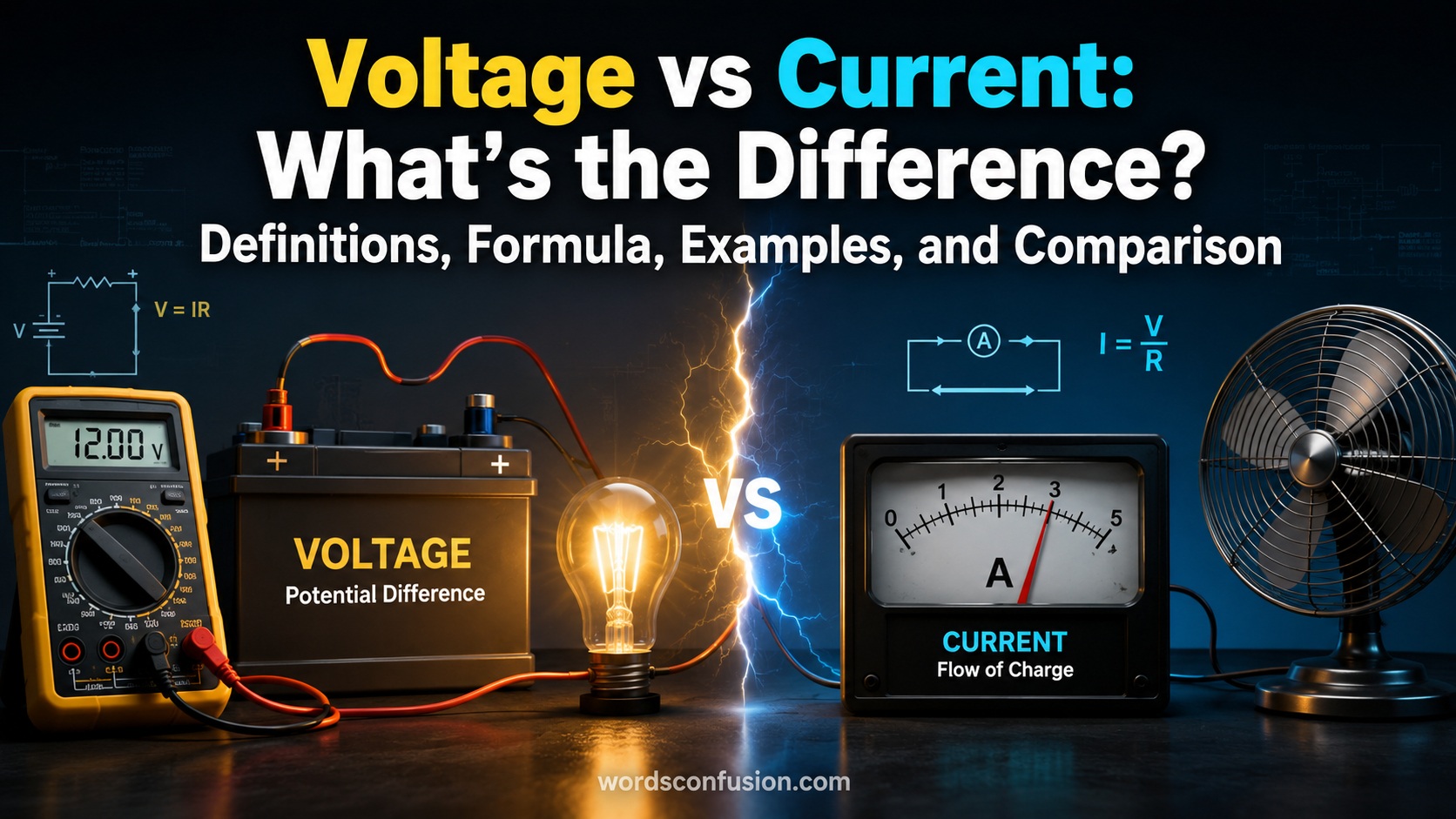
Electricity powers almost every part of modern life. From charging your smartphone and running household appliances to operating electric vehicles and industrial machines, electrical energy keeps the world moving. Yet many people still confuse voltage and current, assuming they mean the same thing. They don’t.
Understanding the difference between voltage vs current is essential whether you’re a student, homeowner, DIY enthusiast, or simply curious about how electricity works. These two electrical quantities work together, but each has a unique role inside every electrical circuit. Think of them as teammates rather than identical twins. One provides the driving force while the other represents the movement of electric charge.
This guide explains voltage vs current in simple language without sacrificing technical accuracy. You’ll learn what each term means, how they relate through Ohm’s Law, why both matter in electrical systems, and how they affect everything from a flashlight to a power grid. Along the way, you’ll find practical examples, comparison tables, real-world applications, and answers to the most common questions.
By the end of this article, you’ll confidently understand the difference between voltage and current and know why engineers pay close attention to both whenever they design or troubleshoot electrical systems.
Voltage vs Current — Quick Answer
The simplest way to understand voltage vs current is this:
- Voltage is the electrical force that pushes electric charges through a circuit.
- Current is the actual flow of electric charges through that circuit.
Imagine filling a garden hose with water. The water pressure inside the hose represents voltage, while the amount of water flowing out each second represents current. Without pressure, water won’t flow. Likewise, without voltage, current cannot move through a complete circuit.
For example, a 9-volt battery creates enough electrical pressure to move electrons through a flashlight. Once you switch the flashlight on, current begins flowing, and the bulb lights up.
In short:
Voltage pushes. Current flows. Both are necessary for electricity to do useful work.
Voltage vs Current Comparison Table
| Feature | Voltage | Current |
| Definition | Electrical potential difference between two points | Flow of electric charge |
| Symbol | V | I |
| SI Unit | Volt (V) | Ampere (A) |
| Named After | Alessandro Volta | André-Marie Ampère |
| Measures | Electrical pressure | Electron flow |
| Measured With | Voltmeter or Multimeter | Ammeter or Clamp Meter |
| Formula | V = I × R | I = V ÷ R |
| Depends On | Energy supplied by the source | Voltage and circuit resistance |
| Exists in Open Circuit | Yes | No |
| Real-Life Example | Battery voltage | Current flowing through a charger |
What Is Voltage?
Voltage is the difference in electric potential between two points in a circuit. It represents the energy available to move electric charges from one location to another.
You can think of voltage as the driving force behind electricity. Without it, electrons remain stationary and electrical devices won’t operate.
Every electrical source creates voltage. Batteries, generators, solar panels, and power stations all produce electrical potential that encourages electrons to move through conductors.
How Voltage Works
Atoms contain tiny negatively charged particles called electrons. When a voltage source creates an electrical potential difference, these electrons experience a force that encourages them to move through a closed circuit.
However, voltage alone doesn’t guarantee current. If the circuit remains open, electrons have no complete path to travel.
A simple example is a wall outlet.
Even when nothing is plugged in, the outlet still has voltage. Once you connect a lamp and turn on the switch, current begins flowing through the circuit and the lamp illuminates.
What Creates Voltage?
Different devices generate voltage using different physical principles.
Common voltage sources include:
- Chemical reactions inside batteries
- Electromagnetic induction in generators
- Solar cells converting sunlight into electricity
- Wind turbines
- Hydroelectric power plants
- Fuel cells
Each source creates an electrical potential difference capable of moving electrons through a connected circuit.
Types of Voltage
AC Voltage
Alternating Current (AC) voltage continuously changes direction many times each second.
Characteristics include:
- Used in homes and businesses
- Efficient for long-distance transmission
- Easily transformed into different voltage levels
- Typically 120V or 230V depending on the country
DC Voltage
Direct Current (DC) voltage flows in only one direction.
Examples include:
- AA batteries
- Car batteries
- USB chargers
- Solar panels
- Power banks
DC voltage is preferred for most electronic devices because it provides stable power.
Voltage Formula
According to Ohm’s Law:
V = I × R
Where:
- V = Voltage (Volts)
- I = Current (Amperes)
- R = Resistance (Ohms)
Example
Suppose a circuit carries 4 amps of current through a 5-ohm resistor.
Voltage equals:
V = 4 × 5 = 20 volts
This means the power source must supply 20 volts to maintain that current through the resistor.
How Voltage Is Measured
Voltage is measured using:
- Digital multimeters
- Analog voltmeters
- Oscilloscopes for AC waveforms
A voltmeter is connected in parallel with the circuit component being measured.
Safety Tip: Never attempt to measure high voltage without proper training and protective equipment. High-voltage systems can cause severe injury or death.
What Is Current?
Electric current refers to the rate at which electric charge flows through a conductor.
Whenever electrons move through a wire, current exists.
Current performs the actual work in an electrical circuit. It powers motors, lights LEDs, heats electric ovens, charges batteries, and runs computers.
Without current, electrical devices remain inactive even if voltage is present.
How Electric Current Works
When a complete circuit forms, electrons begin moving from the negative terminal of the power source toward the positive terminal.
Although individual electrons move relatively slowly, the electrical signal travels close to the speed of light, allowing devices to respond almost instantly when switched on.
Think of turning on a light switch.
The bulb lights immediately because the electric field spreads throughout the circuit almost instantly, causing electrons everywhere in the conductor to start moving together.
Types of Current
Direct Current (DC)
DC flows in one direction continuously.
Examples include:
- Smartphones
- Laptops
- Flashlights
- Electric scooters
- Portable electronics
Alternating Current (AC)
AC repeatedly reverses direction.
It powers:
- Homes
- Factories
- Office buildings
- Air conditioners
- Refrigerators
- Washing machines
Current Formula
Current can also be calculated using Ohm’s Law:
I = V ÷ R
Where:
- I = Current
- V = Voltage
- R = Resistance
Example
A 24-volt power source connected to a 6-ohm resistor produces:
I = 24 ÷ 6 = 4 amps
The resistor allows 4 amperes of current to flow.
How Current Is Measured
Electrical current is measured using:
- Ammeters
- Clamp meters
- Digital multimeters
Unlike voltage measurements, an ammeter must be connected in series with the circuit so that all current passes through the measuring device.
Voltage vs Current Explained with the Water Flow Analogy
One of the easiest ways to understand voltage vs current is by comparing electricity to water flowing through a pipe.
| Water System | Electrical System |
| Water pressure | Voltage |
| Water flow | Current |
| Pipe | Wire |
| Pump | Battery or Generator |
| Valve | Switch |
| Narrow pipe | Resistance |
Imagine a water tank sitting high above the ground. Gravity creates pressure that pushes water through a pipe. If the valve remains closed, pressure still exists, but water doesn’t move.
The same idea applies to electricity. Voltage creates electrical pressure. Once the circuit closes, current begins flowing.
This analogy isn’t perfect, but it helps explain why increasing voltage usually increases current if resistance stays the same.
Relationship Between Voltage, Current, and Resistance
Electricity follows predictable mathematical relationships. The most important one is Ohm’s Law.
V = I × R
This equation explains how voltage, current, and resistance interact.
Here’s what happens when one value changes:
- Increasing voltage increases current if resistance stays constant.
- Increasing resistance decreases current if voltage remains constant.
- Reducing resistance allows more current to flow.
- Lowering voltage decreases current.
Practical Example
Consider a simple LED connected to a battery.
If you replace a 3V battery with a 9V battery without changing the resistor, much more current flows. The LED may become brighter for a moment before burning out.
This demonstrates why engineers carefully calculate resistor values when designing electronic circuits.
Ohm’s Law Summary
| If This Changes | Then This Happens |
| Voltage increases | Current increases |
| Voltage decreases | Current decreases |
| Resistance increases | Current decreases |
| Resistance decreases | Current increases |
Voltage vs Current in Real Life
You encounter voltage and current every day, even if you never think about them. Every electrical device relies on the right combination of both. Too much or too little of either can prevent equipment from working properly or even damage it.
Let’s look at some practical examples.
Household Electricity
A typical home receives either 120 volts or 230 volts, depending on the country’s electrical standard.
The voltage remains relatively constant, but the current changes based on the appliance you use.
For example:
| Appliance | Typical Voltage | Approximate Current |
| LED Light Bulb | 120V/230V | 0.05–0.15 A |
| Television | 120V/230V | 0.5–2 A |
| Microwave Oven | 120V/230V | 8–13 A |
| Electric Heater | 120V/230V | 10–15 A |
| Air Conditioner | 120V/230V | 5–20 A |
Notice that your home’s voltage doesn’t change every time you plug in a different appliance. Instead, each device draws the current it needs.
Smartphone Charging
A smartphone charger converts high-voltage AC electricity from the wall into low-voltage DC electricity.
For example:
- Input: 120V or 230V AC
- Output: 5V, 9V, 12V, or 20V DC
Fast chargers increase voltage, current, or both depending on the charging protocol. Your phone communicates with the charger to request the safest power level.
Car Battery
A standard passenger vehicle uses a 12-volt battery.
Starting the engine requires a very large current. During engine startup, the starter motor may draw 150 to 300 amps, while large diesel engines can require even more.
Once the engine starts, the alternator supplies electrical power and recharges the battery.
Power Banks
Power banks store DC electricity inside lithium-ion batteries.
Most power banks provide:
- 5V USB output
- Higher voltages such as 9V, 12V, or 20V for fast charging
- Different maximum current ratings depending on the model
A higher current capability allows compatible devices to charge more quickly.
Solar Panel Systems
Solar panels generate DC voltage.
A residential solar installation often produces several hundred volts before the inverter converts the electricity into AC for household use.
The amount of current changes throughout the day because sunlight intensity constantly changes.
LED Lighting
LEDs require both the correct voltage and the correct current.
Too little current makes the LED appear dim.
Too much current overheats the semiconductor and dramatically shortens its lifespan. That’s why LED drivers include current-limiting circuits.
Key Differences Between Voltage and Current
Although voltage and current work together, they describe completely different electrical properties.
| Feature | Voltage | Current |
| Meaning | Electrical pressure | Flow of electric charge |
| Symbol | V | I |
| SI Unit | Volt (V) | Ampere (A) |
| Named After | Alessandro Volta | André-Marie Ampère |
| Represents | Potential difference | Charge movement |
| Measured Using | Voltmeter | Ammeter |
| Exists Without Circuit Flow | Yes | No |
| Travels Through Wire | No | Yes |
| Determines | Driving force | Amount of charge flowing |
| Controlled By | Power source | Voltage and resistance |
| Everyday Example | Battery rating | Phone charging current |
| Safety Concern | Can overcome insulation | Can cause heating and electric shock |
The Biggest Difference
A simple way to remember the distinction is this:
- Voltage creates the push.
- Current performs the work.
Neither replaces the other. Every functioning electrical circuit requires both.
Similarities Between Voltage and Current
Despite their differences, voltage and current share several important characteristics.
Both:
- Are fundamental electrical quantities.
- Have internationally standardized SI units.
- Can be measured accurately with electronic instruments.
- Follow well-established electrical laws.
- Influence electrical power.
- Are essential in every complete electrical circuit.
- Help engineers design safe and efficient systems.
Whether you’re building a tiny sensor or a large power station, you’ll always analyze both voltage and current together.
Can You Have Voltage Without Current?
Yes.
This happens whenever a voltage source exists but the circuit remains open.
Example: An Unplugged Wall Outlet
A household outlet has voltage across its terminals even when nothing is plugged into it.
Because there is no complete circuit, no current flows.
Example: A Battery on a Table
Place a fresh AA battery on your desk.
It still measures approximately 1.5 volts, even though it isn’t powering anything.
The voltage exists because of the chemical reaction inside the battery.
Current won’t flow until you connect the battery to a closed circuit.
Example: Open Light Switch
When a room light is switched off, voltage is still present at parts of the wiring.
The open switch interrupts the circuit, preventing current from reaching the bulb.
This concept explains why electricians always test circuits before touching them. Voltage may still be present even when no device appears to be operating.
Can You Have Current Without Voltage?
Under normal electrical conditions, no.
Current needs a driving force.
That driving force is voltage.
Without a difference in electrical potential, electrons have no reason to move in a particular direction.
A Helpful Analogy
Imagine a perfectly flat river.
Without a height difference, water doesn’t naturally flow.
Voltage creates the electrical “hill” that encourages electrons to move through the circuit.
Are There Any Exceptions?
Certain advanced electrical phenomena, such as electromagnetic induction, can produce current in nearby conductors.
However, even in these situations, an induced voltage appears first. The voltage then causes current to flow.
So from a practical standpoint:
Current always depends on voltage.
Read More: Heat vs Temperature: What’s the Difference? Definitions, Examples, and Key Differences
Common Misconceptions About Voltage and Current
Many myths about electricity continue to circulate. Let’s clear up the most common ones.
Myth: Higher Voltage Always Means More Danger
Not necessarily.
Voltage increases the ability to drive current through the body, but the amount of current passing through the body determines the severity of an electric shock.
Both quantities matter.
Myth: Batteries Store Current
Batteries store chemical energy, not current.
They provide voltage that allows current to flow when connected to a circuit.
Myth: Voltage Flows Through Wires
Voltage doesn’t flow.
Current flows.
Voltage is the electrical potential difference between two points.
Myth: More Voltage Always Means More Power
Only if the circuit allows more current to flow.
Power depends on both voltage and current.
The electrical power equation is:
P = V × I
A high-voltage circuit carrying very little current may consume less power than a lower-voltage circuit carrying heavy current.
Myth: Current Is the Same Everywhere
Current depends on circuit design.
In series circuits, the same current flows through every component.
In parallel circuits, the current divides among different branches according to their resistance.
Which Is More Dangerous: Voltage or Current?
This question often appears in classrooms and safety training sessions.
The most accurate answer is that both matter, but they contribute differently.
Voltage creates the force needed to push current through your body.
Current causes the physical damage.
Effects of Electric Current on the Human Body
| Current | Possible Effect |
| 1 mA | Barely noticeable |
| 5 mA | Mild tingling |
| 10–20 mA | Painful muscle contraction |
| 30–50 mA | Difficulty breathing |
| 75–100 mA | Ventricular fibrillation possible |
| Above 200 mA | Severe burns and cardiac arrest risk |
These values vary depending on exposure time, body resistance, and the path the current takes through the body.
Factors That Affect Electrical Shock
- Voltage level
- Amount of current
- Skin condition
- Contact duration
- Current path through the body
- Frequency (AC or DC)
A wet environment dramatically lowers skin resistance, allowing more current to pass.
That’s why electrical safety is especially important around water.
Common Applications of Voltage and Current
Every electrical industry depends on accurate voltage and current control.
Residential Wiring
Electricians ensure homes receive stable voltage while safely distributing current to lighting, outlets, and appliances.
Consumer Electronics
Smartphones, laptops, tablets, and gaming consoles use carefully regulated DC voltages to protect delicate components.
Electric Vehicles
Modern electric vehicles operate using battery packs that often exceed 300 volts and, in many models, 400 to 800 volts.
During rapid acceleration, the motors can draw hundreds of amps.
Renewable Energy Systems
Solar farms and wind turbines constantly monitor voltage and current to maximize efficiency while protecting equipment from overloads.
Industrial Manufacturing
Factories use sensors that continuously measure electrical parameters to detect faults before expensive machinery becomes damaged.
Medical Equipment
Devices such as MRI scanners, patient monitors, infusion pumps, and defibrillators require extremely precise voltage regulation and carefully controlled current levels to operate safely.
FAQs:
Is 240 volts more dangerous than 120 volts?
Yes, 240 volts generally presents a greater shock hazard because it can push more current through the human body under the same conditions. However, voltage alone doesn’t determine the severity of an electric shock. Factors such as body resistance, contact duration, the path the current takes, and environmental conditions all play significant roles. That’s why both 120V and 240V systems should always be treated with extreme caution.
Which uses more electricity: high voltage or high current?
Neither voltage nor current alone determines electricity consumption. Electrical power depends on both values and is calculated using the formula:
Power (Watts) = Voltage × Current
For example:
- 120V × 10A = 1,200 watts
- 240V × 5A = 1,200 watts
Although the voltage and current differ, both circuits consume the same amount of power.
Why do transmission lines use very high voltage?
Power companies transmit electricity at extremely high voltages because it reduces the amount of current needed to deliver the same amount of power. Lower current means less energy is lost as heat in transmission lines, making the electrical grid much more efficient over long distances.
Can increasing voltage damage electrical devices?
Yes. Every electrical device is designed to operate within a specific voltage range. Applying a higher voltage than recommended can overheat components, damage insulation, shorten the lifespan of electronic parts, or permanently destroy the device. Always use the voltage specified by the manufacturer.
What is easier to measure: voltage or current?
Voltage is generally easier and safer to measure because a voltmeter is connected in parallel with a circuit. Measuring current requires an ammeter to be connected in series, meaning the circuit must often be opened. Clamp meters simplify current measurements by detecting the magnetic field around a conductor without breaking the circuit.
Conclusion:
Understanding voltage vs current is fundamental to understanding how electricity works. Although these terms are closely related, they describe different aspects of an electrical circuit. Voltage is the electrical potential or driving force that pushes electrons, while current is the actual flow of those electrons through a conductor.
Neither quantity is more important than the other. A circuit needs the right combination of voltage, current, and resistance to operate efficiently and safely. This relationship, explained by Ohm’s Law, forms the foundation of electrical engineering and applies to everything from a simple flashlight to an electric vehicle and an entire power grid.

Andrew Wilson is an experienced language researcher and content writer specializing in WordsConfusion topics. He helps readers understand commonly confused English words, spelling differences, grammar rules, word meanings, and proper usage through clear explanations, practical examples, and easy-to-follow language guides. His goal is to make English learning simple, accurate, and accessible for students, writers, professionals, and everyday learners.