
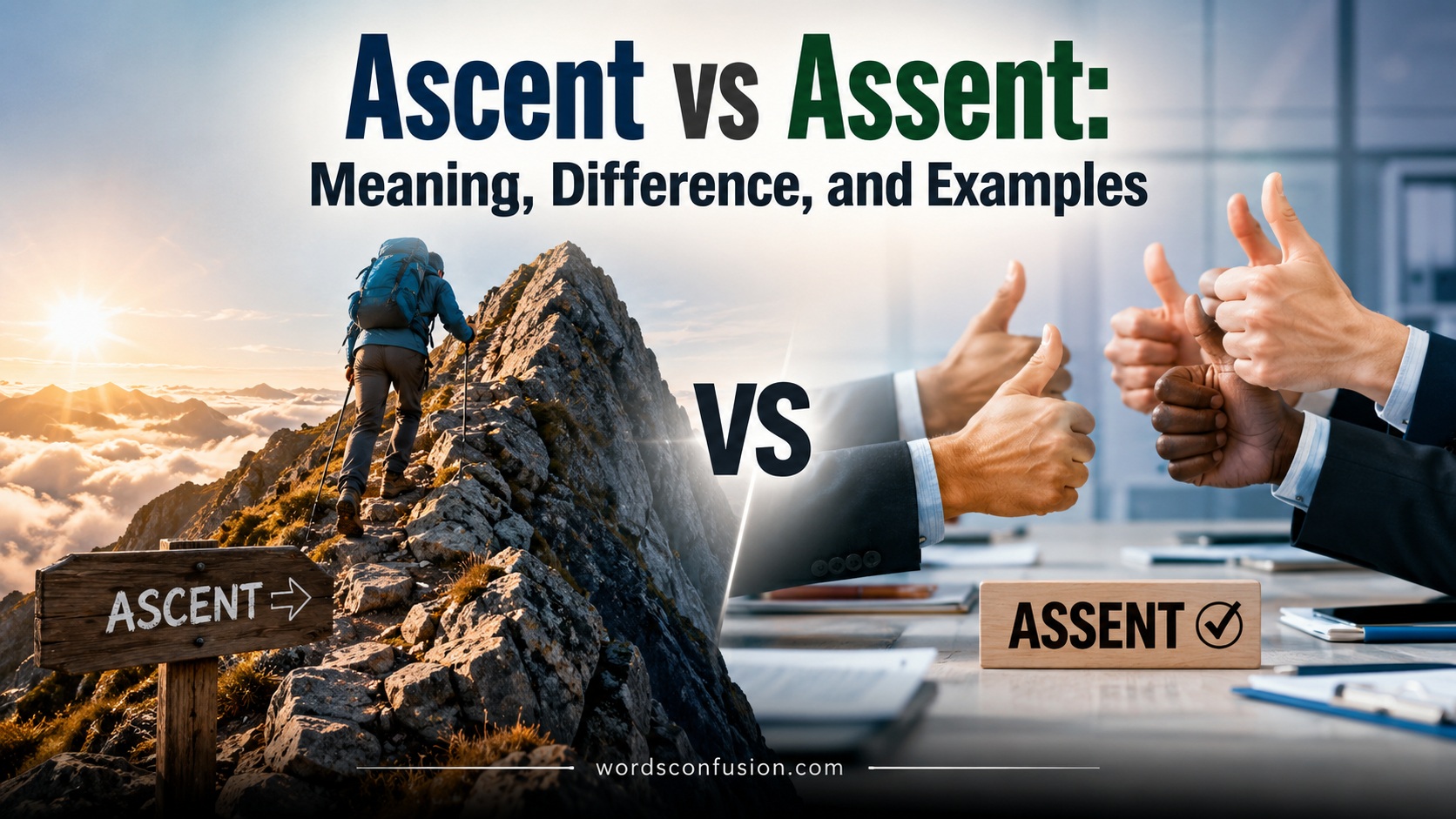
Have you ever written ascent when you meant assent? You’re not alone. These two words sound almost exactly the same, yet they point in completely different directions. One describes going up. The other describes agreeing.
That tiny spelling difference can change an entire sentence.
For example:
- The climbers began their ascent up the mountain.
- The committee gave its assent to the proposal.
In the first sentence, people are moving upward. In the second, people are showing approval. Once you understand that core difference, ascent vs assent becomes much easier to remember.
Quick Answer: Ascent vs Assent
Ascent means a climb, rise, or movement upward. Assent means agreement, approval, or acceptance. The two words are pronounced the same in standard English, but their meanings, spellings, and grammatical uses differ.
| Word | Meaning | Example |
| Ascent | A movement upward or a rise | The hikers began their ascent before sunrise. |
| Assent | Agreement or approval | The board gave its assent to the plan. |
A simple memory trick makes the difference easy:
Ascent = ascend = go up.
Assent = agree.
If you’re talking about a mountain, aircraft, staircase, career, or rise in status, choose ascent. If you’re talking about approval, agreement, or accepting a proposal, choose assent.
What Does Ascent Mean?
Ascent is a noun that means movement upward. It can describe a physical climb, such as going up a mountain, or a figurative rise, such as advancing in a career.
The word often appears in situations involving height, elevation, progress, or advancement.
Ascent as a Physical Climb
The most common meaning of ascent involves moving from a lower position to a higher one.
For example:
- The mountain’s steep ascent tested the climbers’ endurance.
- The hikers began their ascent at dawn.
- The aircraft entered a smooth ascent after takeoff.
- The final ascent to the summit took several hours.
Imagine climbing a mountain. Every step takes you higher. That upward journey is an ascent.
The word can describe a gradual climb or a sudden rise. A gentle hill might involve an easy ascent, while a sheer mountain face could require a difficult one.
Ascent as a Rise or Advancement
Ascent also works in a figurative sense. It can describe someone’s rise to success, power, fame, wealth, or influence.
For example:
- Her rapid ascent in the technology industry attracted attention.
- The athlete’s ascent to international fame took years of training.
- The company experienced a dramatic ascent after launching its new product.
Here, nobody necessarily moves upward physically. Instead, the person or organization rises in status, success, or influence.
Think of it as climbing an invisible ladder. The higher you move, the greater your ascent.
Ascent Pronunciation and Related Words
Ascent is usually pronounced uh-SENT.
It is a noun. The related verb is ascend, which means to move upward or rise.
| Word | Part of Speech | Meaning |
| Ascent | Noun | An upward movement or rise |
| Ascend | Verb | To move upward |
| Ascending | Adjective/Participle | Moving upward |
Examples:
- The ascent was exhausting.
- The climbers ascended the mountain.
- The aircraft was ascending rapidly.
The connection between ascent and ascend provides one of the best spelling clues. Both words relate to moving up.
What Does Assent Mean?
Assent means agreement, approval, or acceptance. Unlike ascent, it can function as both a noun and a verb.
When someone gives their assent, they agree with an idea, proposal, decision, request, or plan.
Assent as a Noun
As a noun, assent means agreement or approval.
Examples include:
- The proposal received the committee’s assent.
- The project cannot begin without official assent.
- She nodded in assent.
- The agreement required the assent of both parties.
In these examples, assent represents a person’s or group’s approval.
For instance, if a school board approves a new policy, the board has given its assent. If a person agrees to a request, that person has given their assent.
Assent as a Verb
As a verb, assent means to agree or approve.
Examples:
- The director assented to the proposed changes.
- She assented to the terms of the agreement.
- After reviewing the plan, the committee assented.
- He assented to the request without hesitation.
The most common structure is assent to something.
So, you might:
- assent to a proposal
- assent to a request
- assent to a plan
- assent to an agreement
A useful detail matters here: assent generally describes agreement with something already proposed. It doesn’t usually mean simply having the same opinion in a casual conversation.
Assent Pronunciation and Word Forms
Assent is also pronounced uh-SENT.
It can appear in several forms:
- assent — noun or verb
- assented — past tense
- assenting — present participle
Examples:
- The board gave its assent.
- The manager assented to the plan.
- The members are assenting to the proposal.
Ascent vs Assent: The Main Difference
The main difference between ascent and assent lies in their meanings.
Ascent describes movement upward. Assent describes agreement or approval.
| Feature | Ascent | Assent |
| Main meaning | Upward movement or rise | Agreement or approval |
| Pronunciation | uh-SENT | uh-SENT |
| Part of speech | Noun | Noun and verb |
| Related word | Ascend | Agree |
| Common context | Mountains, planes, careers | Proposals, decisions, requests |
| Example | The ascent was difficult. | The plan received assent. |
The easiest way to separate them is to ask what the sentence describes.
Is something moving higher? Use ascent.
Is someone agreeing or approving? Use assent.
That simple test solves most usage problems.
Ascent vs Assent Pronunciation
One reason these words cause confusion is that they sound the same in standard pronunciation.
Both are generally pronounced:
uh-SENT
Because the sound offers no useful clue, you must rely on the meaning and spelling.
This makes ascent and assent homophones, or near-homophones depending on dialect and pronunciation. English contains many such word pairs. Words like right and write sound alike but have different meanings. The same basic problem appears with ascent and assent.
When you hear the word, context does the heavy lifting.
For example:
The plane began its ___ after takeoff.
The context clearly involves upward movement. The answer is ascent.
Now consider:
The committee gave its ___ to the proposal.
The context involves approval. The answer is assent.
Ascent vs Assent: Word Origins
The different meanings of these words come from different linguistic roots.
Ascent is connected to the idea of climbing or rising. Its related word ascend also carries the meaning of moving upward.
Assent, on the other hand, is connected to agreement. Its meaning centers on accepting or approving something.
Although the words look and sound similar, their histories point in different directions. One concerns height. The other concerns agreement.
That difference remains visible in modern English:
- Ascent → upward movement
- Assent → agreement
The spelling difference may be only one letter. The semantic gap is much wider.
Ascent Examples in Sentences
Here are examples showing how ascent works in physical and figurative contexts:
- The climbers began their ascent before sunrise.
- The steep ascent required careful footwork.
- The plane began its ascent shortly after takeoff.
- The final ascent to the summit was physically demanding.
- Her professional ascent happened faster than anyone expected.
- The company’s ascent transformed it into a major industry competitor.
- The hikers paused halfway through their ascent.
- The balloon continued its slow ascent into the sky.
Notice the common thread. Every example involves going higher, either literally or figuratively.
Assent Examples in Sentences
Now look at how assent works:
- The committee gave its assent to the proposal.
- The plan requires the assent of all major stakeholders.
- The director assented to the revised terms.
- She gave her assent after reading the contract.
- The council granted its assent to the new regulation.
- He nodded in assent.
- The organization assented to the proposed changes.
- The agreement could not proceed without formal assent.
In each example, the central idea involves agreement, approval, or acceptance.
Common Mistakes With Ascent and Assent
Because the words sound identical, spelling mistakes happen easily. However, the context usually reveals the correct choice.
Mistake: Using Assent for a Climb
Incorrect: The hikers began their assent up the mountain.
Correct: The hikers began their ascent up the mountain.
The hikers are moving upward. Therefore, ascent is the correct word.
Mistake: Using Ascent for Approval
Incorrect: The board gave its ascent to the proposal.
Correct: The board gave its assent to the proposal.
The board isn’t climbing anything. It is approving a proposal. Therefore, the correct word is assent.
Mistake: Confusing Sound With Meaning
When you hear uh-SENT, you can’t determine the spelling from pronunciation alone.
Instead, ask:
What does the word mean in this sentence?
If the meaning involves rising, choose ascent.
If the meaning involves agreement, choose assent.
This small habit prevents many spelling errors.
A Simple Memory Trick for Ascent vs Assent
The best memory trick connects each word to a related word.
Ascent = Ascend = Go Up
The word ascent resembles ascend.
Both relate to upward movement.
- Ascent: The ascent was steep.
- Ascend: They ascended the mountain.
When you see the c in ascent, think of climbing.
Assent = Agree
Think of assent as saying yes to something.
If you assent, you agree.
For example:
- She assented to the proposal.
- She agreed to the proposal.
The meanings are closely related.
The One-Line Rule
Ascent means up. Assent means yes.
That short phrase is worth remembering because it captures the entire difference.
Read More: Amount vs. Number: What’s the Difference?
Ascent vs Assent in Different Contexts
Context makes the distinction even clearer.
Travel and Aviation
In aviation, ascent describes an aircraft moving upward after takeoff.
Example:
The aircraft reached cruising altitude after a steady ascent.
A plane rises during its ascent. Later, it begins its descent when it moves downward.
Hiking and Mountaineering
In outdoor activities, ascent refers to climbing toward a higher point.
Example:
The mountain’s final ascent required careful preparation.
The word often appears in discussions of steepness, elevation, endurance, and altitude.
Business and Career Growth
A person’s ascent can describe professional success.
Example:
Her ascent from entry-level employee to executive took a decade.
The person isn’t literally climbing a staircase. The word describes a rise in rank and influence.
Government and Organizations
Organizations often use assent when describing formal approval.
Example:
The proposal received the board’s assent.
This usage sounds more formal than simply saying agreement.
Everyday Decisions
You can also use assent when someone accepts a request or plan.
Example:
He assented to the arrangement after reviewing the details.
The person agrees. Nothing moves upward.
Ascent vs Assent: Related Words and Confusing Terms
Understanding related vocabulary helps you avoid nearby mistakes.
Words Related to Ascent
- Ascend — to move upward
- Ascending — moving higher
- Climb — to move upward
- Rise — to move to a higher position
- Elevation — height above a reference point
- Uphill — moving toward a higher level
Example:
The hikers ascended during a difficult uphill ascent.
Words Related to Assent
- Agree — to have the same opinion or accept something
- Approval — official or personal acceptance
- Consent — permission or agreement
- Acceptance — receiving or agreeing to something
- Permission — authorization to do something
- Approval — favorable judgment or support
These words overlap in meaning, but they aren’t always interchangeable.
Assent vs Consent
Assent and consent both involve agreement. However, their emphasis can differ.
Assent generally means agreement or approval.
The committee assented to the proposal.
Consent often emphasizes permission or voluntary agreement.
The participant gave consent before joining the study.
In everyday writing, the two words may sometimes overlap. Still, consent often carries a stronger sense of permission.
The distinction matters especially in formal, legal, medical, and ethical contexts.
Ascent, Descent, Assent, and Dissent
These four words often confuse learners because they look and sound similar.
| Word | Meaning | Example |
| Ascent | Movement upward | The ascent was steep. |
| Descent | Movement downward | The aircraft began its descent. |
| Assent | Agreement | The proposal received assent. |
| Dissent | Disagreement | Several members expressed dissent. |
A useful way to organize them is by meaning:
Movement:
- Ascent = up
- Descent = down
Opinions:
- Assent = agree
- Dissent = disagree
This four-word comparison creates a useful mental map. Once you understand the pattern, these terms become far less confusing.
FAQs:
What is the main difference between ascent and assent?
Ascent means moving upward or rising. Assent means agreeing with or approving something.
For example:
- The hikers began their ascent up the mountain.
- The committee gave its assent to the proposal.
A quick way to remember the difference is ascent = up and assent = agreement.
Can ascent and assent be used as verbs?
Ascent is a noun. Its related verb is ascend.
- The ascent was difficult.
- The climbers ascended the mountain.
Assent can work as both a noun and a verb.
- The plan received her assent.
- She assented to the plan.
What is an easy memory trick for ascent and assent?
Connect ascent with ascend. Both words relate to going upward.
For assent, think of agreement. If you assent to something, you agree to it.
Ascent means up. Assent means yes.
What is the difference between assent and consent?
Both words can mean agreement. However, assent usually refers to agreement or approval, while consent often emphasizes permission or voluntary agreement.
For example:
- The board gave its assent to the proposal.
- The participant gave consent before taking part in the study.
The exact difference can depend on the context, especially in formal or legal writing.
What are the opposites of ascent and assent?
The opposite of ascent is descent, which means movement downward.
The opposite of assent is dissent, which means disagreement or opposition.
| Word | Meaning |
| Ascent | Going upward |
| Descent | Going downward |
| Assent | Agreeing |
| Dissent | Disagreeing |
Conclusion:
Although ascent and assent sound the same, their meanings couldn’t be more different. Ascent refers to upward movement, such as climbing a mountain, rising into the sky, or advancing in a career. Assent refers to agreement, approval, or acceptance.
When you’re unsure which word to use, focus on the meaning. If something is moving up, choose ascent. If someone is saying yes or giving approval, choose assent.
The easiest rule to remember is simple:
Ascent means up. Assent means agreement.
Once you connect ascent with ascend and assent with agree, this commonly confused word pair becomes much easier to use correctly.

Andrew Wilson is an experienced language researcher and content writer specializing in WordsConfusion topics. He helps readers understand commonly confused English words, spelling differences, grammar rules, word meanings, and proper usage through clear explanations, practical examples, and easy-to-follow language guides. His goal is to make English learning simple, accurate, and accessible for students, writers, professionals, and everyday learners.