
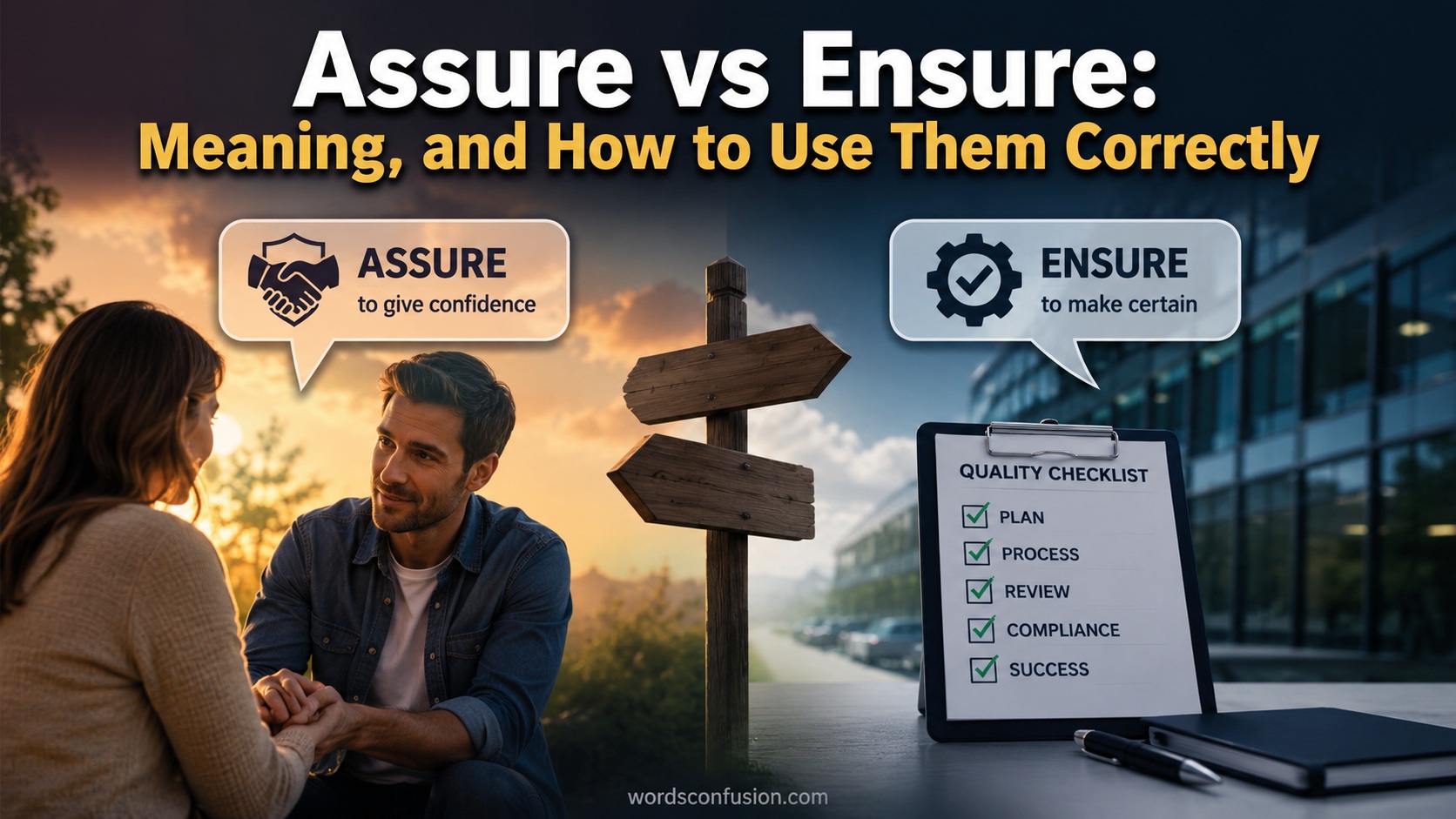
If you’ve ever paused while writing a sentence like “I assure you” or “I ensure you,” you’re not alone. Assure vs ensure creates confusion because both words connect to certainty. However, they don’t work in the same way.
The easiest distinction is simple:
- Assure means to give someone confidence or remove their doubts.
- Ensure means to make something certain or guarantee a result through action.
- Insure usually relates to financial protection through an insurance policy.
In other words, you assure a person and ensure an outcome. Once you understand that basic difference, choosing the right word becomes much easier.
Quick Answer: Assure vs Ensure
Assure means to reassure someone or remove their doubts. Ensure means to make certain that something happens. For example, I assure you that everything is fine means you’re giving someone confidence. Please ensure that everything is ready means you’re taking steps to make sure a condition exists.
| Word | Meaning | Main Focus | Example |
| Assure | Give someone confidence or remove doubt | A person | I assure you that the plan will work. |
| Ensure | Make something certain | An outcome or condition | Check the details to ensure accuracy. |
| Insure | Protect against financial loss | Property, people, or risks | They insured their house against fire. |
A useful memory trick is:
Assure people. Ensure results. Insure against financial risk.
Assure vs Ensure: The Main Difference
The central difference between assure and ensure comes down to reassurance versus action.
When you assure someone, you communicate confidence. You might make a promise, provide information, or calm someone’s worries.
I assure you that your information is safe.
Here, the speaker is addressing a person and trying to remove that person’s concern.
When you ensure something, you take action or create conditions that make a result more likely or certain.
The company uses encryption to ensure data security.
The sentence focuses on the action or system that helps create a specific result.
Assure = Communication With a Person
Assure usually involves a person who receives reassurance.
- She assured me that she had locked the door.
- The manager assured the customers that the problem would be fixed.
- I assure you that I understand your concerns.
Ensure = Action Toward a Result
Ensure focuses on making something happen or preventing something from going wrong.
- She checked the lock to ensure the door was secure.
- The manager created a checklist to ensure accuracy.
- Review the instructions to ensure that you follow every step.
The difference may seem small at first. Yet the focus shifts dramatically. Assure deals with confidence in someone’s mind. Ensure deals with certainty in a situation or outcome.
What Does Assure Mean?
Assure means to tell someone something confidently so that the person feels less worried or uncertain. It can also mean to convince someone that something is true or will happen.
The word often appears when a person has a question, fear, doubt, or concern.
For example:
The doctor assured the patient that the procedure was routine.
The doctor didn’t physically make the procedure routine through the sentence. Instead, the doctor gave the patient confidence.
Common Examples of Assure
- I assure you that I didn’t forget.
- She assured her parents that she had arrived safely.
- The company assured customers that their personal information was protected.
- He assured me that the meeting would not take long.
- The teacher assured the students that the test would be fair.
In each example, someone communicates confidence to another person.
Common Grammar Patterns With Assure
The most common structure is:
assure + person + that-clause
Examples:
- She assured me that everything was fine.
- The manager assured them that the issue was under control.
- I assure you that the information is accurate.
Another structure uses of:
assure + person + of + noun
Examples:
- The company assured customers of its commitment to privacy.
- The officer assured residents of their safety.
You can also use assure oneself:
- He assured himself that he had made the right decision.
Here, the person gives confidence to himself rather than to someone else.
What Does Ensure Mean?
Ensure means to make something certain or to take steps that help guarantee a particular result.
Unlike assure, ensure usually focuses on an event, condition, process, or outcome rather than on someone’s feelings.
For example:
The technician tested the system to ensure reliability.
The technician took a practical step to help create a reliable result.
Common Examples of Ensure
- Please ensure that all doors are locked.
- The checklist helps ensure consistency.
- Back up your files to ensure that you don’t lose important data.
- The company introduced new procedures to ensure workplace safety.
- The editor checked the article to ensure accuracy.
Notice the pattern. The subject usually does something to make a desired result more certain.
Common Grammar Patterns With Ensure
You can use ensure + noun:
- The policy ensures consistency.
- The system ensures security.
- The inspection ensures quality.
You can also use ensure + that-clause:
- Ensure that all information is correct.
- The backup system ensures that important files remain available.
In formal instructions, you may also see ensure + noun phrase + verb:
- Ensure all windows are closed before leaving.
This structure is concise and common in instructions, manuals, and professional writing.
Assure vs Ensure Comparison Table
The following table shows the difference between the two words at a glance.
| Feature | Assure | Ensure |
| Basic meaning | Reassure or give confidence | Make certain |
| Main focus | A person’s confidence | An outcome or condition |
| Common object | A person | A result, process, or condition |
| Typical action | Speaking or promising | Acting or creating conditions |
| Common structure | assure someone that… | ensure that… |
| Example | I assure you that it’s safe. | Follow the rules to ensure safety. |
A quick way to test your sentence is to ask:
Am I reassuring a person? Use assure.
Am I making a result certain? Use ensure.
Assure vs Ensure Examples Side by Side
Seeing the words in similar situations makes the distinction clearer.
| Assure | Ensure |
| I assure you that the report is accurate. | I checked the report to ensure accuracy. |
| She assured him that she would return. | She set a reminder to ensure that she returned on time. |
| The manager assured customers that their data was safe. | The company added encryption to ensure data security. |
| The teacher assured the students that the test was fair. | The teacher reviewed the questions to ensure fairness. |
| He assured me that the door was locked. | He checked the door to ensure that it was locked. |
The contrast is especially clear in the last example. One person says the door is locked. The other person checks the door to make certain it is locked.
That’s the heart of assure vs ensure.
The Easiest Way to Remember Assure vs Ensure
Memory tricks work best when they reflect the actual meaning.
Assure a Person
Think:
Assure = A person
You assure someone when you want to remove that person’s doubt.
- I assure you that everything is fine.
- She assured me that she had the correct address.
The word usually carries a human, communicative element.
Ensure an Outcome
Think:
Ensure = Ensure the result
You ensure something when you take action to make a condition or result certain.
- Check the address to ensure accurate delivery.
- Follow the instructions to ensure proper installation.
The Three-Word Rule
For the quickest possible reminder:
Assure people. Ensure outcomes. Insure risks.
This rule won’t solve every unusual sentence in English. However, it works extremely well for everyday writing, business communication, academic work, and general conversation.
When to Use Assure
Use assure when your sentence involves confidence, reassurance, or a promise directed toward someone.
Use Assure When Someone Is Worried
The pilot assured the passengers that the delay was temporary.
The pilot is addressing people who may feel uncertain or concerned.
Use Assure When Making a Promise
She assured her friend that she would keep the secret.
The sentence focuses on the friend’s confidence in her promise.
Use Assure When Confirming Something
I assure you that the information is correct.
The speaker wants the listener to trust the statement.
Use Assure in Customer Service
Businesses often use assure when responding to complaints or concerns.
We assure you that your complaint is receiving immediate attention.
The sentence tries to build confidence. It doesn’t describe a technical process that guarantees a result.
When to Use Ensure
Use ensure when you describe an action, system, process, or condition that helps make a result certain.
Use Ensure for Safety
Check the equipment before use to ensure safety.
The focus rests on the action and the desired condition.
Use Ensure for Accuracy
The editor reviewed every figure to ensure accuracy.
The editor takes action to prevent mistakes.
Use Ensure for Rules and Procedures
Employees must follow the procedure to ensure compliance.
The procedure exists to create a specific result.
Use Ensure for Technical Systems
The backup server helps ensure continued access to important files.
The system performs a practical function. It doesn’t reassure a person through words.
Read More: Ascent vs Assent: Meaning, Difference, and Examples
Assure vs Ensure in Professional and Business Writing
Business writing often needs precision because a single word can change the tone of a sentence.
Using Assure in Business Communication
Use assure when you communicate directly with a customer, client, employee, or colleague.
Examples:
- We assure you that your request is being reviewed.
- The representative assured the client that the matter would be investigated.
- The company assured employees that the transition would be carefully managed.
These sentences focus on trust and confidence.
Using Ensure in Business Communication
Use ensure when discussing procedures, responsibilities, standards, or measurable results.
Examples:
- Managers must ensure that employees receive proper training.
- The audit helps ensure financial accuracy.
- The company created new controls to ensure compliance with its policies.
These sentences focus on what must happen.
A useful distinction in workplace writing is this:
Assure sounds personal. Ensure sounds procedural.
That difference can help you choose the right verb quickly.
Assure vs Ensure in Academic and Formal Writing
Academic and technical writing often favors ensure when describing methods used to produce reliable results.
For example:
Researchers repeated the experiment to ensure reliable results.
The researchers took action to improve certainty.
However, assure remains correct when the sentence involves people.
Researchers assured participants that their responses would remain confidential.
The researchers communicated reassurance to the participants.
Compare the two:
| Sentence | Focus |
| Researchers assured participants of confidentiality. | People and confidence |
| Researchers used safeguards to ensure confidentiality. | Procedures and results |
Both sentences may appear in the same research paper. They simply describe different aspects of the situation.
Common Mistakes With Assure and Ensure
Confusion usually appears when writers treat these words as interchangeable. They overlap in the general idea of certainty. Their grammatical focus differs.
Mistake: “I Ensure You”
A common error is:
I ensure you that everything is fine.
The standard choice is:
I assure you that everything is fine.
Why? The speaker is reassuring you, a person.
Mistake: Using Assure for a Process
Some writers say:
The checklist assures that all steps are completed.
The more precise choice is:
The checklist ensures that all steps are completed.
The checklist doesn’t reassure a person. It helps create a certain result.
Mistake: Assuming Both Words Mean Exactly the Same Thing
The words can sometimes appear in related contexts. However, their emphasis differs.
- Assure: “Trust me. This is true.”
- Ensure: “I took steps to make this happen.”
That distinction is subtle but powerful.
Assure vs Ensure vs Insure
Many people learn assure, ensure, and insure together because the three words sound similar.
Their meanings, however, are distinct.
| Word | Meaning | Example |
| Assure | Reassure a person | I assure you that the plan is safe. |
| Ensure | Make an outcome certain | Follow the instructions to ensure safety. |
| Insure | Protect against financial loss | They insured the building against fire. |
What Does Insure Mean?
Insure usually relates to insurance. It describes financial protection against a possible loss, damage, or risk.
Examples:
- She insured her car against theft.
- The company insured the building against fire damage.
- The business insured its equipment.
A simple memory line brings all three together:
Assure people. Ensure results. Insure property.
Assure vs Ensure: Grammar Questions
Can You Say “Assure That”?
Yes. However, assure commonly takes a person as its object.
- She assured me that she would call.
- The manager assured us that the problem was resolved.
The person receiving reassurance usually appears between assure and that.
Can You Say “Ensure Someone”?
Usually not when you mean “reassure someone.”
For example:
- Correct: I assure you that the plan is safe.
- Correct: I ensure that the plan follows safety rules.
The first sentence reassures a person. The second describes an action that creates a condition.
Is “Ensure That” Correct?
Yes. Ensure that is extremely common.
- Ensure that all doors are locked.
- The system ensures that data remains secure.
You can sometimes omit that:
- Ensure all doors are locked.
Both structures are widely used. The version without that often sounds more direct in instructions.
FAQs:
1. What is the main difference between assure and ensure?
Assure means to reassure a person or remove someone’s doubts. Ensure means to make something certain or take steps to produce a specific result. For example, I assure you that everything is fine reassures a person, while Check the details to ensure accuracy focuses on achieving an outcome.
2. Is it correct to say “I ensure you”?
Usually, no. When you want to reassure someone, the correct phrase is “I assure you.”
Correct: I assure you that the information is accurate.
Ensure usually describes making something certain:
The team checked the report to ensure its accuracy.
3. Is ensure the same as make sure?
Yes, ensure often means make sure or make certain. Both words can describe taking steps to achieve a particular result.
- Ensure that the door is locked.
- Make sure that the door is locked.
The word ensure often sounds slightly more formal, which makes it common in professional, academic, and technical writing.
4. What is the difference between assure, ensure, and insure?
The three words have different meanings:
- Assure means to reassure a person: I assure you that everything is safe.
- Ensure means to make an outcome certain: Follow the instructions to ensure safety.
- Insure usually means to protect against financial loss: They insured the house against fire.
A simple memory trick is: Assure people, ensure results, and insure against financial risk.
5. Which is correct: “assure safety” or “ensure safety”?
Ensure safety is usually correct when you mean to make a situation safe or take steps to prevent danger.
Example: The new procedures help ensure workplace safety.
However, assure someone of safety has a different meaning. It means giving a person confidence that they are safe.
Example: The manager assured the employees of their safety.
Conclusion:
The difference between assure and ensure becomes much easier when you focus on the target of the action. Assure deals with people, confidence, and reassurance. Ensure deals with results, conditions, and actions that make something certain.
Use assure when you want to reassure someone:
I assure you that everything will be fine.
Use ensure when you want to make an outcome certain:
Check the details to ensure everything is correct.
And remember insure when you’re talking about financial protection against risk.
Assure people. Ensure results. Insure against financial risk.

Andrew Wilson is an experienced language researcher and content writer specializing in WordsConfusion topics. He helps readers understand commonly confused English words, spelling differences, grammar rules, word meanings, and proper usage through clear explanations, practical examples, and easy-to-follow language guides. His goal is to make English learning simple, accurate, and accessible for students, writers, professionals, and everyday learners.