
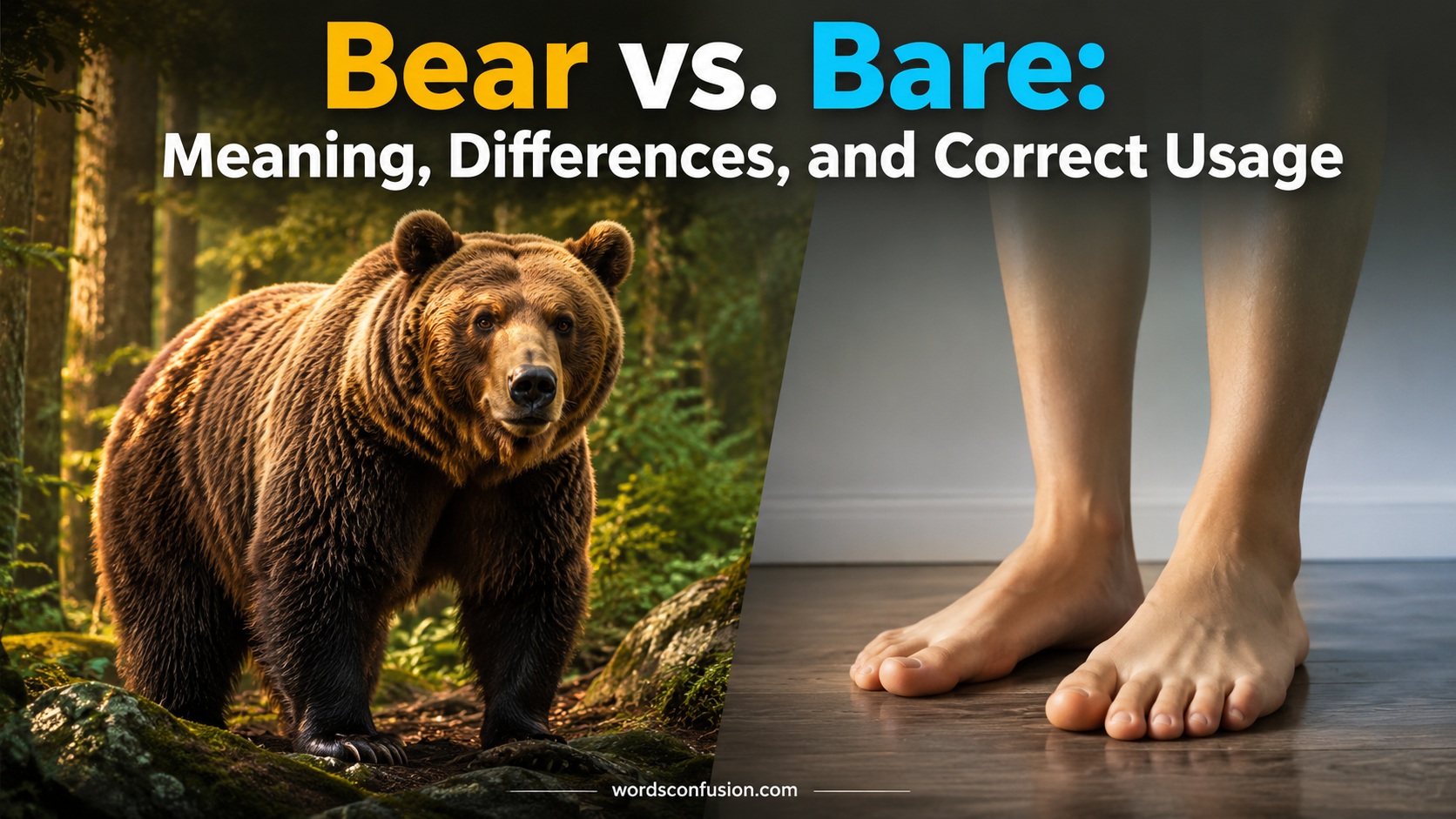
Bear vs. Bare is a common English word confusion because both words sound the same in most standard varieties of American English. However, their meanings, spellings, and grammatical uses are completely different. Choosing the wrong one can change the meaning of a sentence or make otherwise polished writing look careless.
The word bear can refer to an animal. It can also mean to carry, support, tolerate, endure, produce, or give birth. The word bare, on the other hand, describes something uncovered, exposed, empty, or minimal. As a verb, bare means to uncover or reveal something.
That distinction becomes much easier once you connect each word with its central idea. Think of bear as carrying a burden and bare as removing a covering.
For example, you bear pain because you endure it. You have bare feet because they’re uncovered. You bear responsibility because you carry it. You bare your feelings when you reveal them.
Although these words sound identical, context usually makes the correct spelling clear.
Quick Answer
Bear and bare are homophones, but they have different meanings and grammatical functions. Bear commonly means to carry, endure, support, produce, or refer to the animal. Bare means uncovered, exposed, empty, minimal, or to uncover something.
| Word | Main Meaning | Common Use | Example |
| Bear | Carry or endure | Verb | “I can’t bear the pain.” |
| Bear | An animal | Noun | “We saw a bear in the forest.” |
| Bear | Produce | Verb | “The tree bears fruit.” |
| Bare | Uncovered | Adjective | “He walked with bare feet.” |
| Bare | Minimal | Adjective | “We had only the bare essentials.” |
| Bare | Uncover or reveal | Verb | “She bared her feelings.” |
The easiest memory rule is:
Bear carries. Bare uncovers.
If you can replace the word with carry, endure, or support, you probably need bear. If you mean uncovered, exposed, minimal, or reveal, you probably need bare.
Comparison Overview
Bear vs. bare becomes much easier when you compare their core meanings side by side. The pronunciation may be identical, but the words belong to different semantic families.
| Feature | Bear | Bare |
| Pronunciation | Usually /ber/ | Usually /ber/ |
| Homophone | Yes | Yes |
| Noun | Yes | Generally no |
| Verb | Yes | Yes |
| Adjective | Limited uses | Yes |
| Main idea | Carry, endure, support, produce | Uncovered, exposed, minimal |
| Animal meaning | Yes | No |
| Example phrase | bear in mind | bare minimum |
| Example sentence | “I can’t bear it.” | “She has bare feet.” |
The biggest difference is meaning. Bear often involves carrying something either physically or figuratively. Bare usually involves the absence of something that normally covers, fills, or conceals.
Consider these two sentences:
- “She couldn’t bear the pain.”
- “She walked with bare feet.”
In the first sentence, bear means endure. In the second, bare means uncovered.
Main Differences Between Bear vs. Bare
The central difference between bear vs. bare comes down to what you want to express. Bear generally carries the idea of carrying or enduring something. Bare generally carries the idea of exposure or lack.
Bear Means to Carry or Support
One of the oldest and most useful meanings of bear is to carry or support.
You can bear a physical weight:
- “The bridge can bear heavy loads.”
- “The roof must bear the weight of the snow.”
You can also bear something in a figurative sense:
- “She bears a great responsibility.”
- “He bears the financial burden for his family.”
The physical and figurative meanings connect naturally. A person who bears responsibility is metaphorically carrying it.
Bear Means to Endure or Tolerate
Bear frequently describes the ability to tolerate something unpleasant, painful, difficult, or emotionally challenging.
For example:
- “I can’t bear this noise.”
- “She couldn’t bear the disappointment.”
- “He could barely bear the pain.”
- “I can’t bear to watch the final scene.”
This meaning appears constantly in everyday English.
When you say, “I can’t bear it,” you’re saying that something has become too difficult or unpleasant to tolerate.
Bare Means Uncovered
Bare usually describes something that lacks a covering.
You might have:
- bare feet
- bare hands
- bare skin
- bare walls
- bare floors
- bare branches
For example:
“He walked across the cold floor with bare feet.”
Here, bare means the feet aren’t covered by shoes or socks.
This meaning also works metaphorically. A statement can be bare facts, meaning facts presented without decoration, exaggeration, or additional detail.
Bare Means Minimal or Basic
Another important meaning of bare is minimal.
This appears in expressions such as:
- bare minimum
- bare necessities
- bare essentials
- bare facts
- bare bones
For example:
“We brought only the bare essentials for the trip.”
The sentence means that the travelers brought only the most necessary items.
Similarly:
“He did the bare minimum required to pass.”
Here, bare minimum means the smallest amount necessary.
What Does Bear Mean?
Bear has several meanings, which explains why learners sometimes find it more difficult than bare. It can function as a noun or a verb.
Bear as a Verb
As a verb, bear can mean carry, support, endure, tolerate, produce, or give birth. The surrounding sentence tells you which meaning applies.
Bear Means “To Carry”
When something physically carries weight, you can use bear.
Examples include:
- “The truck can bear the load.”
- “The columns bear the weight of the building.”
- “This shelf can’t bear that much weight.”
The word also works with abstract burdens.
“She bears the responsibility for the entire project.”
Nobody is physically placing responsibility on her shoulders. The phrase uses bear metaphorically to describe carrying an obligation.
Bear Means “To Endure”
This meaning appears frequently in conversations about pain, stress, disappointment, and unpleasant situations.
Examples:
- “I can’t bear the thought of losing.”
- “She couldn’t bear the criticism.”
- “They had to bear the hardship together.”
- “He couldn’t bear to tell her the truth.”
The phrase bear with has a related idea.
“Please bear with me while I explain.”
Here, bear with me means to be patient with me.
Bear Means “To Produce”
A plant can bear fruit, flowers, or seeds.
For example:
- “The apple tree bears fruit every autumn.”
- “The plant bears bright yellow flowers.”
- “The farm’s trees bear fruit every year.”
The same basic concept can appear in formal or financial contexts.
For example:
“The account bears interest.”
The account produces or earns interest.
Bear Means “To Give Birth”
Bear can also mean to give birth.
This use appears more often in formal, literary, historical, or biological writing than in casual conversation.
Examples:
- “She bore three children.”
- “The female bear bore cubs.”
- “The queen bore an heir.”
The verb forms can be confusing because bear has an irregular past tense.
| Form | Example |
| bear | “They bear the responsibility.” |
| bears | “She bears the burden.” |
| bearing | “He is bearing the cost.” |
| bore | “She bore a child.” |
| borne | “The burden was borne by the team.” |
| born | “She was born in May.” |
The distinction between born and borne deserves special attention. Born is normally associated with birth, while borne appears in other meanings of the verb.
Bear as a Noun
The most familiar noun meaning of bear is the animal.
Examples include:
- “A bear crossed the trail.”
- “The polar bear hunts on sea ice.”
- “We learned about brown bears in science class.”
The word can refer to several species of large mammals within the bear family.
Bear also appears in figurative language. For example:
“That problem is a real bear.”
In informal English, this can describe something difficult, complicated, or unpleasant to deal with.
The word also appears in financial terminology such as bear market, which describes a period when prices broadly decline.
What Does Bare Mean?
Bare has a simpler central concept than bear. It generally describes something that has been uncovered, exposed, emptied, or reduced to the minimum.
It can work as an adjective or a verb.
Bare as an Adjective
As an adjective, bare describes something that lacks a covering or contains very little.
Bare Means Uncovered
This is probably the most straightforward meaning.
Examples:
- “She stood on the beach with bare feet.”
- “The child had bare arms.”
- “The tree had bare branches.”
- “The room had bare walls.”
If something normally has a covering and that covering isn’t there, bare may be the correct word.
Bare Means Empty
Bare can also describe something that contains little or nothing.
For example:
“The shelves were bare after the store’s grand opening.”
The shelves weren’t necessarily physically uncovered. Instead, they contained very few products.
Another example:
“The kitchen was almost bare.”
That sentence suggests the kitchen had very little equipment, furniture, or supplies.
Bare Means Basic or Minimal
This meaning appears in several familiar expressions.
Bare minimum means the smallest amount required.
Bare necessities means only the things that are truly necessary.
Bare essentials has a similar meaning.
Bare bones describes the most basic form of something without extra features or details.
For example:
“The report gives only the bare facts.”
That means the report provides basic facts without much explanation or additional information.
Bare as a Verb
As a verb, bare means to uncover, expose, or reveal.
This meaning creates an especially useful connection between the adjective and verb.
If something is bare, it is exposed. If you bare something, you expose it.
Examples:
- “The dog bared its teeth.”
- “She bared her emotions.”
- “The investigation bared the truth.”
- “He bared his chest.”
The meaning can be physical or emotional.
When someone bares their soul, they reveal deeply personal thoughts or feelings.
Bear vs. Bare as Verbs
The verb forms create some of the most common mistakes in English.
Use bear when you mean:
- carry
- support
- endure
- tolerate
- produce
- give birth
- take responsibility
Use bare when you mean:
- uncover
- expose
- reveal
- remove a covering
Compare these sentences:
“She couldn’t bear the pressure.”
Here, she couldn’t tolerate the pressure.
“She bared her feelings.”
Here, she revealed her feelings.
The difference is subtle in sound but enormous in meaning.
Bear vs. Bare Examples in Sentences
Examples make this distinction much easier to recognize in real writing.
Correct Examples of Bear
- “I can’t bear the noise anymore.”
- “The bridge can bear the weight of several vehicles.”
- “She bears responsibility for the decision.”
- “The tree bears fruit every summer.”
- “Please bear in mind that the schedule may change.”
- “He couldn’t bear to leave his family.”
- “The company will bear the cost.”
- “She bore three children.”
- “We must bear the consequences of our choices.”
- “The investment bears interest.”
Each sentence uses bear because the meaning involves carrying, enduring, producing, or a related concept.
Correct Examples of Bare
- “She walked across the room with bare feet.”
- “The walls were completely bare.”
- “We packed only the bare necessities.”
- “He told us the bare facts.”
- “The cupboard was almost bare.”
- “The dog bared its teeth.”
- “She bared her feelings during the conversation.”
- “They survived on the bare minimum.”
- “The tree’s bare branches moved in the wind.”
- “The apartment came with bare walls.”
Each example involves exposure, emptiness, or minimal content.
Common Bear vs. Bare Mistakes
These words often appear in phrases that writers memorize incorrectly.
| Common Mistake | Correct Form | Explanation |
| “I can’t bare it.” | “I can’t bear it.” | Bear means endure. |
| “Bear feet” | “Bare feet” | Bare means uncovered. |
| “Bare in mind” | “Bear in mind” | The expression uses bear. |
| “Bear minimum” | “Bare minimum” | Bare means minimal. |
| “The dog bear its teeth.” | “The dog bared its teeth.” | Bare means expose. |
| “The room was bear.” | “The room was bare.” | Bare means empty or lacking furnishings. |
| “The tree bares fruit.” | “The tree bears fruit.” | Bear means produce. |
| “Bear necessities” | “Bare necessities” | Bare means only the essentials. |
These mistakes happen because pronunciation doesn’t provide a spelling clue. You need to focus on meaning.
Read More: Peak vs. Peek: Meaning, Examples, and Correct Usage
Bear vs. Bare in Common Expressions
English contains several fixed phrases that use one word consistently. Learning these expressions can prevent many spelling errors.
Common Expressions With Bear
Bear in Mind
Bear in mind means remember or keep something in consideration.
“Bear in mind that the deadline is Friday.”
You wouldn’t write bare in mind because the phrase involves the figurative idea of carrying something in your thoughts.
Bear With Me
Bear with me means be patient.
“Please bear with me while I check the information.”
The expression is especially common in customer service, presentations, and everyday conversations.
Bear Responsibility
To bear responsibility means to accept or carry responsibility.
“The manager must bear responsibility for the mistake.”
Bear the Cost
To bear the cost means to pay or carry a financial burden.
“The company agreed to bear the cost of repairs.”
Bear Fruit
To bear fruit means to produce fruit or produce a useful result.
“Years of research finally began to bear fruit.”
The phrase can describe literal plants or figurative achievements.
Bear Witness
To bear witness means to give testimony or provide evidence of something.
“Several people came forward to bear witness.”
Grin and Bear It
Grin and bear it means to tolerate an unpleasant situation without complaining too much.
“The training was exhausting, but we had to grin and bear it.”
Common Expressions With Bare
Bare Minimum
The bare minimum is the smallest amount necessary.
“He did the bare minimum to complete the assignment.”
Bare Necessities
The bare necessities are the things you absolutely need.
“We packed only the bare necessities.”
Bare Essentials
Bare essentials has nearly the same meaning.
“The emergency kit contains the bare essentials.”
Bare Bones
Bare bones describes the most basic version of something.
“The proposal gives us the bare bones of the plan.”
Bare Facts
The bare facts are basic facts without embellishment or extra interpretation.
“The report presents the bare facts.”
Bare Your Soul
To bare your soul means to reveal your deepest feelings or thoughts.
“She finally bared her soul to her closest friend.”
Bare Your Teeth
To bare your teeth means to expose your teeth. It can happen literally or serve as a figurative warning of aggression.
“The wolf bared its teeth.”
FAQs:
Is it “bear with me” or “bare with me”?
The correct phrase is bear with me.
It means be patient with me.
For example:
“Please bear with me while I finish the presentation.”
Bare with me would literally suggest uncovering something with you, which isn’t the intended meaning.
Is it “bear minimum” or “bare minimum”?
The correct expression is bare minimum.
It means the smallest amount necessary.
“He completed the bare minimum required for the course.”
Is it “bear feet” or “bare feet”?
The correct phrase is bare feet.
It means feet without shoes or another covering.
“The child ran across the grass with bare feet.”
Is it “bear in mind” or “bare in mind”?
The correct phrase is bear in mind.
It means remember or consider something.
“Bear in mind that prices can change.”
Is it “bare your teeth” or “bear your teeth”?
The correct expression is bare your teeth.
The verb bare means expose or uncover.
“The dog bared its teeth when it felt threatened.”
Conclusion:
Understanding bear vs. bare becomes much easier when you focus on meaning rather than pronunciation. Bear usually means to carry, endure, support, produce, or refer to the animal. Bare means uncovered, exposed, empty, minimal, or to reveal something. Remember the simple rule: bear carries, while bare uncovers. So you bear pain, bear responsibility, and bear a cost, but you have bare feet, bare walls, and the bare minimum. Once you connect each word with its core meaning, choosing the correct spelling becomes quick and natural.

Andrew Wilson is an experienced language researcher and content writer specializing in WordsConfusion topics. He helps readers understand commonly confused English words, spelling differences, grammar rules, word meanings, and proper usage through clear explanations, practical examples, and easy-to-follow language guides. His goal is to make English learning simple, accurate, and accessible for students, writers, professionals, and everyday learners.