
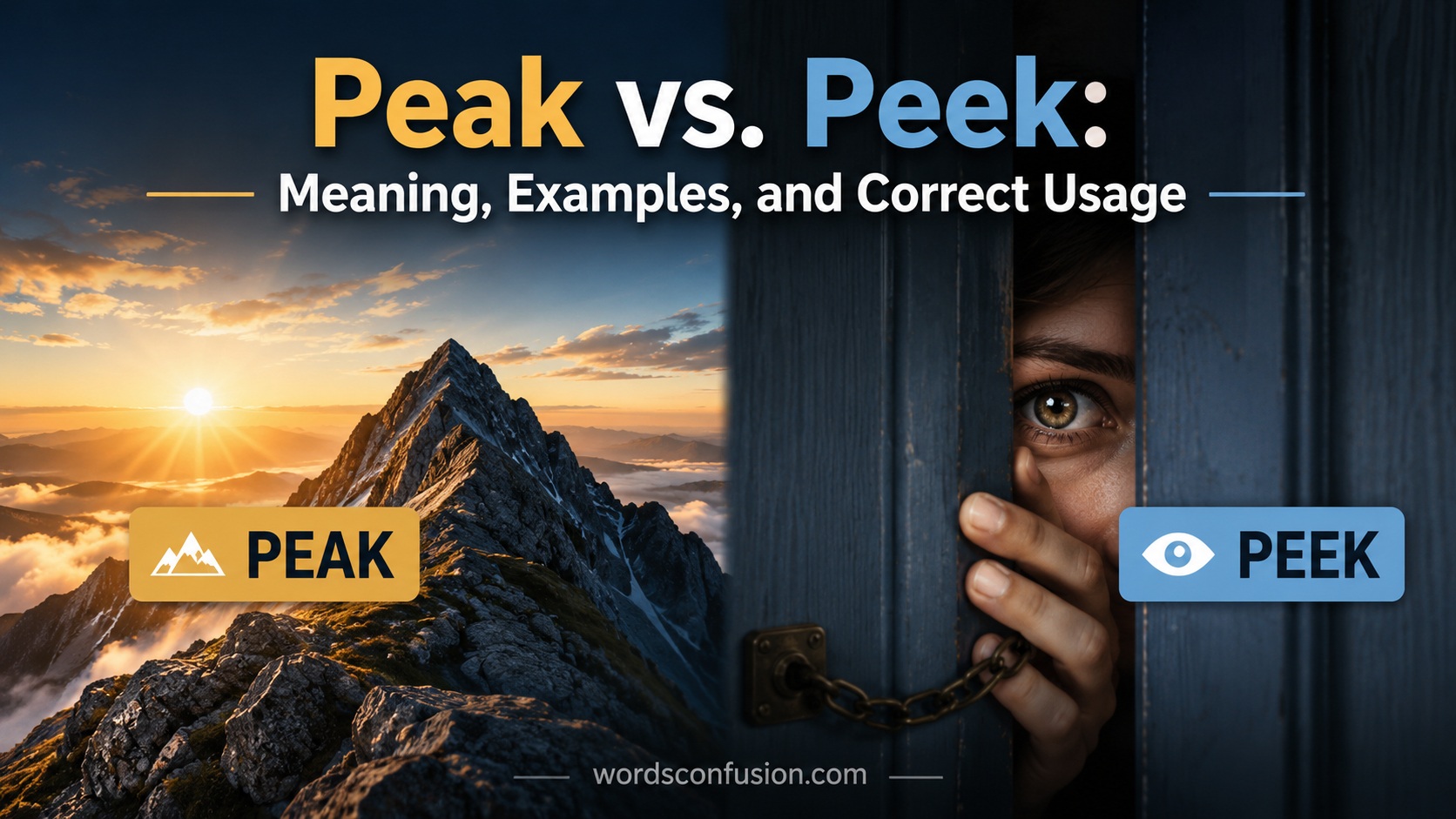
Peak vs. peek is a common English word confusion because both words sound exactly alike but have completely different meanings. One refers to a highest point or maximum level, while the other describes a quick or secret look.
If you write, “Take a peak at this,” you’ve chosen the wrong word. The correct expression is “Take a peek at this.” On the other hand, if you’re describing the highest point of a mountain, career, season, or performance, peak is the right choice.
The difference becomes easy once you connect each word with its main idea. Peak is about reaching the top. Peek is about taking a look.
This guide explains peak vs. peek in detail, including their meanings, parts of speech, common phrases, sentence examples, mistakes, memory tricks, and the related word pique.
Quick Answer
Peak means the highest point, level, degree, or stage of something. It can also mean to reach the highest level of activity, quality, or intensity.
Peek means to take a quick, brief, or sometimes secret look at something.
| Word | Meaning | Example |
| Peak | The highest point or level | The climbers reached the mountain peak. |
| Peek | A quick or brief look | She took a peek inside the room. |
The simplest way to remember the difference is:
- Peak = top
- Peek = look
Think of a mountain peak when you see peak. Think of your eyes looking when you see peek.
Comparison Overview
The words peak and peek are homophones. That means they have the same pronunciation but different spellings and meanings.
Their pronunciation can make them tricky in conversation because you can’t hear which spelling someone intends. You have to understand the meaning from context.
| Feature | Peak | Peek |
| Pronunciation | Same as “peek” | Same as “peak” |
| Core meaning | Highest point or level | Quick or brief look |
| Noun | Yes | Yes |
| Verb | Yes | Yes |
| Adjective | Yes | No |
| Common context | Mountains, careers, sales, demand, performance | Looking, checking, observing |
| Common phrase | Peak season | Take a peek |
| Memory word | Top | Look |
For example, compare these two sentences:
The athlete reached the peak of her career.
She took a peek at the scoreboard.
The first sentence discusses the highest stage of a career. The second describes a quick look.
That’s the key distinction.
Main Differences Between Peak vs. Peek
The biggest difference between peak vs. peek is their meaning.
Peak deals with a maximum or highest point. Peek deals with seeing something briefly.
Peak Means the Highest Point
A peak is the top or highest point of something. The word can describe a physical location or an abstract level.
You can stand on a mountain peak. You can also talk about the peak of someone’s career.
For example:
- The hikers finally reached the peak.
- Her career reached its peak in her thirties.
- Demand reached a peak during the holiday season.
- The team’s performance was at its peak.
The word doesn’t always involve something physically high. In everyday English, peak often refers to the maximum level of an activity, condition, or achievement.
Peek Means a Quick Look
A peek is a short or secret look.
When someone peeks at something, they don’t necessarily study it carefully. They simply look for a moment.
For example:
- He peeked through the window.
- She took a peek inside the bag.
- The child peeked around the corner.
- Can I take a peek at your notes?
A peek can be intentional, curious, cautious, or secretive depending on the situation.
Peak and Peek Have Different Grammatical Uses
Both words can function as nouns and verbs. However, peak has another important use as an adjective.
| Word | Noun | Verb | Adjective |
| Peak | Yes | Yes | Yes |
| Peek | Yes | Yes | No |
This difference becomes important when you construct sentences.
Peak as a noun:
The mountain’s peak was covered with snow.
Peak as a verb:
Sales peaked in December.
Peak as an adjective:
We traveled during peak season.
Peek as a noun:
She took a quick peek inside.
Peek as a verb:
He peeked through the doorway.
What Does Peak Mean?
Peak refers to the highest point, maximum level, greatest degree, or most successful stage of something.
Its literal meaning is easy to visualize. Imagine a mountain. The highest point of that mountain is its peak.
English also uses this idea metaphorically. If something reaches its greatest level of success or intensity, it can peak.
This gives the word several useful applications.
Peak as a Noun
As a noun, peak identifies the highest point of something.
The most obvious example is a mountain.
Mountaineers finally reached the mountain’s peak.
However, English speakers frequently use the word for abstract ideas.
The singer reached the peak of her career.
Here, peak doesn’t refer to physical height. It refers to the highest level of professional success.
Other examples include:
- The company reached its peak in 2024.
- The athlete was at the peak of his career.
- Temperatures reached their peak in the afternoon.
- Traffic usually reaches its peak around 5 p.m.
- The movie’s popularity reached a peak after its release.
Peak as a Verb
As a verb, peak means to reach the highest point or maximum level.
This use is particularly common when discussing numbers, trends, performance, or intensity.
Website traffic peaked at 50,000 visitors.
Temperatures are expected to peak tomorrow.
Sales peaked during the holiday season.
Notice the difference between the noun and verb forms:
- Noun: Sales reached their peak.
- Verb: Sales peaked in December.
The underlying idea remains the same. Something reaches its highest level.
Peak as an Adjective
Peak can also work as an adjective when it describes a period of maximum activity or demand.
Common examples include:
- peak hours
- peak season
- peak performance
- peak demand
- peak time
- peak capacity
- peak traffic
For example:
Electricity consumption rises during peak hours.
Hotels often charge more during peak season.
The adjective peak tells you that the period or condition represents an unusually high level of activity.
What Does Peek Mean?
Peek means to take a quick, brief, or sometimes secret look.
Unlike peak, this word has nothing to do with height or maximum levels.
If you open a box slightly and look inside, you peek. If you look around a door without fully entering the room, you peek. If you quickly look at someone’s screen, you might peek at it.
Peek as a Verb
As a verb, peek describes the act of looking briefly.
It often appears with words such as at, inside, through, out, and around.
Examples:
She peeked at the answer.
He peeked inside the envelope.
The puppy peeked out from under the table.
She peeked through the curtains.
The child peeked around the door.
The word often suggests that the look is short rather than prolonged.
Peek as a Noun
As a noun, peek refers to the quick look itself.
The expression “take a peek” is especially common in everyday English.
Examples:
Can I take a peek at your new phone?
She took a quick peek inside the package.
Let’s take a peek at the menu.
He took a peek through the window.
Another common expression is “sneak peek.”
A sneak peek means an early or limited look at something that hasn’t been fully revealed.
For example:
The studio released a sneak peek of the upcoming movie.
The designer gave fans a sneak peek at the new collection.
This phrase appears frequently in entertainment, advertising, publishing, and online marketing.
Peak vs. Peek Examples
Seeing the words in different contexts makes their distinction much easier to remember.
Examples of Peak
Here are examples where peak means the highest point or maximum level:
- The climbers reached the mountain peak before sunset.
- Her career reached its peak after the award-winning performance.
- The company’s profits peaked last year.
- Traffic reaches its peak during the evening rush.
- The athlete performed at peak level.
- Demand is expected to peak during the summer.
- The temperature reached a peak of 104°F.
- The restaurant becomes extremely busy during peak hours.
- Tourism reaches its peak during the holiday season.
- The runner was in peak condition before the competition.
Examples of Peek
Here are examples where peek means a quick look:
- She took a peek inside the box.
- He peeked through the window.
- Can I take a peek at your homework?
- The child peeked around the corner.
- She peeked at her phone during the meeting.
- The cat peeked out from behind the sofa.
- He gave the audience a sneak peek of the new product.
- I took a quick peek at the document.
- She peeked through the curtains.
- They gave customers a peek at the upcoming collection.
Peak vs. Peek in Common Phrases
Certain phrases can help you identify the correct spelling instantly.
Common Phrases With Peak
Peak season refers to the busiest or most popular period.
Hotel prices usually increase during peak season.
Peak hours refers to periods when activity or demand reaches a high level.
Avoid driving during peak hours if you want lighter traffic.
Peak performance means the highest or best level of performance.
The athlete reached peak performance during the final match.
Peak demand means the time when demand is at its highest.
The power grid experiences peak demand in the evening.
At its peak means at the highest or most successful point.
The business had 200 employees at its peak.
Common Phrases With Peek
Take a peek means take a quick look.
Take a peek inside the drawer.
Sneak a peek means take a quick or secret look.
She tried to sneak a peek at the surprise gift.
Sneak peek means a preview or early look.
The company released a sneak peek of its new website.
Peek inside means look briefly inside something.
He peeked inside the package.
Peek through means look through a narrow opening or barrier.
She peeked through the curtains.
Peek around means look around something briefly.
He peeked around the corner before entering.
Peak vs. Peek Common Mistakes
The most common errors happen when writers rely on pronunciation instead of meaning.
Because peak and peek sound identical, spelling mistakes can slip into otherwise polished writing.
| Common Mistake | Correct Form | Explanation |
| Take a peak at this. | Take a peek at this. | You mean a quick look. |
| Take a peek of the mountain. | Take a peak of the mountain. | You mean the highest point. |
| Sales reached their peek. | Sales reached their peak. | You mean the maximum level. |
| Here’s a peak at our new product. | Here’s a peek at our new product. | You mean a preview. |
| The mountain peek was snowy. | The mountain peak was snowy. | You mean the summit. |
| Traffic peeked at 6 p.m. | Traffic peaked at 6 p.m. | You mean reached its highest level. |
One particularly common error appears in marketing language:
Incorrect: Here’s a peak at our new product.
Correct: Here’s a peek at our new product.
The second sentence means you’re giving someone a brief look at something.
Peak vs. Peek Memory Tricks
A simple memory trick can save you from repeatedly making the same mistake.
Remember Peak as “Top”
Think of a mountain.
The peak sits at the top.
Peak → Mountain → Top
This connection works for both literal and figurative meanings.
- mountain peak
- career peak
- peak performance
- peak demand
Each one involves reaching a highest point.
Remember Peek as “Look”
Think about your eyes taking a quick look.
Peek → Eyes → Look
The spelling peek contains “ee,” which can remind you of your eyes.
That makes expressions such as these easier to remember:
- peek at
- peek inside
- peek through
- sneak peek
- take a peek
Use the One-Question Test
When you’re unsure, ask yourself:
“Am I talking about the top or a look?”
If you’re talking about a top, maximum, or highest point, use peak.
If you’re talking about a quick look, use peek.
For example:
The company’s sales reached their ___.
The answer is peak because sales reached their highest level.
Now consider:
Can I take a ___ at your new design?
The answer is peek because you’re asking for a quick look.
Read More: Its vs. It’s: Meaning, Examples, and Correct Usage
Peak vs. Peek and the Word Pique
There’s a third word that sounds exactly like peak and peek: pique.
Although the three words sound alike, their meanings are different.
Pique commonly means to stimulate interest, curiosity, or attention.
For example:
The unusual headline piqued my curiosity.
The mystery piqued her interest.
Don’t confuse pique with peak when discussing curiosity.
| Word | Meaning | Example |
| Peak | Highest point | The athlete reached her peak. |
| Peek | Quick look | Take a peek inside. |
| Pique | Arouse interest or curiosity | The story piqued my interest. |
A useful three-word memory system is:
Peak = top
Peek = look
Pique = interest
This distinction is especially useful because all three words appear frequently in edited English.
Peak vs. Peek in Different Contexts
Context often tells you which word belongs in a sentence before you even think about spelling.
Business and Economics
Peak is common when discussing sales, revenue, demand, production, or market activity.
Online sales peaked during the holiday season.
Here, peek would be incorrect because the sentence describes a maximum level.
Travel and Tourism
The phrase peak season describes the busiest period for tourism.
Flights often cost more during peak season.
A peek, meanwhile, would describe an actual look.
We took a peek inside the historic building.
Sports
Sports writing frequently uses peak to describe an athlete’s best condition or performance.
The runner reached peak fitness before the championship.
A quick look uses peek:
The coach took a peek at the updated statistics.
Weather
Weather reports can use peak when describing the highest temperature or strongest conditions.
Temperatures are expected to peak at 102°F.
The word refers to the maximum temperature.
Everyday Conversation
Peek appears much more naturally when someone wants to look at something.
Can I take a peek?
Take a peek at this picture.
She peeked through the door.
These everyday expressions have nothing to do with reaching a maximum.
FAQs:
Is it “take a peak” or “take a peek”?
The correct expression is “take a peek.”
It means to take a quick or brief look at something.
Can I take a peek at your new design?
Peak would be incorrect because the sentence doesn’t describe a highest point.
What is the difference between peak and peek?
Peak means the highest point, maximum level, or greatest degree. Peek means a quick, brief, or secret look.
Sales reached their peak.
She took a peek inside.
Are peak and peek pronounced the same?
Yes. Peak and peek are homophones because they have the same pronunciation but different spellings and meanings.
Their pronunciation creates the confusion. Context determines which spelling you need.
Is peak a verb?
Yes. Peak can function as a verb meaning to reach the highest point or level.
Temperatures peaked at 100°F.
Sales peaked during December.
Is peek a noun or a verb?
Peek can be both a noun and a verb.
As a noun:
She took a peek inside.
As a verb:
She peeked inside.
Is “sneak peek” correct?
Yes. Sneak peek is the standard expression for a brief or advance look at something.
The company offered a sneak peek at its upcoming product.
Using peak in this expression would change the meaning and create a spelling error.
Conclusion:
Understanding peak vs. peek becomes simple when you focus on what each word means. Peak refers to the highest point, maximum level, or greatest stage of something, such as a mountain peak, peak performance, or peak demand. Peek, on the other hand, means a quick, brief, or secret look, as in “take a peek” or “sneak peek.” Although both words sound the same, their meanings and uses are completely different. Remember the simple rule: peak means top, while peek means look. With this distinction in mind, you can use both words confidently and avoid one of the most common homophone mistakes in English.

Andrew Wilson is an experienced language researcher and content writer specializing in WordsConfusion topics. He helps readers understand commonly confused English words, spelling differences, grammar rules, word meanings, and proper usage through clear explanations, practical examples, and easy-to-follow language guides. His goal is to make English learning simple, accurate, and accessible for students, writers, professionals, and everyday learners.