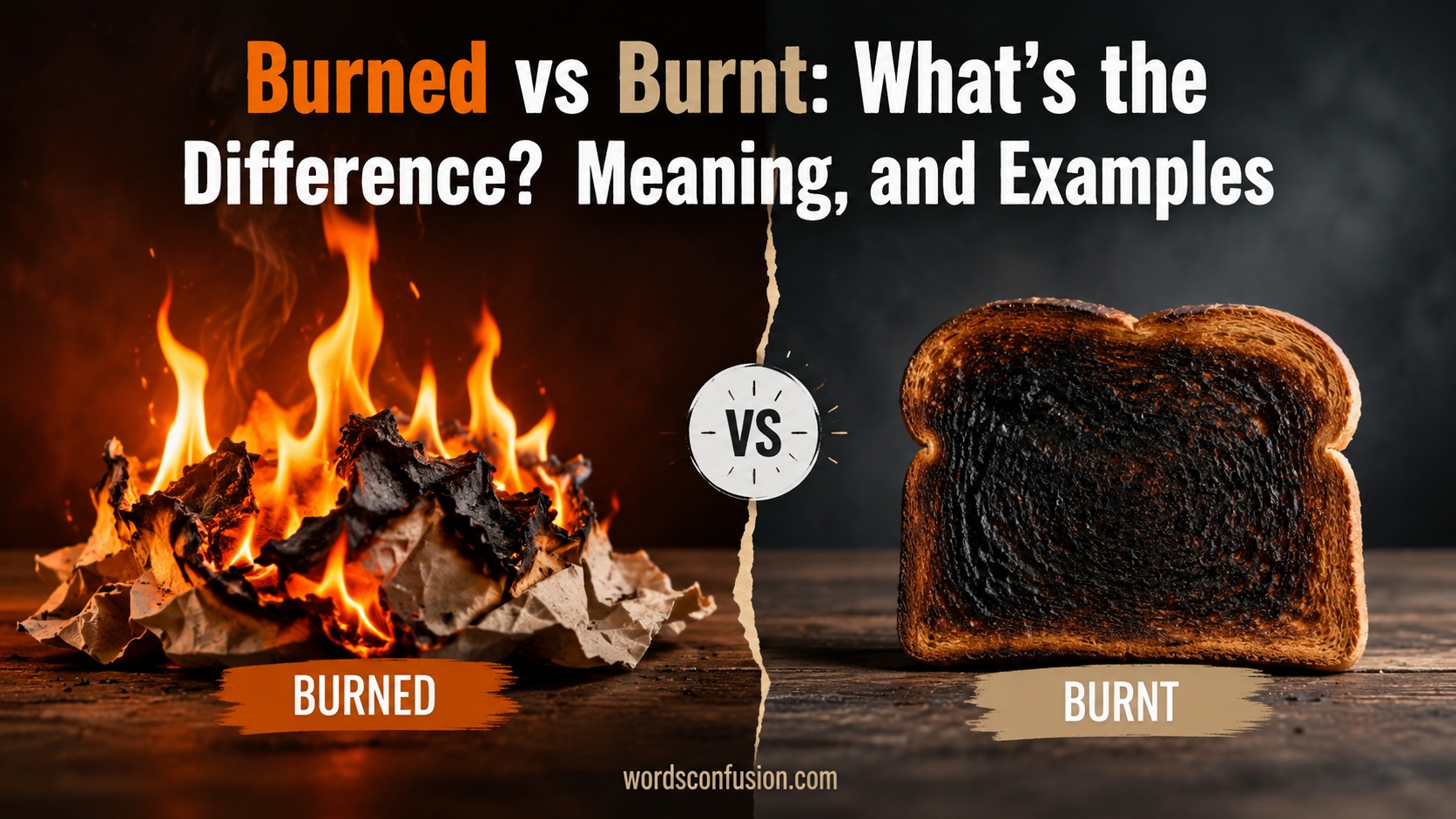
Have you ever wondered whether you should write burned or burnt? You’re not alone. Many English learners and even native speakers pause when choosing between these two words. They look almost identical, they share the same meaning, and both appear in dictionaries. So why do people use different versions?
The short answer is that both “burned” and “burnt” are correct. The difference comes down to the variety of English you’re using, the context, and sometimes the style of writing. In American English, burned is the preferred form in most situations. In British English, burnt appears much more often, especially in everyday conversation and before nouns.
This small spelling difference can make a big impact on your writing. Choosing the right form helps you sound natural and keeps your writing consistent. Whether you’re writing an essay, an email, a blog post, or a business report, understanding when to use burned vs burnt will improve both your grammar and your confidence.
In this guide, you’ll learn the meanings of both words, their grammar rules, regional preferences, common expressions, real-world examples, and practical tips that make the distinction easy to remember.
Burned vs Burnt: Quick Answer
Both burned and burnt are correct past tense and past participle forms of the verb burn.
- Use burned in American English, especially in formal, academic, and professional writing.
- Use burnt more often in British English and in certain fixed adjective phrases such as burnt toast, burnt orange, and burnt sugar.
- Stay consistent with the variety of English you’re using throughout your writing.
Examples:
- The campers burned the wood before sunset. (Preferred in American English)
- The toast is burnt because it stayed in the toaster too long. (Common in British English)
If you’re writing for an American audience, burned is usually the safest choice.
Burned vs Burnt at a Glance
| Feature | Burned | Burnt |
| Meaning | Damaged or consumed by fire or heat | Damaged or consumed by fire or heat |
| Part of Speech | Verb and adjective | Verb and adjective |
| Preferred in American English | Yes | Less common |
| Preferred in British English | Accepted | Very common |
| Formal US Writing | Preferred | Rare |
| Common Before Nouns | Less common | Very common |
| Example | The house burned down. | Burnt toast smells awful. |
Both forms communicate the same basic idea. The difference lies in usage, style, and regional preference, not meaning.
What Does “Burned” Mean?
Definition of Burned
Burned is the standard past tense and past participle of the verb burn in American English. It describes something that has been damaged, injured, or destroyed by fire, heat, chemicals, radiation, or even intense sunlight.
The word also appears in many figurative expressions. Someone can burn calories, burn money, or burn bridges without involving fire at all.
Pronunciation
Burned is pronounced:
/bɝːnd/
It rhymes with words like:
- Turned
- Learned
- Earned
Origin of Burned
The verb burn comes from Old English and Old Norse roots that referred to fire and flames. Over time, English developed two accepted past forms:
- Burned
- Burnt
As American English evolved, burned became the dominant spelling for both speech and writing.
Common Uses of Burned
You can use burned when describing:
- Fire damage
- Heat damage
- Sunburn
- Chemical burns
- Cooking accidents
- Emotional experiences
- Financial loss
- Missed opportunities
Examples of Burned
- The wildfire burned thousands of acres of forest.
- She accidentally burned her hand on the hot pan.
- We burned all the old documents.
- He burned nearly 700 calories during the workout.
- Years of sunlight burned the paint off the fence.
- The company burned millions of dollars on unsuccessful projects.
Notice how only a few of these examples involve actual flames. English often uses burned metaphorically.
Common Collocations with Burned
People frequently pair burned with these words:
- Burned alive
- Burned calories
- Burned bridges
- Burned fuel
- Burned wood
- Burned skin
- Burned documents
- Burned fingerprints
- Burned money
- Burned out
These combinations appear regularly in American newspapers, books, and business writing.
What Does “Burnt” Mean?
Definition of Burnt
Burnt has the same meaning as burned. It describes something affected by fire or excessive heat. The difference isn’t the definition. Instead, it’s the style and regional preference.
British English uses burnt much more frequently than American English. It also appears in several well-established adjective phrases.
Pronunciation
Burnt is pronounced:
/bɜːnt/
The pronunciation is almost identical to burned, although the ending sounds slightly sharper because of the final t.
Origin of Burnt
Burnt developed as an irregular past form of burn many centuries ago. English once had many irregular verbs, and some survived in British English while American English gradually favored more regular verb forms.
Today, both spellings remain correct.
Common Uses of Burnt
You’ll often see burnt describing:
- Food
- Colors
- Smells
- Surfaces
- Landscapes after fires
- Objects damaged by heat
Examples of Burnt
- The cookies smell burnt.
- We scraped the burnt edges off the pizza.
- The kitchen filled with the smell of burnt garlic.
- She wore a jacket in a beautiful burnt orange shade.
- The chef served perfectly grilled vegetables instead of burnt ones.
- The old cabin stood among burnt trees after the wildfire.
Common Collocations with Burnt
Some adjective combinations naturally favor burnt, even outside Britain.
Examples include:
- Burnt toast
- Burnt sugar
- Burnt caramel
- Burnt ends
- Burnt orange
- Burnt sienna
- Burnt timber
- Burnt crust
These expressions have become so common that many Americans use them even if they usually prefer burned elsewhere.
Are Burned and Burnt Interchangeable?
In many situations, yes. Both words describe the result of something being damaged by heat or fire.
For example, these sentences are both grammatically correct:
- The building burned to the ground.
- The building burnt to the ground.
Most readers will understand either version immediately.
However, context matters. Some expressions sound more natural with one form than the other.
| Context | More Natural Choice |
| American business writing | Burned |
| American academic writing | Burned |
| British newspapers | Burnt |
| Everyday British speech | Burnt |
| Burnt orange | Burnt |
| Burnt toast | Burnt |
| Burned calories | Burned |
| Burned bridges | Burned |
Think of it this way.
If you’re writing for an American audience, burned feels familiar in almost every situation.
If you’re writing for a British audience, burnt often sounds more natural, especially when it functions as an adjective.
When They Mean Exactly the Same Thing
Both forms can describe:
- Fire damage
- Heat damage
- Cooking accidents
- Injuries
- Destruction
- Chemical burns
For example:
- The fire burned the barn overnight.
- The fire burnt the barn overnight.
Neither sentence changes the meaning.
When One Sounds Better Than the Other
Native speakers often develop preferences based on habit.
For example:
- Burnt toast sounds more natural than burned toast.
- Burned calories sounds much more natural than burnt calories.
- Burned alive is overwhelmingly more common than burnt alive.
- Burnt orange is the established name of the color.
These differences come from usage rather than strict grammar rules.
Burned vs Burnt in American English
American English strongly favors burned as the regular past tense and past participle of burn.
You’ll see burned in:
- Newspapers
- Government publications
- Academic papers
- School textbooks
- Business reports
- Legal writing
- Scientific journals
Consistency matters in American writing. If you begin using burned, continue using it throughout your document unless you’re referring to a fixed expression like burnt orange.
Examples in American English
- The firefighters burned controlled sections of the forest to stop the wildfire.
- She burned dinner because she answered an important phone call.
- The patient burned his hand while cooking breakfast.
- The engine burned too much fuel during the trip.
- The hikers accidentally burned their map in the campfire.
American style guides generally recommend burned because it follows the regular pattern used by most English verbs.
For example:
- Learn → Learned
- Dream → Dreamed
- Burn → Burned
Although forms like learnt, dreamt, and burnt still exist, they’re much less common in modern American English.
Burned vs Burnt in British English
British English accepts both burned and burnt, yet burnt appears more often in everyday speech and writing. You’ll find it in newspapers, novels, magazines, recipes, and casual conversations across the UK.
Many British writers use burnt naturally because it has remained a common past tense and past participle for centuries. At the same time, burned isn’t incorrect. It simply sounds more formal or less familiar in many contexts.
For example:
- The bread burnt while we were talking.
- The old church burnt during the night.
- I accidentally burnt my hand on the kettle.
- The potatoes tasted burnt, so nobody finished dinner.
British publications also favor burnt when it works as an adjective.
Examples include:
- Burnt toast
- Burnt sugar
- Burnt wood
- Burnt crust
- Burnt orange
- Burnt sienna
These phrases appear so frequently that they have become fixed expressions.
Why Does British English Prefer “Burnt”?
British English has preserved many older verb forms that American English gradually replaced with more regular endings.
You’ll notice the same pattern in several verbs.
| American English | British English |
| Burned | Burnt |
| Learned | Learnt |
| Dreamed | Dreamt |
| Spoiled | Spoilt |
| Smelled | Smelt |
That doesn’t mean one version is better than the other. They simply reflect different language traditions.
Should You Use Burnt in American Writing?
You can, but only in limited situations.
Most American readers won’t question phrases like:
- Burnt orange
- Burnt ends
- Burnt toast
However, writing The house burnt down in a formal American report may sound unusual. In that case, burned fits the expected style.
The safest approach is simple:
- Writing for an American audience? Choose burned.
- Writing for a British audience? Burnt often sounds more natural.
Read More: Data vs Information: What’s the Difference? Meaning, and Examples
Grammar Rules for Burned vs Burnt
Understanding the grammar behind these words makes choosing the right one much easier.
Both burned and burnt can function as:
- Past tense verbs
- Past participles
- Adjectives
The grammar stays the same. Only the preferred form changes depending on region and style.
Burned vs Burnt as the Past Tense
The past tense describes an action that happened in the past.
Examples with burned
- She burned the old letters.
- They burned dry leaves in the backyard.
- We burned too much firewood last winter.
Examples with burnt
- She burnt the cake again.
- They burnt the fence by mistake.
- We burnt all the rubbish yesterday.
Both sets are grammatically correct.
Burned vs Burnt as the Past Participle
The past participle works with helping verbs such as has, have, and had.
Examples with burned
- The forest has burned for three days.
- He has burned every old photograph.
- The candles had burned all night.
Examples with burnt
- The forest has burnt for three days.
- The candles had burnt completely.
- The meat has burnt on the grill.
Again, American English usually favors burned, while British English often prefers burnt.
Burned vs Burnt as an Adjective
This is where many learners become confused.
Both words can describe a noun.
Examples:
- Burned skin
- Burned house
- Burned forest
And:
- Burnt toast
- Burnt cookies
- Burnt popcorn
Some adjective phrases have become standard over time.
These include:
- Burnt orange
- Burnt sienna
- Burnt sugar
- Burnt caramel
- Burnt toast
Although burned toast isn’t wrong, many native speakers naturally say burnt toast.
Which Form Should You Choose?
Use this quick guide.
| Situation | Preferred Form |
| Formal American writing | Burned |
| American school essays | Burned |
| Business documents | Burned |
| British newspapers | Burnt |
| British conversation | Burnt |
| Color names | Burnt |
| Food descriptions | Usually Burnt |
Burned vs Burnt in Everyday Expressions
Some expressions almost always use one form. Learning these combinations will make your English sound much more natural.
| Expression | Preferred Form | Example |
| Burned calories | Burned | She burned 500 calories. |
| Burned bridges | Burned | He burned bridges with his former employer. |
| Burned alive | Burned | The victims were nearly burned alive. |
| Burned out | Burned | After years of stress, she felt burned out. |
| Burned offering | Burned | The text mentions a burned offering. |
| Burnt toast | Burnt | I can’t eat burnt toast. |
| Burnt sugar | Burnt | Burnt sugar creates a rich flavor. |
| Burnt caramel | Burnt | The dessert had burnt caramel notes. |
| Burnt orange | Burnt | She painted the room burnt orange. |
| Burnt sienna | Burnt | The artist mixed burnt sienna with ochre. |
Why Do These Expressions Stay Fixed?
Language develops habits over time.
Millions of speakers repeat the same combinations for decades until they become the expected form.
For example, nearly everyone says:
- Burnt toast
- Burnt orange
On the other hand, people almost always say:
- Burned calories
- Burned out
- Burned bridges
Even though both spellings are technically correct, these established combinations sound more natural.
FAQs:
Is burnt grammatically correct?
Yes. Burnt is completely grammatically correct. It is an accepted past tense, past participle, and adjective form of burn. British English uses burnt more frequently, while American English generally prefers burned, especially in formal writing.
Which is correct: burned or burnt?
Both are correct. The best choice depends on your audience and the type of English you’re using.
- Use burned for most American English writing.
- Use burnt more often in British English or in established phrases like burnt toast, burnt orange, and burnt sugar.
Why do Americans usually write burned?
American English tends to favor regular verb forms ending in -ed. As a result, burned became the standard choice in schools, newspapers, business documents, and academic writing across the United States. Although Americans recognize burnt, they typically reserve it for a few fixed adjective phrases.
Is it burnt toast or burned toast?
Both forms are grammatically correct, but burnt toast is far more common and sounds more natural to most native English speakers. Even in American English, you’ll often hear people say burnt toast because it has become a well-established expression.
Can burned and burnt both be used as adjectives?
Yes. Both words can function as adjectives.
Examples include:
- Burned house
- Burned skin
- Burned forest
- Burnt toast
- Burnt cookies
- Burnt sugar
In practice, burnt appears more frequently before nouns, especially when describing food, colors, or objects affected by heat.
Conclusion:
The difference between burned vs burnt is less about grammar and more about regional preference and natural usage. Both words share the same meaning, and both are recognized by major English dictionaries. The key is knowing which form fits your audience and keeping your writing consistent.
If you’re writing in American English, burned is the preferred choice for nearly all situations, including academic papers, business documents, news articles, and everyday communication. It serves as the standard past tense and past participle of burn.

Andrew Wilson is an experienced language researcher and content writer specializing in WordsConfusion topics. He helps readers understand commonly confused English words, spelling differences, grammar rules, word meanings, and proper usage through clear explanations, practical examples, and easy-to-follow language guides. His goal is to make English learning simple, accurate, and accessible for students, writers, professionals, and everyday learners.